Tag: local news

  • In Search of the Grail: The Story of a Women’s Movement in Loveland, Ohio

    In Search of the Grail: The Story of a Women’s Movement in Loveland, Ohio

    Changing things that look impossible to change.
    by David Miller

    Loveland, Ohio – In 1940, an international movement of women got on a boat. The last boat before Hitler invaded Holland. They made it to America, “by an eyelash” in April of that year.

    The Grail from Loveland became a voice in the United Nations.

    After watching the video below and in the spirit of Grailville’s past of venturing into the seemingly impossible, as the Publisher of this newspaper I have made an executive decision to go “all in” with an attempt to inform Loveland residents about the imminent destruction and erasure of the artifacts of a great cultural event of our local history.

    Grailville was the home of the National Grail movement in the United States; the symbolic heart of the movement.

    Will we allow the Grailville farm to be plowed under or will we choose new furrows planted in a way that continues to grow our future as a community?
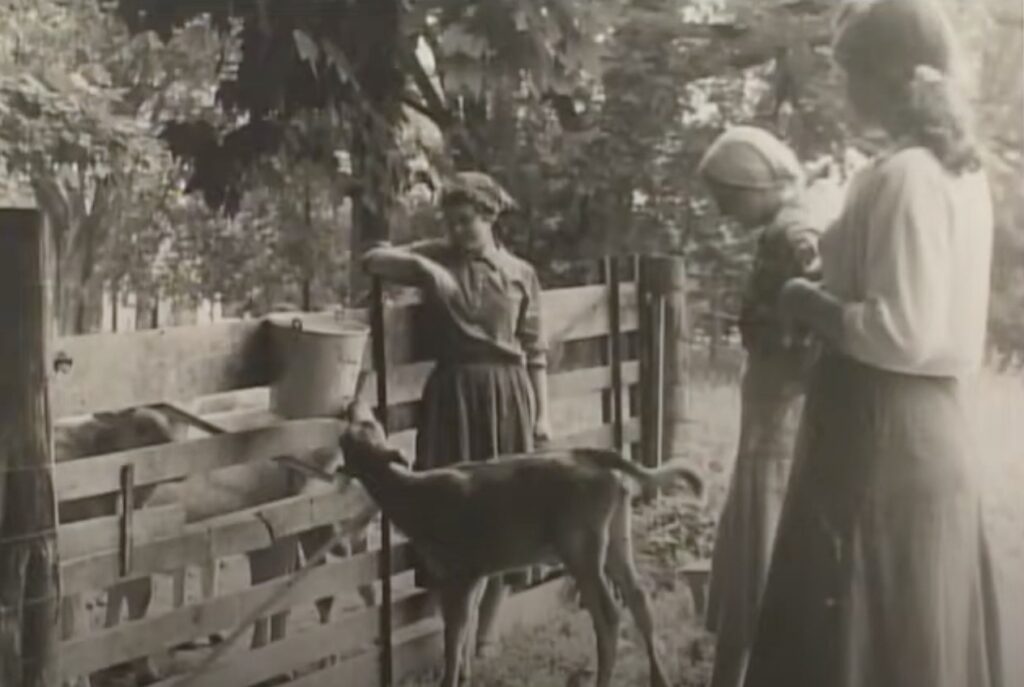
    Screen shot from The U.S. Grail, a lay movement

    If we lose these artifacts, it will be by choice and not that we didn’t know – or know better.

    Will the City Historic Preservation and Planning Commission, the City Tree and Environment Committee, the City Planning and Zoning Commission, the City Council and City Manager, the City Comprehensive Master Development Plan Committee, the City Arts Commission, and Drees Homes stand in support or indifference of the bulldozers without acknowledgment of these, artifacts?

    Will they act out of ignorance or no comprehension of enlightenment? Will our future have value? Will Loveland’s legacy contain important worth? Preserving these artifacts can be value-added.
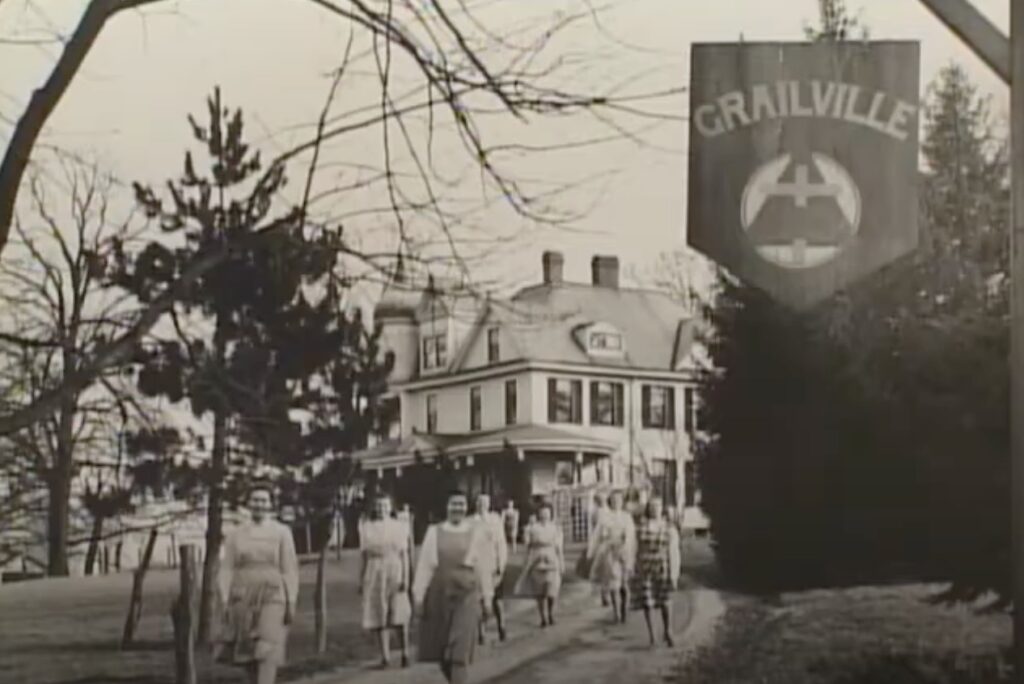
    Screen shot from The U.S. Grail, a lay movement

    A choice for each resident – Follow the Holy or Follow the Folly.

    We will no longer be able to say, “I didn’t know.”

    For sure, expressions of dismay about the impact of 200 plus homes at Grailville and the resulting strain on City services, overcrowding of already inadequate roads and schools, etc., are legitimate, however, so is the destruction of these intrinsic artifacts expressed in this video. A quality life whether for the individual, the collective community, or our grandchildren can be one filled with the remnants of the culture that made it so rich.
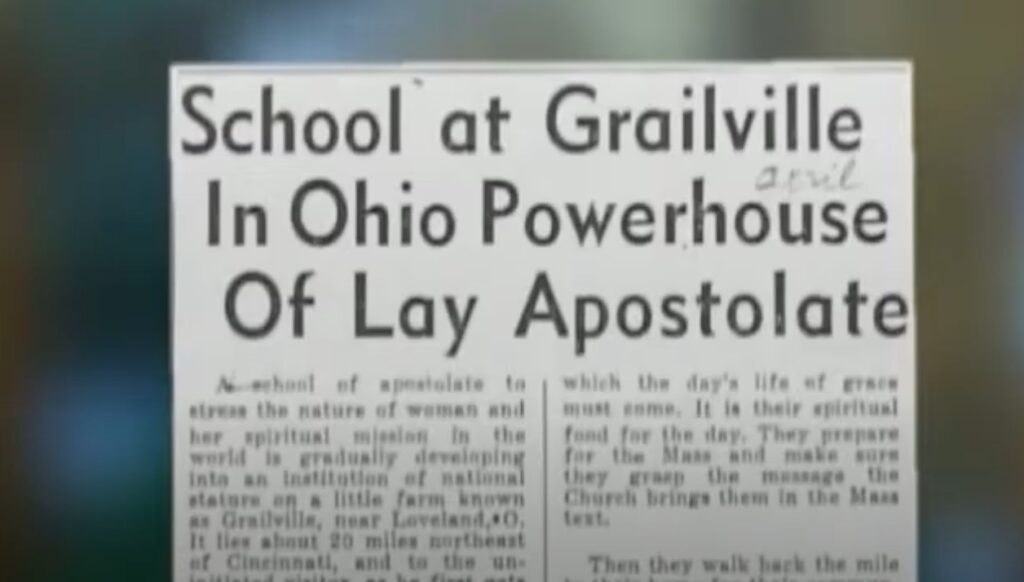
    Screen shot from The U.S. Grail, a lay movement

    This 2006 film by my friend Barbara Wolf, a Cincinnati filmmaker, for The U.S. Grail, a lay movement – explores the journey of those women seeking to transform the world as a matter of personal call and communal action.

    Our communal action in this present day is what?

    The Grail in the U.S. and in Loveland is not defunct by any means, read more HERE and HERE.
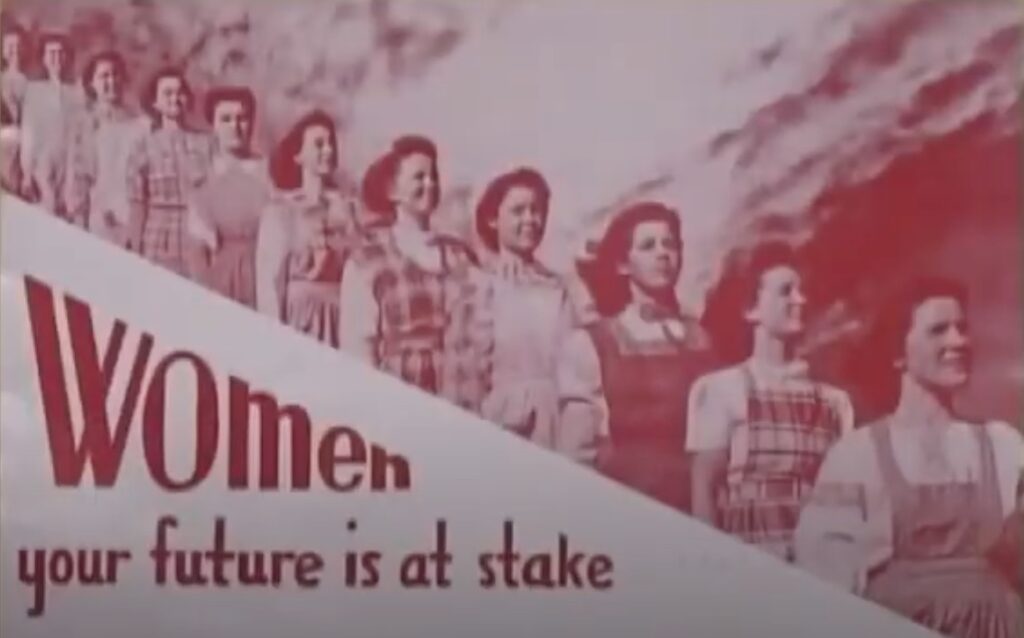
    Screen shot from The U.S. Grail, a lay movement

    Will we let a Kentucky home builder know they are proposing plowing under the footprints on this good earth and artifacts of an international movement of peace, gentleness, justice, and tranquility?

    We all have faith.

    Important artifacts, our seed crops, are about to be plowed under.

    Will our horizons call each other by name to respect these artifacts?

    More reading…

    Why is Grailville important? A look at the Grail founding in Loveland

    David Miller –  Mar 30, 2022

    [VIDEO] With public outpouring, has tide turned on Grailville?

    David Miller –  Mar 22, 2022

    Planning and Zoning Commission to hear from public on re-zoning Grailville

    David Miller –  Mar 8, 2022

    An open letter to City Hall by the Mullins: Grailville decision…

    Guest Column –  Mar 2, 2022

    Drees submits application for 209 homes at Grailville

    David Miller –  Jan 31, 2022

  • Should courts limit jury awards for child rape victims? Supreme Court weighs arguments

    Should courts limit jury awards for child rape victims? Supreme Court weighs arguments

    Photo Courtesy of the Ohio Supreme Court

    BY: JAKE ZUCKERMAN – Ohio Capital Journal

    Columbus, Ohio – Lawyers for a woman who was repeatedly raped and sexually abused as a child argued Wednesday the Ohio Supreme Court should overturn or at least pare down a law that limits millions in damages a jury awarded her.

    In 2005, Ohio lawmakers passed a “tort reform” law that among other provisions, sets a limit of $250,000 on non-economic damages, which are awarded to victims to cover more intangible harms like pain, suffering, stress, anxiety, etc.

    Amanda Brandt was awarded $34 million in noneconomic damages after Roy Pompa, her friend’s father, abused her repeatedly over 18 months starting when she was 11. Court records show he would drug and rape her and record the abuse. Brandt won full damages for abuse that occurred before the tort reform law passed ($14 million), though the other $20 million in punitive damages for abuse after the law passed was cut down to $250,000.

    She still won $100 million in punitive damages — which are only available because Pompa was convicted of a felony (17 counts of rape, five counts of kidnapping, 55 counts of pandering sexually oriented material involving a minor, and 21 counts of gross sexual imposition).

    The Supreme Court has previously denied an effort to nix damage caps as they were applied to another child who was raped by her priest in Delaware County. Her $3.5 million in noneconomic caps was reduced to $350,000 (the law also creates a formula that can provide up to $350,000 pending economic damages like missed days of work and medical bills).

    Brandt’s attorneys asked the court for one of two remedies. The justices could overturn the damage caps outright and restore juries with the power to set damage maximums, as opposed to state lawmakers. Or, the justices could determine that the trauma Brandt sustained should apply to an exception to the damage caps within the law available to people who become deformed or disabled by an injury.

    “These kinds of injuries meet the same level,” said Robert Peck, an attorney representing Brandt.

    Damage caps, he said, infringe on the U.S. Constitution’s right to trial by jury. It’s a jury that hears the facts of a case and decides what kind of penalty is appropriate.

    “With a cap, you’re saying that that cap overrides that jury decision,” he said.

    Pompa, via attorney Marion Little, said it’s untrue that anyone was denied a right to trial by jury. Brandt still won $114 million. The intent of tort reform, he argued, was to create more legal predictability and consistency, which it accomplished without infringing on anyone’s rights.

    As for the reduced non-economic damages, Little said the evidence suggests Brandt has recovered. She still requires counseling, but she has a family, a job and stability and should be “applauded for her success” moving forward.

    In court filings supporting Brandt, lawyers with the Ohio Alliance to End Sexual Violence criticized this line of thinking.

    “[It] puts Ohio judges in the unenviable and morally fraught position of holding against child abuse victims the moments in their life where they have made progress — where they have taken the most basic steps to achieve normalcy despite the abuse they suffered,” wrote attorney Camille Crary in a brief.

    Outside interests 

    Overturning Ohio’s noneconomic damage would significantly reshape Ohio’s legal climate in favor plaintiffs. It applies far beyond the narrow realm of child sex abuse and into products liability and other genres of lawsuits that can result in huge payouts, often from large corporations and institutions.

    As such, the case generated tremendous outside interest. Attorney General Dave Yost argued the law should be upheld. He said it’s perhaps surprising — “some might even say callous” — that Ohio law limits available damages for a child victim of sexual abuse. But “foolish policy” is not necessarily unconstitutional, he argued. He urged lawmakers, as some have tried to do, to lift damage caps in claims against rapists. But that change should come from the legislature, not the Supreme Court, he said.

    The Chamber of Commerce, which represents business interests, said the unpredictability of “runaway” jury awards creates huge risks for businesses. Ohio’s damage caps, its lawyers argued, are reasonable and within the mainstream compared with other states.

    “The extremely sympathetic facts of this case should not blind this Court to the enormous consequences of that invitation: Invalidating the law or opening the door to a vague new exception will expose businesses, nonprofits, and others to unlimited and unpredictable awards and excessive settlement demands in personal injury lawsuits when no more than negligence is alleged,” its lawyers wrote.

    The Product Liability Advisory Council — an association representing large car, tobacco, chemical, firearms, pharmaceutical and other companies — filed arguments in the case supporting the noneconomic damage caps and emphasizing Brandt’s current jury award.

    One mystery in the case, homed in on briefly during oral arguments, is whether Pompa can even pay the $114 million judgement — let alone the additional $20 million if the court overturns the damage cap. Peck, during arguments, said the plaintiffs have not yet sought to collect from him until the court finalizes the issue.

    In an interview after oral arguments, Little said there’s no evidence in the record suggesting Pompa can pay either $114 million or $134 million. He said the plaintiffs’ target is more likely the law and precedent than the specific case at hand.

    Little — a prominent defense attorney currently working on high-profile, white collar cases — declined to answer whether Pompa is paying for his legal services.

    “I think that the, as a practical matter, the plaintiff does not have a financial stake in the results of this case,” he said. “There may be others outside the case, such as the plaintiff’s bar, that have interest in this.”

    Organizations representing trial attorneys argued the right to trial by jury and that jury’s autonomy to set awards for plaintiffs who have been harmed are inextricably tied. Juries, they wrote, are the fact finders in court cases — not policy makers.

    “The General Assembly has not demonstrated a willingness to protect the right to trial by jury, nor is it the role of legislators to draw boundaries around the legislative power,” they wrote. “As a result, it falls on this Court to jealously safeguard that right and protect all Ohioans, not just those with the most lobbying power.”

  • LIFE Food Pantry has expanded their “Financial Assistance” program

    LIFE Food Pantry has expanded their “Financial Assistance” program

    LIFE is a faith and community supported organization that provides food, financial assistance, and programs to those experiencing hardship.

    by Linda Bergholz

    Linda Bergholz

    As we approach the end of winter (fingers crossed, no more snow dances!) we want to thank our supporters who got us through the post-holiday season.

    So many exciting things are happening at the LIFE Pantry. We have a new delivery ramp in the back, a scholarship program ready to launch, and we are looking to expand our Financial Assistance program. To that end, did you know that we have a Financial Assistance program?  Most likely not, as the vision most have is “Oh, they do food” – which we do well, but food insecurity is just one part of the bigger picture for our families. The domino effect of “my car broke down so I lost my job so I can’t pay my rent and I have an eviction notice” is devastating for these families. We offer financial assistance for rent, utilities, medical bills, and various other needs that are considered on an individual basis. The piece we are planning to add is for auto related needs such as car repair, new tires, license plates, gas cards. It’s vital to help:  if our clients can’t get to work, they don’t earn a paycheck, they can’t pay the bills. It’s a crucial part of independence for our families and a piece toward breaking that cycle of poverty.

    Looking toward spring, we will be launching our annual Feed the Hungry campaign, LIFEsavers.  We are thankful for our current monthly subscribers who allow us to better plan for expenses. The event will run April 18th through May 21st.  Look for our signs around town, and updates on our website and Facebook page. Please consider donating, either one time or continuing support. No amount is too small – even $5 a month provides a Tiger Weekend Food Bag for one of our little folks!

    Blessings abound and you, our supporters, are a huge part of those blessings. Stop in and see what we do – then sign up to donate, volunteer, and spread the word!

    Sincerely,

    Linda Bergholz,

    Executive Director
    LIFE Food Pantry

  • Why is Grailville important? A look at the Grail founding in Loveland

    Why is Grailville important? A look at the Grail founding in Loveland

    David Miller is the Publisher and Editor of Loveland Magazine
    Grailville was a place to find your place in the world whatever that meant to you.
    
    [WATCH VIDEO BELOW "Grailville: the early decades]
    
    by David Miller
    
    Loveland, Ohio – Elizabeth Murphy, a Symmes Township resident, along with lifelong Loveland resident Elizabeth Robinson made this video about the early years at Grailville. It was made for Grailville’s 65th anniversary in 2009.
    
    Robinson said, “We made a short video with interviews so we could explain how Grailville came to be. All music is music recorded at Grailville from Grailville Choirs. Many of the founding or early members including my mother Mary Schickel, had passed on and we were losing this history.”
     
    Robinson also added that there was a lot of mystery about what Grailville and the Grail was and how Grailville came to be. The video contains many back in the day vintage photos of the former farm and the many women who moved to those rolling hills just on the outskirts of Loveland. 
    
    From Holland. It was wartime. WWII. The women came when they did because if not then, they didn’t know if they would ever be able to leave Europe.
    
    They came here looking for a farm with running water, enough buildings to house 50 people and within walking distance of a railroad station. They went two-by-two visiting farms and parishes, so much so they joked they were becoming real estate agents.
     
    Liturgy was the unifying factor of the Grail community. There was a lot of singing. It became a quiet, peace-filled beautiful space; an agricultural and religious life.
    
    The “Year School” was a training program for young women “focused on an integrated life of work and prayer, study and fun”.
    
    Throughout the decades, the Grailville Retreat Center brought visitors from all parts of the world to spend time in Loveland, Ohio.
    
    At one time a truckload of goats, 400 chickens, milk cows, pigs, and canning and preserving 10,000 quarts of farm product. It was described as a rich life, however one “materially simple”. 
    
    Spiritually and intellectually very rich. Very rich in things from the ground, sky, and God in many forms.
     
    Trina Paulus said Grailville was a “simplicity” that was ideal for her as a young woman. 
    
    Art was equal to every other thing that happened at Grailville.
    
    Visual arts, music, and writing. 
    
    Paulus said she thought that the Dutch brought tremendous respect for the arts when they came to this country and Loveland. “It was equal to every other thing we did.” 
    
    Grailville had a weaving guild.
    
    Listen to how the Grail women reached beyond Loveland to the world. 
    
    They were not there to hold onto what they were doing. Many of the programs that Grailville started were spun out into the world beyond Loveland. 
    
    The women launched things that were much broader than themselves.
    
    Grailville didn’t look like a church from the outside.

  • March’s “Real Estate Update” With Besl, Baden, and Christy Jones!

    March’s “Real Estate Update” With Besl, Baden, and Christy Jones!

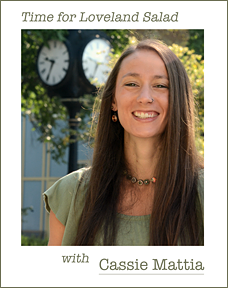
    by Cassie Mattia

    Loveland, Ohio – Are you currently in the market to buy or sell a home? Do you have real estate questions that you don’t know who to go to for the answers? Well look no further Besl, Baden, and Christy Jones have all the answers you are looking for in our newest segment of “Real Estate Update!”

    Once a month the ladies of Besl, Baden, and Christy Jones join us at Loveland Magazine to talk to you about a new real estate topic. The topics will range from local house listings to the current condition of the housing market to trending home decor to what tools you need to secure a new home loan; these 3 real estate gurus plan to talk about it all!

    In our March Real Estate Update Sue Besl Price and Mary Clare Baden cover new topics.

    In this market, whether you’re a buyer or seller it is imperative that you work with an experienced agent. For buyers getting in to see homes can be quite daunting without the assistance of an agent. Good agents are seasoned networkers who know when listings are coming on the market and when they will be available for showings.

    Once you find a home you love, writing a contract is no longer just about the price. There are many variables that go into writing an offer that will get excepted. 

    For sellers, it’s all about the pre-listing work that needs to be done and preparing for multiple offers. A great agent will be able to work with the offers at hand to get the best deal for the seller. 

    Hear all about the specifics in this month’s Besl, Baden and Christy Jones real estate update. 

    Fasten your seat belts and get out your notepad; this is your March Real Estate Update!

    For more Real Estate Updates stay tuned to the Loveland Salad With ME, Cassie Mattia!

  • FDA Authorizes Second Booster Dose of Two COVID-19 Vaccines for Older and Immunocompromised Individuals

    FDA Authorizes Second Booster Dose of Two COVID-19 Vaccines for Older and Immunocompromised Individuals

    Today, the  U.S. Food and Drug Administration (FDA). authorized a second booster dose of either the Pfizer-BioNTech or the Moderna COVID-19 vaccines for older people and certain immunocompromised individuals. https://bit.ly/3NuxvY6

    They previously authorized a single booster dose for certain immunocompromised individuals following completion of a three-dose primary vaccination series.

    This action will now make a second booster dose of these vaccines available to other populations at higher risk for severe disease, hospitalization and death according to a FDA news release.

    The emergency use authorizations was amended as follows:

    • A 2nd booster dose of the Pfizer-BioNTech or Moderna COVID-19 vaccines may be administered to people 50+ years old at least 4 months after receipt of a 1st booster dose of any authorized or approved COVID-19 vaccine.
    • A 2nd booster dose of the Pfizer-BioNTech COVID-19 Vaccine may be administered to people 12+ years old with certain kinds of immunocompromise at least 4 months after receipt of a 1st booster dose of any authorized or approved COVID-19 vaccine.
    • A 2nd booster dose of the Moderna COVID-19 Vaccine may be administered at least 4 months after the 1st booster dose of any authorized or approved COVID-19 vaccine to people 18+ years old with the same certain kinds of immunocompromise.

    Today’s announcement applies only to the Pfizer-BioNTech and Moderna COVID-19 vaccines, and the authorization of a single booster dose for other age groups with these vaccines remains unchanged.

    READ the full news release HERE.

  • Ricky Mulvey talks with Jacob Goldstein about drone delivery, self-driving cars, the future, and Loveland, Ohio

    Ricky Mulvey talks with Jacob Goldstein about drone delivery, self-driving cars, the future, and Loveland, Ohio

    Ricky Mulvey interned at Loveland Magazine for 5-years while he was a student in the Loveland School District and now lives in Denver, Colorado. He recently emceed the meet the candidate night for Loveland Magazine last November.

    It’s 2022. Weren’t we supposed to have flying drones delivering packages to our homes by now? Ricky Mulvey talks with Jacob Goldstein, host of the new Pushkin podcast “What’s Your Problem?”, about drone delivery, self-driving cars, and the future problems that entrepreneurs are trying to solve right now.

    A Drone delivery company that actually works, because they are actually running a big drone delivery company that works right now. They’re actually “doing the thing,” says Goldstein.

    Mulvey doesn’t forget his hometown and talks briefly about Loveland, Ohio in this podcast.

    Mulvey asks the question about the behavior of people living in a place like Loveland, Ohio, and will we ever give up the “privilege” of just being able to hop in a car and go”. Will we get used to our packages being parachuted in from a drone over our front yard or place of business?

    Mulvey’s segment starts at 14:30.

    We’re still in love with this independently produced podcast by Ricky Mulvey:

    Ricky Mulvey’s Podcast: “Total Fighter,” about Cincinnati’s Ezzard Charles


    Listen to more Motley Fool Podcasts produced by Ricky Mulvey:

    The Inside Story of Instagram – Few people know Instagram better than Bloomberg News tech reporter Sarah Frier.

    Making Sense of Past Stock Drops… bout of volatility.

    What’s Happening With Russian Oil and U.S. Gas Prices?… prices spiked?

    The Big News From Apple’s Event… here is Ricky Mulvey.

    The Power of Creating a “Good Enough for Now” Mindset… . In this podcast, Motley Fool producer Ricky Mulvey talks with Evans about: The power of creating a “good enough …

    Pulling the Curtain Back on Just-in-Time Delivery… producer Ricky Mulvey talks with Mims about his book, covering topics including: The roots of the microchip …

    What Crypto to Buy Now, and More Top Questions Answered… Bernd Schmid joins producer RickyMulvey to discuss what long-term investors should look …

    Alphabet’s Discipline, 5G’s Potential, and Microsoft’s Big Buy… , RickyMulvey, caught up with LaConte to talk about Vail’s difficult holiday season. How the company …

    “Grand Theft Auto” Comes to “FarmVille” as Take-Two Buys Zynga… -light and capital-heavy businesses this upcoming earnings season. Later in the show, RickyMulvey talks with Maria …

  • Hop on Over to Downtown Loveland for the Easter Weekend Food Drive!

    Hop on Over to Downtown Loveland for the Easter Weekend Food Drive!

    by Cassie Mattia

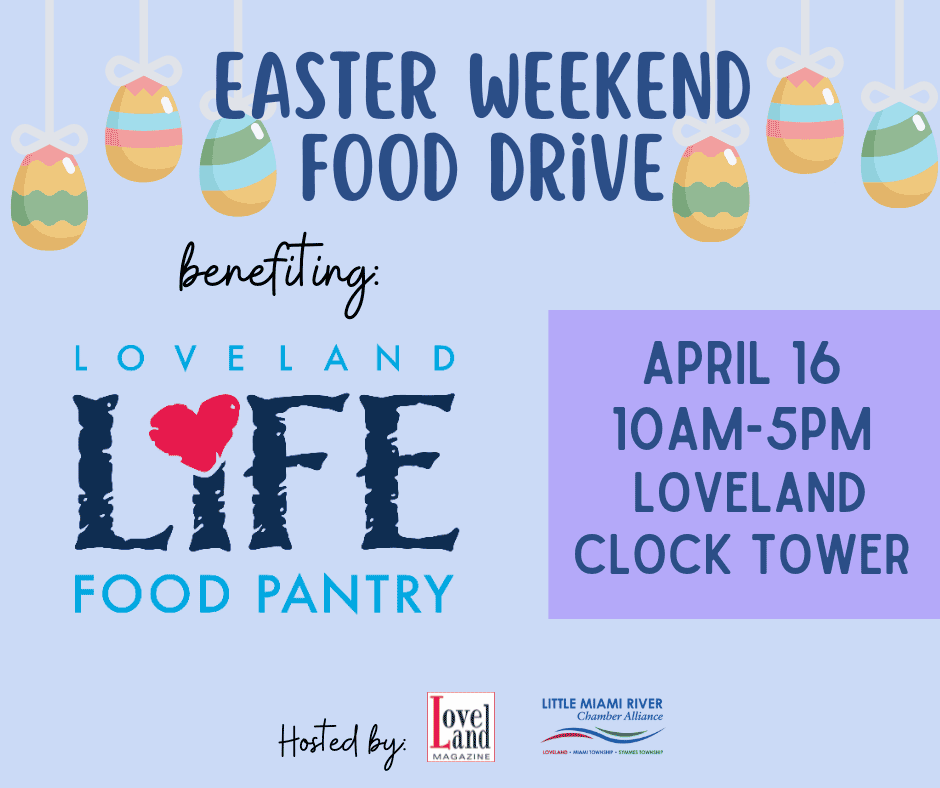
    Loveland, Ohio – Spring has sprung which means the Easter Bunny will be paying Loveland a visit very soon! What better way to celebrate Easter than by giving back to those in need within the community. Join Loveland Magazine and the Little Miami River Chamber Alliance (LMRCA) for the Easter Weekend Food drive benefiting LIFE Food Pantry!

    Easter weekend, for me, is one of the most coveted times to make memories with my family as we come together to enjoy a nice home-cooked meal and exchange Easter baskets filled with goodies. This year, I wanted to make sure that families less fortunate had the opportunity to celebrate Easter like my family and myself have been lucky enough to do for the past several decades. I knew that Loveland’s local food pantry, LIFE, was in desperate need of food donations as this time of year is often a slower time for incoming donations. I had chatted back and forth with some of the wonderful women from LIFE a couple of months ago and promised them that I would find a way to organize a food drive. I searched my brain for those that would be interested in joining me to help make this food drive happen. That’s when I thought, “I should ask CeeCee Collins and Meredith Taylor from the LMRCA to help me make this food drive a reality!” I emailed CeeCee and Meredith and explained my vision and seconds later they were on board! I was overcome with joy!

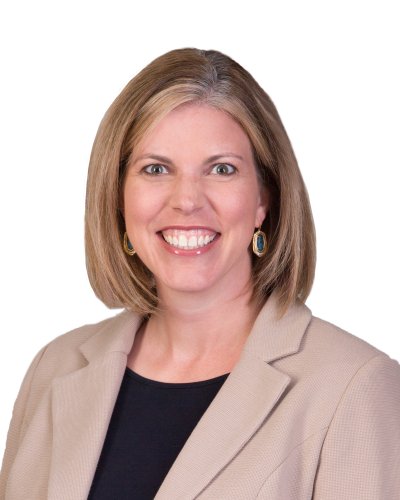
    Meredith Taylor
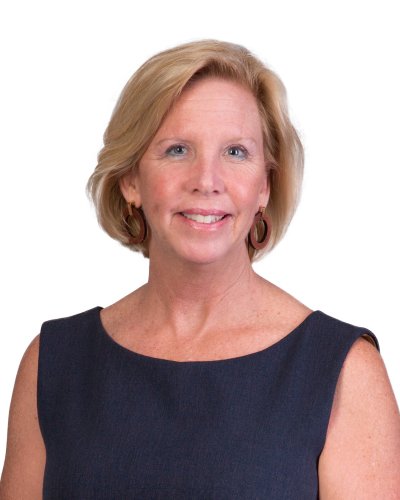
    CeeCee Collins

    Over the past several weeks, Meredith, CeeCee, and I have worked hard to make this unbelievable Easter Weekend Food Drive the best it could possibly be, and needless to say, I couldn’t be happier with what we have in store for the Food Drive! Loveland Magazine, the LMRCA, and LIFE would love nothing more than all of those within our amazing community to come out on April 16th between 10 a.m-5 p.m and donate to the Easter Weekend Food Drive! 

    Here are some important Easter Weekend Food Drive details:

    • We will be stationed next to the historic clock tower in Downtown Loveland right along the Loveland Bike Trail. You will see our decked Easter-themed tent!
    • You may pull your vehicle into the “Carry-Out” Parking spots next to where we will have our tent and we can easily grab your donations straight from your vehicle! You won’t even have to leave your vehicle if you so choose!
    • Each week LIFE lists on their website homepage their current donation needs so before you stop by our Food Drive to donate check out their list here!
    • If you can’t make our Easter Weekend Food Drive or would just simply rather donate money to LIFE you can do so by scanning the QR code below, although we would love to see all of your smiling faces in person at the Food Drive!
    • There will also be another Easter Weekend Food Drive donation box at The Works Pizza so feel free to drop off donations there as well if you’re looking to grab a pizza on your way out!
    • Be sure to bring the kids as we will be handing out candy-filled Easter eggs!
    To Donate to the Easter Weekend Food Drive Scan the QR Code Above!

    We hope to see all of you at the Easter Weekend Food Drive! If you have any questions about the Easter Weekend Food Drive please contact me, Cassie Mattia, or Meredith Taylor! Help us help those in need have a beautiful Easter too! 

    Look for us under the Town Clock at the Loveland Bike Trail.

    For the latest Loveland community events stay tuned to the Loveland Salad With ME, Cassie Mattia!

  • Expert: Hard to know if COVID variant will surge in U.S. or how badly

    Expert: Hard to know if COVID variant will surge in U.S. or how badly

    BY: MARTY SCHLADEN Ohio Capital Journal

    The last thing people want to hear right now is that the coronavirus might have mutated yet again into yet another deadly variant, extending the pain, death, and inconvenience of a pandemic that we long hoped would be over.

    However, whether the subvariant of omicron known as BA.2 will hit the United States as hard as it’s hitting other parts of the world is hard to say at this point, an expert at modeling the disease said Wednesday.

    The pandemic has been full of unpleasant surprises and BA.2 is no exception. Scientists estimate that it’s one-and-a-half times as transmissible as the original omicron strain, BA.1, and is overtaking it.

    Europe, and particularly the United Kingdom, have seen an increase in the new variant in recent months, but that hasn’t been the case everywhere, said Stephen Kissler, a research fellow in the Department of Immunology and Infectious Diseases of Harvard University’s T.H. Chan School of Public Health.

    “The question of if and when a surge is coming and how large is very open,” Kissler said in a Zoom conference with reporters. “I know that we’ve seen surges that are dominated by BA.2 across much of Europe. But in contrast, for example, in South Africa we saw a major BA.1 wave — that’s where we saw the omicron wave first — and now there’s a lot of circulation of BA.2, but it hasn’t really caused an increase in cases so much that it’s lengthened the decline and given the epidemic a very long tail.”

    Kissler explained that vaccination rates in the U.S. are lower than those in Europe, but higher than those in South Africa. That could mean that more Americans have developed antibodies against the omicron variants than have Europeans.

    “To the extent that that gives us protection against BA.2 we might see dynamics that are more similar to what happened in South Africa,” he said.

    Seasonality and other factors likely will play a role, Kissler said, with spring in the United States being a season of relatively low spread and fall a season of relatively high spread.

    So if there is a surge here of the new variant, how will it affect Americans of varying ages?

    “In many ways it will likely resemble our experience with COVID-19 up to this point,” Kissler said.

    And past experience has shown one factor to be hugely important: vaccination. 

    Kissler said that being vaccinated, along with a booster dose, “really goes a long way toward helping to protect you from symptomatic disease and especially severe disease. The biggest delineation I imagine seeing is that people who are boosted will probably fare better than people who are unboosted.”

    Another important factor is age, with the elderly having less natural resistance to all variants of the coronavirus than the young. Vaccines and boosters, though, can be a great equalizer.

    “A vaccinated and boosted person over the age of 75, their risk is probably on the order of — if not lower than — an unvaccinated 20-year-old,” Kissler said.

    COVID eventually will go from being a pandemic disease that spikes rapidly and overwhelms resources to an endemic one where a background level is present, sickening and even killing people, but in semi-predictable ways. Sadly, however, hopes that it will disappear altogether are small.

    Looking forward, one simple public-health measure might be most effective, Kissler said.

    “In many ways, one of the best things we can do to manage outbreaks is to just to continue to keep informing people how much COVID is circulating in their communities and make it just as accessible as a weather report,” he said. “A lot of data suggest that people tend to adjust their behavior accordingly.”

    He said that probably won’t be enough to quell future waves of COVID, or be adequate in the face of major new variants.

    “But as we continue to deal with COVID and we think about this permanent circulation of COVID-19 in the population — recognizing that there’s going to be different dynamics in different places, different patterns across the year — making it clear what’s happening in any given community at any given time through passive surveillance is probably the best thing we can do right now,” he said.