More than half a million Ohioans have cast their ballot in the election so far, as of Friday morning.
Combining absentee and early voting, more than 660,000 Ohioans have voted as of Friday morning, according to the Ohio Secretary Of State.
A majority have been through early voting, which takes place at your local county Board of Elections. Early voting began on Oct. 8 and 433,413 Ohioans have voted early.
More than 34,000 people have voted early so far in Franklin County, the state’s most populous county. In Hamilton County, 25,506 people have voted early so far. Nearly 16,000 people have voted early in Cuyahoga County.
There were 1.1 million absentee ballots requested by mail and 234,786 ballots have been returned. Those who requested an absentee ballot tend to skew older, with about a million of those requests coming from Ohioans 55 and older.
More than 800,000 of those who requested an absentee ballot are Independents. Nearly 400,00 Republicans and nearly 300,000 Democrats requested an absentee ballot.
Absentee ballot applications are due to your local board of elections Oct. 29 by 8:30 p.m. and mailed absentee ballots must be postmarked by Nov. 4.
Election Day is Tuesday Nov. 5 and polls are open from 6:30 a.m. to 7:30 p.m. You can find your local polling location here.
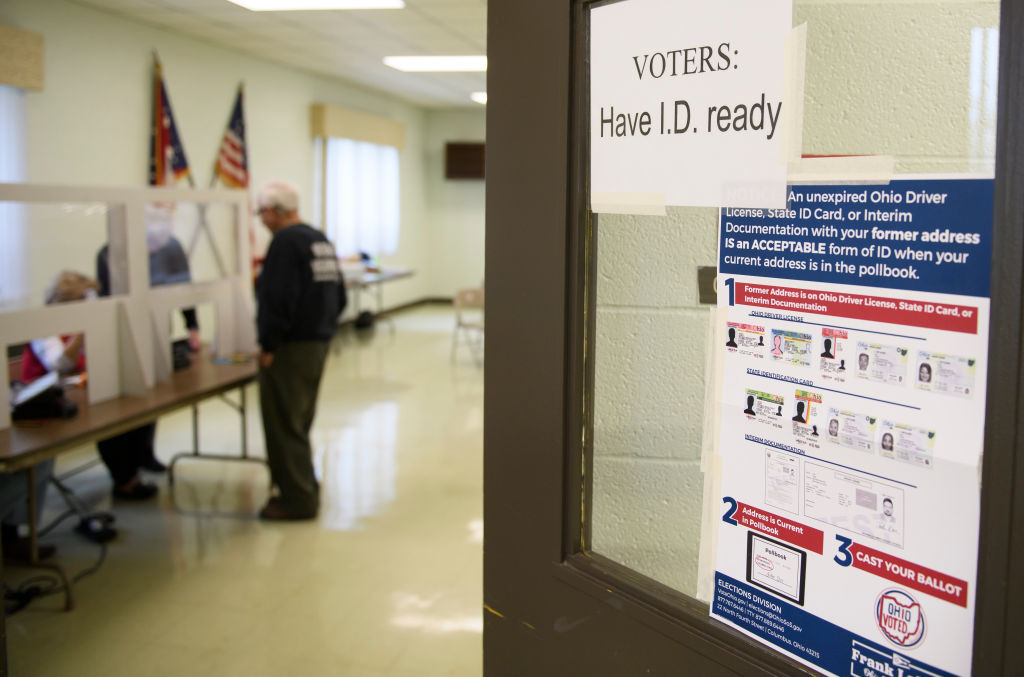
Voters must have a photo ID to vote in person. This could be a valid Ohio driver’s license, a U.S. passport, a military ID, an Ohio ID card, an interim ID form issued by the Ohio BMV, an Ohio National Guard ID card or a U.S. Department of Veterans Affairs ID card.
There are more than 8 million registered voters in Ohio, according to the Ohio Secretary Of State.
Megan Henry is a reporter for the Ohio Capital Journal and has spent the past five years reporting in Ohio on various topics including education, healthcare, business and crime. She previously worked at The Columbus Dispatch, part of the USA Today Network.
Ohio Capital Journal is part of States Newsroom, the nation’s largest state-focused nonprofit news organization.
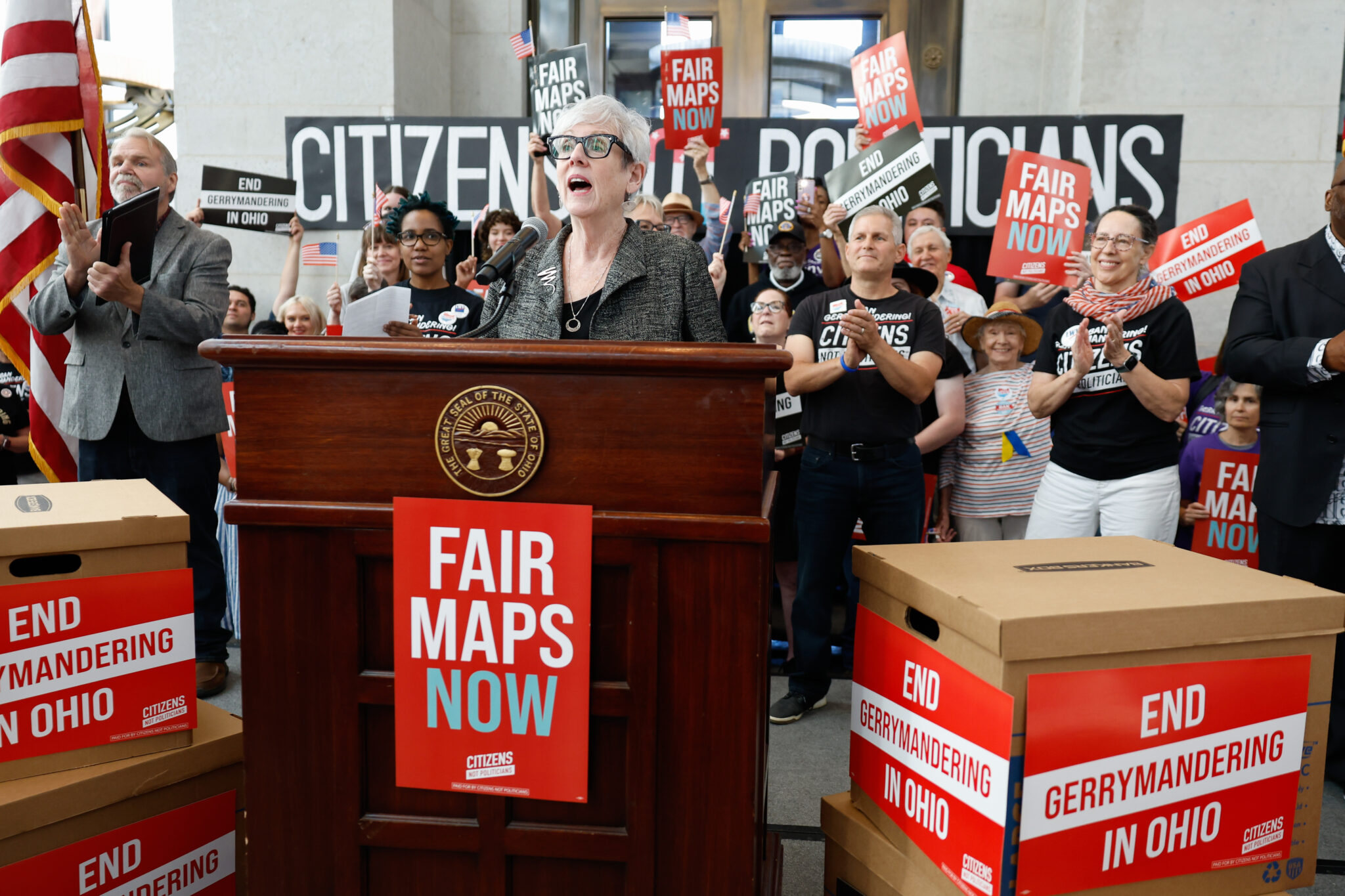
Retired Ohio Supreme Court Chief Justice Maureen O’Connor speaks to supporters at the Citizens Not Politicians rally, July 1, 2024, at the Statehouse in Columbus, Ohio. (Photo by Graham Stokes for Ohio Capital Journal. Republish only with original story.)
Even though Ohioans will be voting on Issue 1, which would remove politicians from the redistricting if approved, it’s possible redistricting will go before the state’s high court again.
The justices elected to the Ohio Supreme Court in 2024 will be the ones deciding on any challenges to new maps if Ohio voters pass the proposed Issue 1 anti-gerrymandering amendment this November.
Even though Ohioans will be voting on Issue 1, which would remove politicians from redistricting if approved, it’s possible redistricting will go before the state’s high court again.
“Maps, no matter who draws them, are certainly subject to challenge, and they’re subject to challenge for violating the provisions of the Ohio Constitution,”said University of Cincinnati Political Science Professor David Niven. “So we’re not done no matter what happens with Issue One. … There are still unhappy political actors who will go to the courts in some cases, questioning the process.”
Redistricting and past Supreme Court rulings
Redistricting is currently done through the Ohio Redistricting Commission — which includes the governor, the secretary of state, the state auditor and four legislative leaders (two from each party). In 2015, 71% of Ohioans voted in favor of a constitutional amendment to create a bipartisan redistricting commission to draw legislative districts in 2021.
Six different Statehouse district maps and two congressional maps have gone through the current redistricting process. The Ohio Supreme Court ruled five of the Statehouse maps unconstitutionally gerrymandered and both congressional maps were rejected as unconstitutional.
A federal court ordered Ohio voters to use the last of the gerrymandered Statehouse maps in 2022 since the commission ran out of time to come up with a constitutionally approved map. State lawmakers are currently occupying those districts.
Republican former Ohio Supreme Court Chief Justice Maureen O’Connor, who served on the state’s high court from 2003 to 2022, talked about this in an ad for Issue 1.
“Seven times career politicians have so blatantly gerrymandered our voting district maps that the Ohio Supreme Court ruled the maps unconstitutional. Seven times,” she said in the ad. “Issue One bans politicians from drawing voting maps. It will restore power to where it belongs, with citizens not politicians.”
Citizens Not Politicians, a nonpartisan coalition, is behind the proposed constitutional amendment. Issue 1 would create a 15-member Ohio Citizens Redistricting Commission made up of Republicans, Democratic and independent citizens. It would prohibit current or former politicians, political party officials, lobbyists and large political donors from being on the commission.
Ohio Supreme Court races
Republicans currently have a 4-3 majority on the Ohio Supreme Court. Depending on the outcome of the election, the Democrats could flip the court or the Republicans could tighten their grip.
“The makeup of the court makes a tremendous difference,” Executive Director of Common Cause Ohio Catherine Turcer said. “Are these folks that are going to serve on the court going to look at new voting districts with an eye to what’s in the Ohio Constitution and to what is actually good for Ohio voters, or are they going to be swayed by partisan interests?”
Ohio Republican lawmakers added party labels to the previously nonpartisan Ohio Supreme Court races starting in 2022.
Incumbent Democratic Justice Michael P. Donnelly is being challenged by Republican Hamilton County Court of Common Pleas Judge Megan Shanahan.
Incumbent Democratic Justice Melody Stewart is being challenged by incumbent Republican Justice Joseph Deters, who decided not to run for his current seat and instead chose to go up against Stewart.
Democratic candidate Lisa Forbes, of the Eighth District Court of Appeals, and Republican candidate Dan Hawkins, of the Franklin County Court of Common Pleas, are fighting for Deters’ open seat.
Deters recently talked briefly about redistricting on a right-wing Cleveland radio show.
“I think it’s kind of humorous to watch when the other side can’t win, they want to change the rules whether it’s hacking the U.S. Supreme Court because they don’t have the justices they like, or getting rid of the Electoral College because they don’t have a clear advantage in the Electoral College like they do, and it’s just a flat popular vote. And now redistricting,” he said on Strictly Speaking with Bob Frantz.
Megan Henry is a reporter for the Ohio Capital Journal and has spent the past five years reporting in Ohio on various topics including education, healthcare, business and crime. She previously worked at The Columbus Dispatch, part of the USA Today Network.
Ohio Capital Journal is part of States Newsroom, the nation’s largest state-focused nonprofit news organization.
As the presidential election inches closer, Ohio social studies and government teachers are using this as an opportunity to engage their students in civics education.
The Ohio Capital Journal talked to three current teachers — elementary, middle and high school — about how they are incorporating the presidential election into their curriculum.
“This is just another opportunity that only comes around once every four years,” Westerville South High School Government Teacher Kelley Stocker said. “The most rewarding part is knowing that I am helping to create a citizenry that understands how our country works.”
She typically tries to find current events that tie into what they are learning about in her class to help give real life examples to her students at the suburban high school just north of Columbus.
“You have to help them understand how government touches their lives and the real world applications,” said Stocker, who is in her 11th year teaching. “I just want them to start to understand why this stuff matters. I always tell them, you know, you can be anything you want to be in (her classroom), except apathetic or ignorant.”
Stocker rearranged her curriculum this semester to cover elections, campaigns, political parties and the First Amendment in a unit called “the role of the people.” Before she starts the unit, she sends letters home to the families to let them know she plans on covering the election in class and encourages parents to reach out if they have any questions.
“It’s like doing the (March Madness) brackets,” she said.
When talking politics in the classroom, Stocker has one boundary with her students — they can talk about issues, not people.
“You can say, I don’t agree with this position, not I don’t like these people,” she said. “I try to separate issues from people.”
Government is a high school graduation requirement in Ohio and Cleveland Teachers Union President Shari Obrenski previously taught high school government and history for more than 20 years.
“I always enjoyed seeing students at the beginning of an election cycle who have absolutely no interest in what’s going on that by the time we get to the presidential election, or a big election of some sort, be able to talk about platforms, be able to analyze commercials, be excited about the process and interested in how it was going to turn out,” she said.
Obrenski fondly looks back on her time in the classroom teaching the political process.
“We would talk about campaign commercials and the techniques that are used in campaign advertising, and having them take a look at different platforms from different political parties, having them analyze their own viewpoints, to see kind of where they line up ideologically with different political parties,” she said.
Some of Obrenski’s former students have reached back out to her and said they vote because of what they learned in her class.
“It reinforces that the work is important and reinforces that civic education is important,” Obrenski said.
James Lautzenheiser, an eighth grade history teacher at Crestview Middle School in Van Wert County in Northwest Ohio, said he views teaching how government works as an introduction to citizenship for his middle schoolers.
“I really like helping kids distinguish between what they think history and government is, and helping them kind of figure out some things for themselves,” Lautzenheiser, who has been a teacher for 15 years, said.
Even though Angel Dyer Sanchez’s fifth grade students aren’t old enough to vote, she hopes what they talk about in class will lead to conversations about voting at the dinner table. The elementary school teacher in Columbus City Schools encourages her students to think for themselves when it comes to which candidate they want to win.
“Don’t just vote because it’s who your parents or grandparents are voting for,” she said. “You should have your own opinion. … You should know who you’re voting for and what they stand for.”
Voting
Stocker keeps voter registration forms, stamps and envelopes in her classroom, so students can come to her if they are ready to register to vote.
“The only thing they have to do by themselves is we have a mail drop box across the street, and they just have to walk it over,” Stocker said.
Voting location. (Photo by the New Jersey Monitor/States Newsroom.)
In a similar vein, Obrenski helped eligible students register to vote and would teach a unit on voting and the country’s evolution of voting rights.
“Students are often really surprised to know that it’s only been 100 years since women have had the right to vote,” she said. “It’s inconceivable to them that that’s possible.”
Sanchez, who is her 20th year of teaching, gives lessons about voting and the three branches of government while encouraging her students to go to the voting polls with their parents.
“I just want to instill in them early that it is a right, and they need to make sure they take advantage of that right,” Sanchez said.
Lautzenheiser’s students are excited about the idea of voting.
“A lot of them have already expressed that it’s frustrating that their parents don’t always vote,” he said.
Only 32% of Ohio’s 18-year-olds are registered to vote as of May, according to the Civics Center, a nonpartisan organization trying to increase voter registration.
“When you look at the types of issues that are on the ballot with the candidates that we have on the ballot, young people are often more impacted by these decisions than other age groups, so it’s so important for them to see value in the process and to try to get them to go to the polls,” Obrenski said.
Teaching about the election doesn’t end once the votes are counted. Stocker plans on analyzing the outcome with her class to see how accurate the polls were.
“If they weren’t accurate how can we maybe explain that?” she said.
Teaching students media literacy goes hand-in-hand with teaching about the election.
“One of my personal goals is that I want them to be able to read the news and understand it,” Stocker said. “I’m teaching them all of the things that they need and the tools that they need to be able to think critically about the news, what they read, what they hear, and to be able to understand it.”
Sanchez said she teaches her fifth graders how to identify if a news outlet is a trustworthy site.
“Half the battle is, are you sure you’re getting truthful information?” she said.
Megan Henry is a reporter for the Ohio Capital Journal and has spent the past five years reporting in Ohio on various topics including education, healthcare, business and crime. She previously worked at The Columbus Dispatch, part of the USA Today Network.
Ohio Capital Journal is part of States Newsroom, the nation’s largest state-focused nonprofit news organization.
A school voucher lawsuit currently in the Franklin County Court of Common Pleas will likely make its way before the Ohio Supreme Court eventually — meaning whichever candidates are elected to the state’s high court this fall could end up ruling on this pivotal school funding case.
Six candidates are running for three seats on the Ohio Supreme Court. Republicans currently hold a 4-3 majority. If Democrats win all three races, the court would flip 4-3 Democratic. However, if Republicans win all three races, it would become a 6-1 Republican court.
Incumbent Democratic Justice Michael P. Donnelly is being challenged by Republican Hamilton County Court of Common Pleas Judge Megan Shanahan.
Incumbent Democratic Justice Melody Stewart is being challenged by incumbent Republican Justice Joseph Deters, who decided not to run for his current seat and instead chose to go up against Stewart.
Democratic candidate Lisa Forbes, of the Eighth District Court of Appeals, and Republican candidate Dan Hawkins, of the Franklin County Court of Common Pleas, are fighting for Deters’ open seat.
Vouchers Hurt Ohio lawsuit
Vouchers Hurt Ohio filed a lawsuit in 2022 targeting the EdChoice private school voucher program, arguing the program has grown disproportionately while resources for public school districts have dwindled. The lawsuit has gone on to gain support from more than 200 Ohio school districts. Since filing the lawsuit, Ohio enacted universal school vouchers through last year’s state budget.
“Everybody has an interest in the school voucher case,” Ohio Education Association President Scott DiMauro said. “I’m sure, regardless of who prevails in the lower courts, that case is going to make its way to the Supreme Court, and so composition on the court that’s going to be open to looking at that issue fairly, and looking at what the constitution says is really important for the future of public education in Ohio.”
“Having a court that will heed the words of our State Constitution that calls for a thorough and efficient system of common schools across the state is really important to us in a court that’s going to be balanced, that’s going to be fair, that is going to exercise good judgment and not act in the way that suggests that it’s in the pocket of interest,” DiMauro said.
The Ohio Supreme Court has been under Republican control since 1986. Partisan labels were added to the previously-nonpartisan races by the state legislature in 2021.
“When you have a court now that is unbalanced, and that is partisan, I think you’re less likely to have that kind of outcome that is really looking at the text of the constitution, and fundamentally is going to act in a way that’s in the best interest of all students across the state, including the close to 90% of kids who attend our public schools,” DiMauro said.
The Buckeye Institute, a public policy think tank, supports private school vouchers.
“We think vouchers are clearly constitutional from the national standpoint as it relates to the Federal Constitution,” said Buckeye Institute Research Fellow Greg Lawson. “I think the makeup of the (Ohio Supreme) Court would have potentially some impact on what the outcome of that case could be. But again, it’s highly questioned. We don’t know how the election is going to turn out, so it’s hard to read the tea leaves until after the dust settles.”
It’s vital the Ohio Supreme Court remains independent, DiMauro said.
“I think what this Republican legislature has done over the past years … is that they want a court that’s going to be an extension of their political power,” DiMauro said. “They’ve very deliberately tried to make this a partisan court, and we need a court that will be above partisan politics in order to serve as a check and balance on the legislature and a check and balance on the governor.”
Megan Henry is a reporter for the Ohio Capital Journal and has spent the past five years reporting in Ohio on various topics including education, healthcare, business and crime. She previously worked at The Columbus Dispatch, part of the USA Today Network.
Ohio Capital Journal is part of States Newsroom, the nation’s largest state-focused nonprofit news organization.
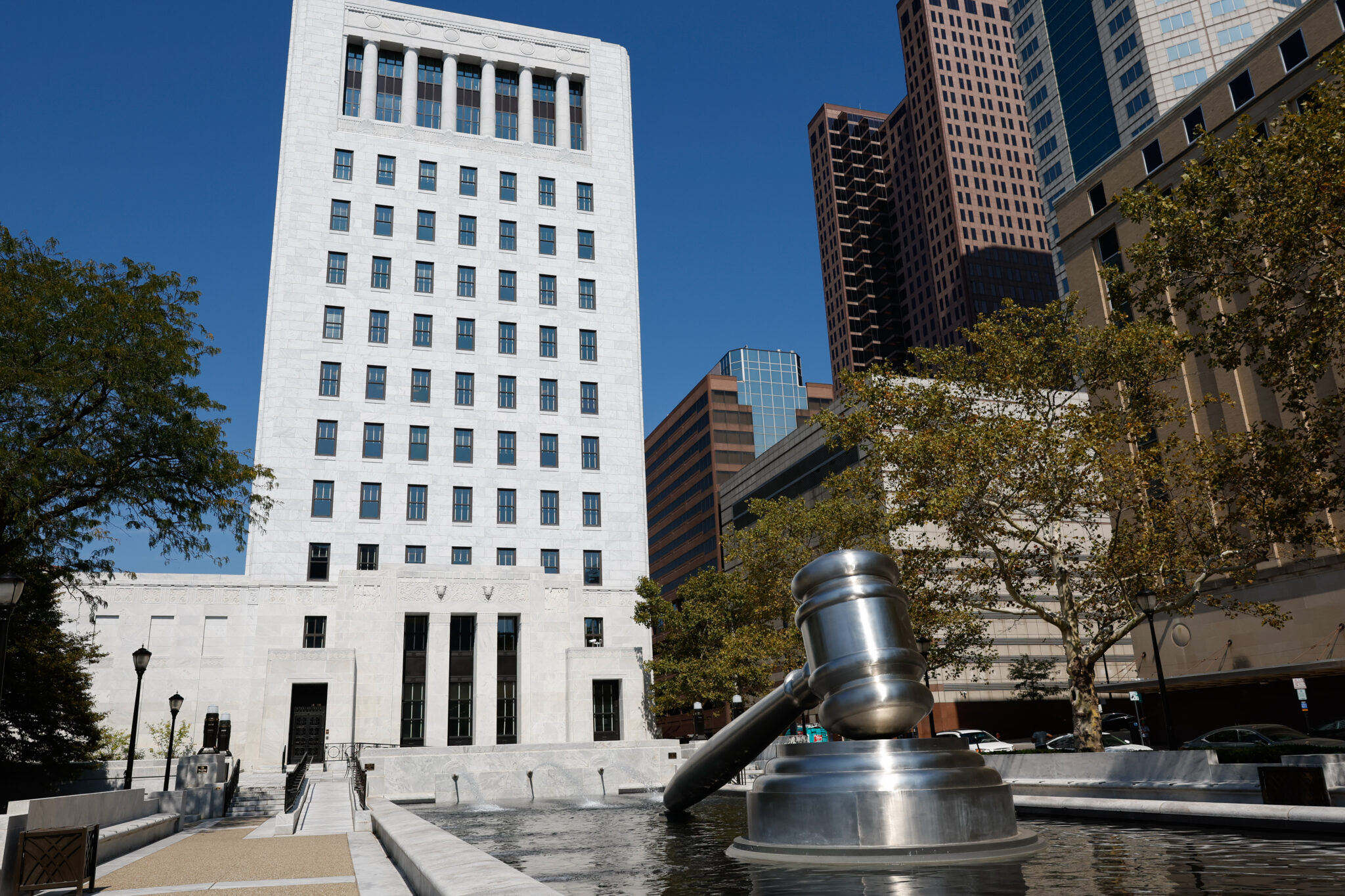
The Gavel outside the Supreme Court of the State of Ohio, September 20, 2023, at 65 S. Front Street, Columbus, Ohio. (Photo by Graham Stokes for Ohio Capital Journal. Republish photo only with original article.)
Ohio’s highest court currently has a 4-3 Republican majority
Three Ohio Supreme Court seats will be up for grabs during the November election. The outcomes will decide the balance of the court and have major impacts on a wide variety of issues that affect the lives of Ohioans, from education and environmental issues to gerrymandering and elections to civil and reproductive rights.
Partisan labels were added to the previously-nonpartisan races by the state legislature in 2021.
This year, incumbent Democratic Justice Michael P. Donnelly is being challenged by Republican Hamilton County Court of Common Pleas Judge Megan Shanahan.
Incumbent Democrat Justice Melody Stewart is being challenged by incumbent Republican Justice Joseph Deters, who opted not to run for his current seat and decided to go up against Stewart.
Vying for Deters’ open seat is Democratic candidate Lisa Forbes, of the Eighth District Court of Appeals, and Republican candidate Dan Hawkins, of the Franklin County Court of Common Pleas.
Deters decided to run for a full-term seat by challenging Stewart, rather than a partial term for the seat Ohio Gov. Mike DeWine appointed him to on Jan. 7, 2023. Because of this, whichever candidate wins Deters’ current seat will have to run again in 2026 for a full six-year term.
Ohio’s highest court currently has a 4-3 Republican majority. If all three Republicans are elected, the Republicans would hold all but one seat on the bench, for a 6-1 majority. On the flip side, if all three Democrats win their elections, the Democrats would hold a 4-3 majority. The Ohio Supreme Court has been under Republican control since 1986.
Democratic Justice Jennifer Brunner’s seat will be up in 2026. Republican Chief Justice Sharon Kennedy, Republican Justice Pat DeWine and Republican Justice Pat Fischer’s seats will be up in 2028.
The Ohio Supreme Court could make decisions on a plethora of critical issues: reproductive rights, gerrymandering, school vouchers, home rule, and environmental issues, among others.
“If there’s a law around it, it could end up in the Supreme Court and have a real, tangible impact on each of our lives,” said Elisabeth Warner, spokesperson for the League of Women Voters of Ohio.
Even though 57% of Ohio voters approved an amendment last year to enshrine reproductive rights in the state’s constitution, the court will inevitably rule on abortion access.
“There are still a lot of anti-abortion laws on the books, so that’s something that the Supreme Court is going to be ruling on,” Warner said.
Ohio’s anti-abortion laws were not automatically nullified when last year’s amendment passed, so abortion advocates are working to undo those laws.
Another lawsuit is currently pending in Hamilton County Court of Common Pleas over whether Ohio’s six-week abortion ban is unconstitutional after voters passed last year’s amendment.
Those lawsuits will likely make their way to the Ohio Supreme Court — meaning the seven justices will end up deciding to what extent reproductive rights are protected.
“At the end of the day, the Ohio Supreme Court will determine whatever’s in the Ohio Constitution that voters put into the Ohio Constitution,” said Catherine Turcer, Common Cause Ohio’s executive director. “It is interpreted by the Ohio Supreme Court.”
Turcer and Warner both criticized the 2021 law that requires party affiliation listed on the ballot for Ohio Supreme Court candidates. More than 1 million Ohio voters left the two Supreme Court races blank during the 2020 election.
“We shouldn’t actually be thinking Democrats and Republicans because at the end of the day, what you want is a referee who’s independent and impartial,” Turcer said.
Megan Henry is a reporter for the Ohio Capital Journal and has spent the past five years reporting in Ohio on various topics including education, healthcare, business and crime. She previously worked at The Columbus Dispatch, part of the USA Today Network.
Ohio Capital Journal is part of States Newsroom, the nation’s largest state-focused nonprofit news organization.
A political newcomer will represent Ohio’s 2nd U.S. Congressional District starting in 2025.
Democrat Samantha Meadows is going up against Republican David Taylor and neither candidate has held office before.
Republican Rep. Brad Wenstrup
Republican Rep. Brad Wenstrup currently represents the 2nd Congressional District, but he announced at the end of last year that he would not seek reelection in 2024 after serving six terms.
The 2nd Congressional District covers 15 southern Ohio counties: Clermont, Clinton, Pike, Adams, Brown, Highland, Ross, Scioto, Pickaway, Hocking, Vinton, Jackson, Lawrence, Gallia, and Meigs counties, and part of Fayette County.
The 2nd Congressional District historically leans Republican and President Donald Trump won in all of those counties during the 2020 election.
Meadows
This is Meadows’ second time running for the 2nd congressional district. She lost against Wenstrup in 2022 — receiving only 25% of the vote — but she thinks her odds of winning have increased since Wenstrup is retiring.
“I am beating down doors … I’m doing everything that I can to let people know that I, personally, as a candidate, care about them,” she said.
Meadows doesn’t feel intimidated running as a Democrat in Republican-dominated counties.
Democrat Samantha Meadows is running for Ohio’s second congressional district. (Headshot provided.)
“I know that a lot of folks down here are Republicans by anger rather than policy,” she said. “I have faith in our region that, no, this isn’t about Republican or Democrat. This is actually about a person that’s going to help us.”
She grew up in McDermott in Scioto County, attended Shawnee State University and Ohio Christian University and went on to work as an EMT.
“I’ve always felt compelled to be of service to my community,” she said. “… I always felt compelled to help others.”
Through her work as an EMT, Meadows has seen firsthand the devastation of the opioid epidemic and she remembers the first Oxycontin overdose patient she helped treat. They administered Narcan and were able to revive the patient.
“At that time, this was new to us,” she said.
That same patient overdosed again a couple weeks later, but didn’t make it this time.
“Addiction was one of the catalysts that made me run for office,” she said. “Everybody knows somebody that’s either addicted or a family that’s going through those things.”
“I had a moment where I literally looked at the TV and said, somebody’s got to do something about this. And so I was like, I’ll do it,” she said.
Taylor
Wenstrup retiring, how most of the 2nd District is Appalachian and “the laundry list of national crises we have going on both inside and outside our borders” is what led to Taylor to run for office.
“The needs of the Appalachian community has been something that’s been in the front of my mind my whole life,” he said. “The opportunity to see this overlooked, underserved community that is the 2nd District of Ohio get the attention it deserves is what compelled me to get into politics.”
Taylor had to endure a competitive primary against ten other Republicans — including state Sens. Shane Wilkin and Niraj Antani — to get on the November ballot. Taylor came out on top with 25% of the vote.
Republican David Taylor is running for Ohio’s second congressional district. (Photo provided by Taylor’s campaign.)
“People don’t want career politicians right now,” he said. “They want somebody from the outside. I think actually, for the voters in the 2nd District, not being a person with a political background was actually a plus.”
Even though the second district leans Republican, Taylor said he is treating the race as if the district was split 50-50 and has been traveling the district to meet people.
“We’re running the tires off my pickup truck and going to all corners of the district,” he said.
Taylor has lived a majority of his life in Clermont County, graduated from Miami University and the University of Dayton School of Law and worked for a prosecutor’s office.
“In criminal law, you’re getting to the nitty gritty on every word in the law, because sometimes somebody’s freedom is at stake,” Taylor said. “So that will serve well in dealing with the legislation that’s written and passed or repealed.”
He now owns his own concrete business Sardinia Ready Mix and said his experience of operating within a budget could help him in D.C.
“Those are things that the government could use a large dose of so more people with that mindset, I think, would lead to better outcomes in Washington, D.C. and those returns come here to Ohio, specifically the second district,” he said.
On the issues
Taylor wants to defund and dismantle the U.S. Department of Education.
“It’s another federal agency that overreaches the federal government’s mandate under the Tenth Amendment,” he said. “We have so many federal bureaucracies that are overstepping the mandate of the Constitution.”
Meadows wants to better fund public schools.
“We don’t have enough private schools in our district to take on an influx of public school kids,” Meadows said, referring to the voucher program.
Meadows wants to protect reproductive rights.
“The ability to have body autonomy and make our own decisions, that is absolutely terrifying that we don’t have that type of freedom, or that we’re trying to be denied that kind of freedom,” she said.
Taylor is anti-abortion, but doesn’t support a total ban on abortion.
“The issue is going to be a state issue from state to state, and that’s where it needs to stay,” he said.
Both candidates support the Second Amendment.
“But I also believe at the very least, we need to have a moratorium on the sale of assault rifles,” Meadows said. “I do believe that they are not necessary in the hands of an average American. They belong on the battlefield.”
Taylor said he would fight against infringements on the Second Amendment.
“Every time you have one of these incidents that causes (people) to call for gun control, multiple laws have been broken, so I’m not sure what law they think can be written that’s going to stop that,” Taylor said.
Megan Henry is a reporter for the Ohio Capital Journal and has spent the past five years reporting in Ohio on various topics including education, healthcare, business and crime. She previously worked at The Columbus Dispatch, part of the USA Today Network.
Ohio Capital Journal is part of States Newsroom, the nation’s largest state-focused nonprofit news organization.
Tuesday has been a long time coming — 57% of Ohioans voted to legalize recreational marijuana in November but there has been nowhere to legally purchase it. Until now.
Boston Grunkemeyer lined up in front of Amplify Dispensary’s Columbus location around 9:45 Tuesday morning and was the store’s first recreational marijuana customer.
He doesn’t have a medical marijuana card, but has anxiety and depression.
“It’s kind of nice to be able to go towards this if I need to, but also it’s gonna be fun just to be able to enjoy myself with my friends,” Grunkemeyer said.
Tuesday has been a long time coming — 57% of Ohioans voted to legalize recreational marijuana in November but there has been nowhere to legally purchase it. Until now.
“It’s incredibly exciting to be able to launch a program that is ahead of schedule, that will be thoughtfully regulated and will ensure that Ohio cannabis consumers no longer have to drive to Michigan or resort to the unregulated market,” Ohio Cannabis Coalition Spokesperson Tom Haren said.
The Ohio Department of Commerce Division of Cannabis Control gave 98 dispensaries the green light to start selling recreational marijuana by giving them their certificates of operation. Ten Columbus dispensaries, eight Cincinnati dispensaries, and five Cleveland dispensaries received their certificates of operation on Tuesday.
Amplify Dispensary in Columbus prepares for the first day of recreational marijuana sales on August 6. (Photo by Megan Henry, Ohio Capital Journal.)
“However, the issuance of COOs does not necessarily mean non-medical sales will begin immediately at every dispensary, as each licensee must determine when they will start sales based on factors including staffing, stock and other business considerations,” the DCC said in a statement.
The DCC plans on awarding certificates of operations to all the remaining eligible dispensaries later this week, according to the division.
Certificates are issued “roughly” in the order when completed applications were received by the division and when compliances were fulfilled, according to the division.
Recreational sales are actually ahead of schedule since the division had until Sept. 7 to approve or deny a license application.
“A big reason we were able to get to this point ahead of the Sept. 7 deadline was due to the foundation laid through the state’s existing Medical Marijuana Control Program,” DCC Superintendent James Canepa said in a statement. “Since existing licensees had already met stringent requirements of that program, we anticipated this process to be rather smooth. They had already undergone many of the comprehensive checks as part of that process.”
Amplify Dispensary
Jerika Tieman was excited to be able to buy weed without needing a medical marijuana card.
“It’s been a long time coming,” she said, standing outside Amplify before the store opened.
She previously had a medical marijuana card but didn’t renew it due to costs. The registration fee for medical marijuana was eliminated earlier this year, but it was previously $50, DCC spokesperson James Crawford said in an email.
“It is a hugely monumental day,” said Amplify’s Digital Brand Manager Cole Wallis. “We’re part of a change, and a change for good, which feels super, and we’re happy to be a part of it. I’m just excited to see it unfold.”
They doubled their staff at their Columbus location in anticipation for recreational sales to start, and have two other locations in Cleveland Heights and in Bedford.
Trulieve
Trulieve expected to see between 500-600 people at one of their Columbus locations on Tuesday — about triple their average number, said Nick Rassler, their director of state operations.
Trulieve has three locations in Ohio — two in the Columbus-area and one near Dayton.
They normally open around nine or ten in the morning, but opened their doors at 7 a.m. this morning. Their line started forming at 6:30 a.m.
“It’s a huge deal for the industry as well and just cannabis in general,” Rassler said. “There’s people who just didn’t have a qualifying condition, but may have still had a need for the product. It’s a great alternative for them, it helps them feel the way they want to feel.”
Medical Marijuana Program
Both Amplify and Trulieve are prioritizing their medical marijuana patients and had different lines for medical and non-medical customers.
Medical marijuana patients don’t have to pay excise tax on the product.
“I would like to see it coexist peacefully, which I think we can get to that point,” Amplify Columbus’ General Manager Alissa Baker said.
Haren said there will be enough medical marijuana supply to meet demand.
“By rule, the supply side will be there to match the demand, whatever it is,” he said. “If the demand shrinks, then you know, there will be less inventory, sort of held for medical patients. But if the demand stays where it is, we will continue to have product at dispensaries in order to meet that demand. And so it’s flexible from a regulatory perspective.”
Megan Henry is a reporter for the Ohio Capital Journal and has spent the past five years reporting in Ohio on various topics including education, healthcare, business and crime. She previously worked at The Columbus Dispatch, part of the USA Today Network.
Ohio Capital Journal is part of States Newsroom, the nation’s largest state-focused nonprofit news organization.
After sounding the alarm on fracking waste injection wells for more than a decade, Roxanne Groff from Athens County is now finally starting to see some of the fruits of her and her friends’ labor.
A handful of Athens County injection wells were suspended after Ohio Department of Natural Resources determined they pose an “imminent danger to the health and safety of the public and is likely to result in immediate substantial damage to the natural resources of the state,” according to letters from Chief of the Division of Oil and Gas Resources Management Eric Vendel.
“I cried,” the 75-year-old activist said when she heard the news.
Groff’s advocacy against injection wells started back in 2012 with the Hazel–Ginsburg well. It has since grown to include many Southeast Ohio residents who are also sounding the alarm — something Groff believes helped led to the wells being suspended.
“All of us together, all of the community members stood up for themselves and pushed back,” Groff said. “We know that this is dangerous.”
Injection wells in Athens
There are seven class 2 injection wells in Athens County, but five are no longer in operation and the ODNR Division of Oil & Gas Resources Management expects those wells to be plugged, ODNR spokesperson Karina Cheung said in an email. Historically, three injection wells have been plugged in the county, she said.
Class 2 wells are used to inject fluids — primarily brines — associated with oil and natural gas production, according to the EPA.
Included in the five Athens wells that are out of operation are three K&H injection wells that were operational until a decision by the Oil and Gas Commission on April 19.
The plugging permits for the three K&H wells will be issued soon and will be effective for two years once they are issued, Cheung said. She said the wells will be plugged this summer (according to the company Tallgrass Energy that owns the K&H wells).
The Frost well was last used in 2021 and has been ordered to be plugged by the Chief of the Division of Oil & Gas Resources Management.
“The company is in receivership and the Division has been in communication with the receiver about their obligation to plug the well,” Cheung said in an email.
Plugging a well includes removing all uncemented casing and tubing from the well, and using cement to plug the well “ in a manner to isolate all oil, gas, and brine to formations that they originate in,” Cheung said.
The exact cost of plugging a well is tough to determine.
“Plugging costs vary due to differences in wells and the costs of abandonment and decommissioning of the surface storage facilities associated with the wells,” Cheung said in an email.
But just because the wells will eventually be plugged doesn’t mean the environmental risks are gone, Athens County resident Susie Quinn said.
“All the stuff that they’ve injected down there, it’s still down there,” she said. “This is not a cleanup. It’s just there stopping anymore from going in.”
The Quinns got earthquake insurance for their house nearly a decade ago because “we’ve had so many little ones because of the fracking and injection wells.”
Groff echoed Quinn’s sentiments about the plugged wells.
“The threat remains … all that waste is there,” she said. “It’s down there. It’s under pressure. If it feels like going somewhere, it’s going to find a crack, and it’s going to keep going through that crack … until it gets to someplace where it either comes up to the surface or it just stops fracturing.”
Advocacy against the wells
The first Athens County injection well was the Hazel–Ginsburg well in 1984, Groff said. At the time Groff was an Athens County Commissioner, a role she served in from 1983 to 1995.
Roxanne Groff (left) at the Mad Hatter’s Tea Party protest against the injection wells in Athens County. (Photo provided by Roxanne Groff.)
It wasn’t until 2012 when her advocacy related to fracking began, after Madeline ffitch was arrested for chaining herself to two barrels and blocking the driveway to the Ginsburg well.
The Ginsburg well was last used in 2015, Cheung said.
“The Division of Oil & Gas Resources Management granted a permit to plug the Ginsberg well, but the owner of the well did not plug it within the permit’s two-year expiration date,” Cheung said in an email. “The Division is conducting regulatory enforcement regarding the Ginsberg well.”
Local environmental groups started popping up, like Athens County’s Future Action Network and Torch CAN DO, which stands for Torch Clean Air Now, Defend Ohio. These groups helped organize informational meetings with epidemiologists and geologists as well as protests to spread the word about fracking and raise awareness. One of their protests was a Mad Hatter’s Tea Party complete with a Queen of Hearts and little toxic tea bottles.
Groff, along with the other activists who joined the fight, have been preaching for years about the environmental impact of injection wells.
“You drill a hole into the ground and then you shove toxic radioactive waste under immense pressure,” Groff said. “Now what kind of fool do you think we are that you don’t think that that’s going to go somewhere?”
There were more than 1,400 fracking incidents associated with oil and gas wells in Ohio between 2018 and September 2023, according to FracTracker Alliance — a nonprofit that collects data on fracking pipelines.
There have been 26 incidents in Athens County during that same time period involving release, unintentional gas release and a fire, according to FracTracker.
“Everybody knew that was going to happen,” Groff said. “We absolutely unequivocally knew that we were right. There was nothing that swayed anybody in this group from thinking that we were making stuff up.”
The Athens County Commissioners also got involved and held meetings.
“These wells are just terrible and what they’ve done and everything that was said that was going to happen, happened,” Athens County Commissioner Charlie Adkins said.
Groff and the team of activists were overjoyed when ODNR ordered the injection wells to suspend operations.
“The language they used is exactly what the people have been saying … they’re an imminent threat to the health and the welfare and well being of the environment and the people who live here,” Groff said.
Quinn always believed they could make a difference.
“We went from Torch CAN DO to Torch can done,” she said. “We’d like to pass our homesteads on to our children. We want to do this for our grandchildren.”
Fight continues
Even though some of the wells are no longer in use, Groff isn’t hanging up her activist hat just yet.
For one, not all injection wells are suspended. The last two remaining wells in operation in Athens County are in Canaan Township and Lee Township, Cheung said.
The long-term effects of the injection wells are not totally known at the moment and could not show up for years or decades, Groff said.
Athens County Commissioner President Lenny Eliason said he would like to focus on long-term monitoring.
“Appalachia has been extracted for years for a number of different materials and the pain of the short term gains sticks around a long time after,” he said. “So we have to get people that are more forward thinking about balancing what that short term gain is going to bring in the long term.”
When asked if the drinking water had been affected by the injection wells, Groff and Quinn said they don’t know yet.
Referring to the state, Groff said ““Your incompetence caused this to happen. If you want to assure people that this is not an imminent threat and danger, then prove it and the only way you can prove it is to continue to test the water.”
Even though their advocacy is not quite done, they are relishing their victory.
“It’s not only just a huge win for everybody here in Athens County, it’s a message to the rest of the people in the state that, with due diligence, you can be in control,” Groff said. “You just have to fight like hell to make yourself heard.”
Megan Henry is a reporter for the Ohio Capital Journal and has spent the past five years reporting in Ohio on various topics including education, healthcare, business and crime. She previously worked at The Columbus Dispatch, part of the USA Today Network.
Ohio Capital Journal is part of States Newsroom, the nation’s largest state-focused nonprofit news organization.
There were 1,797 suicide deaths in Ohio in 2022 — the 13th-leading cause of death in Ohio, according to ODH’s Suicide Demographics and Trends 2022 report. Suicide was the second-leading cause of death among Ohioans ages 10-14 and 20-34 that year.
Demographics
Males accounted for 80% of Ohio suicide deaths and Ohioans between the ages of 35-44 had the highest rate of suicide deaths.
Firearms accounted for more than half of all suicide deaths — 64% of male suicide deaths and 36% of female suicide deaths.
Breaking it down by sex, males 75 and older had the highest rate of suicide deaths and females ages 25-34 had the highest rate of suicide deaths.
Black non-Hispanics saw the the largest increases in rates of suicide deaths (16%) from 2021 to 2022. White non-Hispanics had both the highest rate of suicide deaths (16.1%) and the total number of suicide deaths (1,525).
Vinton County had the highest suicide death rate (38.8 per 100,000) and Mercer County had the lowest rate (9.4 per 100,000). Franklin County had the most suicide deaths with 168, Cuyahoga County had the second most with 163 and Hamilton County had the third most with 136.
Thirteen of the 15 counties with the highest suicide death rates were rural.
988 Suicide and Crisis Line
The National Suicide Prevention Lifeline moved to the 988 Suicide & Crisis Lifeline two years ago and since then Ohio 19’s call centers have responded to nearly 340,000 calls, texts and chats — an average of more than 14,000 contacts each month.
“988 is saving lives,” Gov. Mike DeWine said in a statement. “The lifeline is providing free, around-the-clock support to Ohioans in crisis by connecting them with someone to talk to for help at the moment it’s needed most.”
Ohioans facing a mental health or addiction crisis and their families members can call or text 988 or chat 988Lifeline.org to get connected to a trained call specialist who can help.
“988 is confidential and functions as a crucial gateway to crisis support within our communities,” Ohio Department of Mental Health and Addiction Services Director LeeAnne Cornyn said in a statement. “Our hope is that reaching out to 988 in a behavioral health crisis becomes as natural to Ohioans as dialing 911 in other types of emergencies.”
There have been an average of 9,804 calls from Ohio area codes; 2,686 texts received per month and an average of 1,652 chats per month.
Cities across Ohio are trying to raise awareness of 988.
The City of Columbus Department of Public Utilities put up more than a dozen signs about 988 throughout the city. Some of the police departments in Huron County have added 988 decals to their cars. Heidelberg University rented three billboards about 988 to inform students at the private college in Seneca County.
“Any person or organization that puts effort toward building awareness about 988 is helping save lives,” Ohio’s 988 Administrator Doug Jackson said in a statement.
Megan Henry is a reporter for the Ohio Capital Journal and has spent the past five years reporting in Ohio on various topics including education, healthcare, business and crime. She previously worked at The Columbus Dispatch, part of the USA Today Network.
Ohio Capital Journal is part of States Newsroom, the nation’s largest state-focused nonprofit news organization.
David Miller is the Managing Editor of Loveland Magazine
David Miller
Loveland, Ohio – Because the Ohio Capital Journal is such a vital part of our reporting to the Greater Loveland Area, we are thrilled that we can share that in the “Ohio’s Best Journalism Contest” from the Society of Professional Journalists, the Ohio Capital Journal won seven awards last week, including three first place finishes and four in second place. The contest covered stories and editorial from 2023.
Because of the Journal, Loveland Magazine equals any news outlet in the Greater Cincinnati Area in the number of reports from the Ohio Statehouse; and certainly the quality of the stories we are so fortunate to be able to publish is second to none.
Ohio Capital Journal Editor-in-Chief and Opinion Columnist David DeWitt
In announcing the awards, Ohio Capital Journal Editor-in-Chief and Opinion Columnist David DeWitt said, “We are incredibly honored and grateful for this recognition from our fellow journalists. We are also humbled by and grateful for all of the support we receive from our readers and Ohioans across the state.”
That includes you, our Loveland Magazine faithful readers.
Congratulations Journal! We are certainly very grateful for your devoted work and dedication.
________________
The Ohio Capital Journal is an independent, nonprofit news organization dedicated to connecting Ohioans to their state government and its impact on their lives. The Capital Journal combines Ohio state government coverage with incisive investigative journalism, reporting on the consequences of policy, political insight and principled commentary. They are part of States Newsroom, the nation’s largest state-focused nonprofit news organization.
________________
The latest awards come after the Ohio Capital Journal won seven SPJ awards last year, and five the year before. Overall, the Ohio Capital Journal has won 19 Ohio Society of Professional Journalists awards in the last three years.
In digital media categories, Capital Journal Senior Reporter Marty Schladen won first place for best government/political reporting; reporter Megan Henry won first place for best education reporting; and Editor/Columnist David DeWitt and Columnist Marilou Johanek won first place for best overall commentary/opinion blog section.
Reporter Susan Tebben won second place for best education reporting; OCJ/WEWS reporter Morgan Trau won second place for best government/political reporting; reporter Susan Tebben won second place for best medical/science/health care reporting, and the Ohio Capital Journal won second place for best general news site.
Below we are sharing the award-winning entries.
Marty Schladen
Best Government/Political Reporting — First Place — Marty Schladen






















 Best General News Site — Second Place — Ohio Capital Journal