The Ohio House recently passed a bill that would ban transgender people from using the bathroom and locker room that aligns with their gender identity.
Bradie Anderson fears she will be physically harmed if she uses the boys bathroom at her Northeast Ohio high school.
The 14-year-old sophomore is transgender and her mom Anne said she has never had any issues with using the girls restroom at school.
“She’s not going in the boys bathroom,” Anne said. “If my daughter went into the boys bathroom, I would hate to think what would happen to her in there.”
But the Ohio House recently passed a bill that would ban transgender people, like Bradie, from using the bathroom and locker room that aligns with their gender identity. The bill now heads to the Senate for concurrence, but the legislators are on break until after the election.
______
Jean Schmidt (R) who represents Ohio House District 62 is a co-sponsor of HB 183.
Jennifer Gross (R) who represents Ohio District 45 is a co-sponsor of HB 183.
Thomas Hall (R) who represents Ohio District 46 is a co-sponsor of HB 183.
Bill Seitz (R) who represents Ohio District 30 is a co-sponsor of HB 183.
Adam C. Bird (R) who represents Ohio District 63 is a Primary Sponsor of HB 183.
______
“The bathroom bill is going to get kids hurt and put them in harm’s way,” Anne said. “Why would anyone want to put any child, even if you don’t understand who they are, in harm’s way?”
If the bathroom bill were to pass, Anne questions who is going to monitor the bathrooms.
“If you don’t look feminine enough, if you don’t look masculine enough, are they going to be questioned?” Anne said. “Because cisgender people are also going to get pulled into this as well.”
The American Medical Association opposes policies preventing transgender individuals from accessing basic human services and public facilities consistent with gender identity.
Anti-transgender legislation in Ohio
The bathroom bill is one of many anti-LGBTQ+ bills Ohio lawmakers have introduced in the General Assembly — including one that would ban gender affirming care and prevent transgender athletes from playing women’s sports and another that would force educators to out students to their parents.
“These are our kids,” Anne said. “They’re not talking points. They’re real kids.”
Bradie came out eight years ago and was kicked out of Catholic school for being transgender, forcing her to switch to public school where she started experiencing harassment from her middle school peers around the same time Ohio lawmakers started introducing anti-transgender legislation.
“She had been threatened with physical harm, threatening to cut body parts off of her,” Anne said.
The harassment has not stopped Bradie from advocating for herself and others. She has testified in committee meetings against the various anti-transgender bills and started speaking out at protests when she was 11, Anne said.
But all of the anti-transgender legislation in Ohio is taking a toll on Bradie, who receives gender affirming care.
“The last few weeks have been tough,” Anne said. “Bradie’s been crying. She’s been very upset. The combination of being harassed in our town that we live in and all of the anti-trans bills, especially the bathroom bill, gives her major anxiety.”
Bradie loves playing soccer, but because of all the scrutiny around transgender athletes, she’s not sure if she’ll play this fall.
“She’s so much more than being transgender,” Anne said. “She’s sick of the adult bullies coming for her in this town, and a lot of them don’t even have children in the school.”
Despite all of these proposed anti-transgender bills in Ohio, Bradie doesn’t want to move away.
“She shouldn’t have to,” Anne said. “I grew up here, and I’m not going to be run out of town because people are ignorant.”
Megan Henry is a reporter for the Ohio Capital Journal and has spent the past five years reporting in Ohio on various topics including education, healthcare, business and crime. She previously worked at The Columbus Dispatch, part of the USA Today Network.
Ohio Capital Journal is part of States Newsroom, the nation’s largest state-focused nonprofit news organization.
Many societal structures and systems can be drivers of violent crimes, according to a new report by the Health Policy Institute of Ohio.
More than 30,000 violent crimes — including homicide, rape, robbery and aggravated assault — were reported in Ohio in 2023.
“Even with laws and penalties such as arrest and incarceration in place, violent crime persists and causes significant harm to victims and communities,” the report states. “Community conditions and societal structures can support or prevent violent crime. Since the research evidence is clear that arrests and incarceration are detrimental to the health of individuals, families and communities, it is important to take an upstream approach for violence prevention.”
“We can then also be preventative and treat it as a public health issue by addressing those underlying root causes of violence,” she said.
Violent crimes in Ohio
Ohio ranks 34th in the nation in homicides and 80% were gun-related in 2022, according to the report.
Homicides peaked in Ohio during the COVID-19 pandemic, but have not returned to pre-pandemic rates, according to the report. Two of Columbus’ deadliest years on records were 2021 with 204 homicides and 2020 with 175 homicides. Cleveland had 192 homicides in 2020 and 165 in 2021.
There were 18,742 incoming domestic violence cases in Ohio in 2014 — a number that has increased almost every year since with the exception of 2020 — and there were 24,534 cases in 2023.
Societal Structures and Systems
Racism, income inequality, zoning and neighborhood planning, gender-related social norms, education, employment, healthcare, housing and criminal justice are all structures and systems that can contribute to violent crime, according to the report.
“All of these structures and systems are also interconnected and interrelated, whether we have typical and current ongoing racist policies that have shaped the way communities are structured and the resources that people have access to,” Oberly said. “All of that aligns with income inequality, with how neighborhoods are shaped, and funding that goes into them, and that, of course, ties into the systems that drives violent crime as well.”
Redlining and the building the Interstate Highway System through communities of color in the 1950s are two examples of historical policies and practices.
“These … resulted in poor community stability, lower home valuations, increased foreclosures and limited economic mobility in majority-Black, Hispanic and Asian neighborhoods,” the report said. “As a result, many of these communities experienced concentrated disadvantage, which includes limited educational and employment opportunities and higher rates of poverty, unemployment and food insecurity that continue today.”
Ohio ranks 30th when it comes to income inequality, which puts people at risk for a shortened life span, poor health and increased neighborhood and interpersonal violence.
The report illustrates that increases in income supports — such as increased minimum wage, Earned Income Tax Credits and the Supplemental Nutrition Assistance Program — have been shown to lower violence and result in less firearm homicides.
Zoning and neighborhood planning can also play a role in the amount of violence in a particular area.
The report explained the relationship between alcohol outlet density and violent crime in a neighborhood. Off-premise outlets such as liquor and convenience stores are associated with higher rates of violent crime compared to on-premise outlets such as bars and restaurants.
“Alcohol outlet density is a prime example of how zoning impacts violence,” according to the report. “Due to inequitable zoning codes and weakened political power, communities of color and low-income neighborhoods are more likely to have a high density of alcohol outlets.”
Ohio’s liquor sales have increased 98% in the past two decades while the state’s adult population has gone up 8%. Ohio ranks 34th in the nation for excessive drinking.
Legislative actions
There have been legislative attempts to curb violent crimes.
The DeWine administration gave $20 million in grants to support more than three dozen community-based intervention programs to reduce violence and help victims of crime as part of the Community Violence Prevention Grant Program, according to the report.
DeWine recently signed a bill into law that will go into effect in September that aims to help formerly incarcerated people find stable housing.
House Bill 420 would create the Office of Firearm Violence Prevention within the Ohio Department of Children and Youth which would administer grant programs to reduce firearm violence. Reps. Darnell T. Brewer, D-Cleveland, and Munira Abdullahi, D-Columbus introduced the bill earlier this year, which is in the House Finance Committee.
The report recommends implementing evidence-based firearm safety policies that includes child access prevention laws and firearm licensing laws.
Ohio is not one of the 30 states with child-access prevention laws nor is Ohio one of the 14 states that require checks at the point of transfer for all firearms.
The report also recommends increasing housing affordability, alcohol policies, including density zoning and pricing; and education, employment and criminal justice reform.
Megan Henry is a reporter for the Ohio Capital Journal and has spent the past five years reporting in Ohio on various topics including education, healthcare, business and crime. She previously worked at The Columbus Dispatch, part of the USA Today Network.
Ohio Capital Journal is part of States Newsroom, the nation’s largest state-focused nonprofit news organization.
These laws have been challenged in Florida, Oklahoma, Idaho, and Tennessee. The U.S. Court of Appeals for the 9th Circuit blocked Idaho’s law in the fall.
Ohio’s bill would require K-12 schools and universities to mandate that students only be able to use the bathroom or locker room that matches their gender assigned at birth. It would not prohibit a school from having single-occupancy facilities and it would not apply to someone helping a person with a disability or a child younger than 10 years old being assisted by a parent, guardian, or family member.
The bathroom ban bill, which was tucked into Senate Bill 104 at the end of a marathon House session, heads back to the Ohio Senate for concurrence. The lawmakers are currently on summer break, so that won’t happen anytime soon.
Ohio Gov. Mike DeWine has indicated he would sign the bill if it came to his desk.
“As it stands now, I would sign the bill,” he told reporters on Friday.
Lawsuits would be filed if Ohio passes the bill, said Cleveland attorney Robert Chaloupka.
“There’s good reason to believe that if the (Ohio) Attorney General decides to defend this case, they’re going to lose, which means we’re spending taxpayer money on something that we have a good sense of how it’s going to go,” he said.
Chaloupka sees lots of legal challenges with Ohio’s bill.
“My most critical point about this is who’s going to police this?” Chaloupka asked.
He thinks this would be especially challenging in a university setting where there are non-traditional students.
“You’re going to regulate where a 75 year olds trans individual goes to the bathroom?” Chaloupka said.
The Supreme Court declined to weigh in earlier this year on whether schools can ban transgender students from using a restroom that reflects their gender identity. That denial left in place a U.S. Court of Appeals for the 7th Circuit decision that allowed a transgender middle school Indiana boy to use the boys’ restroom.
The American Medical Association officially opposes policies preventing transgender individuals from accessing basic human services and public facilities consistent with gender identity.
“Banning transgender students from freely and safely accessing public places, like bathrooms and changing rooms, sends the message that transgender children do not belong,” Ash Orr, spokesperson for the National Center for Transgender Equality, said in an email. “Everybody should be able to safely access public places without fear of persecution or harassment.”
Utah’s bathroom ban law — which went into effect in May— applies to K-12 schools and all government-owned buildings.
“Using the bathroom is a human function that everybody needs to be able to do, and bathrooms can tend to feel like vulnerable spaces, so I think the real concern is that people will feel uncomfortable in a bathroom setting and choose not to use the bathroom at all, which obviously can lead to health issues,” said Equality Utah’s Policy Director Marina Lowe.
What happened in North Carolina?
North Carolina was the first state to limit bathroom access to transgender people in 2016 when they enacted a law that banned transgender people from using the restroom that matched their gender identity in most public spaces.
Megan Henry is a reporter for the Ohio Capital Journal and has spent the past five years reporting in Ohio on various topics including education, healthcare, business and crime. She previously worked at The Columbus Dispatch, part of the USA Today Network.
Ohio Capital Journal is part of States Newsroom, the nation’s largest state-focused nonprofit news organization.
The bill would require Ohio K-12 schools and colleges to mandate that students would only be able to use the bathroom or locker room that matches up with their gender assigned at birth.
Jean Schmidt (R) who represents Ohio House District 62 is a co-sponsor of HB 183.
Jennifer Gross (R) who represents Ohio District 45 is a co-sponsor of HB 183.
Thomas Hall (R) who represents Ohio District 46 is a co-sponsor of HB 183.
Bill Seitz (R) who represents Ohio District 30 is a co-sponsor of HB 183.
Adam C. Bird (R) who represents Ohio District 63 is a Primary Sponsor of HB 183.
Transgender Ohioans and allies are outraged the Ohio House passed a bathroom ban bill at the 11th hour of a marathon session Wednesday night before going on summer break.
The bill would require Ohio K-12 schools and universities to mandate that students only be able to use the bathroom or locker room that matches their gender assigned at birth.
“Hate mongers in Columbus want to see trans and gender nonconforming Ohioans stripped of their right to exist in public spaces. They can make our lives harder, but they can’t make us not a part of this state,” TransOhio Executive Director Dara Adkison said in a statement.
Sam Shim, the parent of two transgender high school students, said his biggest concern with the bathroom ban bill is how lawmakers don’t seem to be focused on students.
“It seems like it’s a political stunt designed to help with their messaging when they go back out on the campaign trail,” Shim said. “My kids should be able to go to the bathroom without worrying about being accosted.”
Honesty for Ohio Education said this bill would harm transgender students and families.
“We are deeply disturbed that extremists in the state legislature prioritized the passing of this transphobic and hateful legislation over anything that would help Ohioans,” Christina Collins, Executive Director at Honesty For Ohio Education, said in a statement.
“We have school districts that can’t afford busses or find teachers, colleges that are losing students and closing their doors, and over 505,000 Ohio children going hungry every day,” Trans Allies of Ohio said in a statement. “But attacking less than 1% of the population has become a priority.”
“HB 183 is absurd and unnecessary, and the passage of this bill through the Ohio House in the late hours of the night is nothing short of targeting and bullying behavior. Our legislators make it hard to feel proud of being an Ohioan,” Jennifer Kuhn, spokesperson for Kaleidoscope Youth Center, said in an email.
Equality Ohio said the bill undermines the dignity and rights of transgender and gender diverse Ohioans.
“Across races, backgrounds, and genders, we all deserve the dignity of safely existing in public life and using the most basic of public accommodations,” Morgan Zickes, Equality Ohio’s public policy manager, said in a statement. “We saw extremists in the General Assembly resort to eleventh-hour back door legislative efforts to ensure that transgender and gender expansive Ohioans are stripped of this fundamental decency.”
Ten states have laws that limit bathroom access that correspond with gender identity in K-12 schools, according to the UCLA Williams Institute 2024 report on the impact of anti-transgender legislation on youth. An estimated 34,800 transgender students ages 13-17 live in those states.
However, those laws have been challenged in Florida, Oklahoma, Idaho and Tennessee.
How did the bill pass?
The bathroom ban bill (House Bill 183) was favorably voted out of the House Higher Education Committee in April, but wasn’t on the agenda for Wednesday’s House session — the last one before lawmakers went on summer break.
House Republicans used Senate Bill 104, which revises the College Credit Plus Program, as the vehicle to pass the transgender bathroom ban.
Rep. Adam Bird, R-New Richmond, one of the sponsors of H.B. 183, introduced the amendment that ended up weaving his bill into S.B. 104. Because of the changes, the bill now goes back to the Senate to concur.
TransOhio called adding H.B. 183 to S.B. 104 an “underhanded move” that “undermines the legislative process.”
Since the lawmakers are on summer break, the bill likely won’t go before the Senate until the fall.
“When the Senate returns from summer recess we urge everyone to pressure the Senate to not concur, and for the Governor to veto,” Adkison said in a statement. “HB 183 is not law today, nor should it ever become so.”
Transgender bills in Ohio
There are a handful of transgender bills at various spots on the way to becoming a law.
Ohio’s gender-affirming care ban for trans youth (House Bill 68) is the closest to becoming law, but is currently tied up in court. A Franklin County judge placed a temporary restraining order on the bill that will be in effect until the conclusion of a July hearing.
House Bill 8 has also seen movement in the General Assembly lately and it would force educators to out a student’s sexuality to their parents, require public schools to inform parents about sexuality content materials ahead of time and give them the option to request alternative instructions.
H.B. 8 passed the House last year and just had a fourth hearing in the Senate Education Committee.
Megan Henry is a reporter for the Ohio Capital Journal and has spent the past five years reporting in Ohio on various topics including education, healthcare, business and crime. She previously worked at The Columbus Dispatch, part of the USA Today Network.
Ohio Capital Journal is part of States Newsroom, the nation’s largest state-focused nonprofit news organization.
House Bill 183 was added to Senate Bill 104 as an amendment on the House floor late Wednesday night, then S.B. 104 passed as amended with a 60-31 vote.
The Ohio House passed a bill late Wednesday night amid its last session before going on summer break that would ban transgender students from using the bathroom and locker rooms that match up with their gender identity.
House Bill 183 was added to Senate Bill 104 as an amendment on the House floor Wednesday night, then S.B. 104 passed as amended with a 60-31 vote. All House Democrats who were present voted against the bill. Republicans Jamie Callender and Gayle Manning also voted against the bill.
State Sen. Jerry Cirino, R-Kirtland, introduced Senate Bill 104, which revises the College Credit Plus Program.
The bill heads back to the Senate to concur, but the lawmakers are now on summer break.
What is in H.B. 183?
State Reps. Beth Lear, R-Galena, and Adam Bird, R-New Richmond, introduced H.B. 183, which would make Ohio K-12 schools and colleges mandate that students can only use the bathroom or locker room that aligns with their gender assigned at birth.
“Boys and girls should not be in locker rooms together,” Lear said. “They should not be in bathrooms together and they should not be sharing overnight accommodations.”
Bird said school superintendents from around the state came to him saying they need this bill.
“Superintendents and school boards, they need clarity on this issue,” Bird said. “…We want to protect women and girls from assault, from intimidation.”
The bill would not prohibit a school from having single-occupancy facilities and it would not apply to someone helping a person with a disability or a child younger than 10 years old being assisted by a parent, guardian, or family member.
The American Medical Association officially opposes policies preventing transgender individuals from accessing basic human services and public facilities consistent with gender identity.
Thirty percent of LGBTQ+ students said they were prevented from using the bathroom that aligned with their gender, and 26% were stopped from using the locker room that aligned with their gender, according to Ohio’s 2021 state snapshot by GLSEN, which examines the school experiences of LGBTQ middle and high school students.
When looking specifically at transgender and nonbinary students, 42% were prevented from using the bathroom that aligned with their gender and 36% couldn’t use the locker room that aligned with their gender, according to the Ohio GLSEN report.
More than 100 people testified against the bill in the House Higher Education Committee.
Debate on the House floor
There was about 30 minutes of debate over the bathroom ban amendment before it was voted favorably out of the House.
Democrats opposing the bill said it is an attack on Ohio’s most marginalized students.
“I didn’t anticipate that we would be using the power of the state to bully transgender children and individuals today,” State Rep. Beth Liston, D-Dublin, said. “I will reiterate my concern that we continue to focus on children’s genitals rather than their education. As far as protecting girls and women, I will tell you as a woman, I do not want nor need your protection.”
State Rep. Beryl Brown Piccolantonio, D-Gahanna, said she testified against this bill back when she was the president of the Gahanna-Jefferson School Board, before she was sworn in as a legislator.
“Most egregiously, this bill needlessly targets some of our most marginalized students,” she said. “And worse than that, it targets a basic human function for which every single one of us deserves privacy. This is not what any of the children need.”
House Minority Leader Allison Russo, D-Upper Arlington, shared her frustration with Republican lawmakers for spending time on the bathroom bill when there are other pressing issues in schools such as the teacher shortage or busing issues.
“Here we are, again, I think focusing on the wrong things,” she said. “There’s so many things that need to be done in our school districts and for schools and for our students. But this body continues, over and over again, to focus on the small group of children and target and bully children. … This is what we’re spending our time and energy on. I’m sorry, but don’t tell me your school districts are coming to you begging for this. Baloney.”
Russo has three school-aged children.
“No one has talked to me about this,” she said. “This is a made up problem.”
Republicans argued the bill makes sense.
State Rep. Jena Powell, R-Arcanum, said the bathroom bill amendment is probably the most straightforward piece of legislation lawmakers will vote on for the next few years.
“This is easy,” she said. “This is simple. This should not be complicated.”
Megan Henry is a reporter for the Ohio Capital Journal and has spent the past five years reporting in Ohio on various topics including education, healthcare, business and crime. She previously worked at The Columbus Dispatch, part of the USA Today Network.
Ohio Capital Journal is part of States Newsroom, the nation’s largest state-focused nonprofit news organization.
Students getting their l lunch at a primary school. Photo by Amanda Mills/Centers for Disease Control and Prevention.
Summer Electronic Benefits Transfer (S-EBT) —also known as SUN Bucks — is a new grocery benefit program through the U.S. Department of Agriculture that will give eligible families $120 per student to buy groceries during the summer.
Summer can be the hungriest time of the year for students who rely on free or reduced school meals and a new federal program is trying to help those families.
Summer Electronic Benefits Transfer (S-EBT) — also known as SUN Bucks — is a new grocery benefit program through the U.S. Department of Agriculture that will give families $120 per eligible student to buy groceries during the summer.
“We have a lot of Ohio children who rely on their school meals for their breakfasts and lunches, and in the summertime sometimes it’s very difficult for households to be able to provide meals,” said Brigette Hires, director of nutrition for the Ohio Department of Education and Workforce. “This new Summer EBT has really helped to just have another safety net for households in the summertime to be able to provide nutritious meals for their families.”
The SUN Bucks program is estimated to help 840,000 Ohio students afford groceries during the summer and is the first new permanent federal nutrition program in more than 50 years.
“This program gives direct resources to families to be able to go to the store, and pick out the foods that are best for them and their families,” said Hope Lane-Gavin, director of nutrition policy and programs for the Ohio Association of Foodbanks.
Children should receive their one-time SUN Bucks payment of $120 by July 31. SUN Bucks will be added to current Ohio Direction Cards or will be mailed on a new card to eligible children.
“The distribution is happening a little bit later in the summer time than it will in subsequent summers,” Hires said. “It’s mostly just because in standing up a brand new program, there’s a lot of different processes that have to be put into place.”
Going forward, she anticipates the benefits will be distributed closer to the beginning of summer.
Eligible families who do not receive the Summer EBT benefits by July 31 should contact the Ohio Department of Job and Family Services at 1-866-244-0071.
Students who are eligible for SUN Bucks can also participate in other nutrition programs such summer meal sites or local food pantries.
“The programs are meant to work together to really help households provide nutritious meals for their children,” Hires said.
SUN Bucks allows families to decide what food they want to buy which comes in handy when being mindful of different cultures, food allergies and picky eaters.
“Kids are really picky,” Lane-Gavin said. “That’s the reality. Kids are picky, and that’s okay. They still need to eat.”
Who is eligible for SUN Bucks?
Many Ohio families will be automatically enrolled while others will need to apply at sebt.ohio.gov.
Eligible children who fall under these categories will automatically receive SUN Bucks and do not need to fill out an application:
Children whose family receives SNAP or Ohio Works First benefits.
Children receiving Medicaid that met the free and reduced-price lunch threshold during the previous school year.
Children who were individually approved to receive free or reduced-price school meals through the National School Lunch Program (NSLP) last school year.
These children may be eligible, but need to apply:
Migrant children.
Children who are experiencing homelessness.
Children in families earning less than 185% of the federal poverty line based on their monthly income ($4,810 per month for a family of four).
Children who receive free or reduced-price school meals but did not fill out a NSLP application.
Megan Henry is a reporter for the Ohio Capital Journal and has spent the past five years reporting in Ohio on various topics including education, healthcare, business and crime. She previously worked at The Columbus Dispatch, part of the USA Today Network.
Ohio Capital Journal is part of States Newsroom, the nation’s largest state-focused nonprofit news organization.
Ohio fared slightly better than the rest of the country — 74% of American eighth graders not proficient in math, according to the latest Annie E. Casey Foundation Kids Count Data Book
Seventy-one percent of Ohio eighth graders were not proficient in math — a number that has only gotten worse over time, according to the latest Annie E. Casey Foundation Kids Count Data Book. Back in 2019, 62% of Ohio eighth graders were not proficient in math.
“It’s super important to reach those benchmarks because it’s what’s at least been shown to be where we want our students to be that helps set them up to be successful in later grades and later in life,” said Matthew Tippit, policy associate at Children’s Defense Fund-Ohio.
Ohio fared slightly better than the rest of the country — 74% of American eighth graders were not proficient in math, according to the report.
Sixty-five percent of Ohio fourth graders were not proficient in reading in 2022, a percent point worse when compared to 2019. Nationally, 68% of fourth graders were not proficient in reading.
Ohio public schools are preparing to implement the science of reading which is based on decades of research that shows how the human brain learns to read and incorporates phonemic awareness, phonics, fluency, vocabulary, and comprehension.
A little more than half (57%) of Ohioans three and four-year-olds were not in school during 2018-2022, according to the report.
Thirty percent of all students nationally (14.7 million) were chronically absent from school, which typically means missing at least 10% of school days in a year.
“The COVID-19 pandemic wrought serious academic damage as it closed schools and separated students from their physical learning environment,” Annie E. Casey Foundation President and CEO Lisa Hamilton said in the report. “Unprecedented drops in fourth grade reading and eighth grade math proficiency among students in the United States between 2019 and 2022 amounted to decades of lost progress.”
The stakes for catching up on the COVID-19 learning loss are high. Up to $31 trillion in the U.S. economic activity is dependent on addressing unfinished pandemic-era backsliding, according to a February report from the Hoover Institution, a public policy think tank at Stanford University.
Overall, Ohio ranked 28th in the nation based on 16 indicators and ranked 18th in the education category.
Poverty
Almost half a million Ohio children were living in poverty in 2022, according to the report. The 446,000 children living in poverty made up 18% of Ohio’s kids. 10% of Ohio children representing 264,000 kids lived in high-poverty areas in 2022.
Sixteen percent of American children totaling 11,583,000 kids were living in poverty in 2022, according to the study.
“That’s so concerning to me just because of what we know that living in poverty can do to all other factors of life,” Tippit said. “We know that health indicators tend to be lower. We know that education outcomes are worse. We know that long term, you’re more likely to stay at that level of income as your family.”
About 40% of Ohio children have experienced one or more adverse childhood experience such as family economic hardships, their parents being divorced or a parent spending time in jail, according to the report.
Ohio House Bill 352 would create the 26-member Adverse Childhood Experiences Study Commission which would recommend legislative strategies to the General Assembly.
State Reps. Rachel B. Baker, D-Cincinnati, and Sara Carruthers, R-Hamilton, introduced the bipartisan bill which passed last month in the House.
Megan Henry is a reporter for the Ohio Capital Journal and has spent the past five years reporting in Ohio on various topics including education, healthcare, business and crime. She previously worked at The Columbus Dispatch, part of the USA Today Network.
Ohio Capital Journal is part of States Newsroom, the nation’s largest state-focused nonprofit news organization.
More than 150,000 Ohio voters could potentially not be eligible to vote in the upcoming Presidential election.
Ohio Secretary of State Frank LaRose recently published a list of 158,857 inactive voter registrations who are eligible to be removed from the Statewide Voter Registration Database — meaning they would be purged from voter rolls.
“These registrations are eligible for removal under the law because records show they’re no longer residing or active at the registered address for at least the last four consecutive years,” LaRose said in a statement.
Why are voters inactive?
A registered voter could be on the list if they filled out a change-of-address form with the U.S. Postal Service signaling they have moved or they have not voted at their registered address in the past four years after being marked for removal by a county’s voter registration system.
All 88 county boards of elections were required to collect and submit this data to LaRose’s office earlier this year. The voter purge is part of Ohio’s process of updating its rolls and removing voters who have moved out-of-state or died.
County boards of elections must complete their voter purge by July 22, so people on the inactive voter list have until then to take action.
What can inactive voters do to get off the list?
In order to not be removed from the rolls and still be able to vote in the November election, an inactive voter can —
Confirm or update their voter registration at VoteOhio.gov, by mail or in-person at their local county board of elections.
Update or confirm their address with their county board of elections.
Submit an absentee ballot application.
Sign a candidate or issue petition that is verified by a board of elections.
The deadline to register to vote in the Nov. 5 election is Oct. 7.
A voter whose registration has been purged can regain their ability to vote by reregistering on the Secretary’s registration website or by visiting their county board of elections.
Megan Henry is a reporter for the Ohio Capital Journal and has spent the past five years reporting in Ohio on various topics including education, healthcare, business and crime. She previously worked at The Columbus Dispatch, part of the USA Today Network.
Ohio Capital Journal is part of States Newsroom, the nation’s largest state-focused nonprofit news organization.
The Ohio Restaurant & Hospitality Alliance released the results of the survey earlier this week, which received 990 responses from tipped employees working at full-service restaurants across Ohio. The online survey was conducted in April by national research and consulting firm CorCom Inc. and had a 3% margin of error.
The survey comes as Raise the Wage Ohio is collecting signatures to put a proposed constitutional amendment on Ohio’s ballot that would raise the minimum wage to $12.75 an hour starting Jan. 1, 2025 and would eliminate Ohio’s tipped wage. Minimum wage would go up to $15 an hour starting on Jan. 1, 2026. Raise the Wage is part of a national campaign run by One Fair Wage.
“We believe it would really devastate the third largest industry in our state, which employs about 550,000 Ohioans and is still trying to recover from the pandemic,” said John Barker, president and CEO of the Ohio Restaurant and Hospitality Alliance. “Our industry is currently trying to weather the cumulative effect of record high inflation over the last three years.”
Raise the Wage Ohio needs to collect more than 413,000 signatures by July and they currently have more than 410,000 signatures, said Mariah Ross, the executive director of One Fair Wage.
Ohio’s current minimum wage is $10.45 an hour for non-tipped employees and $5.25 for tipped employees. An employer in Ohio can pay tipped employees half the starting wage, so tipped employees are guaranteed to receive the full minimum wage, but most earn a lot more through tipping.
“Zero restaurant workers make less than minimum wage by law. This has always been true,” said Todd Bowen, ORHA’s managing director of external affairs and government relations.
The median income for tipped workers in Ohio is $27 an hour, according to ORHA.
“The current system works well, but this proposal would force servers and bartenders to live on an hourly wage, which we know would lower their income, and it would nearly triple labor costs for restaurants and bars and other businesses employ tip workers,” Barker said.
Raising the minimum wage would force restaurant operators to raise their menu prices by about 20-30%, he said.
The survey also revealed 83% of tipped employees are earning $20 per hour or more and 64% of tipped employees are earning anywhere between $25 to more than $40 per hour.
Nearly 70% said they make more now than they could in a job in a different industry and 64% like having a flexible schedule.
“You might have a mom, you may have a student in college who can work when they want and they can make good money while they’re doing it,” said Lloyd Corder, a professor at Carnegie Mellon University who leads the consulting firm.
If tipped wages are eliminated, 91% worry tipped employees would earn less money and 85% think customers would not tip on top of a mandatory service charge.
One Fair Wage called the results misleading.
“This is a mischaracterization of One Fair Wage’s proposal, which advocates for a full minimum wage plus tips, not one in place of the other,” One Fair Wage said in a statement. “The survey employs questions that skew the true nature of the policy and is part of an ongoing strategy to mislead workers.”
Workers speak out against raising minimum wage
Laurie Torres, owner & operator of Mallorca Restaurant in Cleveland, worries raising minimum wage could potentially close her restaurant. She said she would have to raise her prices more than 22% if the minimum wage ballot measure passed — something she has shared with her customers.
“Time and time again customers say they would visit less often,” Torres said. “And tip less dollars. If the ballot initiative passes my guests would pay more. My servers would make less and there is a real chance I would have to close my restaurant and the doors to a place so many call home. … My restaurant is just like your favorite restaurant. Are you ready to say goodbye to it?”
Lindsay Odell, a bartender at Submarine House in Huber Heights, said she easily makes more than $30 an hour — more than her engineer husband.
“If this did pass, this would change my life,” she said. “This would be terrible. I would never be a bartender and I love being a bartender. That’s all I’ve ever done. It’s all I ever want to do.”
The potential ballot measure could have a “devastating impact” on communities, Bowen said.
“It’s often a cool restaurant or a cool brewery that makes a neighborhood or development or a small community vibrant and anything that negatively impacts hospitality negatively impacts those communities,” he said.
Senate Bill 256 would raise the minimum wage for non-tipped workers to $15 and tipped to $7.50 by 2028.
“We think Senator Blessing’s approach has a slower, thoughtful, measured approach to $15 that gets there over a number of years … but do so without devastating Ohio’s businesses and the communities that they rely on,” Bowen said.
Megan Henry is a reporter for the Ohio Capital Journal and has spent the past five years reporting in Ohio on various topics including education, healthcare, business and crime. She previously worked at The Columbus Dispatch, part of the USA Today Network.
Ohio Capital Journal is part of States Newsroom, the nation’s largest state-focused nonprofit news organization.
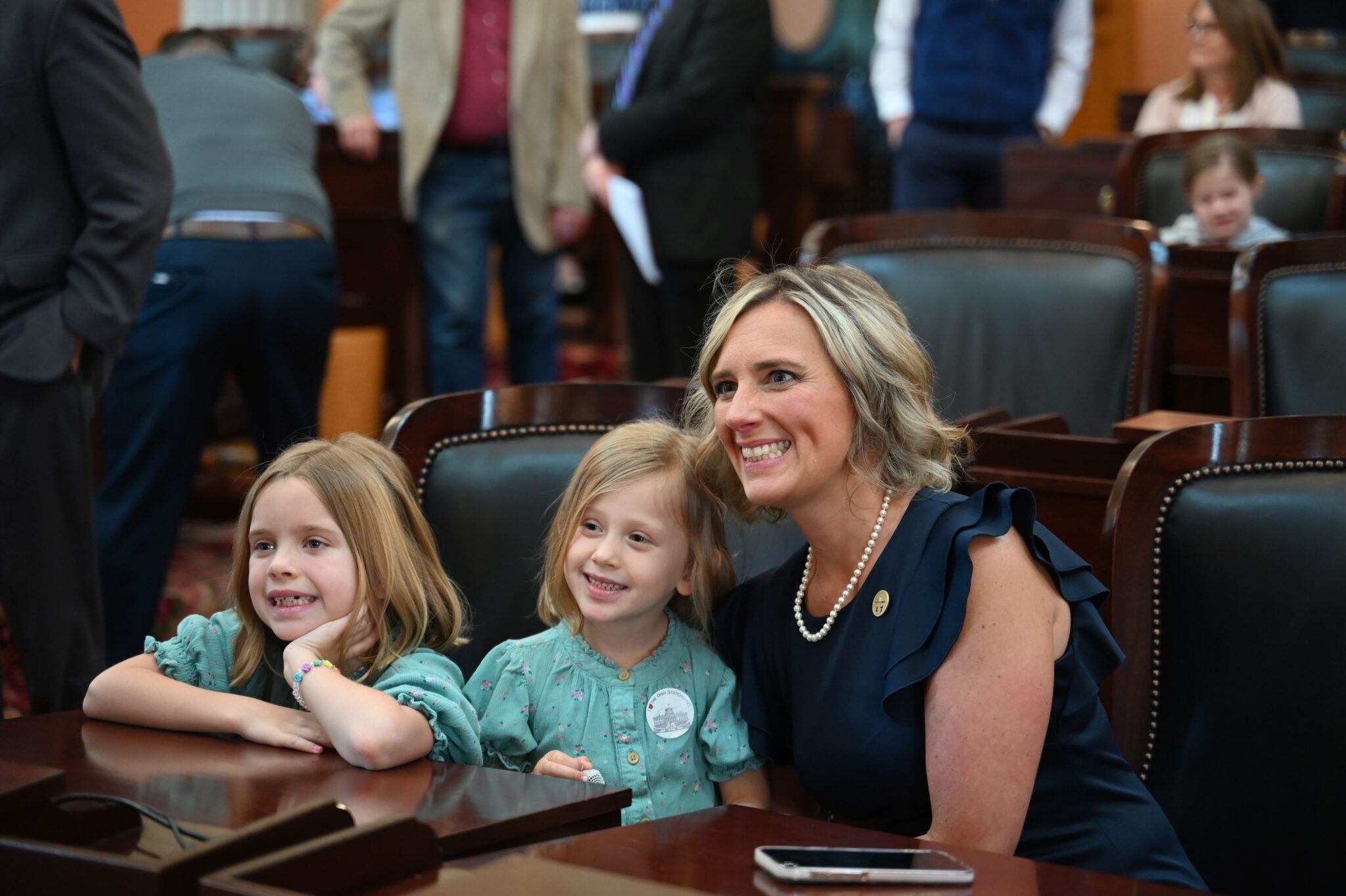
Mom lawmakers grow in visibility but their proportional representation is still lacking
A few Ohio mom lawmakers said they had an important thing to do before officially deciding to run for office — conduct a family meeting.
“I’m a single mom, so I’m the only adult support in our family,” said state Rep. Rachel Baker, D-Cincinnati. “I knew to run and to serve would be a family endeavor, so I needed my kids to be on board.”
Child care can be a big obstacle for moms to figure out when campaigning and, ultimately, as a lawmaker. House Minority Leader Allison Russo, D-Upper Arlington, remembers spending thousands of dollars in extra child care costs when she first campaigned in 2018. Her youngest daughter hadn’t celebrated her second birthday yet and her two sons were in elementary school at that time.
“It was a big, expensive part of my first campaign that we paid out of pocket,” she said. “I am privileged to have the circumstance that I have with family nearby and the support network, but not everybody has that, and I think if we want more parents with young children, especially women to run for office, we have to think about how do we create this support at work.”
Mom lawmakers and their families face additional attention and scrutiny by being in such a public position, especially on social media and during campaign season, lawmakers said.
“Running for office where the campaigns are not always friendly can be very difficult on families,” said State Rep. Beth Liston, D-Dublin. “When you have mail pieces that come to your house that say horrible things or TV ads or YouTube streaming, I think that’s something that women feel a lot that will hurt their kids at school.”
Ohio House Minority Leader Allison Russo, D-Upper Arlington
“I am always thinking about what are we doing that is setting up our children, not just my children, but all children, for success in the future,” she said.
COLUMBUS, OH — MAY 08: House Minority Leader Allison Russo, D-Upper Arlington, during the Ohio House session, May 8, 2024, at the Statehouse in Columbus, Ohio. (Photo by Graham Stokes for Ohio Capital Journal)
Russo’s children are 17, 14 and 7, and they were often with her on the campaign trail.
“I think it was a good thing for my kids to be with me knocking on doors, because I think voters recognized that I’m just a normal person trying to balance all the things that most people are trying to balance,” she said. “It reminds people that yes, I’m a real person.”
Her children would often get rewarded with ice cream or a cookie at a reception after being on the campaign trail with Russo.
“(The Statehouse) certainly has been a big part of their childhood,” she said.
Her children are in elementary, middle and high school, so she has a good understanding of what’s going on in schools — something that comes in handy with various education legislation.
“What is clear to me, often, is legislation gets passed, or gets introduced rather, by people who don’t necessarily have kids that are currently in school,” she said.
Russo is grateful to live about 15 minutes from the Statehouse.
“It does give me that flexibility to be able to balance, particularly at this stage in my kids’ lives where they are very busy and involved in activities,” she said. “I want to be able to see their games. I go to school activities during the middle of the week, so because of my proximity to the Statehouse, I’m able to balance those things.”
She leans on her husband, a set of grandparents that live nearby and supportive neighbors and friends for help with the kids and their various activities.
“A lot of it is my husband and I, a lot of negotiation between the two of us as we both balance careers and figuring out how we’re going to make it work,” she said. “If we can’t be there, can a grandparent be there? Or do we have a friend who can take a picture or text us to let us know how the game is going?”
State Rep. Rachel Baker, D-Cincinnati
State Rep. Rachel Baker, D-Cincinnati, is a single mom to three adopted children. (Photo from the Ohio General Assembly website).
One of the biggest reasons Baker ran for office was because of her three adopted children (ages 18, 15, and 12).
“I want to make Ohio a place that my kids want to stay, a place that my kids want to study and want to build their own life,” she said.
Baker, who is a single mom, has continued her career as a nurse so her three children took it upon themselves to help out around the house.
“I can’t work full time, serve in the legislature, be your mom, and do everything around the house,” she recalls thinking. “So something has to give and what it’s going to be is stuff around the house and they were like, this is important. We should do this as a family.”
Her oldest helps with car rides, her middle son cooks dinner every night and her youngest walks the dog.
“They really see the need for all of us to pitch in and all of us to be a family and contribute to the family and also help each other out,” Baker said, noting her son has become quite the cook.
“No one wants to go back to my cooking,” she said. “He started that in the middle of my campaign and he still cooks dinner every night.”
She drives up to Columbus on Tuesdays for committee meetings, stays the night in a hotel and drives back home on Wednesdays.
“I try to do a ton of my work Tuesday evening … and try to get as much done Tuesday and Wednesday, so that I’m not doing as much in the evenings the other days when I’m home and taking time away from them,” she said.
Being so busy has forced her family to be more deliberate in spending time together and they prioritize going out to dinner as a family every Sunday night.
“It’s been so nice,” she said. “Everyone enjoys it.”
State Rep. Monica Robb Blasdel, R-Columbiana
COLUMBUS, OH — MAY 08: State Rep. Monica Robb Blasdel, R-Columbiana County, during the Ohio House session, May 8, 2024, at the Statehouse in Columbus, Ohio. (Photo by Graham Stokes for Ohio Capital Journal)
The distance from Blasdel’s home in Columbiana to the Statehouse is the hardest part of her job. She uses the two-and-a-half to three hour drive to take calls from constituents and listen to committee hearings.
Blasdel does nightly FaceTime calls with her daughters (ages 7 and 5) before they go to bed when she spends the night in Columbus for her job at the Statehouse.
“I just try to make the most of my time that I’m away from home, so that I can be more present when I am home,” she said. “As long as I’m transparent with my girls and they understand when mommy’s coming home and how many days I’ll be away, they’re usually pretty good.”
Her daughters were five and three when she first started campaigning for office. She is currently serving in her first term.
“I did make a promise to my family when we made this decision together (to run for office) that they would always come first,” Blasdel said. “I included my children as much as possible when it’s appropriate on the campaign trail. I like to take them to events. I like them to see me interacting with my constituents and understand the work that I do.”
Blasdel recently brought her daughters to the Statehouse so they could see what their mom does in Columbus.
“That answers a lot of questions in their head,” she said. “They have a better understanding of what I’m doing when I’m down here and what my schedule looks like.”
State Rep. Beth Liston, D-Dublin
When Liston started running for office in 2017, her daughter (who was 13 at the time) knocked on a lot of neighborhood doors to help her mom’s campaign. Her son, who was 11 at the time, would occasionally wear a shirt to support his mom’s campaign.
COLUMBUS, OH — MAY 08: State Rep. Beth Liston, D-Dublin, speaks during the Ohio House session, May 8, 2024, at the Statehouse in Columbus, Ohio. (Photo by Graham Stokes for Ohio Capital Journal)
Her husband was a stay-at-home dad then, so he was able to help with child care.
“I’m very lucky that way in terms of being a mom and running for office,” she said. “I know other women that I work with certainly had a lot more stress in terms of figuring out what to do with their kids.”
But that doesn’t mean balancing being a mom and being a lawmaker doesn’t come with challenges.
“You still don’t want to miss the things that they’re doing,” Liston said. “Even if you had someone to watch them, you still miss portions of their lives which are important to you.”
She considers herself lucky to live near the Statehouse.
“The role involves weird hours,” she said. “A lot of events in the evening, which isn’t really all that great for family. … It’s always deciding whether I should go to those receptions and take those evening opportunities or be at home and make sure that I see my kids and have dinner together.”
As her children have ventured into their teenage years (her daughter is now 19 and her son is 17), she said “touch points” with her kids when they get home from school or an event have become important.
“Those are their important points that I think it’s hard to maintain when you have such atypical hours that are not really predictable,” she said.
House Bill 114
An Ohio bill, among other things, is trying to help make it easier for parents to run for office by allowing political candidates to use their campaign funds to pay for child care and bring Ohio campaign finance regulations in line with federal campaign finance regulations.
“I think it’ll help a lot of people to really start thinking about actually pursuing a role in politics and running for office,” said state Rep. Latyna Humphrey, D-Columbus. “… It’s hard to run for office and having to carry your kids with you. It makes it hard for them to do their job and really run the way that they want to because they’re trying to have that balancing act.”
Humphrey, who has an 11-year-old son, and fellow state Rep. Bill Seitz, R-Cincinnati, introduced House Bill 114 last year and it passed the House over the summer.
The Ohio Senate recently passed the bill but not before making significant changes by adding amendments that would allow President Joe Biden to be on Ohio’s ballot for November’s presidential election and ban foreign nationals from contributions for campaigns.
“The original intent of (HB) 114 was to make it allow campaign funds to be used for child care for candidates running for office,” State Sen. Bill DeMora, D-Columbus, said. “Senate Republicans held us hostage by slapping completely irrelevant partisan nonsense onto this bill because they know it needs to pass.”
Megan Henry is a reporter for the Ohio Capital Journal and has spent the past five years reporting in Ohio on various topics including education, healthcare, business and crime. She previously worked at The Columbus Dispatch, part of the USA Today Network.
Ohio Capital Journal is part of States Newsroom, the nation’s largest state-focused nonprofit news organization.











 Mom lawmakers grow in visibility but their proportional representation is still lacking


