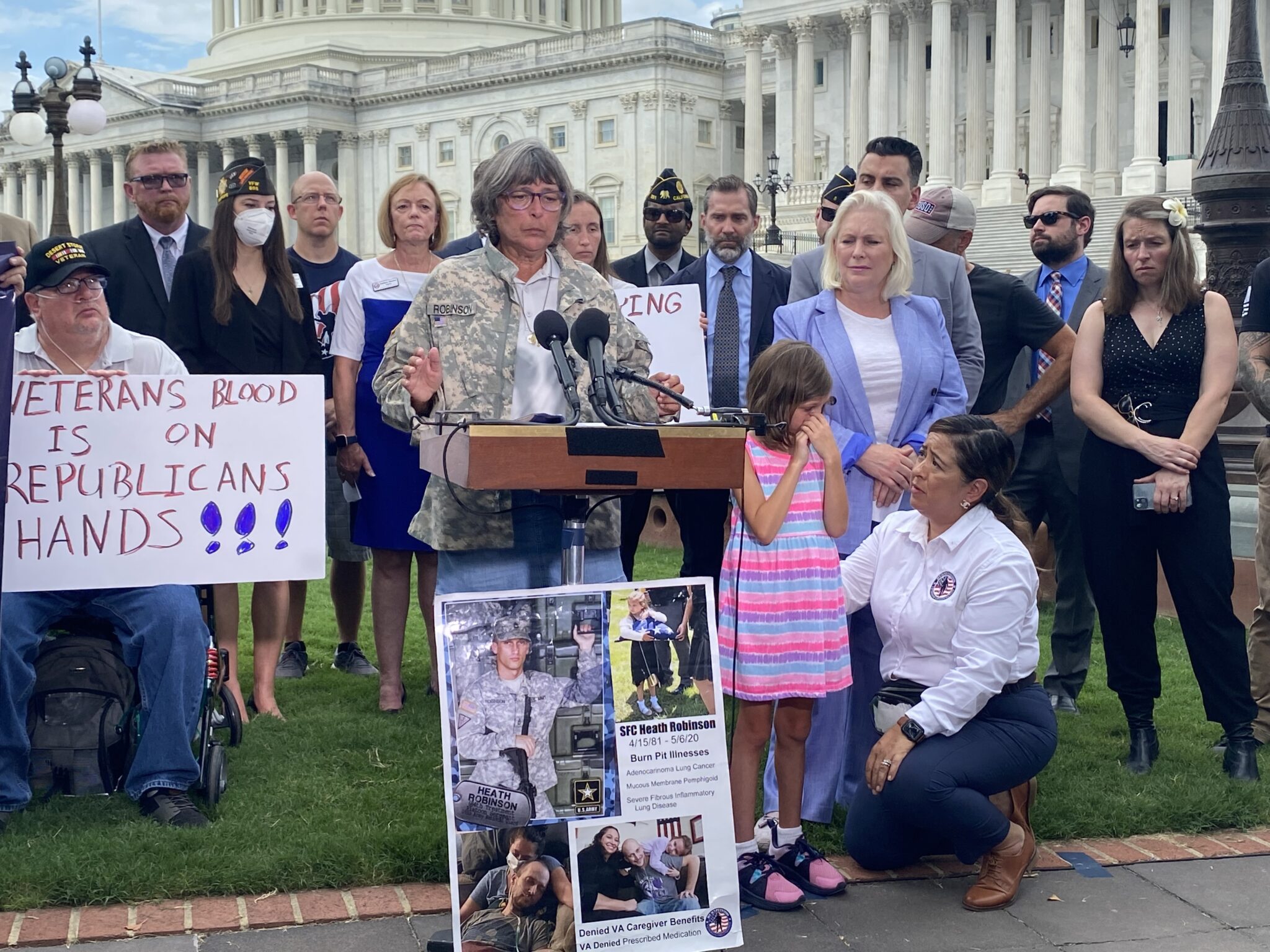
Susan Zeier, mother-in-law of late Sgt. First Class Heath Robinson of the Ohio National Guard, speaks during a press conference on the PACT Act on July 28, 2022 while Rosie Torres, co-founder of Burn Pits 360, comforts Robinson’s daughter, Brielle Robinson. (Photo by Jennifer Shutt, States Newsroom.)
WASHINGTON — President Joe Biden on Friday celebrated the number of veterans enrolled in VA health care and benefits as part of a law he signed nearly two years ago, though he said more work must be done for troops who were stationed at a base in Uzbekistan in the early 2000s.
“Two years ago, I signed the bipartisan Sergeant First Class Heath Robinson Honoring Our Promise to Address Comprehensive Toxins (PACT) Act enacting the most significant expansion of benefits and health care for toxic exposed veterans and their survivors in over thirty years,” Biden wrote in a statement.
The law, which spent years gaining the support it needed in Congress, expanded health care coverage and benefits for veterans exposed to toxic substances like Agent Orange and open-air burn pits.
To date, more than 1 million veterans and 10,000 survivors of veterans who died have begun to receive disability benefits stemming from the law, accounting for approximately $6.8 billion in earned benefits.
Biden said in his statement that his administration would continue studying veterans’ other illnesses for a “presumptive status,” which could ensure them access to health care and benefits without having to prove to the VA that their conditions are directly linked to their military service.
The VA is also planning to “close loopholes for certain veterans exposed to harmful toxins during their military service,” Biden wrote, without elaborating.
A White House fact sheet says the VA is looking into providing benefits for 16,000 veterans who served at Karshi-Khanabad in Uzbekistan, also known as K2, between 2001 and 2005, since there were “several contaminants…in either the air, water, soil, or soil gas.”
“VA plans to take steps to consider veterans who served in Uzbekistan as Persian Gulf Veterans so that any veteran who served at K2 and who experience undiagnosed illness and medically unexplained chronic multi-symptom illnesses can get the benefits they deserve,” it states. “VA will also create new training materials for claims processors and examiners on the hazards identified at K2.”
Since the law — known as the Promise to Address Comprehensive Toxics Act or the PACT Act — took effect nearly two years ago, the VA says that 739,421 veterans have enrolled in its health care programs.
Of that total, 333,767 veterans are covered under the new law, including those who served in the Vietnam War, the Gulf War and the wars that followed the Sept. 11 attacks.
The numbers released Friday are significantly higher than they were when Biden gave a speech on the law’s one-year anniversary. The VA said at the time, which was one year ago, that 408,581 veterans had filed their claims and that 348,469 of those had been approved.
Secretary of Veterans Affairs Denis McDonough said on a call with reporters at the time the law had led to “more than $5.7 billion in earned benefits for veterans.”
The exact number of veterans with approved PACT Act claims as of Friday stood at 1,005,341 while the number of survivors approved had reached 10,777.
A total of 1,251,720 veterans so far have completed filing Pact Act claims as have 21,416 survivors.
The VA has an interactive dashboard that provides veterans with information about how to apply for health care and benefits under the PACT Act as well as how many claims have been submitted.
The VA has a calendar of in-person events that can be found here. Veterans or their family members can also call the VA at 800-698-2411 to inquire about PACT Act benefits.
Jennifer Shutt
Jennifer covers the nation’s capital as a senior reporter for States Newsroom. Her coverage areas include congressional policy, politics and legal challenges with a focus on health care, unemployment, housing and aid to families.
Ohio Capital Journal is part of States Newsroom, the nation’s largest state-focused nonprofit news organization.
In 2012, a Porsche dealership owned by Republican U.S. Senate nominee Bernie Moreno recruited a general manager from Virginia with decades of experience selling the German sports cars. A year and a half later they cut ties with the salesman, and pretty soon he was in court claiming Moreno hadn’t delivered on the pay package that lured him to Ohio.
From hiring to firing
Before agreeing to take the job, Michael Falcone’s complaint states, he wanted assurance that the move to Ohio would make financial sense. The offer on the table was $80,000 in base pay as well as a commission of 5% of the dealership’s “total variable gross profit.”
In a follow-up email exchange, Falcone pressed Moreno on the terms and according to court documents, Moreno wrote back, “Just so we are clear, you will get paid on ALL VARIABLE gross profit.”
Falcone signed the offer sheet the following day and began work shorty after. His complaint describes working for several months before asking for documentation so he could double check his commission. “Despite multiple requests,” Falcone argued, the company didn’t provide the kind of sales information that would help him calculate what he was owed.
What’s more, Falcone contends that after he began asking about his compensation, his superiors retaliated against him and “embarked on a concerted campaign to force Mr. Falcone’s resignation.”
Falcone was demoted from general manager to used car manager and stripped of responsibilities. In January of 2014, after he’d been working there for about a year and a half, Falcone was terminated. The company said he was being let go because of unsatisfactory performance and a “permanent reduction in force.”
But that round of downsizing was exceptionally narrow. Falcone was the only employee dismissed.
Falcone alleged that the manager in the meeting told him he would not receive his outstanding compensation until he signed the termination agreement. He did so, albeit reluctantly, because he wanted to be paid, and because he understood the reduction in force designation would make him eligible to collect unemployment compensation.
They didn’t give him a copy of the form when we left and Falcone got an unsettling surprise when he emailed the human resources department asking them to provide one.
“When HR e-mailed him a copy of the form, it was clear that the form had been altered after it had been signed and without Mr. Falcone’s knowledge or consent,” the complaint states. “Specifically, the line indicating that his termination was, in part, due to a permanent reduction in force had been whited out, leaving only the unsupported allegation of unsatisfactory performance as the sole reason for Mr. Falcone’s termination.”
To claim unemployment benefits in Ohio a worker must be out of work through no fault of their own. If Falcone was terminated for his performance, and nothing but, it could have complicated his application.
Moreno’s response
In court filings, Moreno shared a copy of Falcone’s signed offer sheet. He argued Falcone can’t assert he was relying on Moreno’s representations in an email when he signed a form the following day.
Falcone “cannot conceivably demonstrate reasonable reliance on his communication with Mr. Moreno on June 28, 2012 because he clearly signed the Pay Plan on June 29, 2012 that specifically outlines the terms of his monthly incentive,” Moreno argued.
As for Falcone’s termination, Moreno acknowledged Falcone was the only one fired and that they did alter the termination form.
“Defendants admit that the termination form was altered,” Moreno’s attorneys wrote, “but this was done to correct an error on Defendants’ part and was not done to accomplish a fraudulent purpose.”
But Moreno argued even if they had engaged in fraud to get Falcone to sign the form, it would be irrelevant. After all, Falcone was an at-will employee.
Moreno’s dealership was “entitled to terminate him for any reason or for no reason whatsoever — regardless of whether he signed the form,” the filing states. “Therefore, it is immaterial for (Falcone) to argue that he would have refused to sign the Form if the only listed reason for termination was unsatisfactory performance.”
Although Falcone complains the changes to the termination form jeopardized his unemployment claims, “glaringly absent,” Moreno argued, “is any factual allegation that he was denied unemployment compensation benefits as a proximate result of signing the Employee Termination Form.”
In March of 2016, Moreno and Falcone settled out of court.
What now?
Speaking to reporters at campaign event in Chillicothe, Moreno called Falcone “a good guy,” but added “in any business, somebody doesn’t perform, they typically don’t blame themselves, they blame others.”
“This was a disgruntled employee that filed the suit,” he added, “and like all businesses, we eventually settle these things, because it’s cheaper than litigation.”
Look at his hundreds of happy employees, Moreno argued. Look at his top workplace awards.
But to Moreno’s political opponents, the Falcone case echoes wage theft cases filed against Moreno in Massachusetts. In that dispute, Moreno’s employees argued he had improperly withheld time-and-a-half pay. The court ordered him to maintain documents related to the case, but he shredded overtime reports. Moreno argued the underlying data was still intact, but the judge and the jury weren’t buying it. He was ordered to pay more than $400,000.
In a statement, Ohio AFL-CIO president Tim Burga argued “the choice for Senate in Ohio is easy. While (Democratic U.S. Sen.) Sherrod Brown looks out for Ohio workers, Bernie Moreno continues to show them that he only cares about himself.”
“With working people your word is your bond,” he added. “Sherrod Brown’s word is good while Moreno has proven he can’t be trusted.”
Tiffany Muller who heads up the organization End Citizens United argued the cases demonstrate a “clear pattern.”
“Moreno’s record of wage theft should be disqualifying,” she said. “If he can’t be trusted as a business owner, how can he expect Ohio voters to trust him in the Senate?”
Nick Evans has spent the past seven years reporting for NPR member stations in Florida and Ohio. He got his start in Tallahassee, covering issues like redistricting, same sex marriage and medical marijuana. Since arriving in Columbus in 2018, he has covered everything from city council to football. His work on Ohio politics and local policing have been featured numerous times on NPR.
Ohio Capital Journal is part of States Newsroom, the nation’s largest state-focused nonprofit news organization.
Tuesday has been a long time coming — 57% of Ohioans voted to legalize recreational marijuana in November but there has been nowhere to legally purchase it. Until now.
Boston Grunkemeyer lined up in front of Amplify Dispensary’s Columbus location around 9:45 Tuesday morning and was the store’s first recreational marijuana customer.
He doesn’t have a medical marijuana card, but has anxiety and depression.
“It’s kind of nice to be able to go towards this if I need to, but also it’s gonna be fun just to be able to enjoy myself with my friends,” Grunkemeyer said.
Tuesday has been a long time coming — 57% of Ohioans voted to legalize recreational marijuana in November but there has been nowhere to legally purchase it. Until now.
“It’s incredibly exciting to be able to launch a program that is ahead of schedule, that will be thoughtfully regulated and will ensure that Ohio cannabis consumers no longer have to drive to Michigan or resort to the unregulated market,” Ohio Cannabis Coalition Spokesperson Tom Haren said.
The Ohio Department of Commerce Division of Cannabis Control gave 98 dispensaries the green light to start selling recreational marijuana by giving them their certificates of operation. Ten Columbus dispensaries, eight Cincinnati dispensaries, and five Cleveland dispensaries received their certificates of operation on Tuesday.
Amplify Dispensary in Columbus prepares for the first day of recreational marijuana sales on August 6. (Photo by Megan Henry, Ohio Capital Journal.)
“However, the issuance of COOs does not necessarily mean non-medical sales will begin immediately at every dispensary, as each licensee must determine when they will start sales based on factors including staffing, stock and other business considerations,” the DCC said in a statement.
The DCC plans on awarding certificates of operations to all the remaining eligible dispensaries later this week, according to the division.
Certificates are issued “roughly” in the order when completed applications were received by the division and when compliances were fulfilled, according to the division.
Recreational sales are actually ahead of schedule since the division had until Sept. 7 to approve or deny a license application.
“A big reason we were able to get to this point ahead of the Sept. 7 deadline was due to the foundation laid through the state’s existing Medical Marijuana Control Program,” DCC Superintendent James Canepa said in a statement. “Since existing licensees had already met stringent requirements of that program, we anticipated this process to be rather smooth. They had already undergone many of the comprehensive checks as part of that process.”
Amplify Dispensary
Jerika Tieman was excited to be able to buy weed without needing a medical marijuana card.
“It’s been a long time coming,” she said, standing outside Amplify before the store opened.
She previously had a medical marijuana card but didn’t renew it due to costs. The registration fee for medical marijuana was eliminated earlier this year, but it was previously $50, DCC spokesperson James Crawford said in an email.
“It is a hugely monumental day,” said Amplify’s Digital Brand Manager Cole Wallis. “We’re part of a change, and a change for good, which feels super, and we’re happy to be a part of it. I’m just excited to see it unfold.”
They doubled their staff at their Columbus location in anticipation for recreational sales to start, and have two other locations in Cleveland Heights and in Bedford.
Trulieve
Trulieve expected to see between 500-600 people at one of their Columbus locations on Tuesday — about triple their average number, said Nick Rassler, their director of state operations.
Trulieve has three locations in Ohio — two in the Columbus-area and one near Dayton.
They normally open around nine or ten in the morning, but opened their doors at 7 a.m. this morning. Their line started forming at 6:30 a.m.
“It’s a huge deal for the industry as well and just cannabis in general,” Rassler said. “There’s people who just didn’t have a qualifying condition, but may have still had a need for the product. It’s a great alternative for them, it helps them feel the way they want to feel.”
Medical Marijuana Program
Both Amplify and Trulieve are prioritizing their medical marijuana patients and had different lines for medical and non-medical customers.
Medical marijuana patients don’t have to pay excise tax on the product.
“I would like to see it coexist peacefully, which I think we can get to that point,” Amplify Columbus’ General Manager Alissa Baker said.
Haren said there will be enough medical marijuana supply to meet demand.
“By rule, the supply side will be there to match the demand, whatever it is,” he said. “If the demand shrinks, then you know, there will be less inventory, sort of held for medical patients. But if the demand stays where it is, we will continue to have product at dispensaries in order to meet that demand. And so it’s flexible from a regulatory perspective.”
Megan Henry is a reporter for the Ohio Capital Journal and has spent the past five years reporting in Ohio on various topics including education, healthcare, business and crime. She previously worked at The Columbus Dispatch, part of the USA Today Network.
Ohio Capital Journal is part of States Newsroom, the nation’s largest state-focused nonprofit news organization.
Vice President Kamala Harris, the Democratic nominee for president, selected Minnesota Gov. Tim Walz as her running mate Tuesday in a move meant to boost the Democratic ticket’s appeal in key Midwestern states and with blue-collar voters.
Walz, a former social studies teacher and Army National Guard veteran who won challenging elections in a rural U.S. House district before running for governor in 2018 and winning reelection in 2022, balances Harris geographically and demographically, while bringing a history of campaign wins in purple-to-red areas and a governing record among the most progressive of any contender to join the ticket.
“One of the things that stood out to me about Tim is how his convictions on fighting for middle class families run deep,” Harris wrote in a statement. “It’s personal. As a governor, a coach, a teacher, and a veteran, he’s delivered for working families like his own. We are going to build a great partnership. We start out as underdogs but I believe together, we can win this election.”
Walz was also seen as the preferred vice presidential pick of the party’s progressive wing, especially as an alternative to Pennsylvania Gov. Josh Shapiro. Harris interviewed both governors, and U.S. Sen. Mark Kelly of Arizona, in Washington Sunday as she whittled down her shortlist.
Little known until recently outside his home state to all but the closest political observers, Walz’s laid-back style and approachable demeanor — and straightforward attacks on Republican rivals Donald Trump and J.D. Vance — over weeks of consistent national TV appearances won praise from Democratic officials and strategists who have struggled to break Trump’s hold over white voters without college degrees.
Walz, 60, emerged in recent weeks as one of the party’s top communicators through the power of a single adjective for Republicans and their policy goals.
“These are weird people on the other side,” Walz said in a July 23 interview on MSNBC. “They want to take books away, they want to be in your exam room … These are weird ideas.”
Despite the best efforts of President Joe Biden’s abandoned reelection bid to describe Republicans under Trump’s leadership as a threat to U.S. democracy and reproductive rights who couldn’t be trusted to responsibly govern, the attacks didn’t stick and Trump continued to climb in the polls.
But shortly after Biden’s July 21 exit from the race, Democrats embraced the succinct message that has been credited to the Minnesota governor.
“I am loving Tim Walz on TV,” Rebecca Pearcey, a Democratic strategist, told States Newsroom in a July interview on potential vice presidential picks for Harris.
“I love that he’s just so down-to-earth and so pithy and that he’s like, ‘These guys are weird,’” she added. “That’s exactly it — we are overcomplicating what this message has to be.”
In a statement, Shapiro said he was grateful to have been considered for Harris’ running mate and would continue his work as governor, calling that role “the highest honor” of his life.
Shapiro congratulated Walz, saying he would be an “exceptionally strong addition to the ticket.” He said he would work to help the Harris-Walz ticket win in November.
“Vice President Kamala Harris has my enthusiastic support – and I know that Governor Tim Walz is an exceptionally strong addition to the ticket who will help Kamala move our country forward,” he wrote. “Over the next 92 days, I look forward to traveling all across the Commonwealth to unite Pennsylvanians behind Kamala Harris’ campaign to defeat Donald Trump, become the 47th President of the United States, and build a better future for our country.”
According to his official schedule, Shapiro is scheduled to speak at Walz’s first public appearance with Harris, a rally in Philadelphia Tuesday evening.
‘Far-left radical’
Shortly after reports of the Walz choice surfaced, Trump’s campaign blasted him in a statement that sought to undercut his appeal to rural Midwestern voters and tie him to Harris’ Bay Area background, potentially previewing the attacks Walz will see throughout the three months leading up to Election Day.
“It’s no surprise that San Francisco Liberal Kamala Harris wants West Coast wannabe Tim Walz as her running-mate – Walz has spent his governorship trying to reshape Minnesota in the image of the Golden State,” Trump campaign press secretary Karoline Leavitt said in a statement.
“If Walz won’t tell voters the truth, we will: just like Kamala Harris, Tim Walz is a dangerously liberal extremist, and the Harris-Walz California dream is every American’s nightmare.”
Leavitt highlighted Walz’s signature on a bill to require the state move to 100% non-carbon energy by 2040.
A political action committee associated with Trump also slammed the Minnesota governor.
A written statement from MAGA Inc. criticized Walz’s positions on transgender rights and immigration, as well as his response to the riots in Minneapolis after police there killed George Floyd, an unarmed Black man.
The PAC also sought to tie Walz to a federal fraud case in the state that saw five convicted in federal court of taking federal COVID-19 relief money intended to feed needy children. The case dealt with a nonprofit, but a June report from the state auditor found the state’s Department of Education failed to properly oversee the federal payments.
“Governor Tim Walz and Kamala Harris will get along just great,” the statement said. “They’re both far-left radicals that don’t know how to govern.”
Former House Speaker Nancy Pelosi, who is also from San Francisco, said in an appearance on MSNBC’s Morning Joe on Tuesday that characterizations of Walz as far-left were “mystifying.”
“To characterize him as left is so unreal,” Pelosi said. “He’s right down the middle. He’s a heartland-of-America Democrat.”
As the top Democrat on the U.S. House Veterans Affairs Committee, Walz made “tremendous, tremendous gains” for veterans, Pelosi said.
Communicating rural values
Walz, who grew up in a rural community in Nebraska, has slammed national Republicans for a relentless focus on cultural issues. He’s trained that criticism recently on Vance, a U.S. senator from Ohio whose rise to Republican vice presidential nominee was built on his controversial book detailing the lives of people in impoverished rural areas of Kentucky.
Vance and Republicans have “obsessions” with taking away rights, Walz has said, especially related to reproductive rights and education that includes discussion of gender and sexuality.
“The golden rule that makes small towns work so we’re not at each other’s throats all the time in a little town is: Mind your own damn business,” Walz told MSNBC’s Jen Psaki on July 25. “I don’t need him (Vance) to tell me about my family, I don’t need him to tell me about my wife’s health care and her reproductive rights, I don’t need him telling my children what books to read.”
Walz instead projects a pragmatic vision of Democratic governance.
“They scream socialism, we just build roads and we build schools and we build prosperity into this,” he told Psaki.
Working-class message
As governor, Walz has notched a series of policy wins he can boast to the party’s progressive wing about. He signed laws to offer free meals to all public school students, expand abortion access and legalize some recreational uses of THC.
But the sometimes bespectacled former high school teacher and football coach, who has donned t-shirts and hunting caps in national TV hits, also projects an image of Midwestern pragmatism.
That may help balance voters’ views of a Democratic ticket led by Harris, who would be the first woman president, the first president of South Asian descent and the second Black president, and who is seen as more liberal than most in the party after climbing the ranks through Democratic primaries in California.
Christopher Devine, a political scientist at the University of Dayton, said Walz’s appeal is not unlike that of Harris’ last running mate.
“Walz has a message that kind of reminds me of Joe Biden’s appeal, kind of a working-class focus,” he said. “He can speak from a rural background, he’s been a teacher and a coach and has a military background as well. He seems to me like he’s someone who could maybe help with kind of a working-class message.”
The campaign will depend on Walz to carry that message to neighboring Wisconsin and other crucial Rust Belt states such as Michigan and Pennsylvania.
Kim Lyons contributed to this report.
Jacob Fischler
Jacob covers federal policy as a senior reporter for States Newsroom. Based in Oregon, he focuses on Western issues. His coverage areas include climate, energy development, public lands and infrastructure.
Ohio Capital Journal is part of States Newsroom, the nation’s largest state-focused nonprofit news organization.
WASHINGTON — The Democratic National Committee announced late Monday that Vice President Kamala Harris had secured the support of 99% of delegates to formally become the party’s presidential nominee, following the conclusion of a five-day virtual vote.
The results, which included a state-by-state breakdown, followed the DNC announcing Friday that Harris had surpassed the number of delegates needed to become the nominee as voting proceeded. She was the only candidate to qualify. The DNC said 4,567 delegates cast their votes for her.
The next steps will be the certification of the roll call by the convention secretary, Jason Rae, and the acceptance of the nomination by Harris and her running mate, who as of early Tuesday still had not been named.
There will also be a celebratory roll call at the Democratic National Convention in Chicago later this month.
“With the support of 99% of all participating delegates in the virtual roll call, Vice President Harris has historic momentum at her back as we embark on the final steps in officially certifying her as our Party’s nominee,” DNC Chair Jaime Harrison and DNCC Chair Minyon Moore said in a statement. “We thank the thousands of delegates from all across the country who took seriously their responsibility throughout this process to make their voices – and the voices of their communities – heard. As we prepare to certify the nomination alongside Convention Secretary Rae, we know that we are all a part of an important piece of history.”
On the way to Election Day
Harris and her vice presidential pick will have fewer than 100 days to campaign before Nov. 5.
She’s undertaking a swing-state tour that has the two holding rallies Tuesday in Pennsylvania, Wednesday in Wisconsin and Michigan, Thursday in North Carolina, Friday in Arizona, and Saturday in Nevada. The Associated Press reported a stop in Georgia was postponed due to Hurricane Debby and the North Carolina appearance could be affected.
Harris didn’t compete in a Democratic primary campaign this election cycle, which could potentially hamstring her, though she did introduce herself to voters during the 2020 Democratic presidential primary and has held public events throughout her time as vice president.
Debate over debates
As of Tuesday it did not appear that Harris and Republican presidential nominee Donald Trump would debate ahead of Nov. 5, which would have given her an opportunity to showcase her policy goals and personality to a broader cross-section of voters.
Trump and the Biden campaign agreed to two debates — the first in June, which was hosted by CNN and led to a widespread lack of confidence in Biden’s cognition, and a second on Sept. 10, hosted by ABC News.
The Trump campaign had been noncommittal about debating Harris since Biden announced in July he would step aside as the presumptive nominee and endorsed Harris to take over at the top of the ticket.
Harris for President Co-chair Cedric Richmond said in a statement released Friday that Trump “needs to man up” and attend the previously agreed to debate on Sept. 10.
“He’s got no problem spreading lies and hateful garbage at his rallies or in interviews with right-wing commentators. But he’s apparently too scared to do it standing across the stage from the Vice President of the United States,” Richmond said. “Since he talks the talk, he should walk the walk and — as Vice President Harris said earlier this week — say it to her face on September 10. She’ll be there waiting to see if he’ll show up.”
Trump posted on social media over the weekend that he would only attend a Fox News debate on Sept. 4, though neither the Biden nor Harris campaigns ever agreed to attend a Fox debate.
“Kamala Harris doesn’t have the mental capacity to do a REAL Debate against me, scheduled for September 4th in Pennsylvania,” Trump posted. “I’ll see her on September 4th or, I won’t see her at all.”
Who is Kamala Harris?
Harris was born in Oakland, California, in October 1964. She graduated from Howard University, a historically Black institution of higher education, in 1986 before receiving her law degree from the University of California in 1989.
Harris worked as a deputy district attorney in Alameda County, California, from 1990 until 1998. Her career as a prosecutor continued when she moved to the San Francisco District Attorney’s office, where she worked as a managing attorney.
She spent time as the chief of the San Francisco City Attorney’s Division on Children and Families and as the district attorney of San Francisco before California voters elected her attorney general in 2010.
Residents in the Golden State then elected Harris to the U.S. Senate in 2016, where she stayed until she was sworn in as vice president in January 2021.
Harris sought the Democratic presidential nomination during the 2020 primary, but dropped out two months before voting began.
Roll call, keynote speech
Harris is scheduled to give the convention keynote speech on Aug. 22, the final night of the gathering in Chicago. She’ll likely be speaking to the largest audience she’ll have in person and watching on television until election night.
That will provide a major opportunity for her to speak directly to the centrist and undecided voters who will determine the outcome of the November elections, including control of the U.S. House and U.S. Senate.
Should Harris win the Electoral College vote, she will become the country’s first female president, the first president of South Asian descent and the second Black president when she’s inaugurated on Jan. 20, 2025.
Jennifer Shutt
Jennifer covers the nation’s capital as a senior reporter for States Newsroom. Her coverage areas include congressional policy, politics and legal challenges with a focus on health care, unemployment, housing and aid to families.
Ohio Capital Journal is part of States Newsroom, the nation’s largest state-focused nonprofit news organization.
When Kamala Harris was announced as the running mate for Joe Biden in the 2020 presidential campaign, the questions about her heritage, ethnicity and even eligibility for office came strongly from the opposition.
Now that she’s running for the top job following President Joe Biden’s suspension of his reelection campaign, the emphasis on her skin color and her gender has come back fast and furious, just as swiftly as the enthusiasm for her campaign brings big fundraising numbers to the camp.
A supporter holds a sign as members of the San Francisco Democratic Party rally in support of Kamala Harris. (Photo by Loren Elliott/Getty Images)
“The United States has conflicting traditions,” said Dr. Susan Burgess, distinguished professor emerita of political science at Ohio University. “One of rampant racism and misogyny, and another toward greater change and inclusion.”
U.S. Sen. J.D. Vance of Ohio, the vice presidential candidate alongside former president Donald Trump, added to the rhetoric in a 2021 clip that has been brought back up in light of his new role. In the clip from a Fox News interview, he mentions the fact that Harris (and others) has not birthed any children of her own (she has two stepchildren with First Gentleman Doug Emhoff), and criticizes Democrats as “a bunch of childless cat ladies who are miserable at their own lives and so they want to make the rest of the country miserable, too.”
The comments don’t surprise those who are a part of or study the history of political campaigns, where sexism and misogyny are “alive and well,” according to Ohio University history professor Dr. Katherine Jellison.
“A man running for office, I’ve never heard comments about him being a childless cat/dog/fish person,” Jellison said. “These double standards are so blatantly on display and voiced whenever we have a prominent woman running.”
‘Attacks on the person, not the policy’
For women currently in the state legislature, criticism based on gender and family is nothing new. Even in local campaigns, female politicians have been underestimated and questioned on their merits in ways they say they don’t witness in male campaigns.
The Capital Journal contacted every female state representative and senator in the Ohio General Assembly to talk about their experience campaigning and working in politics. Included in the those who responded were the leaders of the minority side in both chambers, House Minority Leader Allison Russo and Senate Minority Leader Nickie Antonio.
Consistently, those that responded said they have talked to constituents with all sorts of interests and issues, and worked with local campaigns or in favor of local issues before they worked their way up to state office. Also consistently, it was their community and their families that were their biggest advocates.
House Minority Leader Allison Russo, left, talks with Senate Minority Leader Nickie Antonio, as they await the start of the Sept. 13, 2023, Ohio Redistricting Commission meeting.
(Photo by Susan Tebben, Ohio Capital Journal.)
Often, the women who are now representatives and senators didn’t intend to pursue politics until they were encouraged to or an issue motivated them to action. For most, misogyny wasn’t blatant, but the fact that they worked among a “boy’s club” was still highlighted.
“People told me I couldn’t win because, you know,” Antonio told the Capital Journal. “And I would make them say what that was, and it was because I was a lesbian.”
She faced the criticism of being a woman running for office, but called it a “false narrative that some people embrace, that I think they want to hang on to because frankly, I think we’re better at the job.”
The first time state Rep. Sharon Ray, R-Wadsworth, campaigned back in the early 1990s, she said she knocked on the door of a man in her community. She explained that she was running for local office and had a conversation with him about local issues.
“At the end he said, ‘You seem nice and all, but I would never vote for a woman,’” Ray said. “I had to tell him, ‘Well you’re in a bad way, because the two people going up for this are both women.’”
State Rep. Bride Rose Sweeney fought against the fact that not only was she a woman running for office, but she was also a 25-year-old.
“Most people, when I’d go to the door, thought I was selling Girl Scout cookies,” she said.
Though she had worked as a staffer in the Statehouse and could point to quotes she’d written for elected officials, she still had to answer questions about her life experience.
“I was shocked at how many times they didn’t think I was the candidate,” Sweeney said.
As a single mom who had adopted her children from China, state Rep. Rachel Baker went through a similar struggle to other moms running for office, in that she balanced taking care of her family and campaigning.
But when Chinese flags appeared around her campaigns signs in the yards of her supporters, put there anonymously in the dark of night, she saw a different side of campaigning.
It’s such a paradox, (my children) are why I’m doing it, but it’s also why I’m scared to do it.
– State Rep. Rachel Baker, D-Cincinnati
Russo – who also ran for a congressional seat in the U.S. House in 2021 against U.S. Rep. Mike Carey – said when she talks to women who are contemplating running for office, putting themselves out there, and even more, putting their family in the public eye is high on the list of reasons not to.
“It’s that piece that is the hesitation: Am I willing to open up my family for the level of scrutiny and potential for harassment,” Russo said.
She and other moms who campaigned often had no choice but to bring their kids along as they talked to voters, because of partner work schedules or a lack of alternative child care. Sometimes, that worked to the candidate’s advantage.
“Voters appreciated that because I’m a real person just trying to balance all the things in my life,” Russo said.
Still, she was questioned about who would care for her children.
“I’m pretty sure my male counterparts never got that question,” she said.
Accidental advantages
Dealing with heightened scrutiny as a woman in public office can be a struggle, but it can also be something that feels familiar to women who have faced challenges their entire lives and for which women already have coping mechanisms.
“You can’t change your ethnicity or race or sex,” said state Sen. Paula Hicks-Hudson, D-Toledo. “I am who I am, and therefore you just have to deal with whatever those issues are.”
COLUMBUS, Ohio — MAY 10: State Rep. Bride Rose Sweeney, D-Westlake, speaks during the Ohio House session, May 10, 2023, at the Statehouse in Columbus, Ohio. (Photo by Graham Stokes for Ohio Capital Journal)
Nothing can prepare you for “people writing the most heinous things about you,” as Sweeney said of social media attacks, but for many woman public officials, life has prepared them to work harder than might be expected of others.
“We think that we have to check certain boxes to run, and the reality is most of us are overqualified for office,” Russo said. “The woman candidates that I’ve worked with are incredibly good at putting together teams and networks, and that’s something that I think is very intuitive for women.”
Antonio said women are often “auditioning long before we see ourselves in that role” as a leader in the community or in politics.
State Rep. Beryl Brown Piccolantonio, D-Gahanna, feels like “it’s much more relevant that I’m a woman” with the issues in the political spotlight these days, including reproductive health.
“I don’t think the legislature should be making decisions about people’s health, and the population that is directly impacted, I’m in it,” she said.
The state representatives and senators who talked to the Capital Journal had their start in smaller ways, whether it be working in the Statehouse, opening their houses for local candidate meet-and-greets, knocking on doors for local campaigns or volunteering in their children’s events. It was those efforts that gave them the inside scoop on the issues that were important to their neighbors and melded them into the community to the point that they would be encouraged to make bigger moves.
As a divorced young mom going to night school, one thing Ray liked to do with her free time was work on campaigns. In one Wadsworth race, the candidate left the race and after being encouraged to – and seeing an opportunity to help her son get his Boy Scout government badge – Ray decided to run.
Antonio was miffed after a pitch for her daughter and other Lakewood kids to have a safe place to skateboard fell to an uninterested city council, when the opportunity occurred to her.
“I came home and I said I’m sick of explaining what’s important in our community,” she said. “I could do that job, and I heard myself say I could do that job.”
Looking forward, reaching back
The road to November will be fast-paced for the Vice President and other women running for office, but there’s a sense of hope from public officials that more women will take up the cause, whether it be at a local, state or congressional level.
The women of the Ohio legislature emphasized the need for anyone seeking the job of representing their community to meet with those constituents, whether at campaign events or at the residents’ front doors.
State Rep. Beth Liston, D-Dublin, speaks at a rally to protect abortion rights. (Photo from General Assembly website.)
“When you run for office, you’re often running to represent specific values, and you definitely learn the values of your constituents when you knock on doors,” said state Rep. Dr. Beth Liston, D-Dublin.
Not only do you get to hear what the community needs from their legislators, but candidates get to explain their “why” when it comes to running.
“I know because of the sacrifices that I’ve made to be in this position that some lives are better and people’s voices get heard because of the work that I do, and that gets me up and going everyday,” Sweeney said.
Russo, Ray, Sweeney, Baker, Piccolantonio and Liston are all running for reelection to their districts in the November general election.
And while the differences may be the focal point of campaigns against candidates in a political climate the public officials acknowledged is divisive and “terrifying” in some ways, those differences are reason enough for women to enter races.
“I don’t think differences are deficiencies,” Hicks-Hudson said. “I think they add flavor.”
It’s those who already hold office that can make the difference in whether or not more women come into the political space, too, according to Antonio.
“I think it’s important for those of us who are in office to encourage it,” the minority leader said. “You have to reach back as you climb, and bring folks with you.”
Comments like Vance’s “childless cat ladies” statement only serve as motivation for officials like Sweeney who see more women in office as the way to “change the world.”
“To say that I have no stake in America, that I can’t contribute … (Vance) clearly hasn’t been around a lot of women and doesn’t respect them,” Sweeney said.
Parsing through the messaging
Throughout the next three months (and already this election cycle), voters will go through the process of making decisions about who and what they want to choose in the general election. That means parsing through the heavy load of information coming from all sides about how to feel about those candidates and issues.
As elected officials who have read and distributed their fair share of campaign info, the legislators said it’s important to form opinions based on resources voters trust, and nonpartisan research like voting guides from the League of Women Voters of Ohio.
But it’s also just as important to base decisions on the issues and values that matter most to each voter, and vet each candidate based on those specific values.
“I personally think the voters should be able to interact with the people that are wanting to represent them,” Piccolantonio said.
When it comes to the presidential race, self-reflection and a vision for the future come right along with diligent research.
We are at a critical time for finding out what the integrity of candidates are. As we go forward with this presidential election, let’s look at what does this country need, what should we be looking for when it comes to our next leader.
– State Sen. Paula Hicks-Hudson, D-Toledo
While some people might be looking for parity in representation, Antonio said she thinks some are ready “for a majority of women to be running things to right the ship.”
Right before Biden announced he would be abandoning his reelection bid, Antonio said she was pulled aside by a man who said, “Look, it’s time, can the women just … I know we’ve made a mess of this, could you just fix this for us?”
The Senate minority leader said she smiled.
“I looked at him and I said, ‘We’re working on it.”
______________
Susan Tebben
Susan Tebben is an award-winning journalist with a decade of experience covering Ohio news, including courts and crime, Appalachian social issues, government, education, diversity and culture. She has worked for The Newark Advocate, The Glasgow (KY) Daily Times, The Athens Messenger, and WOUB Public Media. She has also had work featured on National Public Radio.
Ohio Capital Journal is part of States Newsroom, the nation’s largest state-focused nonprofit news organization.
WASHINGTON — Enough Democratic delegates selected Kamala Harris to make her the party’s presidential nominee by Friday, during an ongoing virtual vote that began less than two weeks after President Joe Biden ended his reelection campaign.
The vote, which will not officially close until Monday evening, was held in advance of the Democratic National Convention, scheduled to take place in Chicago later this month, to assuage concerns about state registration deadlines that begin in August.
The DNC began laying the groundwork for the virtual nomination months before Biden announced his decision to step aside.
Harris said on a call with supporters Friday that she was happy to have surpassed the threshold needed to win the nomination.
“Of course, I will officially accept your nomination next week once the virtual voting period has closed, but already I’m happy to know that we have enough delegates to secure the nomination,” Harris said.
DNC Chair Jaime Harrison encouraged DNC delegates to keep sending in their ballots during the Zoom call, but said the support for Harris so far has been overwhelming.
“I am so proud to confirm that Vice President Harris has earned more than a majority of votes from all convention delegates and will be the nominee of the Democratic Party following the close of voting on Monday,” he said.
“The outpouring of support we have witnessed for the vice president has been unprecedented,” Harrison added. “We knew your ballots would come back quickly. But the fact that we can say today, just one day after we opened voting, that the vice president has crossed the majority threshold and will officially be our nominee next week — folks, that is simply outstanding.”
The virtual roll call vote began Thursday at 9 a.m. Eastern and will conclude Monday at 6 p.m. Eastern. Harris was the only candidate to qualify.
The DNC plans to announce the final results afterward, including a state-by-state breakdown.
One of Harris’ first official acts will be selecting a running mate from a list that holds several governors as well as at least one senator. Her decision will set the tone for the sprint to the ballot box.
Harris and her running mate are expected to hold rallies in swing states next week, including Pennsylvania on Tuesday, Wisconsin and Michigan on Wednesday, North Carolina on Thursday, Georgia and Arizona on Friday, and Nevada on Saturday.
Jennifer Shutt
Jennifer covers the nation’s capital as a senior reporter for States Newsroom. Her coverage areas include congressional policy, politics and legal challenges with a focus on health care, unemployment, housing and aid to families.
Ohio Capital Journal is part of States Newsroom, the nation’s largest state-focused nonprofit news organization.
Ohio Gov. Mike DeWine stood in staunch opposition Wednesday to an anti-gerrymandering proposal heading to voters in November that would replace politicians with a citizen redistricting commission, but he stopped short of presenting a competing proposal this year.
DeWine held a press conference on Wednesday, not only to criticize the Citizens Not Politicians ballot initiative, but to acknowledge the process that’s currently in place in Ohio — a process that includes him — doesn’t work either.
“We need to end this writing and re-writing of our constitution, and we must defeat this misguided ballot initiative,” DeWine said.
Asked whether he thought it was possible the initiative headed to the ballot could work, despite his misgivings, the governor said, “No. No way in hell.”
DeWine instead presented his preference for an “Iowa plan,” where Ohio lawmakers would draw up a redistricting amendment proposal of their own early next year, based on the state of Iowa’s.
Iowa has a non-partisan legislative services agency draw maps for approval by lawmakers and the governor. If a map doesn’t get passed by the legislature and governor on its first two attempts, Iowa lawmakers are able to make amendments to the map plan as they see fit on the third attempt. This gives Iowa lawmakers final authority on maps.
In a response issued after DeWine’s news conference, Citizens Not Politicians leader and retired Republican Ohio Supreme Court Chief Justice Maureen O’Connor issued a statement saying that the “disinformation from the governor today is insulting to everyone in Ohio.”
Redistricting in Ohio
The governor was a member of the Ohio Redistricting Commission (as dictated by current state law regarding redistricting), so he saw firsthand the process over the two years that the commission adopted six Statehouse maps and two U.S. congressional maps.
All of the maps were challenged in court, with five of the Statehouse maps rejected by the Ohio Supreme Court, and both of the congressional maps ruled unconstitutionally partisan. The sixth map was not rejected by a state supreme court led by new Chief Justice Sharon Kennedy, rather than the previous swing vote on all the maps, now-retired Chief Justice Maureen O’Connor.
The process also saw two independent map-drawers, who were brought in at the behest of the court, but whose suggestions and draft maps were rejected by the commission at the last minute, in favor of a previous draft drawn up by Republican staffers.
“This was a decision that I have consciously made after having watched the turmoil, political partisanship that’s been going on for a long time in Ohio,” DeWine said on Wednesday as he decried the Citizens Not Politicians proposal.
The one thing DeWine said did need to happen in redistricting reform that matches up with the current ballot proposal is a removal of politics as part of the process.
“Ohio should have a constitutional provision that instructs the mapmakers that they can not consider past voting data, that the map-drawers know will lead to a pre-determined partisan outcome,” he said.
He said the proposal set to come before voters would need replaced once again after voters realized they were “unhappy,” and that the new process “will make things much worse.”
“If this ballot proposal were to be adopted, Ohio would actually end up with a system that mandates, that compels map-drawers to produce gerrymandered districts,” DeWine alleged.
The proposal headed for voters after the Ohio Ballot Board approves ballot language for it, would create a 15-person independent redistricting commission made up of citizens, and without elected officials, according to the proposal. The citizens would be chosen through a vetting process done by local judges, and public hearings would be a part of the process as maps are drafted, Citizens Not Politicians has stated.
The main problem with the proposal for DeWine is that proportionality “supersedes” all when it comes to drawing maps and determining Statehouse and congressional districts. Proportionality requires representation based on the voting trends in past elections.
The governor critiqued the initiative for having proportionality supersede things like communities of interests and township/county/municipality lines.
Ohio Gov. Mike DeWine points to a proposed Ohio voting district during a Wednesday press conference. At the press conference, he spoke out against the Citizens Not Politicians redistricting reform proposal, and brought up his own plan for reform after the November election. (Photo by Susan Tebben, Ohio Capital Journal.)
Using two examples of maps drawn with the simulation software Dave’s Redistricting App — one done by “Kevin” with a proportionality score of 100 out of 100, and another officially submitted by the Ohio Democrats — he endeavored to show possible problems with maps that focus solely on proportionality.
He mentioned the “snake on the lake” — a nickname for a northeast district based on its shape — comparing it to a district in one simulation that connected Sandusky and Lorain counties. He said another district in the proposals reminded him of an ice cream cone in its “scooping” out of parts of the area.
“This is what proportionality does if you adhere to it,” he said.
DeWine’s plan
Whether or not the Citizens Not Politicians initiative goes through, Ohio might see DeWine and the legislature attempting to rewrite the constitution again.
If the initiative doesn’t pass, DeWine was resolute in his plan to “work with the General Assembly to introduce a resolution in the next session.”
“We’ll vet that proposal, there’ll be hearings on it, we’ll hear from citizens on all sides,” DeWine said. “And I hope then, approve the resolution to place an initiative on the ballot for voters to approve the way the process should be.”
He said he will ask for passage of “a version of the Iowa ballot language that’s been in effect … for about 40 years now.”
The Iowa system has gone through its share of changes, but in the 1980 legislative session, state legislators established the current process, in which the Legislative Service Bureau, “a nonpartisan bill drafting agency of the General Assembly” is given the “primary responsibility for drawing proposed congressional and legislative districts, subject to legislative and gubernatorial approval,” according to a legislative guide to the process produced by the Iowa Legislative Services Agency, a combination of agencies including the LSB.
The plan requires a first redistricting plan to be submitted to the General Assembly, after which a “Temporary Redistricting Advisory Commission” holds at least three hearings in “different geographic regions of the state,” submitting a report after the hearings.
If that map fails to be approved by the legislature or the governor, specific reasons must be given via resolution or governor’s veto message. The GA then has 35 days to get a second plan to a vote. No public hearings are required for the second plan.
If there is need for a third plan, the process repeats, but this time “the third plan is subject to amendment in the same manner as any other bill,” meaning that Iowa lawmakers can make desired changes directly.
If no agreement can be made or if that plan is legally challenged, judicial intervention from the state supreme court begins.
The Iowa Constitution “provides that the Iowa Supreme Court will likely assume or be given the responsibility for establishing a valid redistricting plan,” according to the LSA.
As DeWine explained the Iowa process, he said the Legislative Service Commission in Ohio would be the non-partisan entity to start the process, but Ohio’s version would perhaps not follow the rest of the process, including the provision that states the Iowa Legislature has the formal passage power on maps.
As for enforcement measures to keep the redistricting leaders in check under the plan he’s proposing, DeWine said “none of that changes” from the process now.
The biggest part of the system that DeWine wants to see in Ohio is the map-drawing criteria.
“The Iowa criteria makes it impossible for someone legally following the constitution to use partisan politics,” the governor said.
He acknowledged Iowa’s smaller population and more compact counties, but said the “basic principle” works in both states.
“Do you want politics in it, or do you want politics prohibited from being in it?”
If an Ohio GA plan “deviates very much” from the Iowa system, DeWine said he “will not be in favor of it.”
Even if the ballot measure does pass in November, DeWine still wouldn’t rule out the possibility that he would push for the Iowa plan to be on the ballot at a later date.
“What I’m not going to say is ‘never, never, never’ will I ever do that, I’m not going to say it,” DeWine said. “What I hope happens is that we can defeat this in the fall … and I will push and I will do whatever I can to lead so that we end up with something that’s better than what we have now.”
He went further, saying even if the legislature does not bring about the plan he envisions, “I will do everything I can to get it on the ballot by initiative.”
Despite his fervor for the plan, DeWine said he would not be calling a special session for the legislature to work on the initiative now, to try to beat the Aug. 7 petition-filing date.
“I don’t have time to go to the ballot, number one; number two, I don’t know that at this late date if there’s support in the House to do that; three, the advantage that you have by waiting …is that we can go through a normal process where there are public hearings and things can be vetted,” DeWine told reporters on Wednesday.
The governor alleged that the Citizens Not Politicians amendment had not been properly vetted, saying if voters understood the proposal, they wouldn’t want it, even if they support proportionality as a lead method in redistricting. The proposal made the ballot with 535,005 valid Ohio voter signatures.
“The idea of proportionality sounds good, it sounds fair,” DeWine said. “However, we see how requiring a map-drawer to draw districts, each of which favors one political party … obliterates all other good government objectives.”
Reactions
The Citizens Not Politicians leaders were unsurprisingly against DeWine’s comments and his new plan.
“The disinformation from the governor today is insulting to everyone in Ohio, and especially insulting to the half-a-million Ohioans – Republicans, Democrats and Independents – who put the Citizens Not Politicians amendment on the November ballot,” said retired Chief Justice Maureen O’Connor, in a statement with Citizens Not Politicians.
O’Connor offered to sit down with the governor and “explain” the plan since, she said, “the governor demonstrated in his rambling and disjointed press conference today that he does not understand our amendment.”
Senate Minority Leader Nickie Antonio, D-Lakewood, who was on the Ohio Redistricting Commission with DeWine when they passed the most recent statehouse district map, said the governor’s proposal “appears to be another eleventh-hour attempt to subvert the will of the people and keep a stranglehold on the GOP artificial supermajority.”
House Minority Leader Allison Russo, D-Upper Arlington, also served on the commission with DeWine through a number of maps, and commented after the most recent map adoption that she agreed to the map solely to take the process out of the hands of the ORC.
On Wednesday, she called the DeWine’s press conference a “manufactured attempt to confuse and misdirect voters from the truth.”
“Republicans are desperate because they know their gerrymandered grip on power is coming to an end, so they’re once again attacking Ohioans’ fundamental freedoms and putting their own self-interest ahead of the interest of the people,” Russo said in a statement.
The governor wasn’t without his supporters in the effort, however. A spokesperson for Senate President Matt Huffman said the governor “is correct about proportionality, also known as ‘representational fairness,’ it is the textbook definition of gerrymandering.”
“It’s important to remember that the current system, approved by more than 70% of the voters, produced a unanimous bipartisan vote that approved maps for the General Assembly over the remainder of the decade,” spokesperson John Fortney said.
House Speaker Jason Stephens posted a statement on X after DeWine’s press conference, saying “I look forward to working with the governor, the Senate and the entire GOP Caucus to defeat Issue 1 in November.”
“Once Issue 1 is defeated, we will continue to work to ensure all Ohioans voices are heard and represented,” the statement read.
Susan Tebben
Susan Tebben is an award-winning journalist with a decade of experience covering Ohio news, including courts and crime, Appalachian social issues, government, education, diversity and culture. She has worked for The Newark Advocate, The Glasgow (KY) Daily Times, The Athens Messenger, and WOUB Public Media. She has also had work featured on National Public Radio.
Ohio Capital Journal is part of States Newsroom, the nation’s largest state-focused nonprofit news organization.
After sounding the alarm on fracking waste injection wells for more than a decade, Roxanne Groff from Athens County is now finally starting to see some of the fruits of her and her friends’ labor.
A handful of Athens County injection wells were suspended after Ohio Department of Natural Resources determined they pose an “imminent danger to the health and safety of the public and is likely to result in immediate substantial damage to the natural resources of the state,” according to letters from Chief of the Division of Oil and Gas Resources Management Eric Vendel.
“I cried,” the 75-year-old activist said when she heard the news.
Groff’s advocacy against injection wells started back in 2012 with the Hazel–Ginsburg well. It has since grown to include many Southeast Ohio residents who are also sounding the alarm — something Groff believes helped led to the wells being suspended.
“All of us together, all of the community members stood up for themselves and pushed back,” Groff said. “We know that this is dangerous.”
Injection wells in Athens
There are seven class 2 injection wells in Athens County, but five are no longer in operation and the ODNR Division of Oil & Gas Resources Management expects those wells to be plugged, ODNR spokesperson Karina Cheung said in an email. Historically, three injection wells have been plugged in the county, she said.
Class 2 wells are used to inject fluids — primarily brines — associated with oil and natural gas production, according to the EPA.
Included in the five Athens wells that are out of operation are three K&H injection wells that were operational until a decision by the Oil and Gas Commission on April 19.
The plugging permits for the three K&H wells will be issued soon and will be effective for two years once they are issued, Cheung said. She said the wells will be plugged this summer (according to the company Tallgrass Energy that owns the K&H wells).
The Frost well was last used in 2021 and has been ordered to be plugged by the Chief of the Division of Oil & Gas Resources Management.
“The company is in receivership and the Division has been in communication with the receiver about their obligation to plug the well,” Cheung said in an email.
Plugging a well includes removing all uncemented casing and tubing from the well, and using cement to plug the well “ in a manner to isolate all oil, gas, and brine to formations that they originate in,” Cheung said.
The exact cost of plugging a well is tough to determine.
“Plugging costs vary due to differences in wells and the costs of abandonment and decommissioning of the surface storage facilities associated with the wells,” Cheung said in an email.
But just because the wells will eventually be plugged doesn’t mean the environmental risks are gone, Athens County resident Susie Quinn said.
“All the stuff that they’ve injected down there, it’s still down there,” she said. “This is not a cleanup. It’s just there stopping anymore from going in.”
The Quinns got earthquake insurance for their house nearly a decade ago because “we’ve had so many little ones because of the fracking and injection wells.”
Groff echoed Quinn’s sentiments about the plugged wells.
“The threat remains … all that waste is there,” she said. “It’s down there. It’s under pressure. If it feels like going somewhere, it’s going to find a crack, and it’s going to keep going through that crack … until it gets to someplace where it either comes up to the surface or it just stops fracturing.”
Advocacy against the wells
The first Athens County injection well was the Hazel–Ginsburg well in 1984, Groff said. At the time Groff was an Athens County Commissioner, a role she served in from 1983 to 1995.
Roxanne Groff (left) at the Mad Hatter’s Tea Party protest against the injection wells in Athens County. (Photo provided by Roxanne Groff.)
It wasn’t until 2012 when her advocacy related to fracking began, after Madeline ffitch was arrested for chaining herself to two barrels and blocking the driveway to the Ginsburg well.
The Ginsburg well was last used in 2015, Cheung said.
“The Division of Oil & Gas Resources Management granted a permit to plug the Ginsberg well, but the owner of the well did not plug it within the permit’s two-year expiration date,” Cheung said in an email. “The Division is conducting regulatory enforcement regarding the Ginsberg well.”
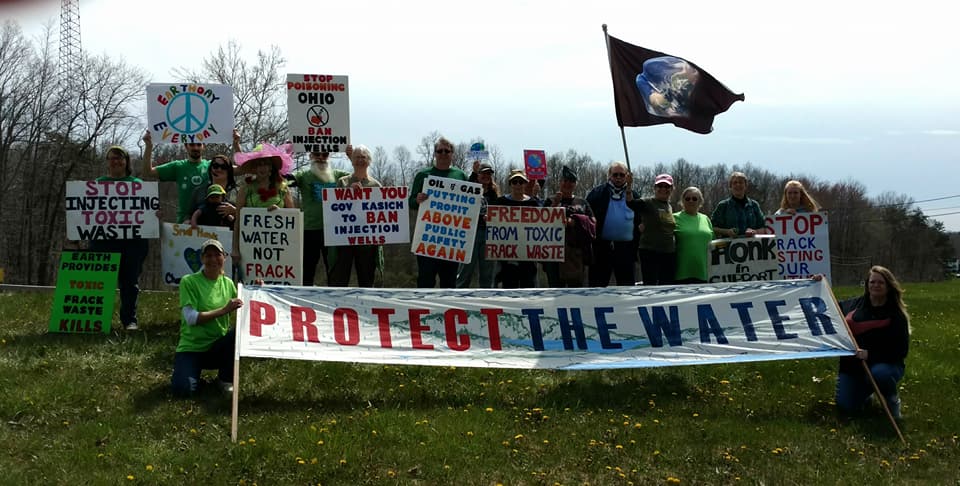
Local environmental groups started popping up, like Athens County’s Future Action Network and Torch CAN DO, which stands for Torch Clean Air Now, Defend Ohio. These groups helped organize informational meetings with epidemiologists and geologists as well as protests to spread the word about fracking and raise awareness. One of their protests was a Mad Hatter’s Tea Party complete with a Queen of Hearts and little toxic tea bottles.
Groff, along with the other activists who joined the fight, have been preaching for years about the environmental impact of injection wells.
“You drill a hole into the ground and then you shove toxic radioactive waste under immense pressure,” Groff said. “Now what kind of fool do you think we are that you don’t think that that’s going to go somewhere?”
There were more than 1,400 fracking incidents associated with oil and gas wells in Ohio between 2018 and September 2023, according to FracTracker Alliance — a nonprofit that collects data on fracking pipelines.
There have been 26 incidents in Athens County during that same time period involving release, unintentional gas release and a fire, according to FracTracker.
“Everybody knew that was going to happen,” Groff said. “We absolutely unequivocally knew that we were right. There was nothing that swayed anybody in this group from thinking that we were making stuff up.”
The Athens County Commissioners also got involved and held meetings.
“These wells are just terrible and what they’ve done and everything that was said that was going to happen, happened,” Athens County Commissioner Charlie Adkins said.
Groff and the team of activists were overjoyed when ODNR ordered the injection wells to suspend operations.
“The language they used is exactly what the people have been saying … they’re an imminent threat to the health and the welfare and well being of the environment and the people who live here,” Groff said.
Quinn always believed they could make a difference.
“We went from Torch CAN DO to Torch can done,” she said. “We’d like to pass our homesteads on to our children. We want to do this for our grandchildren.”
Fight continues
Even though some of the wells are no longer in use, Groff isn’t hanging up her activist hat just yet.
For one, not all injection wells are suspended. The last two remaining wells in operation in Athens County are in Canaan Township and Lee Township, Cheung said.
The long-term effects of the injection wells are not totally known at the moment and could not show up for years or decades, Groff said.
Athens County Commissioner President Lenny Eliason said he would like to focus on long-term monitoring.
“Appalachia has been extracted for years for a number of different materials and the pain of the short term gains sticks around a long time after,” he said. “So we have to get people that are more forward thinking about balancing what that short term gain is going to bring in the long term.”
When asked if the drinking water had been affected by the injection wells, Groff and Quinn said they don’t know yet.
Referring to the state, Groff said ““Your incompetence caused this to happen. If you want to assure people that this is not an imminent threat and danger, then prove it and the only way you can prove it is to continue to test the water.”
Even though their advocacy is not quite done, they are relishing their victory.
“It’s not only just a huge win for everybody here in Athens County, it’s a message to the rest of the people in the state that, with due diligence, you can be in control,” Groff said. “You just have to fight like hell to make yourself heard.”
Megan Henry is a reporter for the Ohio Capital Journal and has spent the past five years reporting in Ohio on various topics including education, healthcare, business and crime. She previously worked at The Columbus Dispatch, part of the USA Today Network.
Ohio Capital Journal is part of States Newsroom, the nation’s largest state-focused nonprofit news organization.
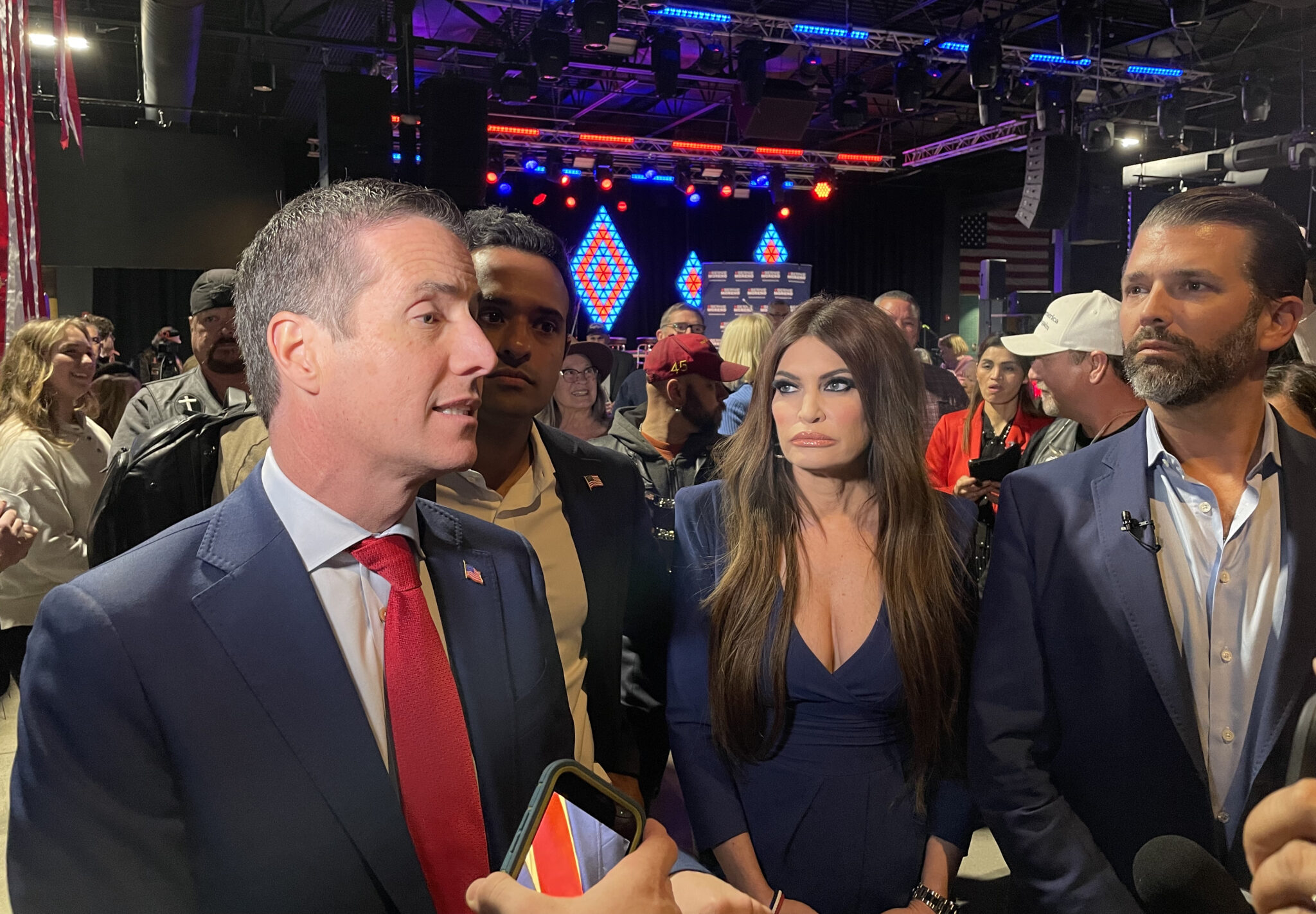
From left, Bernie Moreno, Vivek Ramaswamy, Kimberly Guilfoyle, and Donald Trump, Jr. speaking before a campaign rally in Butler County. (Photo by Nick Evans, Ohio Capital Journal.)
The U.S. Senate campaign of Republican Bernie Moreno took to X last week to claim that because of the current administration’s policies, migrants have “destroyed” Ohio communities.
However, the campaign didn’t answer when asked to identify a single Ohio city that had been harmed by migration, where the migrants doing the destruction came from, and how the communities had been harmed. The statement also ignores the fact that Moreno, a Cleveland businessman, is himself a migrant.
Moreno is the Republican nominee for the U.S. Senate seat that has been occupied by Democrat Sherrod Brown since 2007. The race is one of the most closely watched in the country this cycle.
As his fellow Republicans have, Moreno has tried to stoke fears of migrants following a surge at the southern border, which has since subsided — at least temporarily. Many have also claimed that undocumented migrants commit more crime than the native-born, although research indicates that the opposite is actually the case. And border cities such as El Paso and McAllen have significantly lower crime rates than the average American city.
Some of the rhetoric has at least seemed to be racist. When former President Donald Trump last year repeatedly said undocumented immigrants “are poisoning the blood of our country,” he seemed to echo Adolf Hitler, who used several versions of the poison-blood metaphor in his racist musings.
For his part, Moreno hasn’t been shy about using harsh rhetoric about immigration. He has repeatedly referred to what’s happening at the southern border as an “invasion” despite the fact that El Paso has already been the victim of a racist massacre by a man who said he was trying to stop an invasion, and experts worry that it’s only a matter of time before it happens again.
On Wednesday, the Moreno campaign took to X to say, “San Francisco liberal @KamalaHarris and @SherrodBrown destroyed Ohio communities by flooding our state with migrants.”
However, his campaign didn’t respond when asked which Ohio communities had been destroyed and how.
But what made the post especially head-scratching is the fact that Moreno is himself a migrant, being born in Colombia in 1967. His family migrated to Florida in 1971.
It was part of the image he’s tried to cultivate of an immigrant who came to the United States the “right” way as opposed to impoverished Colombians who’ve survived the trek through the Darien Gap, made their way the U.S.-Mexico border and entered without documents.
However, Moreno’s depiction of his family as a poor one is misleading. In Columbia, his people were wealthy and politically connected, and while the family lived in straitened circumstances the first years they were in the states, things quickly got better.
His father, Bernardo Moreno Sr., was a surgeon who was educated at the University of Pennsylvania and later served as the Colombian equivalent of the secretary of health, the New York Times reported. He initially worked at low pay in Florida as a surgical assistant, but by 1973, he had full privileges as a surgeon.
In addition, one of Bernie Moreno’s brothers served as the Colombian ambassador to the United States and another founded a multinational construction empire.
MARTY SCHLADEN
Marty Schladen has been a reporter for decades, working in Indiana, Texas and other places before returning to his native Ohio to work at The Columbus Dispatch in 2017. He’s won state and national journalism awards for investigations into utility regulation, public corruption, the environment, prescription drug spending and other matters.
Ohio Capital Journal is part of States Newsroom, the nation’s largest state-focused nonprofit news organization.