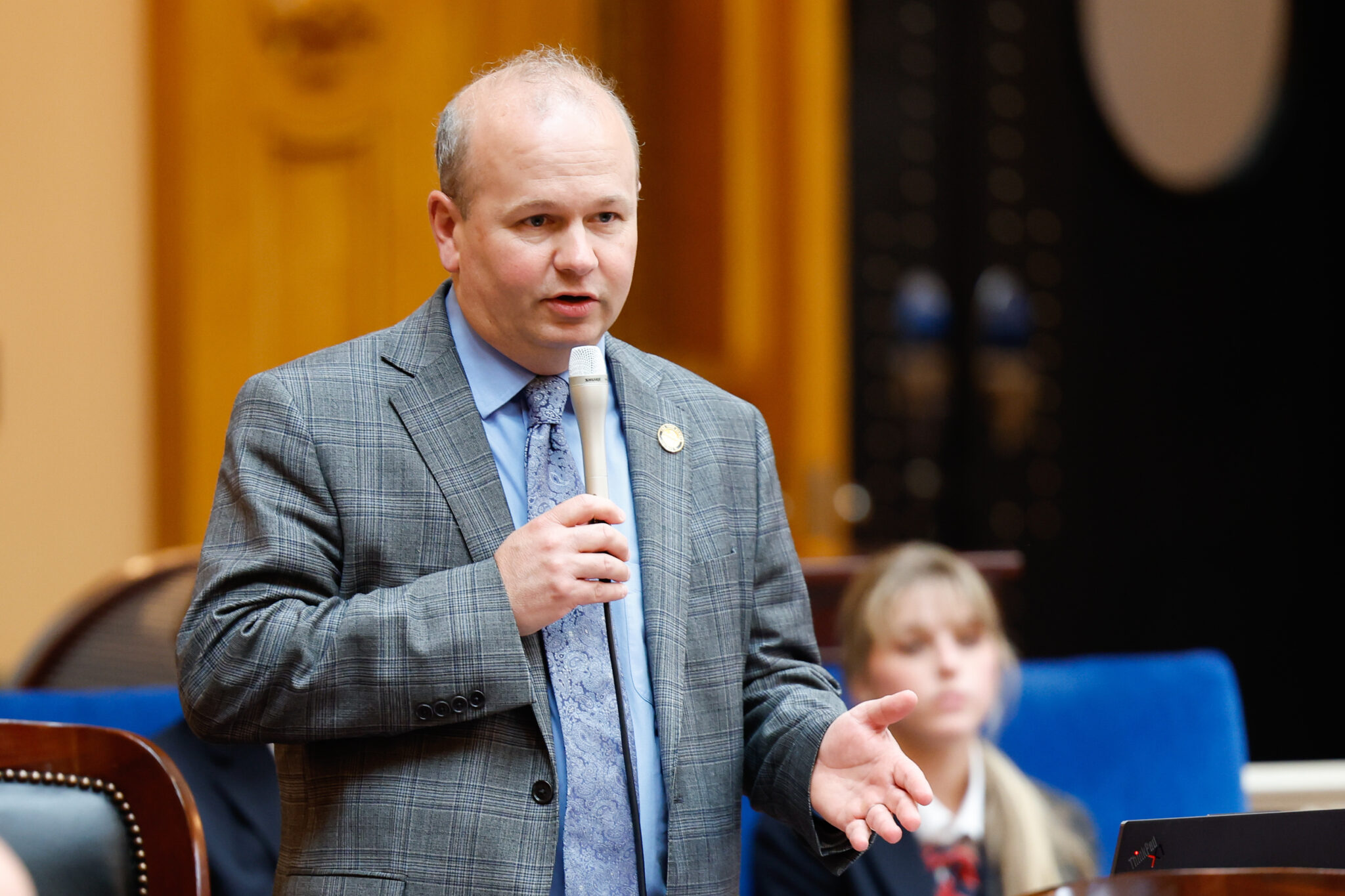
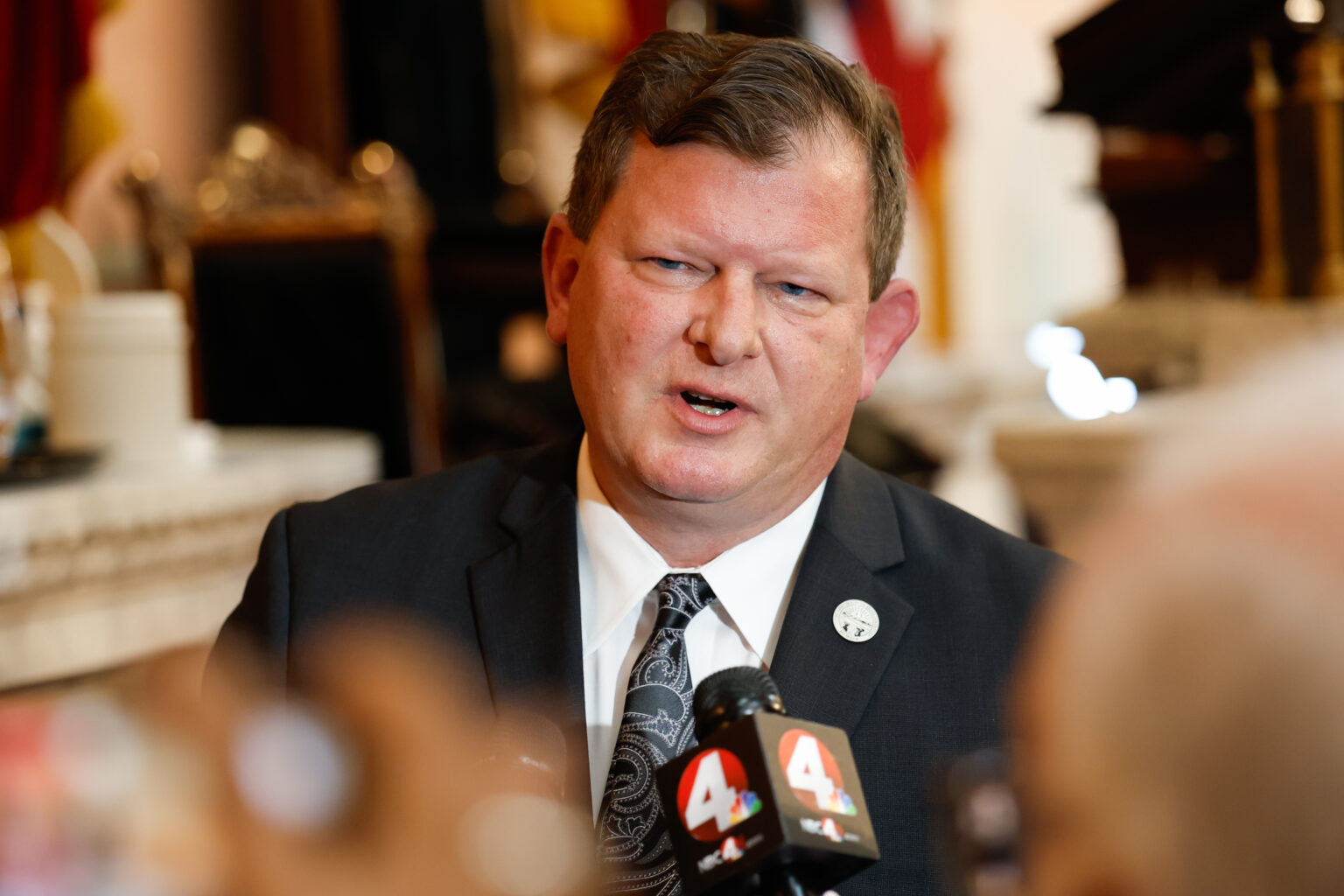
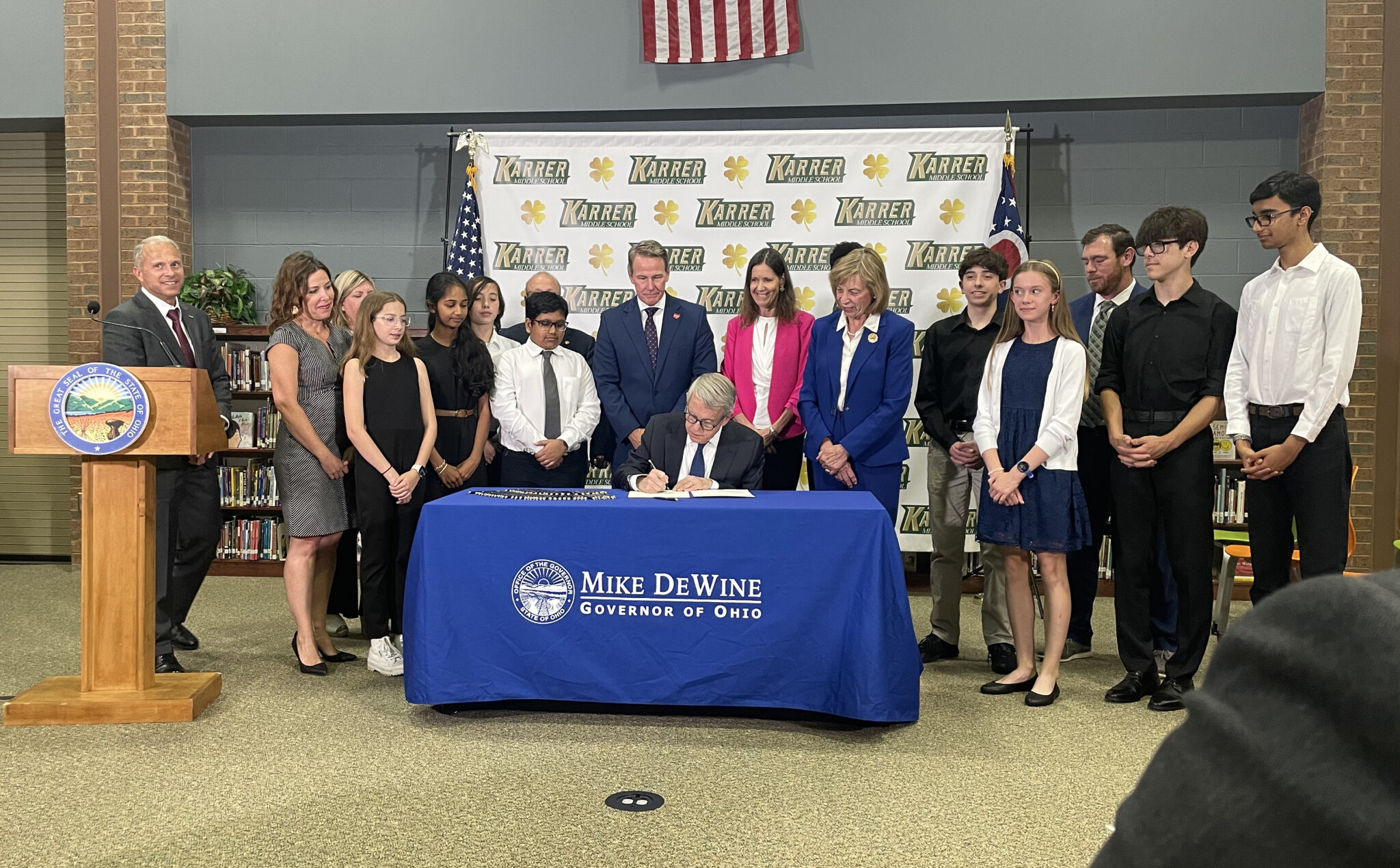
At a Dublin middle school Wednesday, Ohio Gov. Mike DeWine signed legislation ordering school districts around the state to develop written policies for cellphones on campus. The state education department will write it’s own model policy that districts may adopt, but so long as they come up with something to keep cellphone use “as limited as possible” districts can do what they like.
District level view
Several districts around the state stood up their own cellphone policies well before state lawmakers acted. Dublin City Schools, for instance, prohibited cell phones in high school classrooms this year, but they eliminated them completely for middle schools.
“It’s so much fun to walk into a middle school lunch again,” Superintendent John Marschhausen explained. “Because it used to be you’d go in and it’d be somewhat quiet, kids looking down at their phones. But now that it’s loud, it’s fun, and the interaction and the interpersonal skills that students learn is increasing.”
Dublin City Schools Superintendent John Marschhausen. (Photo by Nick Evans, Ohio Capital Journal.)
The law carries a provision retroactively blessing the policies Dublin and other school districts instituted if they meet the minimum standards laid out in law. Although it’s too soon to connect the policy changes to outcomes like test scores, Marschhausen explained the impact is still showing up in noticeable ways.
“Our discipline is down, our bullying is down,” he explained. Without kids on social media during the day, he added, teachers and administrators aren’t forced to respond to the latest post and students’ group chats aren’t fanning the flames of that day’s drama.
“When they go to class they learn,” Marschhausen said. “So we have statistical data for discipline that shows an improvement.”
In a press release, Ohio Education Association President Scott DiMauro applauded the legislation, but he argued teachers — the eventual frontline of whatever policy a district establishes — need to be included in the planning process.
“This law will ensure educators have clear guidance and support while allowing for local flexibility to set policies that will improve learning conditions,” he stated. “Our members must be included in the development of those local policies.”
Signing ceremony
In the Karrer Middle School library, DeWine emphasized the potential for distraction that cellphones present. Nearly all teenagers have a phone, he argued, and notifications roll in according to one study, about once every five minutes.
“Even when students don’t check their cell phones — or when adults don’t check their cell phones — the presence of the phone impacts their ability to think,” DeWine said.
Like Superintendent Marschhausen, the governor brought up the return of noisy lunchrooms. Lt. Gov. Jon Husted reported district leaders who have restricted access to phones report “the facts are clear.”
“Eliminating smartphones in schools leads to improved academic performance, reduces bullying and lessens disciplinary issues,” Husted said.
In his statements, DeWine referenced author Johnathan Haidt’s book “The Anxious Generation,” which kicked off a national discussion about removing phones in schools a few months ago.
The administration’s victory lap comes after a brief and painless trip through the state legislature. DeWine urged lawmakers to act just five weeks ago in his State of the State address, and after hitching a ride on a noncontroversial bill dealing with military seals on high school diplomas, the idea passed both chambers unanimously.
“You don’t get a unanimous vote out this legislature, or very few legislatures, on anything other than naming roads,” DeWine quipped after signing the bill.
The governor said he expects state education officials to have their model policy ready for districts within the next ten days or so. The law take effect in mid-August, right in time for kids to head back to school.
Nick Evans has spent the past seven years reporting for NPR member stations in Florida and Ohio. He got his start in Tallahassee, covering issues like redistricting, same sex marriage and medical marijuana. Since arriving in Columbus in 2018, he has covered everything from city council to football. His work on Ohio politics and local policing have been featured numerous times on NPR.
Ohio Capital Journal is part of States Newsroom, the nation’s largest state-focused nonprofit news organization.
A long-standing lawsuit challenging Ohio law with regard to telehealth abortions might now challenge other abortion-related laws in the state, according to a new filing.
The ACLU, the Planned Parenthood Federation of America and two other law firms filed an amendment to their original lawsuit, asking a Hamilton County Court of Common Pleas judge to add new complaints against state laws that keep certain medical professionals from prescribing a drug called mifepristone, commonly used in combination with misoprostol for medication abortions.
A separate law being challenged prohibits physician assistants, nurse practitioners and certified nurse midwives from providing medication abortions, according to a press release by the ACLU announcing the new challenges.
The amended complaint is an update to a lawsuit that has been active since 2021 in Hamilton County. The suit started out as a case against a law banning telehealth abortion services, that is, medication abortion appointments conducted virtually.
Senate Bill 260
Back in April 2021, Planned Parenthood groups sued to stop Senate Bill 260, which had been passed months prior to ban the telehealth option for medication abortions, requiring in-person visits with a physician to receive medication abortion treatment and making it a fourth-degree felony for a physician to violate the law.
Hamilton County Common Pleas Judge Alison Hatheway has twice granted a preliminary injunction in the case, which keeps SB 260 from being enforced. The most recent preliminary injunction was put in place “until final judgment is entered in this case,” according to Hatheway’s order.
When the health clinics first sued the state over the law, they argued the law “irrationally prohibits abortion providers from using telemedicine to provide medication abortion to Ohioans.”
The clinics also said the law violates the state constitution’s due process, equal protection and “free choice in health care” guarantees.
An attorney for the Ohio Attorney General’s Office argued at the time that there was “no fundamental right at issue” in the case, and that the law impacted “a very narrow subset” of patients seeking abortions.
As of November of last year, there’s a new amendment in the Ohio Constitution, one that protects the right to reproductive health, including abortion and miscarriage care. The mifepristone-misoprostol treatment can also be used in miscarriages, which are referred to in medical terms as “spontaneous abortions.”
Attorneys hope to use the newest constitutional amendment as an argument against not only the telehealth law, but the other laws they’ve added in as well.
“The Amendment therefore creates a new cause of action that applies directly to the challenged law … further rendering it unconstitutional,” attorneys wrote in the most recent court filing.
They call the amendment’s passage “a major legal development” that “establishes a clear and unequivocal right to abortion” while also barring the state from interfering in abortion care.
“Individually and collectively, the challenged laws ‘burden, penalize … interfere with, (and) discriminate against’ both Ohioans who seek to exercise their fundamental right to abortion and plaintiffs who assist Ohioans in exercising that right by providing abortion care, by delaying, impeding and restricting access to medication abortion,” court documents stated.
Other law(suits)
Ohio law already requires a minimum of two visits to a provider before an abortion can take place, identification of fetal cardiac activity before the procedure and a 24-hour waiting period before the procedure is conducted. All of these laws are now being challenged in one court case or another.
In Franklin County, a lawsuit asks the court to eliminate the 24-hour waiting period before an abortion can take place and the requirements that doctors provide certain information and a fetal heartbeat exam before they can provide an abortion.
A separate lawsuit is still chugging along in Hamilton County as well, seeking to kill the six-week abortion ban enacted in 2019. The law was almost immediately challenged, but the state was able to bring the ban back after the Dobbs decision by the U.S. Supreme Court that overturned the national abortion legalization in Roe. v. Wade.
After the Ohio Supreme Court didn’t act on a lawsuit submitted to them, clinics moved the lawsuit to Hamilton County, where they successfully got the ban paused as the lawsuit continues.
The state tried to appeal the pause to the state’s highest court, but the court cited “a change in law” when it rejected the appeal.
Ohio Attorney General Dave Yost has pushed back against the Franklin County lawsuit, along with certain aspects of the six-week abortion ban suit.
In both cases, he acknowledged the constitutional amendment “invalidated” the six-week ban, but he pushed back on arguments that the amendment covers abortion issues as broadly as abortion rights advocates think it does.
In a filing related to the six-week abortion ban case, Yost said the amendment does not bar “all laws that touch on abortion – and even some laws that have nothing to do with abortion or anything else the amendment mentions.”
Telehealth abortions went up following the U.S. Supreme Court decision in Dobbs. A national study from the Society of Family Planning showed 16% of abortions were conducted via telehealth as of September 2023, up from 4% pre-Dobbs.
SUSAN TEBBEN
Susan Tebben is an award-winning journalist with a decade of experience covering Ohio news, including courts and crime, Appalachian social issues, government, education, diversity and culture. She has worked for The Newark Advocate, The Glasgow (KY) Daily Times, The Athens Messenger, and WOUB Public Media. She has also had work featured on National Public Radio.
Ohio Capital Journal is part of States Newsroom, the nation’s largest state-focused nonprofit news organization.
The Federal Trade Commission in March released a report saying that the three largest grocers “accelerated and distorted” food costs amid supply disruptions caused by the coronavirus pandemic. It also said that prices — and profits — remain high for Kroger, Walmart and Amazon even after the supply kinks have straightened themselves out.
But the country’s trade watchdog didn’t say in its report what might be done about it. The agency this week might have given a hint.
But that’s unrelated to the findings of the “6(b)” report, which was started during the pandemic in November 2021. It found problems with consolidation in the grocery sector even without the Kroger-Albersons merger.
Asked if the FTC planned to do anything about those problems, an agency official speaking on background on Monday said, “The report outlines several areas where further scrutiny by the FTC and policymakers is warranted. The report doesn’t specifically spell out any enforcement actions to be taken as a result of the report, but the report will inform the FTC’s future work as the Commission reviews potentially anticompetitive mergers and conduct as it works to protect consumers.”
The report itself found several broad areas in which it said the three big grocers were using their size to suppress competition.
One had to do with the big boys’ use of “on time, in full,” or OTIF, contracts with their suppliers. Because they’re such huge customers, they’re able to get strict guarantees that they’ll have their orders completely and promptly fulfilled or the supplier has to pay a steep penalty.
The FTC report said that at the beginning of the pandemic, virtually no grocers were insisting that the terms of their OTIF contracts be met — an acknowledgement that supply-chain disruptions made it impossible. But as time wore on, some of the biggest grocers reimposed them with a vengeance, the report said.
“Even as the supply chain crisis brought on by the pandemic continued, some retailers reimposed or even heightened the standards for their OTIF policies later in 2020,” it said. “For example, Walmart tightened its OTIF requirements in September 2020, requiring suppliers to achieve 98 percent OTIF compliance to avoid fines of 3%.”
Imposition of the contracts had an anticompetitive effect because, in a time of scarcity, they directed limited supplies of some items to the biggest grocers while their smaller competitors went begging, the report said.
In addition, large grocers are able to use their heft to negotiate constant, relatively low prices from suppliers, a practice known as “everyday low pricing.” Meanwhile, their smaller competitors depend on producer promotions to offer certain items at temporarily low rates.
As the pandemic set in and producers were already struggling to fill orders, they had little incentive to voluntarily reduce prices. That created another mismatch between the biggest grocers and their smaller competitors, the FTC report said.
“Promotions designed to increase sales made little sense when those producers were unable to meet existing demand,” it said. “These changes affected retailers differently depending on their pricing model. Most notably, these trade promotions reflect a significant amount of money within the industry, and so the competitive impact of these differential effects (or of the promotions generally), may warrant further study.”
More broadly, food prices have jumped 25% over four years and they remain high even as supply problems related to covid have eased. Grocers have said their costs remain high, but according to the FTC report, food and beverage retailers saw their revenue rise to 6% over total costs in 2021 — higher than the previous peak of 5.6% in 2015. Then in the first three quarters of 2023, it went even higher — to 7% over costs.
It seems that might be an avenue of further inquiry.
“This profit trend casts doubt on assertions that rising prices at the grocery store are simply moving in lockstep with retailers’ own rising costs,” the report said. “Examining the cause or nature of rising industry profits is beyond the scope of this limited study into pandemic-related supply chain disruptions. However, the question warrants further inquiry by the Commission and policymakers.”
MARTY SCHLADEN
Marty Schladen has been a reporter for decades, working in Indiana, Texas and other places before returning to his native Ohio to work at The Columbus Dispatch in 2017. He’s won state and national journalism awards for investigations into utility regulation, public corruption, the environment, prescription drug spending and other matters.
Ohio Capital Journal is part of States Newsroom, the nation’s largest state-focused nonprofit news organization.
Mom lawmakers grow in visibility but their proportional representation is still lacking
A few Ohio mom lawmakers said they had an important thing to do before officially deciding to run for office — conduct a family meeting.
“I’m a single mom, so I’m the only adult support in our family,” said state Rep. Rachel Baker, D-Cincinnati. “I knew to run and to serve would be a family endeavor, so I needed my kids to be on board.”
Child care can be a big obstacle for moms to figure out when campaigning and, ultimately, as a lawmaker. House Minority Leader Allison Russo, D-Upper Arlington, remembers spending thousands of dollars in extra child care costs when she first campaigned in 2018. Her youngest daughter hadn’t celebrated her second birthday yet and her two sons were in elementary school at that time.
“It was a big, expensive part of my first campaign that we paid out of pocket,” she said. “I am privileged to have the circumstance that I have with family nearby and the support network, but not everybody has that, and I think if we want more parents with young children, especially women to run for office, we have to think about how do we create this support at work.”
Mom lawmakers and their families face additional attention and scrutiny by being in such a public position, especially on social media and during campaign season, lawmakers said.
“Running for office where the campaigns are not always friendly can be very difficult on families,” said State Rep. Beth Liston, D-Dublin. “When you have mail pieces that come to your house that say horrible things or TV ads or YouTube streaming, I think that’s something that women feel a lot that will hurt their kids at school.”
Ohio House Minority Leader Allison Russo, D-Upper Arlington
“I am always thinking about what are we doing that is setting up our children, not just my children, but all children, for success in the future,” she said.
COLUMBUS, OH — MAY 08: House Minority Leader Allison Russo, D-Upper Arlington, during the Ohio House session, May 8, 2024, at the Statehouse in Columbus, Ohio. (Photo by Graham Stokes for Ohio Capital Journal)
Russo’s children are 17, 14 and 7, and they were often with her on the campaign trail.
“I think it was a good thing for my kids to be with me knocking on doors, because I think voters recognized that I’m just a normal person trying to balance all the things that most people are trying to balance,” she said. “It reminds people that yes, I’m a real person.”
Her children would often get rewarded with ice cream or a cookie at a reception after being on the campaign trail with Russo.
“(The Statehouse) certainly has been a big part of their childhood,” she said.
Her children are in elementary, middle and high school, so she has a good understanding of what’s going on in schools — something that comes in handy with various education legislation.
“What is clear to me, often, is legislation gets passed, or gets introduced rather, by people who don’t necessarily have kids that are currently in school,” she said.
Russo is grateful to live about 15 minutes from the Statehouse.
“It does give me that flexibility to be able to balance, particularly at this stage in my kids’ lives where they are very busy and involved in activities,” she said. “I want to be able to see their games. I go to school activities during the middle of the week, so because of my proximity to the Statehouse, I’m able to balance those things.”
She leans on her husband, a set of grandparents that live nearby and supportive neighbors and friends for help with the kids and their various activities.
“A lot of it is my husband and I, a lot of negotiation between the two of us as we both balance careers and figuring out how we’re going to make it work,” she said. “If we can’t be there, can a grandparent be there? Or do we have a friend who can take a picture or text us to let us know how the game is going?”
State Rep. Rachel Baker, D-Cincinnati
State Rep. Rachel Baker, D-Cincinnati, is a single mom to three adopted children. (Photo from the Ohio General Assembly website).
One of the biggest reasons Baker ran for office was because of her three adopted children (ages 18, 15, and 12).
“I want to make Ohio a place that my kids want to stay, a place that my kids want to study and want to build their own life,” she said.
Baker, who is a single mom, has continued her career as a nurse so her three children took it upon themselves to help out around the house.
“I can’t work full time, serve in the legislature, be your mom, and do everything around the house,” she recalls thinking. “So something has to give and what it’s going to be is stuff around the house and they were like, this is important. We should do this as a family.”
Her oldest helps with car rides, her middle son cooks dinner every night and her youngest walks the dog.
“They really see the need for all of us to pitch in and all of us to be a family and contribute to the family and also help each other out,” Baker said, noting her son has become quite the cook.
“No one wants to go back to my cooking,” she said. “He started that in the middle of my campaign and he still cooks dinner every night.”
She drives up to Columbus on Tuesdays for committee meetings, stays the night in a hotel and drives back home on Wednesdays.
“I try to do a ton of my work Tuesday evening … and try to get as much done Tuesday and Wednesday, so that I’m not doing as much in the evenings the other days when I’m home and taking time away from them,” she said.
Being so busy has forced her family to be more deliberate in spending time together and they prioritize going out to dinner as a family every Sunday night.
“It’s been so nice,” she said. “Everyone enjoys it.”
State Rep. Monica Robb Blasdel, R-Columbiana
COLUMBUS, OH — MAY 08: State Rep. Monica Robb Blasdel, R-Columbiana County, during the Ohio House session, May 8, 2024, at the Statehouse in Columbus, Ohio. (Photo by Graham Stokes for Ohio Capital Journal)
The distance from Blasdel’s home in Columbiana to the Statehouse is the hardest part of her job. She uses the two-and-a-half to three hour drive to take calls from constituents and listen to committee hearings.
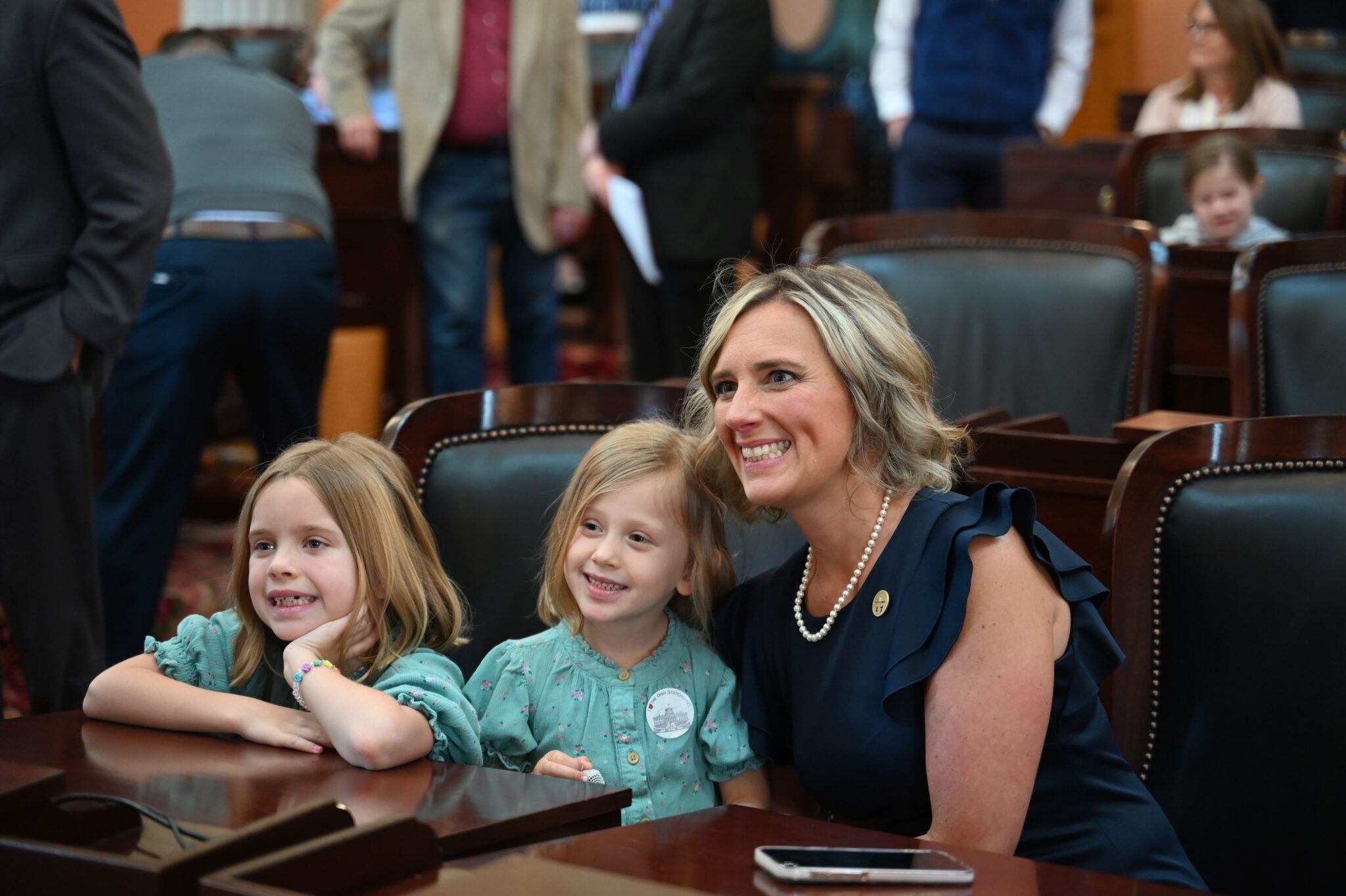
Blasdel does nightly FaceTime calls with her daughters (ages 7 and 5) before they go to bed when she spends the night in Columbus for her job at the Statehouse.
“I just try to make the most of my time that I’m away from home, so that I can be more present when I am home,” she said. “As long as I’m transparent with my girls and they understand when mommy’s coming home and how many days I’ll be away, they’re usually pretty good.”
Her daughters were five and three when she first started campaigning for office. She is currently serving in her first term.
“I did make a promise to my family when we made this decision together (to run for office) that they would always come first,” Blasdel said. “I included my children as much as possible when it’s appropriate on the campaign trail. I like to take them to events. I like them to see me interacting with my constituents and understand the work that I do.”
Blasdel recently brought her daughters to the Statehouse so they could see what their mom does in Columbus.
“That answers a lot of questions in their head,” she said. “They have a better understanding of what I’m doing when I’m down here and what my schedule looks like.”
State Rep. Beth Liston, D-Dublin
When Liston started running for office in 2017, her daughter (who was 13 at the time) knocked on a lot of neighborhood doors to help her mom’s campaign. Her son, who was 11 at the time, would occasionally wear a shirt to support his mom’s campaign.
COLUMBUS, OH — MAY 08: State Rep. Beth Liston, D-Dublin, speaks during the Ohio House session, May 8, 2024, at the Statehouse in Columbus, Ohio. (Photo by Graham Stokes for Ohio Capital Journal)
Her husband was a stay-at-home dad then, so he was able to help with child care.
“I’m very lucky that way in terms of being a mom and running for office,” she said. “I know other women that I work with certainly had a lot more stress in terms of figuring out what to do with their kids.”
But that doesn’t mean balancing being a mom and being a lawmaker doesn’t come with challenges.
“You still don’t want to miss the things that they’re doing,” Liston said. “Even if you had someone to watch them, you still miss portions of their lives which are important to you.”
She considers herself lucky to live near the Statehouse.
“The role involves weird hours,” she said. “A lot of events in the evening, which isn’t really all that great for family. … It’s always deciding whether I should go to those receptions and take those evening opportunities or be at home and make sure that I see my kids and have dinner together.”
As her children have ventured into their teenage years (her daughter is now 19 and her son is 17), she said “touch points” with her kids when they get home from school or an event have become important.
“Those are their important points that I think it’s hard to maintain when you have such atypical hours that are not really predictable,” she said.
House Bill 114
An Ohio bill, among other things, is trying to help make it easier for parents to run for office by allowing political candidates to use their campaign funds to pay for child care and bring Ohio campaign finance regulations in line with federal campaign finance regulations.
“I think it’ll help a lot of people to really start thinking about actually pursuing a role in politics and running for office,” said state Rep. Latyna Humphrey, D-Columbus. “… It’s hard to run for office and having to carry your kids with you. It makes it hard for them to do their job and really run the way that they want to because they’re trying to have that balancing act.”
Humphrey, who has an 11-year-old son, and fellow state Rep. Bill Seitz, R-Cincinnati, introduced House Bill 114 last year and it passed the House over the summer.
The Ohio Senate recently passed the bill but not before making significant changes by adding amendments that would allow President Joe Biden to be on Ohio’s ballot for November’s presidential election and ban foreign nationals from contributions for campaigns.
“The original intent of (HB) 114 was to make it allow campaign funds to be used for child care for candidates running for office,” State Sen. Bill DeMora, D-Columbus, said. “Senate Republicans held us hostage by slapping completely irrelevant partisan nonsense onto this bill because they know it needs to pass.”
Megan Henry is a reporter for the Ohio Capital Journal and has spent the past five years reporting in Ohio on various topics including education, healthcare, business and crime. She previously worked at The Columbus Dispatch, part of the USA Today Network.
Ohio Capital Journal is part of States Newsroom, the nation’s largest state-focused nonprofit news organization.
Ohio lawmakers signed off on changes to the military seal for high school diplomas on Wednesday. But the bill’s most notable provision was a last minute amendment regarding cellphones in K-12 schools that caught a ride on the non-controversial measure.
Recently, Gov. Mike DeWine urged lawmakers to address cellphones in classrooms during his state of the state address. Now, about a month later, those changes are headed to his desk.
Some lawmakers casually refer to the changes as a “cellphone ban,” but that’s a bit of a misnomer. Instead, the law directs every district to develop a written policy aimed at minimizing phone use during school hours and potential distractions during class instruction.
The bill also includes an exception for students who need a phone to assist in learning or to track a health concern, so long as it is reflected in their individual education plan.
On the Senate floor, the cellphone provision’s chief backer, Sen. Andrew Brenner, R-Delaware, explained “the legislation does not require districts to adopt a ban on all students’ cell phone use, though that is an option if the school district chooses to do so.”
He added that those districts with cellphone policies in place don’t need to change them so long as the policy “emphasize(s) minimal use and least amount of distraction.”
“The language also directs the Department of Education and Workforce to develop a model policy informed by evidence-based research on the effects of smartphones and classrooms, that districts may choose to adopt as their policy if they wish to do so,” Brenner said.
COLUMBUS, Ohio — JANUARY 10: Newly sworn in State Rep. Beryl Brown Piccolantonio, D-Gahanna. (Photo by Graham Stokes for Ohio Capital Journal)
Across the hall in the House, Rep. Tracy Richardson, R-Marysville, emphasized how their approach gives districts direction without being prescriptive.
“Each school district is required to create their own policy, thus ensuring — and let me make this very clear — local control,” she said.
Up until this January, Rep. Beryl Piccolantonio, D-Gahanna, was serving as president of the Gahanna-Jefferson School Board, and she described the changes as “critically important.”
“A frequent issue that was raised to us by staff, and by students, quite frankly, was how difficult it was for staff to enforce their own classroom policies because they didn’t have broader support to back up that enforcement.”
She praised the measure for giving districts the “flexibility” to develop their own approaches to deal with the issue. Highlighting a recent take your child to work day event where kids debated cellphones in schools, she noted “even some of the students acknowledge the distraction that cellphones have within their classroom.”
Nick Evans has spent the past seven years reporting for NPR member stations in Florida and Ohio. He got his start in Tallahassee, covering issues like redistricting, same sex marriage and medical marijuana. Since arriving in Columbus in 2018, he has covered everything from city council to football. His work on Ohio politics and local policing have been featured numerous times on NPR.
Ohio Capital Journal is part of States Newsroom, the nation’s largest state-focused nonprofit news organization.
After years of complaints about gold-plated salaries, billions in investment fees and lackluster returns, things seem poised to hit the fan at Ohio’s State Teachers Retirement System.
Gov. Mike DeWine on Wednesday issued a press release saying that he was alarmed at the news that a consultant for the $90 billion retirement plan, Aon, was severing its contract.
“This is a huge red flag, calling into question how STRS is operating and providing oversight,” the press release said. “The unstated implication is that the governance issues at STRS are so concerning that Aon could not continue its contract in good faith. STRS may now be out of compliance with portions of audit recommendations due to Aon ending the contract.”
The statement also cited unspecified allegations against members of the pension fund’s board, to which the governor appoints some members.
“Additionally, my office has received documents containing some other disturbing allegations regarding the STRS board,” the statement said. “I have directed my staff to forward these documents to a number of relevant offices, including the Ohio Ethics Commission, the Ohio Retirement Study Council, Attorney General Yost, Auditor Faber, Treasurer Sprague, Secretary of State LaRose, and relevant members of the Ohio General Assembly. I encourage them to review the document and take any action that may be appropriate under any jurisdiction they may have.”
DeWine himself has fueled some of the controversy at the retirement system. Exactly a year ago, just as reformers were about to achieve a majority on the board, DeWine terminated a reform member.
DeWine said the member, Wade Steen, didn’t attend board meetings regularly enough. But Steen countered that the charge was trumped up. The Ohio 10th District Court of Appeals said DeWine’s termination of Steen was unlawful and ordered that Steen be restored to his position.
The turmoil at the teachers’ pension fund isn’t the only controversy facing the DeWine administration.
Marty Schladen has been a reporter for decades, working in Indiana, Texas and other places before returning to his native Ohio to work at The Columbus Dispatch in 2017. He’s won state and national journalism awards for investigations into utility regulation, public corruption, the environment, prescription drug spending and other matters.
Ohio Capital Journal is part of States Newsroom, the nation’s largest state-focused nonprofit news organization.
In a surprise move, the Ohio House decided not to take up legislation to ensure President Joe Biden appears on the November ballot in Ohio.
But elected leaders from both parties insist Biden will appear on voters’ ballots. They have said so many times. But the thing is, they’re not exactly sure how, and an obscure provision in state law gives them a deadline they may not be able to meet.
Ohio law provides that political parties must certify their candidates with the Secretary of State “on or before” the 90th day prior to an election. The Democratic National Convention, the meeting at which the party will officially nominate Biden, won’t happen until August 22 — 75 days prior to the election.
This week, lawmakers hammered out two competing proposals, one in the House and one in the Senate, that would push that deadline to 74 days instead.
At the eleventh hour, the House and Senate were still wrangling over which bill should serve as the vehicle for passage. The Senate approved its bill and adjourned, but unrelated amendments soured some House members – mostly Democrats – on the proposal.
Rather than put the Senate bill to a vote, House Speaker Jason Stephens adjourned, over howls of protest from conservative members. They jeered “shame” at Stephens, and “Russo wins again” in reference to the House Minority Leader, Allison Russo, after the motion to adjourn passed.
“I think there’s a lot of different options in order to get him on the ballot,” Stephens told reporters after the session concluded. “You guys have probably went through a lot of the different possibilities. So you know, I’m not concerned about that happening.”
COLUMBUS, Ohio — MAY 31: Senate President Matt Huffman, R-Lima (left), talks to Senate Majority Floor Leader Rob McColley, R-Napoleon, after the Ohio Senate session, May 31, 2023, at the Statehouse in Columbus, Ohio. (Photo by Graham Stokes for Ohio Capital Journal. Republish photo only with original story.)
The Senate approach
The Ohio Senate significantly changed and ultimately passed House Bill 114, a campaign child care bill, by adding amendments to put Biden on Ohio’s ballot for November’s presidential election and ban foreign nationals from contributing to political campaigns.
HB 114 passed in the Senate on Wednesday afternoon with a vote of 24-7, with Democrats voting against it.
The bill moves the date Biden would need to be certified as the Democratic candidate from Aug. 7 to Aug. 23 in order to get him on Ohio’s ballot.
“That should allow for the Democratic National Committee to provide the nominee so we’ll have that choice on the ballot when they go to vote,” Sen. Rob McColley, R-Napoleon, said on the Senate floor.
This bill is a temporary change and it doesn’t change the deadline for future presidential elections.
“My personal opinion is that this should not be a permanent law change, given how quickly we’ve had to go through and deal with this issue,” McColley said. “If we are going to deal with a permanent fix, that wouldn’t even be necessary, in theory, until at least four years from now, hopefully longer. We should take our time and try to get it right. But I understand under the circumstances that we got to act quickly regarding this upcoming election. … We shouldn’t be using state law as a weapon to keep somebody off the ballot.”
“Our intention will be to ensure that we don’t have foreign election interference in the state of Ohio, via the campaign contributions by foreigners and foreign nationals,” said McColley, who is also a sponsor of SB 215.
McColley said organizations linked to foreign nationals contributed almost $14 million in the state last year, “related to the elections that occurred in August and November.”
Senate President Matt Huffman, R-Lima, said weaving SB 215 into HB 114 was the only option.
“Republicans in both the House and the Senate aren’t going to vote for a standalone Biden bill,” he said. “There’s not enough support for it. … There’s a little bit of things in this bill for both sides to like and dislike, and I think this puts the Biden issue to rest,” he said.
Republican Senators added a substitute bill to HB 114 on Wednesday morning during the Senate General Government Committee.
State Reps. Latyna Humphrey, D-Columbus, and Bill Seitz, R-Cincinnati, introduced HB 114 last year to allow political candidates to use their campaign funds to pay for child care. The bill passed in the House over the summer, and would bring Ohio campaign finance regulations in line with federal campaign finance regulations.
Senate Democrats spoke out against the amendments made to HB 114.
“This was not a compromise bill,” said Ohio Senate Minority Leader Nickie Antonio, D-Lakewood. “That’s why the Democrats all voted no.”
State Sen. Bill DeMora, D-Columbus, called the move the worst kind of partisan politics.
“Senate Republicans held us hostage by slapping completely irrelevant partisan nonsense onto this bill because they know it needs to pass,” DeMora said.
Antonio is confident Biden will get on Ohio’s ballot one way or another — whether it be through the legislature, through the courts or through another avenue. Biden won the Democratic nomination in Ohio during the March primary with 87% of the vote.
“There are different paths to get to the end result that Biden’s on the ballot,” she said. “I’m confident he will be on the ballot. It benefits everyone that he is on the ballot.”
The House approach
Early this week, the House amended the new nomination timeline onto a different bill, and they chose an interesting proposal for the task. In the run up to last year’s August election, state senators fast-tracked a bill allowing them to hold an August election in the first place. Lawmakers had prohibited them just a few months prior.
But that Senate bill, SB 92, stalled out in committee. The election wound up going forward anyway because the courts decided to allow lawmakers to set the date in the resolution itself – without altering the underlying law.
But with an election crisis looming, SB 92 had one thing going for it – it had already passed the Senate.
COLUMBUS, OH — MAY 08: House Minority Leader Allison Russo, D-Upper Arlington, during the Ohio House session, May 8, 2024, at the Statehouse in Columbus, Ohio. (Photo by Graham Stokes for Ohio Capital Journal)
So the House gutted it, removing everything to do with special elections, and then plugged in the presidential nomination language. The result was a clean bill, importantly, in all but name.
“You know, sometimes it’s about knowing the process and procedures around here,” Minority Leader Allison Russo said, “and you (can) turn a lemon into lemonade.”
The House committee took up and passed the amended bill with little fanfare. Afterward the chairman, state Rep. Bob Peterson, R-Selina, downplayed the last minute wrangling.
“I think it’s just kind of common sense,” he said. “Consistently, people have said, of both parties, Joe Biden is gonna be on the ballot in Ohio, and he should be on the ballot in Ohio.”
In addition to pushing the date for parties to certify their nominee in the current election, the House proposal would’ve given them greater flexibility for future elections as well. Notably, since setting the 90-day deadline in state law, Ohio has been forced to pass legislative fixes – twice – to clear a presidential nominee for the ballot.
But that clean bill approach rankled some Republicans in the House, such as state Rep. Brian Stewart, R-Ashville, who tweeted about the issue. Why, if Republicans are voting for legislation to help a Democratic presidential candidate, wouldn’t they at least try to extract concessions?
At the same time, the Senate’s inclusion of language prohibiting campaign funding from foreign nationals was a non-starter for Democrats.
“Foreign money is already illegal for federal campaign finance laws and state finance laws,” Minority Leader Allison Russo argued. “What they are actually doing is undermining ballot initiatives and silencing the peoples’ voices.”
“But you know, listen,” she said, “Biden will be on the ballot. We’ve always known that the legislative fix was not the only route.”
Although she didn’t close the door on addressing the matter with legislation, she acknowledged the timeline isn’t working in their favor. Lawmakers can always pass a bill with an emergency clause to ensure it takes effect immediately, but that raises the bar for passage – two-thirds of the members have to agree. Other options on the table include going to court or holding a kind of virtual convention to declare Biden’s nomination early.
The problem with the Democratic National Convention’s timing was first brought to light by Republican Secretary of State Frank LaRose. He’s thrown up his hands, claiming he’s powerless to do anything, but he took a different tack when it comes to ballot access for his own party’s candidate.
The secretary went so far as to travel to Washington, D.C., for oral arguments in a U.S. Supreme Court case considering whether states could keep former President Donald Trump off the ballot. A Colorado court determined Trump’s attempt to overturn the 2020 election on January 6, amounted to an insurrection under the 14th Amendment.
“I owe a duty to the people of Ohio,” he said in a video outside the court building, “eight million registered voters, to make sure that they have the opportunity to cast their vote, and that that vote will result in them being able to choose their party’s nominee for president and eventually their president.”
“I think that the court should send down a very clear decision that the voters – not a judge, not a secretary of state – gets to decide,” he added.
In a unanimous decision, the justices said only Congress can make a determination about insurrection. But with the tables turned, and Democrats’ “opportunity to cast their vote” in the balance, his response has been different.
In a Wednesday statement, he insisted “the easiest way” to get Biden on the ballot, “is to pass temporary legislation that adjusts the deadline by which they can certify their nominee to my office.”
He laid the blame for inaction at the feet of the minority party, rather than the Republican leaders who control both chambers of the legislature.
COLUMBUS, OH — MAY 08: State Rep. Ron Ferguson, R-Wintersville, tries to get the attention of Speaker Jason Stephens, R-Kitts Hill, during the Ohio House session, May 8, 2024, at the Statehouse in Columbus, Ohio. (Photo by Graham Stokes for Ohio Capital Journal)
The neverending Speaker’s race
Speaker Stephens has faced dissension within his party’s ranks since winning the gavel, because he built that majority with the help of Democrats. At the very outset of Wednesday’s session, half a dozen hard-right members stood and shouted out motions to vacate his speakership. Stephens didn’t entertain those motions. At least one of those members packed up his things and left the chamber.
His decision to adjourn without taking up the Senate proposal shocked many Republican members.
“What about 114?” Rep. Scott Lipps, R-Franklin, shouted.
Rep. Rodney Creech, R-West Alexandria, who had shouted out a motion to vacate earlier, mad the comment “you’re consistent – you take care of the 32,” in reference to the chamber’s Democratic members.
Speaking after the session, Stephens bristled somewhat at the focus on the presidential ballot changes.
“We did pass a lot of really good bills today, which I think is important,” he said. “I think that you know President Biden will end up on the Ohio ballot as we go forward.”
Remarkably, the House’s legislative fix, SB 92, still isn’t dead. Lawmakers “informally passed” the bill which leaves it in a kind of limbo. It’s still on the legislative calendar, and the Speaker can call it up for a vote whenever he likes. But taking that route would require an emergency clause.
“I mean, it’s a technical issue, so it should be able to be done,” Stephens said about the possibility of approving emergency legislation.
Nick Evans has spent the past seven years reporting for NPR member stations in Florida and Ohio. He got his start in Tallahassee, covering issues like redistricting, same sex marriage and medical marijuana. Since arriving in Columbus in 2018, he has covered everything from city council to football. His work on Ohio politics and local policing have been featured numerous times on NPR.
Ohio Capital Journal is part of States Newsroom, the nation’s largest state-focused nonprofit news organization.
Megan Henry is a reporter for the Ohio Capital Journal and has spent the past five years reporting in Ohio on various topics including education, healthcare, business and crime. She previously worked at The Columbus Dispatch, part of the USA Today Network.
Ohio Capital Journal is part of States Newsroom, the nation’s largest state-focused nonprofit news organization.
The road toward the November general election will include many more debates about abortion and reproductive rights in Ohio.
The conversation is taking shape in the form of campaigning candidates and their stances on upholding the constitutional amendment approved by 57% of voters last November, and the potential for a national abortion ban floated by Republicans on the federal level.
Several lawsuits and legislative measures are working their way through the Ohio Statehouse and the court system.
Most recently, Ohio Attorney General Dave Yost filed his opposition to a request in a Franklin County court by abortion providers that would pause a 24-hour waiting period required in state law before an abortion can be conducted, among other laws the suit challenges.
In the court documents, Yost acknowledged the new amendment to the Ohio Constitution that legalized abortion services and other reproductive treatments, and maintained a previous concession that the amendment “invalidated Ohio’s 2019 law prohibiting most abortions, absent certain exceptions, after a fetal heartbeat was detected – around six weeks after conception.”
That law is still the subject of its own lawsuit in Hamilton County, where clinics have asked for the six-week abortion ban to be eliminated, and for which the Ohio Supreme Court said it would not intervene in an enforcement pause“due to a change in law.”
But the attorney general would not bend to the idea he said was being argued by providers: that the amendment “bars all laws that touch on abortion – and even some laws that have nothing to do with abortion or anything else the amendment mentions.”
“Just as it is the state government’s duty to respect the will of the people by conceding the invalidity of a statutory provision that conflicts with the current language of the Ohio Constitution, it is also the state governor’s duty to respect the will of the people by defending statutory provisions that the amendment does not invalidate against meritless attack,” Yost’s office said in the court filing last week.
Yost also argues the abortion clinics “lack standing to challenge” laws like the waiting period provision, the requirement that patients attend in-person appointments to hear possible risks and other information about abortion, and a requirement that an ultrasound be conducted to identify a heartbeat.
Ohio Attorney General Dave Yost. Official photo.
Yost’s argument explains that though the amendment keeps the state from burdening, penalizing, prohibiting, interfering with or discriminating against anyone seeking an abortion or assisting with an abortion, “only the physician plaintiff must comply with the challenged statutes, and only she can be penalized for the violations of those laws.” Thus, the clinics as a whole can’t claim a violation of rights, only the physicians themselves.
“No party in this case has asserted a claim based on the individual right to obtain an abortion created by the amendment,” Yost’s office wrote.
Because the amendment was enacted to restore the rights from the national abortion legalization in Roe v. Wade, which was overturned in the U.S. Supreme Court’s Dobbs decision of June 2022, and not the laws of the state related to abortion, “these laws remain valid under the amendment,” the attorney general claims.
Responding to claims by clinics, which argued the 24-hour waiting period creates a situation in which “in practice, patients are often forced to wait much longer” based on physician availability, procedural requirements like fasting for sedation and anesthesia, and even things like transportation barriers for the patients, Yost said delays were not a legal issue.
“But the fact that patients often wait longer than 24 hours is not because of the law, but rather is attributable to several factors outside of the state’s control,” Yost’s filing stated.
The opposition filing further argues the requirement to check for a fetal heartbeat before an abortion “in no way acts to prevent any abortion, and indeed, plaintiffs have long admitted that they easily complied with that law for years.”
Blocking enforcement of the laws at issue in the lawsuit “would irreparably harm the public,” Yost concluded. The public interest would be at stake in the lawsuit as well, “because the General Assembly is democratically elected to represent the public interest of the state as a whole.”
Abortion and the 2024 general election
The General Assembly election and the race for the U.S. Senate seat that Sen. Sherrod Brown currently holds could become a referendum on how Ohioans feel about abortion and the candidates’ stances on it.
One legislator running for reelection in the 45th Ohio House district, the staunchly anti-abortion GOP state Rep. Jennifer Gross, has said she “will not swear allegiance” to the reproductive rights amendment included in the Ohio Constitution if she’s reelected. She also made comments to the public that she believes Issue 1 is unconstitutional, and helped author a bill in the legislature to take enforcement of Issue 1 away from the judicial branch and lay the authority upon the legislature itself. House Speaker Jason Stephens has dismissed concerns about the bill, or even the likelihood that the bill will be taken up.
Also up for reelection is state Sen. Sandra O’Brien, R-Ashtabula, in the 32nd state Senate district. She introduced a bill that would allow tax credits for those who donate to “pregnancy resource centers,” highly criticized centers who are often affiliated with anti-abortion entities, and does not allow for a tax credit for a donation going to any center that performs or is affiliated with abortion services.
The bill was brought to committee just weeks after the abortion amendment passed, and currently sits in the Senate Finance Committee.
Most recently, the incumbent up for reelection in the 41st House district, state Rep. Josh Williams, R-Sylvania, introduced a bill that would keep state funds from going to “any entity that supports, promotes or provides abortions,” even threatening to withhold local government funds from municipalities found to reimburse for abortion services. It’s been assigned to the Ohio House Government Oversight Committee, but has yet to receive a hearing.
Days after the constitutional amendment passed last year, the Ohio Democratic Party was already working to connect the anti-abortion rights views that failed to convince a majority of voters in Ohio on Issue 1 to the opinions of Brown’s November opponent, Bernie Moreno, and the other candidates in the March primary.
Fundraising emails and press releases sent out in the months that followed continued to spotlight Moreno’s anti-abortion views and comments about a national 15-week abortion ban that has been floated by Republicans.
Even in Ohio after the abortion amendment passed, Senate President Matt Huffman pondered the idea of a 15-week ban as a potential idea in the future.
Dr. Courtney Kerestes, an OB/GYN practicing in Columbus and a member of Physicians for Reproductive Health said there is “no medical significance” to the 15th week as a landmark to ban abortion, but sees the marker as merely a talking point to bolster supporters against abortion rights. The Mississippi case that would become the Dobbs case through which the U.S. Supreme Court overturned Roe v. Wade involved a 15-week ban.
According to the most recent induced abortion report released by the Ohio Department of Health, only 10.4% of all abortions happened between 13 and 22 weeks gestation, with a vast majority (67.4%) happening at less than nine weeks.
But the talk of an abortion ban at any gestational age causes confusion for patients in Ohio, who also know the amendment exists with a provision stating the decision about pregnancy and abortion is left up to the patient and their treating physician based around fetal viability.
Kerestes said patients who had “strongly desired pregnancies” came to her afraid that a fetal anomaly could arise in their pregnancy, and that the decision as to whether or not they were allowed a say in the fate of the pregnancy may not be up to them. The same would not be said of someone getting a colonoscopy, or those in need of cardiac care, she said.
“It’s important to think of all of these unfortunate complications that can come with pregnancy,” Kerestes said. “I don’t want to be sitting there wondering if I need to refer to a lawyer before I provide care.”
Moreno did not respond to requests for comment from the Capital Journal, but has previously said he would support a national 15-week abortion ban and has called himself “100% pro-life, no exceptions.”
On Twitter, he called Roe v. Wade “a terrible decision made over 50 years ago that led to the ending of millions of unborn lives.”
A statement from Brown’s campaign said the incumbent U.S. senator “stands with the overwhelming majority of Ohioans who voted to protect abortion rights in Ohio’s constitution last year.”
SUSAN TEBBEN
Susan Tebben is an award-winning journalist with a decade of experience covering Ohio news, including courts and crime, Appalachian social issues, government, education, diversity and culture. She has worked for The Newark Advocate, The Glasgow (KY) Daily Times, The Athens Messenger, and WOUB Public Media. She has also had work featured on National Public Radio.
Ohio Capital Journal is part of States Newsroom, the nation’s largest state-focused nonprofit news organization.
The Biden administration plans to remove marijuana from a list of the most dangerous and highly regulated drugs, the Department of Justice said Tuesday night.
The Drug Enforcement Administration will propose moving the drug from a Schedule I substance, which also includes heroin and methamphetamine, to Schedule III, which is the category for regulated-but-legal drugs including testosterone and Tylenol with codeine.
“Today, the Attorney General circulated a proposal to reclassify marijuana from Schedule I to Schedule III,” DOJ spokesperson Xochitl Hinojosa said in a statement to States Newsroom. “Once published by the Federal Register, it will initiate a formal rulemaking process as prescribed by Congress in the Controlled Substances Act.”
Cannabis has been listed as a Schedule I drug under the Controlled Substances Act since 1971, even as many states have moved to legalize recreational use for more than a decade and medicinal use for even longer.
State-legal marijuana businesses make up a multibillion-dollar industry, but the illegal status of the drug under federal law creates barriers unseen by other industries, including a lack of access to banking and the inability to deduct business expenses from taxes.
Social justice advocates have also noted that prosecutions for marijuana-related crimes have hurt communities of color. Many of those convicted for offenses related to marijuana have not benefited from the recent decriminalization in many states.
Moving cannabis to Schedule III would allow a more permissive approach to the drug, including permitting greater study of medicinal uses and allowing related businesses to use a common tax deduction.
Schumer praises development
Congressional leaders on the issue and other advocates of changing marijuana’s status welcomed the news Tuesday afternoon, even as they called for further action.
“It is great news that DEA is finally recognizing that restrictive and Draconian cannabis laws need to change to catch up to what science and the majority of Americans have said loud and clear,” Senate Majority Leader Chuck Schumer said in a statement.
The New York Democrat added that other legislation, including bills to provide cannabis businesses with greater access to banking and to completely delist the drug, is still needed.
“Congress must do everything we can to end the federal prohibition on cannabis and address longstanding harms caused by the war on drugs,” he said.
Sen. John Hickenlooper, a Democrat from Colorado who was the state’s governor when it and Washington became the first states to legalize recreational use in 2012, said the news was welcome but did not go far enough.
“Rescheduling marijuana is a step in the right direction. But – just a step,” he posted to X. “Marijuana should be DEscheduled altogether.”
The state’s current Gov. Jared Polis, also a Democrat, cheered the move in a written statement.
“I am thrilled by the Biden Administration’s decision to begin the process of finally rescheduling cannabis, following the lead of Colorado and 37 other states that have already legalized it for medical or adult use, correcting decades of outdated federal policy,” Polis said.
“This action is good for Colorado businesses and our economy, it will improve public safety, and will support a more just and equitable system for all.”
The U.S. Cannabis Council, a business group, applauded the expected change.
The move was based on U.S. Department of Health and Human Services research and would have myriad benefits for business, Executive Director Edward Conklin said in a written statement.
The update would put marijuana on a path to full legalization and make it easier for state-legal businesses to run profitable operations, he said.
“Moving to Schedule III represents a tectonic shift in our nation’s drug laws. The US Cannabis Council is committed to ending federal cannabis prohibition, and we believe that reclassification is a necessary and critical step toward that goal,” he wrote. “In the coming days, we will submit comments to the DEA in support of the proposed rule.”
Jennifer Shutt contributed to this report.
JACOB FISCHLER
Jacob covers federal policy as a senior reporter for States Newsroom. Based in Oregon, he focuses on Western issues. His coverage areas include climate, energy development, public lands and infrastructure.
Ohio Capital Journal is part of States Newsroom, the nation’s largest state-focused nonprofit news organization.
Jennifer covers the nation’s capital as a senior reporter for States Newsroom. Her coverage areas include congressional policy, politics and legal challenges with a focus on health care, unemployment, housing and aid to families.
Ohio Capital Journal is part of States Newsroom, the nation’s largest state-focused nonprofit news organization.
Hundreds of Ohio State University students, faculty and community members protested the ongoing Israel-Hamas war in Gaza on May 1, 2024. (Photo by Megan Henry, Ohio Capital Journal.)
Ohio State University, Case Western Reserve University, Oberlin College, Ohio University, Miami University and Denison University have all had campus protests the past couple of weeks.
Ohio colleges and universities have been the site of recent protests over the Israel-Hamas war in Gaza.
Ohio State University, Case Western Reserve University, Oberlin College, Ohio University, Miami University and Denison University have all had campus protests the past couple of weeks as the semester winds downs.
Protesters are calling for universities to divest their finances from companies and institutions with connections to Israel, transparency over their financial investments and an immediate ceasefire in Palestine.
However, Ohio law stands in the way of some of their demands. Ohio Revised Code Section 9.76 prohibits state agencies like universities from contracting with companies that are boycotting or disinvesting from Israel.
Protests at colleges and universities have ramped up across the nation after more than a hundred protesters at Columbia University were arrested after setting up an encampment on April 18. The University of Southern California canceled its commencement ceremony over safety concerns due to recent protests.
President Joe Biden said he respects the rights of people to express their opinions during the campus protests, but said it must be done without violence or destruction.
“Violent protest is not protected,” he said in a speech Thursday morning. “Peaceful protest is. It’s against the law when violence occurs. Destroying property is not a peaceful protest. It’s against the law. Vandalism, trespassing, breaking windows, shutting down campus, forcing the cancellation of classes and graduation. None of this is a peaceful protest. … To dissent is essential to democracy. But dissent must never lead to disorder, or to denying the rights of others so students can finish a semester and their college education.”
Ohio State University
Hundreds of Ohio State students and faculty as well as community members peacefully protested Wednesday night on the South Oval.
A chorus of chants rang out throughout the protest:
“From the river, to the sea, Palestine will be free.”
“From the river, to the sea, Palestine will live forever.”
“Ohio wants divestment now.”
“Divestment is our demand. No more bloodshed on our hands.”
“Disclose. Divest. We will not stop, we will not rest.”
There were no encampments erected on the South Oval. Ohio State University Police were present as well as Ohio State Highway Patrol cars. An electronic sign near the South Oval read “no overnight events permitted … to include encampments.”
Protesters voluntarily dispersed after a few hours and no arrests were made — a stark contrast to last week when 41 people were arrested at various campus protests. Nineteen of those arrested were Ohio State students, one was an Ohio State staff member and the rest were not affiliated with the university.
“Encampments are not allowed on campus regardless of the reason for them,” Ohio State University President Ted Carter wrote in a campus-wide letter after last week’s protests. “They create the need for around-the-clock safety and security resources, which takes these resources away from the rest of our community.”
“As a public university, demonstrations, protests and disagreement regularly occur on our campus — so much so that we have trained staff and public safety professionals on-site for student demonstrations for safety and to support everyone’s right to engage in these activities,” Carter went on to write in his letter. “Sadly, in recent days, I have watched significant safety issues be created by encampments on other campuses across our nation. These situations have caused in-person learning and commencement ceremonies to be canceled. Ohio State’s campus will not be overtaken in this manner.”
Ohio House Speaker Jason Stephens, R-Kitts Hill, said he supports Carter’s actions.
“There’s always a challenge whenever you have protests and whatnot,” Stephens said when asked about last week’s arrests at Ohio State. “But, again, I think it’s important for the safety of everyone at a campus that the rules be followed.”
Case Western Reserve University
There have been no arrests so far at any protests at Case Western Reserve University in Cleveland, but about 20 protesters were detained and released from police custody Monday morning, a university spokesperson said.
The private university originally put a 8 p.m. curfew in place, but has allowed students to camp on the university’s Kelvin Smith Library Oval Monday, Tuesday and Wednesday nights, a university spokesperson said.
“Oberlin supports the right of our students to gather and demonstrate peacefully,” the university said in a statement. “Oberlin expects all who participate to conduct themselves in ways that are respectful of others, that do not disrupt the day-to-day activities of the school and that uphold our shared values: respect for each other and our community.”
About 100-125 people attended a protest at Ohio University Wednesday night where people chanted up and down the escalators at Baker Center. No one was arrested.
Megan Henry is a reporter for the Ohio Capital Journal and has spent the past five years reporting in Ohio on various topics including education, healthcare, business and crime. She previously worked at The Columbus Dispatch, part of the USA Today Network.
Ohio Capital Journal is part of States Newsroom, the nation’s largest state-focused nonprofit news organization.








 Mom lawmakers grow in visibility but their proportional representation is still lacking