Tag: Ohio Capital Journal

  • As deadline for reform measure nears, advocates look to future of Ohio redistricting

    As deadline for reform measure nears, advocates look to future of Ohio redistricting

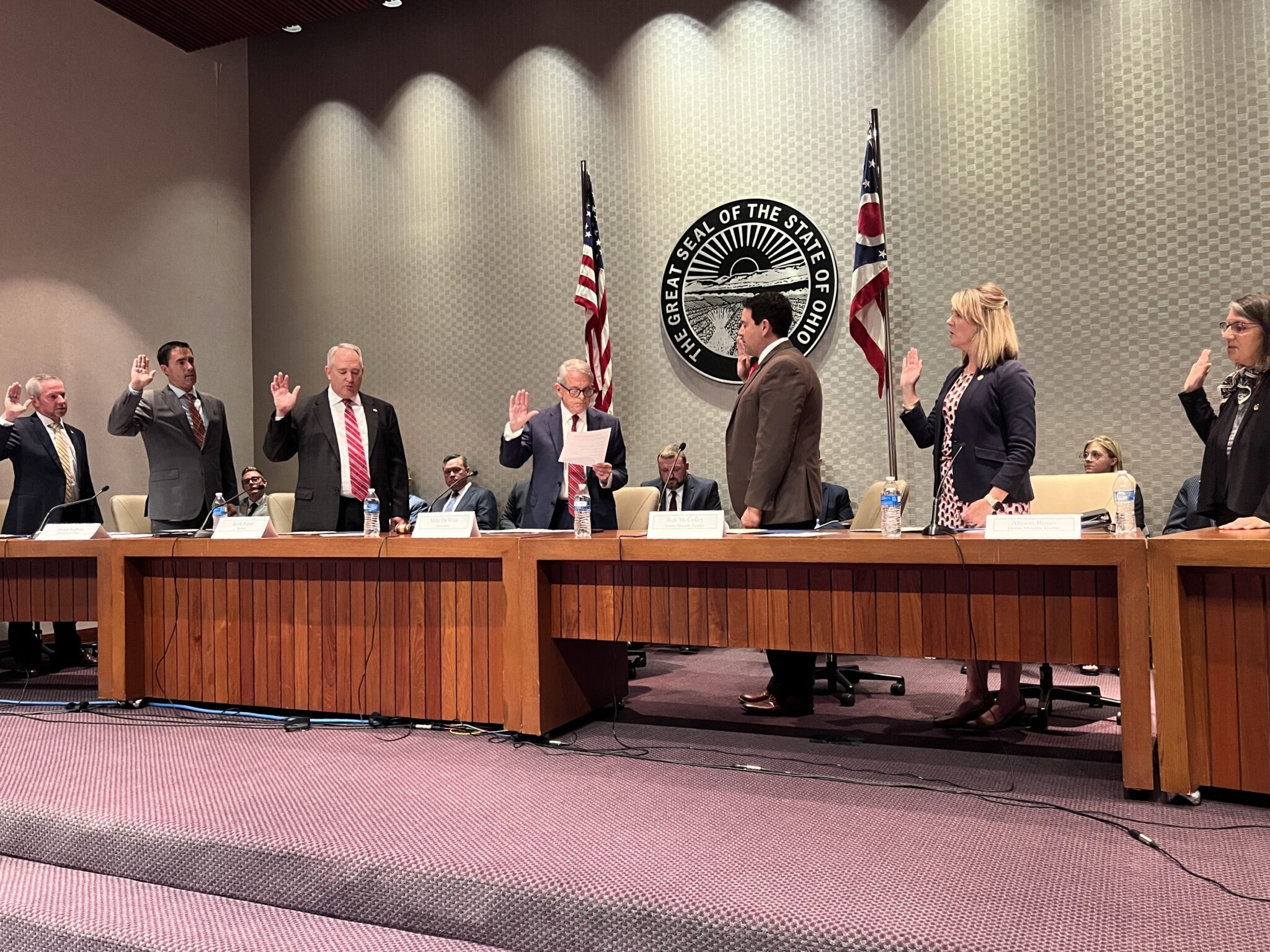
    The members of the Ohio Redistricting Commission are sworn in by Gov. Mike DeWine on Wednesday. Left to right: State Rep. Jeff LaRe, Secretary of State Frank LaRose, Auditor of State Keith Faber, DeWine, Senate Majority Floor Leader Rob McColley, House Minority Leader Allison Russo and Senate Minority Leader Nickie Antonio. (Photo by Susan Tebben, OCJ.)

    BY:  Ohio Capital Journal

    Signature collection continues for an anti-gerrymandering ballot measure in Ohio that would replace politicians on the redistricting commission with citizens. As the July deadline approaches, supporters are pointing to a new study showing how uncompetitive Statehouse races are.

    The Brennan Center for Justice at NYU’s law school analyzed Ohio’s current maps alongside the results of the most recent primary election.

    Authors of the study said the data “reveals one of the tangible ways Ohio’s gerrymandered maps undermine electoral competition, and how the districts leave millions of Ohio voters without a significant voice in the Ohio House elections slated for this November.”

    “An overwhelming majority of Ohioans will cast ballots this November in legislative districts that were drawn to lock in general election outcomes, and few districts featured meaningful primary contests,” the Brennan Center report stated. “These are the predictable consequences of living in a gerrymandered state.”

    One of the authors of the report, released Tuesday, is Yurij Rudensky, who spoke in support of the new ballot initiative proposed to hit voters in November. If it gets on the ballot and is passed by voters, the reforms would replace the current Ohio Redistricting Commission made up of elected officials with a citizen-run, judge-vetted commission to draw the next Statehouse and U.S. Congressional maps.

    Rudensky spoke in a March panel, alongside former Ohio Supreme Court Chief Justice Maureen O’Connor and others, about the difference between the reforms passed in 2015 and 2018 and the proposed amendment that voters may see on their general election ballots.

    At the March panel discussion, Rudensky hesitated to call the last two measures reforms because he argued no changes were made and the previous amendments merely demonstrated that “political insiders have no business being in the process.”

    Since those amendments passed — reforms made through legislative negotiation before hitting the voters — the Ohio Redistricting Commission has been built on a Republican majority, with Gov. Mike DeWine, Senate President Matt Huffman, former House Speaker Bob Cupp, Secretary of State Frank LaRose and Auditor of State Keith Faber all standing on the commission during some or all of the proceedings over the two years it took for the group to pass six Statehouse maps and two congressional maps. State Rep. Jeff LaRe, R-Violet Twp., replaced Cupp and state Sen. Rob McColley, R-Napoleon, came in for Huffman toward the end of the two-year span.

    The Statehouse maps were declared unconstitutionally gerrymandered five times by a bipartisan majority on the Ohio Supreme Court, but voters were forced by federal judges to use them for the 2022 Election.

    Statehouse maps passed by the redistricting commission this past September, and set to be used for this year’s election, were the only to receive bipartisan agreement (with Senate Minority Leader Nickie Antonio and House Minority Leader Allison Russo’s votes), while the state’s Congressional map is still considered unconstitutional under an Ohio Supreme Court ruling.

    In analyzing the current Ohio Statehouse maps, Rudensky and co-author Gina Feliz concluded that about 77% of the state’s population live in “districts where elections for state representatives are not in serious dispute.”

    “That is, these districts are either uncontested, or they give one party a disproportionate advantage in the general election so that the district is uncompetitive, even if it’s formally contested,” the researchers wrote.

    The report defines “uncompetitive” as districts where the partisan draw favors one party by 55% or more.

     Source: Brennan Center analysis of Ohio Secretary of State’s Office Unofficial 2024 Primary Election Results. 

    Nearly half of the districts in the Ohio House didn’t have a primary contest in March to drive a November general election race, the Brennan Center research found, citing data from the Ohio Secretary of State.

    “In all, there are 15 districts (out of 99 total) that will give voters no choice between Democratic and Republican candidates for state representative,” according to the study.

    The report also recognized the low turnout in the state during the primary season, with an average of 18.8% of registered voters casting ballots in districts with competitive primaries.

    Because of that, Rudensky and Feliz counted fewer than 450,000 voters who “all but decided who would serve as state representatives on behalf of more than 2.3 million registered voters and 3.5 million constituents.”

    The report pointed to the proposed ballot initiative led by Citizens Not Politicians as a redistricting reform that could “center community needs and voter preferences rather than the interests of incumbents.”

    Looking to a future that may have an independent redistricting commission, the voting rights group Common Cause put out its own report, a summary of a 2023 conference where members reflected on states who already have such a system in place, and those like Ohio that could see the change come in November.

    “Unsurprisingly, all those who attended the conference believed in the possibilities of fair and representative maps and that independent redistricting commissions were the best strategy to achieve this goal,” Common Cause stated in the new report.

    The “Roadmap for Fair Maps in 2030,” a summary of the 2023 National Citizen Redistricting Commissioners Conference, talked about the need to make redistricting a transparent process that is “responsive to community needs.” At the conference, the report said a “model commission” was organized for Ohio and neighbor state Indiana “to demonstrate how an alternative process based on community input and transparency can work.”

    In a previous report, released shortly after the Ohio Redistricting Commission adopted the current Statehouse district maps, Common Cause gave the state a failing grade, calling the current map-drawing process and the results that came from it “unmitigated disasters.”

    Ideally in redistricting, Common Cause members said the process should “ensure that commissions reflect the diversity of the jurisdiction” and engage community-based organizations and leaders to build resident trust and hold commissions accountable.

    What should not be included in the process, according to the report, are legislature-appointed commissioners or any legislative role in the mapping process.

    “Commission decisions on maps should be final, except for judicial review, with no approval from elected officials required,” the report stated.

    The Citizens Not Politicians initiative was supported in the report as part of strategies to “increase fair representation in 2030,” the next time the process is set to start, though maps in Ohio would need to be redrawn in 2025 if the ballot measure passes in November.

    Opposition to the initiative has been led by Huffman, who helped formulate the previous redistricting reforms. In an Ohio Chamber of Commerce event following the March primaries, he laid out his arguments against the initiative, saying litigation would pile up with the proposed system, and that “when allowed to work,” the current system did its job.

    In order for the measure to appear on Ohio ballots in the general election, supporters must collect 413,487 valid state voter signatures by July 3.

    Susan Tebben
    SUSAN TEBBEN

    Susan Tebben is an award-winning journalist with a decade of experience covering Ohio news, including courts and crime, Appalachian social issues, government, education, diversity and culture. She has worked for The Newark Advocate, The Glasgow (KY) Daily Times, The Athens Messenger, and WOUB Public Media. She has also had work featured on National Public Radio.

    Ohio Capital Journal is part of States Newsroom, the nation’s largest state-focused nonprofit news organization.

    MORE FROM AUTHOR

  • 12 race-based scholarships worth $46,000 weren’t awarded to Ohio University journalism students

    12 race-based scholarships worth $46,000 weren’t awarded to Ohio University journalism students

    That’s only a fraction of $450,000 worth of scholarship money at OU that’s under review after advice from Ohio Attorney General Dave Yost.

    BY:  Ohio Capital Journal

    Twelve race-based scholarships totaling $46,000 weren’t given out at Ohio University’s E.W. Scripps School of Journalism’s awards banquet this week, said Journalism School Director Eddith Dashiell.

    And that’s only a fraction of the 130 gift agreements that represent $450,000 worth of scholarship money under review by the university after comments Ohio Attorney General Dave Yost made about race-based scholarships after the U.S. Supreme Court ruled against race-conscious admissions.

    “I’m disappointed that the university chose this route,” Dashiell said to the Ohio Capital Journal. “It would have been a clear, very easy way to demonstrate their true commitment to diversity and by cowardly cowering to one person’s opinion about how to interpret the U.S. Supreme Court’s decision has resulted in at least 12 of our students not getting scholarships they need.”

    Ohio University’s scholarship review is ongoing, university spokesperson Dan Pittman said in an email.

    “It would be premature for us to speculate on any potential outcomes, including the scope of impacted scholarships and/or gift agreements,” Pittman said.

    Dashiell said it’s misleading for a university to say the scholarships are still under review at the tail end of spring semester.

    “To me, when the university says their official position is the scholarships are still under review, that is code for they haven’t been given out,” she said. “Scholarship season is over. … The decision has already been made.”

    The Capital Journal reported in March that at least seven Ohio public universities — including OU — are reviewing scholarships. The other universities include Cleveland State University, Kent State University, the University of Akron, the University of Toledo, Youngstown State University and Ohio State University. Bowling Green State University is also reviewing race-based scholarships.

    Cleveland State University said the scholarships in questions remain under review and Bowling Green said it “continues to evaluate next steps.” The rest of the universities did not respond by the Capital Journal’s deadline.

    Dave Yost’s remarks

     Ohio Attorney General Dave Yost. (Photo by Morgan Trau, WEWS.) 

    The day after the Supreme Court decision, Yost sent a letter to Ohio colleges and universities saying his office won’t legally protect someone at a college or university who uses race as a factor.

    Race-based scholarships came up on a January call Yost had with universities — even though scholarships were not mentioned in the Supreme Court decision.

    “What was said in response to a question was after the recent Supreme Court decision, scholarships will need to be looked at to ensure compliance with the law,” Yost’s spokesperson Bethany McCorkle said in a Febuary email. “… Race-based scholarships discriminate on the basis of race in awarding benefits. Therefore, it would follow that such programs are unconstitutional.”

    Not long after that phone call, university faculty and staff across the state got wind that diversity scholarships were under review.

    “A public institution of higher education is … supposed to follow the law,” Dashiell said. “(OU is) following one man’s opinion of what the law is.”

    12 missing scholarships

    Dashiell compared this year’s list of journalism scholarships to last year’s list and noticed 12 scholarships were missing.

    “They aren’t there,” she said. “That’s more than under review. They made a decision. They deleted them.”

    OU’s journalism school is made up of 84% white students, Dashiell said.

    “The diversity scholarships weren’t created to keep white students from getting any money,” she said. “They were designed to help encourage African American students to come to a little bitty town called Athens, Ohio. … To say that these 12 scholarships somehow according to the Ohio Attorney General’s Office, somehow that these scholarships discriminate against whites, is so blatantly racist, I don’t even know how to explain that.”

    Dashiell apologized to the donors whose scholarships weren’t awarded in her speech during Tuesday’s awards banquet.

    “On behalf of the E. W. Scripps School of Journalism: To our donors, please accept our deepest apology for our inability to share your generosity with our students for next academic year,” she said.

    Some of the donors whose scholarships weren’t awarded include Pulitzer Prize winning journalist and columnist Clarence Page and former Washington Post ombudsman Andrew Alexander.

    Dashiell is worried how else the Supreme Court decision is going to be interpreted.

    “If it’s diversity scholarships this year, what are they going to pause next year?” she asked. How are they going to stretch the U.S. Supreme Court decision again?”

    Follow OCJ Reporter Megan Henry on X.


    Megan Henry
    MEGAN HENRY

    Megan Henry is a reporter for the Ohio Capital Journal and has spent the past five years reporting in Ohio on various topics including education, healthcare, business and crime. She previously worked at The Columbus Dispatch, part of the USA Today Network.

    Ohio Capital Journal is part of States Newsroom, the nation’s largest state-focused nonprofit news organization.

    MORE FROM AUTHOR

  • Ohio doctors fear effects of emergency abortion care case set to go before U.S. Supreme Court

    Ohio doctors fear effects of emergency abortion care case set to go before U.S. Supreme Court

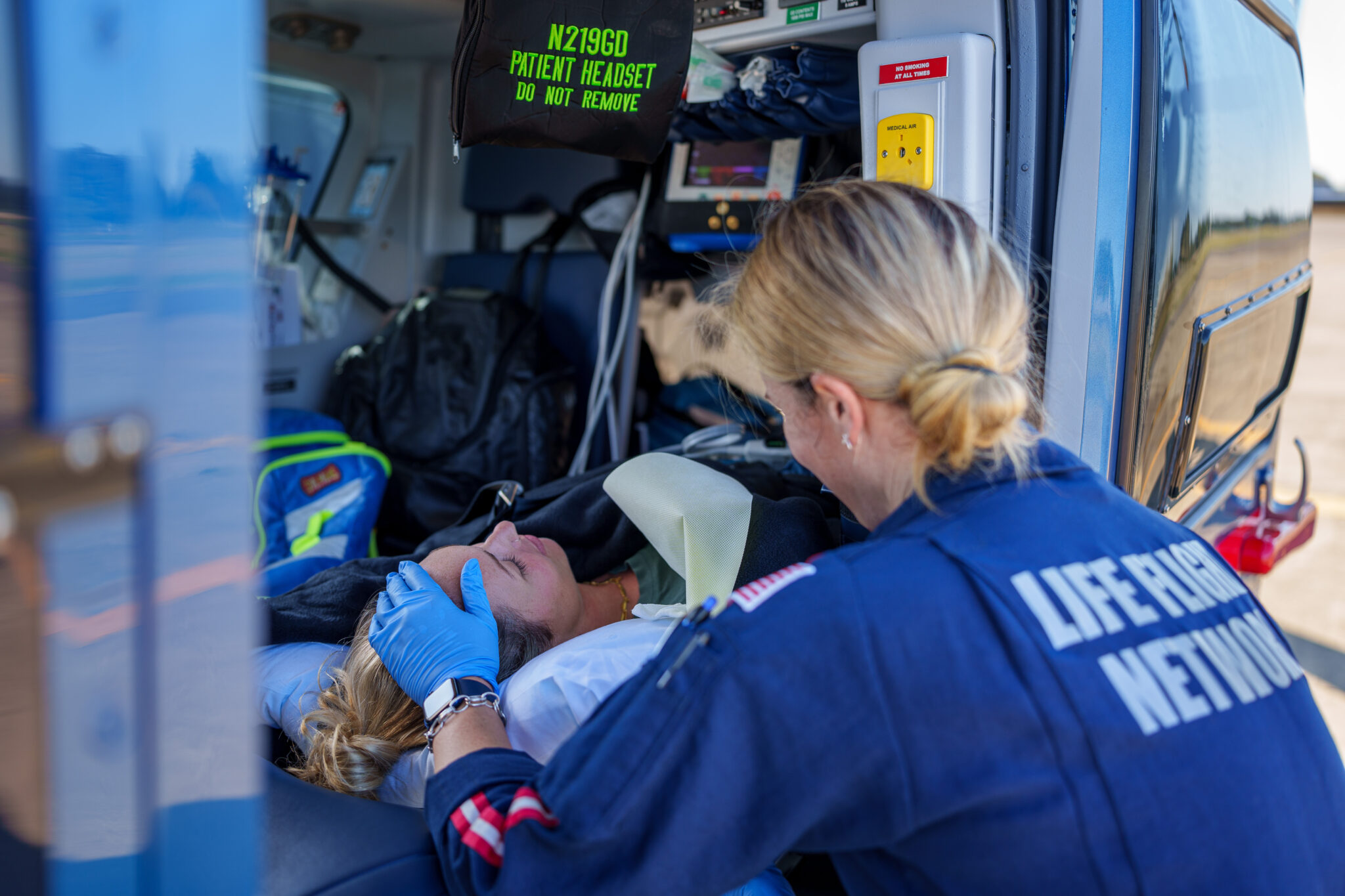
    Because of Idaho’s abortion ban and a court decision that does not protect emergency room physicians from prosecution under that law, some Idaho physicians are advising their pregnant patients, or those trying to become pregnant, to purchase memberships with companies like Life Flight Network or Air St. Luke’s in the Boise area to avoid potentially significant costs if they need air transport in an emergency. (Courtesy of Life Flight)

    BY:  Ohio Capital Journal

    A federal law that allows emergency departments to treat patients without regard to their ability to pay will be under U.S. Supreme Court scrutiny this week, and Ohio doctors are concerned about the case’s local impact on emergency abortion care.

    The nation’s highest court will hear oral arguments in Idaho v. United States, an appeal in which the state is questioning elements of a 1986 law called the Emergency Medical Treatment and Labor Act (EMTALA). The law compels emergency rooms to treat all patients who are experiencing emergency medical conditions and stabilize or transfer those patients, whether or not insurance or financial payment has been confirmed.

    “It is the only guarantee of universal health care in the United States, and it only applies to emergency departments,” Dr. Laurel Barr, a practicing emergency physician in central Ohio, said at a press conference discussing EMTALA and the Supreme Court case.

    The U.S. Department of Justice sued after Idaho passed their own abortion ban that only provides exceptions for the life of the pregnant individual. The DOJ argued the EMTALA preempts any such law.

    After the 2022 decision by the court in Dobbs — which overturned the nationwide right to abortion care and returned the decision to the states — the U.S. Department Health and Human Services sent out a memo with guidelines telling medical professionals that EMTALA still preempted state laws, including in the use of medically necessary abortions.

    “If a pregnant patient is experiencing an emergency medical condition and abortion is the stabilizing treatment necessary to resolve that condition, the physician must provide that treatment to stabilize that patient,” said Ohio health care attorney Jennifer Nelson Carney.

    At issue in the Idaho case is whether or not abortions can be considered a stabilizing treatment, but Carney said depending on how the Supreme Court rules, the case could have ripple effects far beyond reproductive health.

    “(Plaintiffs) think that what they’re asking for is to have the court rule that abortion is not a possible treatment to stabilize, but the likelihood is that, if the court were to go that way, that it would be a much broader implication that would result in people not being treated at all,” Carney said.

    She called it the “classic legal analysis of slippery slope,” and potentially criminalizing conduct covered under EMTALA “places health care providers in a very grim situation of risking criminal liability if they follow just their expertise, training and ethical obligations.”

    “If the opinion says that states can decide what health care services are subject to EMTALA and what aren’t, that is just a brand new health care framework that we haven’t seen in 40 years,” Carney said.

    Ohio is already too familiar with conflicting regulations for physicians, which can cause hesitation when it comes to providing needed care. Though voters approved a constitutional amendment establishing the right to reproductive care such as abortion and miscarriage treatment with 57% of the vote last November, laws still remain on the books in the state that require a 24-hour waiting period before an abortion can take place and for doctors to have hospital privileges within a certain distance from a health clinic that provides abortions services.

    “The big problem right now for us is that Issue 1 has passed … and yet we have seen nothing done with the laws in Ohio,” said Dr. Amy Burkett, an OB/GYN who also served on the board of directors for Ohio Physicians for Reproductive Rights, a leader in the campaign to pass Issue 1.

    To that end, abortion clinics have joined with the ACLU of Ohio in lawsuits to undo regulations that conflict with the recently minted constitutional rights. Most recently, the groups filed a lawsuit in the Franklin County Court of Common Pleas to eliminate “several Ohio laws that together force abortion patients to wait a minimum of 24 hours after receiving unnecessary state-mandated information in person before they can access their desired abortion care,” the clinics said in announcing the suit.

    A separate lawsuit that has been active in one form or another since the fall of Roe v. Wade asks a Hamilton County court to permanently strike down a six-week abortion ban still enacted in the state, though the various court cases targeting it have largely prohibited its enforcement.

    With those lawsuits still working their way through the courts, Dr. Marcelo Azevedo, also a member of OPRR as part of its executive committee, said the EMTALA decision from the Supreme Court could have the same effect that the undoing of Roe v. Wade had on Ohio medicine.

    “I would prepare ourselves for having that same level of confusion that we had after the decision in Dobbs,” Azevedo said.

    That confusion could filter directly from hospital administration decisions to the patients. Barr said before EMTALA, a trend of “patient dumping” was present in hospitals. The term refers to private hospitals who transferred patients to public hospitals after finding out they couldn’t pay or didn’t have the needed insurance.

    Without EMTALA, the situation could return to those days, even when it comes to conditions that don’t involve pregnancy. For those who are stable but need a refill of their insulin prescription, for example, “hospitals will have no financial incentive to treat you when you’re sick, so then they won’t let me provide that prescription unless you swipe a credit card,” according to Barr.

    “It will become an issue where if you can pay, you’ll get your care,” Barr said. “If you can’t, you’ll die.”

    The U.S. Supreme Court is set to hear oral arguments in the Idaho case on Wednesday, April 24.


    Susan Tebben
    SUSAN TEBBEN

    Susan Tebben is an award-winning journalist with a decade of experience covering Ohio news, including courts and crime, Appalachian social issues, government, education, diversity and culture. She has worked for The Newark Advocate, The Glasgow (KY) Daily Times, The Athens Messenger, and WOUB Public Media. She has also had work featured on National Public Radio.

    Ohio Capital Journal is part of States Newsroom, the nation’s largest state-focused nonprofit news organization.

    MORE FROM AUTHOR

  • “Who’s gonna want to move here?” How fracking around Ohio’s Salt Fork State Park is changing area

    “Who’s gonna want to move here?” How fracking around Ohio’s Salt Fork State Park is changing area

    BY:  Ohio Capital Journal

    Terri Sabo has a breathtaking view of Salt Fork State Park from her dining room window in Guernsey County.

    She and her husband Rick Sabo have lived in their ranch home since 1983 — three years after they moved to Cambridge from Canton.

    Terri loves the dark night skies the park provides, but more recently she sees the occasion flare from a fracking injection well about 14 miles away while standing on her front porch.

    “We thought we would always have beauty, but Cambridge is so different than the ’80s,” Sabo said. “I mean, it’s so industrialized now and every, every other pickup truck has an Oklahoma or Texas plate. And it’s, it’s very, very different than it used to be.”

    The presence of the oil and gas industry around Salt Fork and ongoing fracking have turned the Sabos into advocates trying to protect the land around Ohio’s largest state park. Well pads, injection wells and a couple of drilling rigs dot the area around Salt Fork and its winding roads.

    “I’m past the sadness,” Sabo said, as she drove around Salt Fork on a recent Friday morning. “I’m into acceptance now. And it’s gonna happen.”

    Fracking in Ohio

    Fracking is the process of injecting liquid into the ground at a high pressure to extract oil or gas. It has been documented in over 30 states, according to the Center for Biological Diversity.

    Former Ohio Gov. John Kasich signed a law allowing drilling companies to frack in state parks back in 2011. Under the law, potential drillers had to get permission from the newly created Oil and Gas Commission, but Kasich never appointed members to the commissions — effectively preventing anyone from drilling in parks.

    Then in 2022, an amendment to speed up the process for oil and gas companies to get a fracking lease in state parks was added to House Bill 507, which was originally written to reduce the number of poultry chicks that can be sold in lots from six to three.

    The bill (dubbed the “chicken bill”) made it to Ohio Gov. Mike DeWine’s desk and he signed the bill into law in January 2023. The law — which requires the Ohio Department of Natural Resources to allow fracking for natural gas in Ohio’s public lands and state parks — went into effect in April 2023.

    Within the same week DeWine signed the bill into law, the Sabos got a letter from Texas-based company Encino Energy asking to buy their mineral rights — which they still haven’t done.

    “You work all your life to build something and then they frack it,” Sabo said.

    Encino Energy, the largest oil producer and second-largest producer of gas in Ohio, did not respond to questions sent by the Ohio Capital Journal.

     COLUMBUS, OH — FEBRUARY 26: Terri Sabo (center) who can see Salt Fork State Park from her home, weeps and calls out after the Ohio Oil and Gas Land Management Commission voted to approve a bid to drill under the park and two wildlife areas, February 26, 2024, at the Ohio Dept. of Public Safety, Charles D. Shipley Building Atrium in Columbus, Ohio. (Photo by Graham Stokes for Ohio Capital Journal. Republish photo only with original article.) 

    Recently, the Ohio Oil and Gas Land Management Commission selected the “highest and best” bidders to lease part of Salt Fork State Park, Valley Run Wildlife Area, and Zepernick Wildlife Area. This gives the green light for ODNR to lease parcels to these companies.

    West Virginia-based Infinity Natural Resources had the winning bid to drill at least two parcels at Salt Fork for $58.4 million.

    Encino leased three different parcels at Valley Run Wildlife Area in Carroll County for $1.05 million and leased one parcel at Zepernick Wildlife Area in Columbiana County for $231,692.

    Sabo cried at the OGLMC meeting were the winning bids were announced.

    “It’s just a very sad day,” she said after the Feb. 26 meeting. “My biggest immediate concern, obviously, is the loss of the park to (reindustrialization). I’ve really seen it grow and come back.”

    Fracking incidents in Ohio

    There were more than 1,400 fracking incidents associated with oil and gas wells in Ohio between 2018 and September 2023, according to FracTracker Alliance — a nonprofit that collects data on fracking pipelines. About 10% of those incidents were reported as fires or explosions.

    During that same time period, there were 56 total incidents in Guernsey County (where Salt Fork is located), according to FracTracker.

    “When the activities first started moving into the town, we were concerned with explosions and exposures,” Sabo said.

    Encino Energy had five incidents during that time frame, and Washington County was the county with the most incidents in the state with 73, according to FracTracker.

    Changes to the area

    The Sabos first started coming to Salt Fork in the late 1960s and early 1970s, before they lived in Cambridge. They enjoy kayaking and biking at the park and have hiked almost every navigable trail in Salt Fork.

    “We really are outdoorsy people,” Sabo said. “The hiking trails are great. And they’re beautiful.”

    Fracking in the area has brought increased truck traffic, new power lines, and additional cell towers. In particular, it has brought brine trucks and Halliburton trucks that haul fracking sand.

    “Who’s gonna want to move here?” Sabo said. “I mean, who’s gonna want to raise their kids here?”

    They have two adult children and grandchildren, but none of them live in Guernsey County.

    Sabo has learned to pick up on various clues — trees being trimmed and power lines going up — to learn where a new well pad is going to be built.

    “You get suspicious of truck driving activity,” Sabo said. “And you will also see the infrastructure that starts getting built up for people to move in. Like they’ll put in new power lines and towers.”

    She usually sees something new being built when she drives around the Salt Fork area.

    “I wonder what they are doing?” she asked as she drove past new construction.

    She was recently taken aback when she spotted new pipeline being put down next to the Bears Den Steakhouse in Cambridge.

    “This is new since last time I went down this road, and we’re only talking pipeline right now,” Sabo said, visibly distraught. “Seriously, this was not here a week ago. Wow. … Forgive me if I’m shocked.”

    What’s next for the Sabos?

    The Sabos have turned their home into their own personal oasis by adding on to it throughout the years and their next addition will be a hot tub in the backyard.

    They seriously considered moving a couple of years ago, but after much thought they have decided to stay — despite what’s happening to the land around them with fracking.

    “It is beautiful here,” she said.

    Follow OCJ Reporter Megan Henry on X.


    Megan Henry
    MEGAN HENRY

    Megan Henry is a reporter for the Ohio Capital Journal and has spent the past five years reporting in Ohio on various topics including education, healthcare, business and crime. She previously worked at The Columbus Dispatch, part of the USA Today Network.

    Ohio Capital Journal is part of States Newsroom, the nation’s largest state-focused nonprofit news organization.

    MORE FROM AUTHOR

  • Ohio near bottom in preschool spending compared to other states

    Ohio near bottom in preschool spending compared to other states

    BY:  Ohio Capital Journal

    Ohio Gov. Mike DeWine used his recent State of the State speech to proclaim the importance of child care and education, but a national report released last week ranks Ohio near the bottom of the country in preschool spending.

    The National Institute for Early Education Research’s annual “state of preschool” report showed nationwide disparities in access, quality and funding for preschool, with Ohio sitting at 43rd in total reported spending on the early education.

    “Most states have not committed to serving all children, and even those states that have often fall short,” W. Steven Barnett, senior co-director and founder of NIEER at Rutgers University, said in a statement. “Most states need to increase funding per child substantially to enable providers to meet minimal standards for a high-quality, effective program.”

    The report called inadequate funding “a near universal problem.”

    Barnett did praise a 2023 increase in state-level funding of $122 million over two years as part of the most recent state budget, as well as a $250 increase in per-pupil funding, the first in the state since 2009. Ohio ranked 36th in state-specific spending on preschool in the new report, which specifically studied the Ohio Department of Education and Workforce’s publicly funded Early Childhood Education program for the 2022-2023 school year.

     Source: National Institute for Early Education Research 

    That boost followed a reduction in the 2022-2023 school year, when state spending dropped $268 per child from the 2021-2022 year.

    “We encourage Ohio to keep up the progress, as much work remains to provide access to full-day, adequately funded early learning opportunities that will help children develop and parents earn a living,” Barnett wrote in a release on the new data.

    Ohio has a total of 18,000 children enrolled in pre-K education, with 35% of the school districts offering a state-funded program. The federally funded Head Start program for ages 3 and 4 has a state enrollment of 24,649. No state contributions go to the Head Start program for 3 or 4 year olds, according to the study.

    Nationally, preschool enrollment rose to 35% of 4-year-olds and 7% of 3-year-olds, with overall state expenditures increasing by 11% compared to 2021-2022 data.

    “However, despite this notable progress, most states still fell short of their pre-pandemic preschool enrollment,” NIEER stated.

    In terms of access, Ohio ranked 36th for 4-year-olds and 26th for 3-year-olds.

    Last year’s report saw Ohio in 36th for 4-year-old enrollment, but slightly lower at 27th for three-year-old enrollment.

    In the 2024 research, Ohio only met half of the 10 benchmarks noted in the report.

    Benchmarks met by the state in the most recent NIEER report included early learning and development standards; curriculum supports; specialized training for teachers; screening and referral; and its continuous quality improvement system.

    Researchers found the state hadn’t met benchmarks in teacher degrees, assistant teacher degrees, staff professional development, maximum class size and staff-to-child ratios. This data was identical to last year’s met and unmet benchmarks for Ohio.

    An associate degree is required in the state for pre-K teachers, but the NIEER benchmark is a bachelor’s degree. For assistant preschool teachers, the Ohio requirement is a high school diploma, though the NIEER sets a benchmark of a child development associate credential or equivalent credential.

    Maximum class size set in Ohio is 24 for 3-year-olds and 28 for 4-year-olds, though NIEER recommends 20 or lower.


    Susan Tebben
    SUSAN TEBBEN

    Susan Tebben is an award-winning journalist with a decade of experience covering Ohio news, including courts and crime, Appalachian social issues, government, education, diversity and culture. She has worked for The Newark Advocate, The Glasgow (KY) Daily Times, The Athens Messenger, and WOUB Public Media. She has also had work featured on National Public Radio.

    Ohio Capital Journal is part of States Newsroom, the nation’s largest state-focused nonprofit news organization.

    MORE FROM AUTHOR

  • Bill to rid Ohio of spousal rape exception receives support in state Senate

    Bill to rid Ohio of spousal rape exception receives support in state Senate

    BY:  Ohio Capital Journal

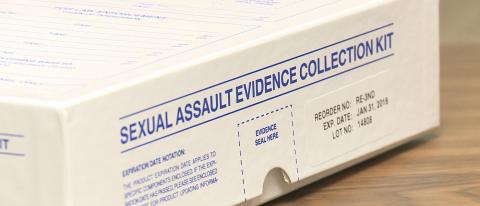
    This story mentions rape and sexual assault. If you or someone you know needs help, the National Sexual Assault Hotline is 1-800-656-4673.

    Survivors of sexual assault perpetrated by their spouses had a simple request for the Ohio Legislature with regard to a loophole in state law that keeps their spouses from being held accountable.

    “Please help us,” Sarah Tucker said.

    Tucker said she not only endured rape from her former husband, but also a lack of action by law enforcement because of an exception for married couples within Ohio sex offense laws.

    While she was finally able to separate herself from her spouse, Tucker still has not received the justice she demands for herself and for her kids. Her journey out of the situation included mental health treatment and other assistance to deal with the “lasting effects of this trauma.”

    “Going through something like this changes a person, changes them to lose faith in the justice system, changes how they see themselves, changes how they face new relationships,” Tucker told the Ohio Senate Judiciary Committee.

    The committee heard proponent testimony recently on House Bill 161, which would eliminate spousal exceptions to rape, sexual battery, unlawful sexual conduct with a minor, gross sexual imposition and sexual imposition, according to the language of the bill.

    “The spousal exception for rape is distinct from the others because it currently applies only if the spouse lives with the offender,” according to an analysis of the bill by the Legislative Service Commission. “Under the bill, a person could be convicted of rape involving the spouse, regardless of whether the spouse lives with or apart from the offender.”

    HB 161 would also allow an individual to testify against their spouse in the prosecution of one of the crimes listed in the bill, and allows testimony “concerning a communication made by one to the other in a case involving any of those offenses, as well as public indecency,” the LSC analysis stated.

    Ohio currently stands as one of only 11 states who still holds an exception for marriage in rape and sexual assault cases, according to the bill’s sponsors.

    Those who advocate for rape and sexual assault survivors see the bill as necessary closure of loose ends that can leave law enforcement without options, and survivors with even less.

    “There can be many obstacles in the path of justice for survivors of sexual violence, but to not even have the option of justice is negligent and re-traumatizing for Ohio survivors,” said Rebecca Peckinpaugh, a licensed social worker and director for Allen County and Putnam County’s Crime Victim Services, and regional director of the Ohio Alliance to End Sexual Violence.

    Maria York, policy director for the Ohio Domestic Violence Network said in her 10 years as a victim advocate prior to working for ODVN, intimate partner sexual assault and spousal sex offenses were seen “repeatedly.”

    “The law enforcement, the prosecutor’s office, did a fantastic job trying to get justice for victims, but unfortunately the law isn’t there,” York told the Senate committee.

    She cited data from the National Institute of Justice, which found 40% to 45% of women in abusive relationships experience sexual assault from a partner.

    The need for a resolution is increasing in the state as well, according to Davina Cooper, director of rural services for Women Helping Women, a rape crisis center serving Adams, Brown, Butler, Clermont and Hamilton counties.

    “Intimate partner violence is a public health epidemic that impacts the lives of survivors, their children, family members and the community,” Cooper said.

    The center saw a 25% increase in “hospital response for sexual assault by a spouse” in 2023, according to Cooper. That number was the highest in WHW’s history, and necessitated an increase in staff for rural programming, she said.

    HB 161, which has bipartisan sponsors, has already passed the Ohio House, and approval from the state Senate would take the bill to the governor’s desk for signature.


    Susan Tebben
    SUSAN TEBBEN

    Susan Tebben is an award-winning journalist with a decade of experience covering Ohio news, including courts and crime, Appalachian social issues, government, education, diversity and culture. She has worked for The Newark Advocate, The Glasgow (KY) Daily Times, The Athens Messenger, and WOUB Public Media. She has also had work featured on National Public Radio.

    Ohio Capital Journal is part of States Newsroom, the nation’s largest state-focused nonprofit news organization.

    MORE FROM AUTHOR

  • Ohio Lt. Gov. Husted won’t say if he knew about $1M dark-money contribution

    Ohio Lt. Gov. Husted won’t say if he knew about $1M dark-money contribution

    Donation came from utility behind massive bribery scandal

    BY:  – Ohio Capital Journal

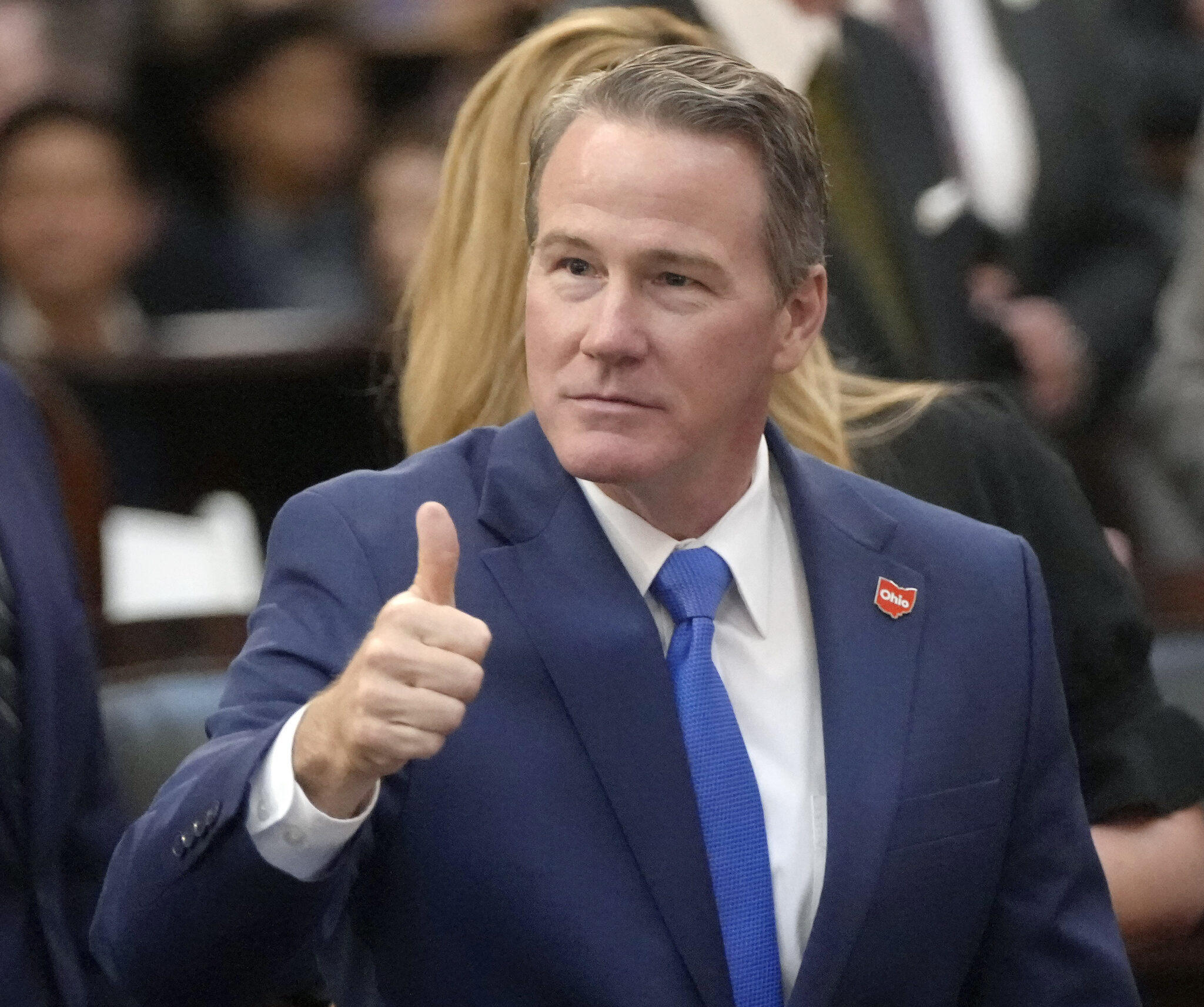
    Ohio Lt. Gov. Jon Husted is refusing to say whether he was aware of a $1 million contribution in 2017 to a political group that was supporting his bid for governor. Instead, his office is only reiterating that the group wasn’t affiliated with the Husted campaign.

    The massive donation came from Akron-based FirstEnergy, which over the next two years ponied up more than $60 million in bribes in exchange for a $1.3 billion ratepayer bailout — a law that Gov. Mike DeWine signed just hours after it passed.

    The donation was discovered among a trove of documents that a group of news organizations including the Capital Journal requested from the Office of Ohio Consumers’ Counsel.

    As reported last week by the Energy News Network and Floodlight, the documents also contained emails indicating that Husted was lobbying DeWine to support the bailout. The lobbying came just 11 days after Husted abandoned his gubernatorial bid and joined DeWine’s ticket on Dec. 1, 2017.

    “Jon Husted called me to say he was meeting with DeWine on our issue to try and get him aligned to help keep the plants open,” a Dec. 12, 2017 email by FirstEnergy lobbyist Joel Bailey said.

    The plants were money-losing nuclear and coal plants that FirstEnergy wanted to prop up with the bailout and then spin off.

    FirstEnergy in 2021 signed a deferred prosecution agreement in which it admitted to paying bribes to elect a friendly Republican majority to the state House, which would elect a friendly speaker who would pass and protect the corrupt bailout.

    The company also admitted to paying a $4.3 million bribe to Sam Randazzo, DeWine’s pick to chair the Public Utilities Commission of Ohio, who died by suicide last week. A state indictment said that FirstEnergy executives arranged the bribe with Randazzo the same night they discussed his suitability as a regulator at a dinner meeting with Gov.-elect DeWine and Lt. Gov.-elect Husted on Dec. 18, 2018.

    The ensuing scandal has landed former House Speaker Larry Householder, R-Glenford, in federal prison for 20 years, and former Ohio GOP Chair Matt Borges for five. Two others have pleaded guilty and await sentencing. Another defendant, lobbyist Neil Clark, also died by suicide — clad in a “DeWine for Governor” T-shirt.

    DeWine and Husted haven’t been charged in case, and they adamantly deny wrongdoing.

    However, they haven’t publicly discussed just what they knew about Randazzo’s long-standing relationship with FirstEnergy, or what they knew about the torrent of dark money flooding from FirstEnergy into Capitol Square to pass and protect the bailout. They also haven’t discussed what senior administration officials with close ties to FirstEnergy might have known.

    Among the documents turned over once FirstEnergy made its agreement with federal prosecutors was a spreadsheet listing 501(c)(4) political contributions the company made in 2017.

    Such donations are called “dark money” because recipients don’t have to disclose their sources. By law, dark-money contributions can’t go directly to candidates, but they can go to groups that support them, but aren’t supposed to directly coordinate with them.

    The FirstEnergy spreadsheet is only now becoming public because the FBI investigated the scandal and the U.S. Department of Justice brought a prosecution. During the battle over the bailout law in 2019, there were suspicions that FirstEnergy was bankrolling the effort, but the press and public couldn’t know because the money was being funneled through dark-money groups — without which U.S. Attorney David DeVillers said the conspiracy would have been impossible.

    Now that FirstEnergy’s 2017 donation to a Husted-aligned group is known, it raises new questions.

    Special interests sometimes piously claim that they spend millions on politics solely in the interests of “good government.” But as was shown in Householder’s lengthy trial last year, corporate political donations are often — if not usually — intended to buy influence with people in government.

    In order for that to happen, a government official would have to know that a special interest had contributed on his or her behalf. But Husted — who is eyeing a 2026 gubernatorial run — won’t say whether he knew that FirstEnergy in 2017 gave a million bucks to a group supporting his earlier bid.

    His spokeswoman, Hayley Carducci, was asked if Husted knew of the contribution and if he did, when he learned of it. She was also asked if Husted persuaded DeWine to support the FirstEnergy bailout; what Husted knew about Randazzo’s links to FirstEnergy when he was picked to regulate the company; and whether he knew that FirstEnergy was flooding Cap Square with dark money in its effort to pass and preserve the bailout.

    In an email, Carducci repeated her earlier statement: “The Husted campaign never received this donation and is not affiliated with any of these groups.”

    She added, “As for your other questions, we will not be commenting.”


    Marty Schladen
    MARTY SCHLADEN

    Marty Schladen has been a reporter for decades, working in Indiana, Texas and other places before returning to his native Ohio to work at The Columbus Dispatch in 2017. He’s won state and national journalism awards for investigations into utility regulation, public corruption, the environment, prescription drug spending and other matters.

    Ohio Capital Journal is part of States Newsroom, the nation’s largest state-focused nonprofit news organization.

    MORE FROM AUTHOR

  • COMMENTARY: Ohio’s true state of the state: Relentless misrepresentation, extremism and corruption

    COMMENTARY: Ohio’s true state of the state: Relentless misrepresentation, extremism and corruption

    David DeWitt

    Meanwhile, Ohio ranks in the bottom half of all states on education, economy, environment, infrastructure, and health care.

    by David DeWitt

    You wouldn’t know it from Gov. Mike DeWine’s State of the State Wednesday, but Ohioans are currently suffering under a state government captured by corruption and yoked to extremist lawmakers racked with dysfunction and intent on little more than imposing radical ideology from the safety of unconstitutionally gerrymandered districts.

    Sweetheart Republican special interests often get everything they ask for in Ohio, while community advocates fighting every day to obtain proven policy solutions that improve the lives of Ohioans get largely ignored. Wealthy families and corporations continue to do phenomenally in the Buckeye State while millions get left behind, or outright attacked.

    Back in 2010, Ohio was ranked by Education Week as having the 5th best public school system in the nation. Education Week’s last ranking was in 2021 and put Ohio at No. 20. A recent ranking from U.S. News & World Report puts Ohio education at No. 29. If you break those numbers down, Ohio sits at No. 21 for Pre-K to 12 education, and No. 37 for higher education.

    State disinvestment from higher education is one of the primary drivers of our country’s vastly over-inflated higher education costs and subsequent record student loan debt.

    The National Center for Science and Engineering Statistics calculated state support for higher education per full-time student in 2021. Ohio ranked No. 40 in the amount of money we provide to fund higher education, giving about $5,600 per student compared to a national average of nearly $8,000.

    So are gerrymandered Ohio lawmakers thinking of how they can help better support our storied and cherished institutions of higher learning as they grapple with enrollment declines and right-sizing? No. They are attacking them. They are attacking freedom of speech and expression in the classroom, and any efforts toward diversity on campuses.

    They’ve proposed and then walked back their ultimate desire to attack tenure and collective bargaining, and in accordance with their own weird preoccupations, they also want to force transgender people on campus to use restrooms that do not match their gender identity and appearance.

    The Ohio Attorney General’s Office has meanwhile put the fear into Ohio colleges over awarding any diversity scholarships. Our student loan debt at college graduation is higher than the national average, and our high school graduation rate is below the national average.

    Regarding K-12, Ohio was giving out $69 million worth of private school vouchers in 2008. In 2023, gerrymandered Ohio lawmakers imposed near-universal private school voucher eligibility. This year, Ohio public funding of private school vouchers is on track to be more than $1 billion by June.

    Who is all the new voucher money going to? Mostly to families whose children were already attending private school. As for the 90% of Ohio K-12 students who attend public school, many are in cash-strapped districts facing budget cuts.

    Ohio doesn’t fare much better in any of the other rankings by U.S. News & World Report. Overall, it puts us at No. 34.

    Ohio ranks No. 31 in crime and corrections; No. 37 in economy; No. 42 in natural environment; No. 32 in infrastructure; and No. 29 in health care.

    Take heart though, Ohio is sitting on $3.5 billion in the state’s rainy day fund and ranks No. 14 in fiscal responsibility. But don’t go counting those chickens just yet. Gerrymandered Ohio lawmakers want to end state income taxes, which would leave a $13 billion state budget deficit.

    They say they could make up the money by raising the sales tax, cutting spending, and letting the economy allegedly “fix itself.” In other words, the rich get richer while everybody else pays a higher percentage of our income for other taxes and fees to make up the difference, and low-income families get their support services cut. This, in a state where 1 in 5 children already suffer food insecurity.

    But wait, what’s this? Ohio ranks No. 11 in “opportunity”? What’s that mean? Well, it’s not economic opportunity. For that we rank No. 35. But it is affordable to live in Ohio, so we grabbed a No. 16 ranking for that.

    Nevertheless, our median household income is below the national average and our poverty rate is above the national average. Ohio also has one of the worst infant mortality rates in the country, and ranks No. 29 in income inequality, with the top 1% of Ohioans taking home nearly 16% of all of the income in the state.

    We often hear from our leaders about what a great place Ohio is to do business. Surely we have a top-notch ranking there then, right? No. We rank No. 29 in business environment, No. 34 in growth, and No. 42 in employment.

    We crack the top half of states on health care when it comes to access (No. 24) and quality (No. 23), but our public health is abysmal, coming in at No. 42. Our pollution ranking is also abysmal, at No. 45. Columbus even recently won the crown for most-polluted city in America. And even though gerrymandered lawmakers have now opened our beautiful state parks and lands to fracking, we still rank No. 35 on energy.

    The national average for renewable energy usage is 12.3%, and Ohio’s is 4.4%. We once had one of the robust commitments to alternative energy in the nation, but, if you’ll recall, that corrupt Ohio House Bill 6 law that DeWine signed same-day that was the product of a $60 million political bribery and money laundering scheme that awarded a $1.3 billion bailout to FirstEnergy and a couple of failing coal-fired plants? It also gutted the state’s renewable energy portfolio.

    Insult to injury, gerrymandered Ohio lawmakers and DeWine also stripped Ohio communities of home rule when it comes to fossil fuel rigs, but made sure local solar projects could be astroturfed and attacked into oblivion.

    This may all sound pretty bleak, because it is.

    But hey, buck up, Ohio. We may not be No. 1 in anything. (In fact, we don’t even crack the Top Ten in anything good.) But at the end of the day, at least we can pick up our kids from one of our under-funded public schools or colleges, gather with our over-worked and under-paid family and friends, and get out in the sun to enjoy some pollution.

    We could picnic at one of our favorite state parks, and take in the soothing views of a fracking operation.

    “We’re No. 34! We’re No. 34!”

    _________________

    David DeWitt
    DAVID DEWITT

    Ohio Capital Journal Editor-in-Chief and Opinion Columnist David DeWitt has been covering government, politics, and policy in Ohio since 2007, including education, health care, crime and the courts, poverty, state and local government, business, labor, energy, the environment, and social issues. He has worked for the National Journal, The New York Observer, and The Athens NEWS. He holds a bachelor’s degree from Ohio University’s E.W. Scripps School of Journalism and is a board member of the E.W. Scripps Society of Alumni and Friends. He can be found on X @DC_DeWitt

    Ohio Capital Journal is part of States Newsroom, the nation’s largest state-focused nonprofit news organization.

    MORE FROM AUTHOR

  • Transgender student bathroom ban bill passes out of Ohio House Higher Education Committee

    Transgender student bathroom ban bill passes out of Ohio House Higher Education Committee

    Getty Image

    House Bill 183 would require Ohio K-12 schools and colleges to mandate that students could only use the bathroom or locker room that matches their sex assigned at birth.

    Local Cosponsors are:

    Jean Schmidt, District 62 (R)
    Jennifer Gross, District 45 (R)
    Thomas Hall, District 46 (R)
    Bill Seitz, District, 30 (R)
    BY:  Ohio Capital Journal

    A bill that would ban transgender students from using the bathroom and locker room that matches up with their gender identity passed out of the Ohio House Higher Education Committee Wednesday by a 10-5 party line vote.

    State Reps. Beth Lear, R-Galena, and Adam Bird, R-New Richmond, introduced House Bill 183 which would require Ohio K-12 schools and colleges to mandate that students could only use the bathroom or locker room that matches their sex assigned at birth. It would also prohibit schools from allowing students to share overnight accommodations with the opposite sex.

    HB 183 now awaits further consideration in the House, which is next scheduled to be in session April 24.

    Parents, grandparents, and school superintendents asked Bird for this bill, he said.

    The American Medical Association officially opposes policies preventing transgender individuals from accessing basic human services and public facilities consistent with gender identity.

    HB 183 would not prohibit a school from having single-occupancy facilities and it would not apply to someone helping a person with a disability or a child younger than 10 years old being assisted by a parent, guardian, or family member.

    State Rep. Gayle Manning, R- North Ridgeville, thought about bringing an amendment to the committee that would have carved colleges and universities out of the bill, but she decided against it.

    “I’m hopeful we will continue to have these discussions on the removal of higher ed,” she said. “The reason being, we’re talking about adults. Universities are similar to a city with the number of students that they have. Frivolous lawsuits that will increase the cost of tuition eventually and the cost of our families.”

    Manning voted in favor of the bill even though she hopes lawmakers can continue conversations to “find a better solution.”

    Bird opposes taking the higher education component out of the bill.

    “The reason I oppose that is because we have college credit plus in Ohio,” he said. “We seventh graders going to college, kids in high school going to colleges and in that college environment, we got to make sure they are protected.”

    State Rep. Joe Miller, D-Amherst, vocalized his disdain for the bill before the committee voted.

    “Here we are again … taking away school districts and colleges’ ability and their leadership to make decisions that are best for providing safe, equitable access for all Ohio students,” Miller said. “I hope that this doesn’t see the floor and doesn’t see the governor’s desk.”

    More than 100 people submitted opponent testimony on HB 183 and more than 30 people submitted proponent testimony.

    “We do love and care about all kids,” Bird said when asked about all the backlash the bill has received. “Me and my Republican colleagues have heard from constituents all across the state. They may not have been loud. They may not have been vocal. They may not have come with a sign to the Statehouse, but we are here representing the vast majority of Ohioans who want protections.”

    Trans advocates speak out against HB 183

    Transgender advocates hosted a press conference following the House Higher Education Committee to voice their opposition to HB 183.

    Trans Ohio Board Member Carson Hartlage said HB 183 is harmful to all students, including cisgender students.

    “Most trans non binary and gender non conforming students only begin using restrooms that align with their gender identities after they’ve experienced some form of trauma when using a restroom that aligns with their sex assigned at birth,” Hartlage said.

    Thirty percent of LGBTQ+ students said they were prevented from using the bathroom that aligned with their gender, and 26% were stopped from using the locker room that aligned with their gender, according to Ohio’s 2021 state snapshot by GLSEN, which examines the school experiences of LGBTQ middle and high school students.

    When looking specifically at transgender and nonbinary students, 42% were prevented from using the bathroom that aligned with their gender and 36% couldn’t use the locker room that aligned with their gender, according to the Ohio GLSEN report.

    Ohio’s first openly transgender public official and member of the Gahanna-Jefferson Public Schools’ Board of Education Dion Manley shared his concerns.

    “As a trans man is I’ve been going into men’s restrooms for 25 years without incident,” Manley said. “I go visit the schools on a regular basis. So these legislators want me to go into a girls restroom in the elementary school, middle school, and high school.”

    Mallory Golski, civic engagement and advocacy manager at Kaleidoscope Youth Center, said how Ohio was recently at the center of history in a positive way with Monday’s eclipse.

    “We’re here reflecting on how we’re at the epicenter of another piece of history,” she said. “And unfortunately, we’re at the wrong place at the wrong time. Unlike the fleeting blackout of the total solar eclipse, the history I’m talking about here today at the statehouse leaves transgender youth in the dark.”

    Jeanne Ogden’s daughter would be directly impacted by this bill. Her daughter’s college classroom building does not have single-use restrooms in the building, forcing her daughter to go across the street to use the restroom.

    “These kids getting bullied and yes, their mental health is suffering,” said Ogden, the executive director of Trans Allies of Ohio. “Trans people are tired. Parents are exhausted.”

    Follow OCJ Reporter Megan Henry on Twitter.

    _______________

    Megan Henry
    MEGAN HENRY

    Megan Henry is a reporter for the Ohio Capital Journal and has spent the past five years reporting in Ohio on various topics including education, healthcare, business and crime. She previously worked at The Columbus Dispatch, part of the USA Today Network.

    Ohio Capital Journal is part of States Newsroom, the nation’s largest state-focused nonprofit news organization.

    MORE FROM AUTHOR

  • FirstEnergy gave $1 million to boost Ohio Lt Gov Husted’s campaign before scandal, document shows

    FirstEnergy gave $1 million to boost Ohio Lt Gov Husted’s campaign before scandal, document shows

    Records show Jon Husted worked behind the scenes to bail out the company’s nuclear power plants. The million dollar donation was secret — until now.

    BY:  AND 

    Versions of this story were published by Floodlight, Energy News Network and the Ohio Capital Journal.

    A surge in FirstEnergy political spending ahead of the utility’s push to secure a legislative bailout for its nuclear power plants included a $1 million dark money contribution to support the campaign of Ohio Gov. Mike DeWine’s eventual running mate.

    The previously unreported gift linked to Lt. Gov. Jon Husted’s 2017 primary bid was revealed as part of a raft of documents obtained under Ohio’s public records law by a coalition of news organizations, including Floodlight, Energy News Network, and the Ohio Capital Journal.

    Among the documents are company emails describing behind-the-scenes efforts by Husted to persuade DeWine to support House Bill 6, the utility-backed legislation at the heart of the state’s ongoing $60 million public bribery scandal.

    Neither Husted nor DeWine, whose campaign also benefited from a previously reported $1 million in dark money from the utility, has been implicated in the scheme in which eight people, including the state’s former House Speaker Larry Householder, have been indicted.

    Two of those charged in the multi-million-dollar scandal surrounding the passage of HB 6 may have taken their own lives, including Sam Randazzo, the former chairman of the Public Utilities Commission of Ohio, who was found dead earlier this week of an apparent suicide.

    ‘Confidential’ email details campaign gift

    One of the documents from the Office of the Ohio Consumers’ Counsel Office is a spreadsheet attached to a January 2020 message labeled “confidential.” It shows $1 million went from FirstEnergy to the conservative group Freedom Frontier in 2017, with “Husted campaign” noted as the reason.

    That group backed Husted during his 2017 primary campaign for governor. The group then supported DeWine after Husted dropped out of the race to become his running mate.

    Husted is considered among possible front runners for the Republican nomination for governor in 2026. A January report by the Jon Husted for Ohio campaign committee shows it got roughly $1.7 million last year.

    Husted was also dubbed the “‘Golden Boy’ for FirstEnergy” by lobbyist Neil Clark, a co-defendant with Householder and others in the federal government’s criminal corruption case. Clark died by suicide in 2021.

    In several of the recently released records, Husted is mentioned in the same breath as Householder, the convicted House speaker, and Randazzo, the former PUCO commissioner, by FirstEnergy leadership as they sought to pass and then defend HB 6, the nuclear and coal bailout law at the heart of Ohio’s ongoing corruption scandal.

     FirstEnergy records released via public records request show how executives at the power company relied on Ohio Lt. Gov John Husted and convicted former House Speaker Larry Householder to help them pass a $1.3 billion nuclear bailout bill. 

    Husted has maintained that his support for the 2019 law stemmed from his belief that nuclear energy is an important part of Ohio’s energy portfolio. Parties in HB 6-related shareholder litigation have subpoenaed Husted to answer questions under oath, although a new date needs to be set.

     FirstEnergy records released via public records request show how executives at the power company relied on Ohio Lt. Gov John Husted and convicted former House Speaker Larry Householder to help them pass a $1.3 billion nuclear bailout bill. 

    “The Husted campaign never received this donation and is not affiliated with any of these groups,” said spokesperson Hayley Carducci. By law, candidate campaigns are not supposed to coordinate with groups like Freedom Frontier, which can spend unlimited amounts to support or attack them.

    The document and others reflect a major commitment by FirstEnergy to Husted’s political future. Before 2017, the company’s reported political spending to support Husted was less than $25,000 per campaign, according to data from OpenSecrets.

    Dark money spending rises sharply

    More broadly, the document also indicates a major increase in FirstEnergy’s political spending through nonprofit groups exempt from taxes under Section 501(c)(4) of the Internal Revenue Code. Those, along with privately held corporations, are common structures for dark money organizations — groups that aren’t required by law to disclose the ultimate source of their funding.

    The company’s giving to such groups jumped to more than $12 million in 2017, after much lower levels of $200,000 in 2016 and $100,000 in 2015, according to the spreadsheet.

    Starting in 2014, FirstEnergy had sought bailouts for noncompetitive coal and nuclear plants. And in late 2016, regulators approved a $456 million consumer surcharge that ultimately was held unlawful. Yet the company claimed it needed more.

    The document details once-secret contributions to groups supporting “everyone from the mayor of Akron to President Trump that FirstEnergy made to secure bailouts for its soon-to-be bankrupt coal and nuclear plants and to gain influence on other key issues,” said Dave Anderson, policy and communications manager for the Energy and Policy Institute.

     A spreadsheet details dark money expenditures by northeastern power company FirstEnergy as it sought to secure a $1.3 billion bailout for its struggling nuclear power plants. The sheet reveals a previously unreported $1 million donation to benefit the candidacy of Ohio Lt. Gov. Jon Husted. 

    Anderson added that the spreadsheet also “provides some key new evidence for utility regulators and consumer advocates to use to ensure that every dollar of ratepayer money that FirstEnergy misused to fund its secret political spending is publicly disclosed and refunded, with interest and ideally serious financial penalties.”

    At the time, the author of the document that details the donations, Kristina Housley, was executive assistant to FirstEnergy’s Mike Dowling, who is now a defendant in a state criminal case along with former CEO Chuck Jones.

    Finding out all the details about the dark money spending behind HB 6 is like peeling back the layers of an onion, said Catherine Turcer, executive director of Common Cause Ohio.

    “The reason that transparency matters so much is that money that is spent in the shadows influences elections, and it influences really important policy decisions that impact us every day,” Turcer said. “And we have the right to know what is going on in government and how decisions are being made and who’s attempting to influence those decisions.”

    The ‘Golden Boy’ for FirstEnergy

    A December 2017 email from former FirstEnergy lobbyist Joel Bailey said Husted was working to get DeWine on board with FirstEnergy’s “issues.” FirstEnergy also supported other pro-DeWine/Husted efforts during the election cycle.

     Former FirstEnergy CEO Chuck Jones (top left), former FirstEnergy VP Michael Dowling (top right), former PUCO Chair Sam Randazzo (bottom middle). Graphic by WEWS. 

    After the election, Husted and DeWine dined with Jones and Dowling on December 18, 2018. Later that night, FirstEnergy agreed to pay $4.3 million to energy lawyer Randazzo, who went on to become DeWine’s first pick for chair of the Public Utilities Commission of Ohio. FirstEnergy later identified Jones and Dowling as the two people responsible for paying alleged bribes.

    Husted’s office has been evasive about his recollections, despite Jones noting in texts to Randazzo that the PUCO chair position was discussed in at least general terms. Another text by Jones in 2019 said the DeWine/Husted team was forced “to perform battlefield triage” to secure Randazzo’s nomination after a 198-page dossier provided to DeWine’s staff threatened to derail it.

    Evidence from last year’s criminal trial of Householder, the former Ohio House speaker, and lobbyist Matt Borges also included messages between former FirstEnergy executives Jones and Dowling about Husted working behind the scenes to build support for the bill. Among the actions were efforts to extend the bailout period for the company’s former nuclear power plants in Ohio.

    Husted long a friend of utilities

    Husted had been Ohio’s secretary of state immediately before becoming lieutenant governor. Before that, he served as House speaker in the General Assembly. In that role, he played a pivotal part in securing passage of another major energy bill, Senate Bill 221.

    At the time, Husted supported the law’s clean energy standards that were ultimately gutted by HB 6. However, SB 221 set the stage for so-called electric security plans. Those have let FirstEnergy and other utilities avoid full rate cases for more than a decade, while allowing cross-subsidies and adding multiple additional charges to consumers’ bills.

    “That bill upset the balance” of energy regulation in Ohio, said Ashley Brown, a former PUCO commissioner. “It was a humongous gift for the utilities.”

    Lawmakers repealed HB 6’s $1 billion-plus in subsidies for FirstEnergy’s former nuclear power plants and its recession-proofing provisions in 2021, eight months after the arrests of Householder and others.

    Earlier this year, Husted told NBC4 in Columbus the rest of HB 6 “needs to be completely removed.” He did not respond to Energy News Network questions this week about whether that includes both the law’s subsidies for two 1950s-era coal plants and its gutting of Ohio’s renewable energy and energy efficiency standards.

    FirstEnergy spokesperson Jennifer Young declined to comment on the company’s 2017 donation to Freedom Frontier due to ongoing litigation. However, she added, “FirstEnergy will post information regarding its support of 501(c)(4) social welfare organizations on the company’s website on a quarterly basis.”

    Those disclosures are currently required under the company’s July 2021 deferred prosecution agreement. That agreement expires later this year.

    Meanwhile, FirstEnergy still has not disclosed its dark money spending for the years 2018 through 2020. And proposals for reforms that would require such disclosures from all electric utilities remain stalled in the General Assembly.

    “It’s incredibly frustrating that Ohioans can be aware that dark money impacted decision-making at the statehouse,” Turcer said, “and yet we still haven’t gotten the legislators to create greater transparency.”

    The Energy News Network is a nonprofit news site dedicated to keeping influencers, policymakers and citizens informed of the important changes taking place in the transition to a clean energy system. Floodlight is a nonprofit newsroom that investigates the powerful interests stalling climate action. 

    This article first appeared on Energy News Network and is republished here under a Creative Commons license.

    _____________

    Mario Alejandro Ariza, Floodlight
    MARIO ALEJANDRO ARIZA, FLOODLIGHT

    Mario Alejandro Ariza is an investigative reporter and a Dominican immigrant. His byline has appeared in publications like the South Florida Sun Sentinel, The New Republic, and The Atlantic. Mario wrote a book called “Disposable City: Miami’s Future on the Shores of Climate Catastrophe,” which was published by Bold Type Books. His essays have been featured in The Believer and selected for Best American Essays. He lives in South Florida with a cat, a dog, and a sturdy pair of waterproof boots.

    MORE FROM AUTHOR

    Kathiann M. Kowalski, Energy News Network
    KATHIANN M. KOWALSKI, ENERGY NEWS NETWORK

    Kathi is the author of 25 books and more than 600 articles, and writes often on science and policy issues. In addition to her journalism career, Kathi is an alumna of Harvard Law School and has spent 15 years practicing law. She is a member of the Society of Environmental Journalists and the National Association of Science Writers. Kathi covers the state of Ohio.

    MORE FROM AUTHOR