Tag: Ohio Capital Journal

  • Ohio House Speaker calls redistricting deadline a ‘myth’

    Ohio House Speaker calls redistricting deadline a ‘myth’

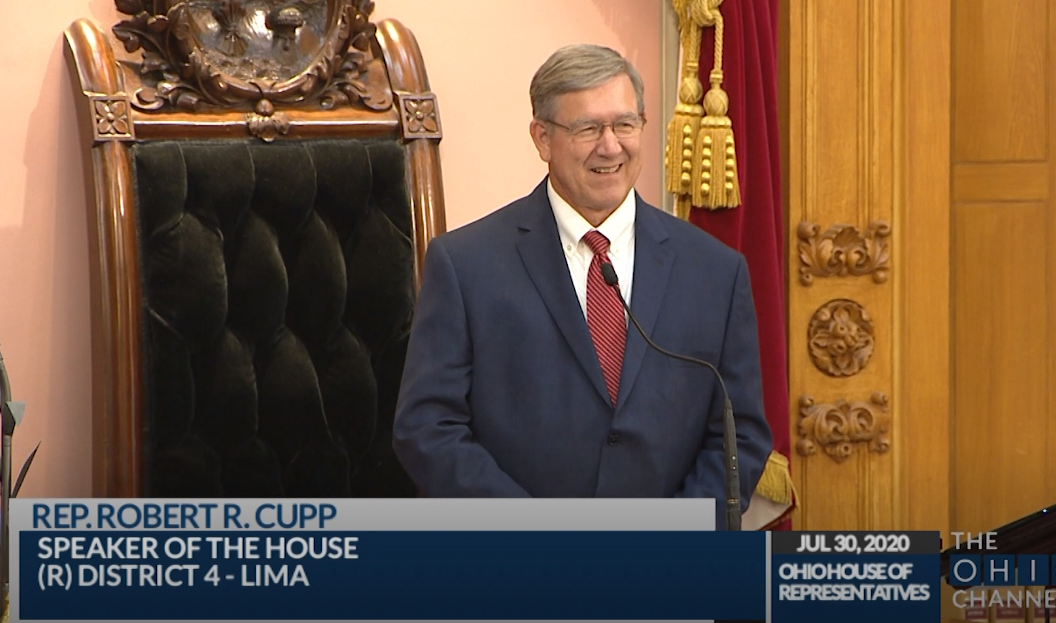
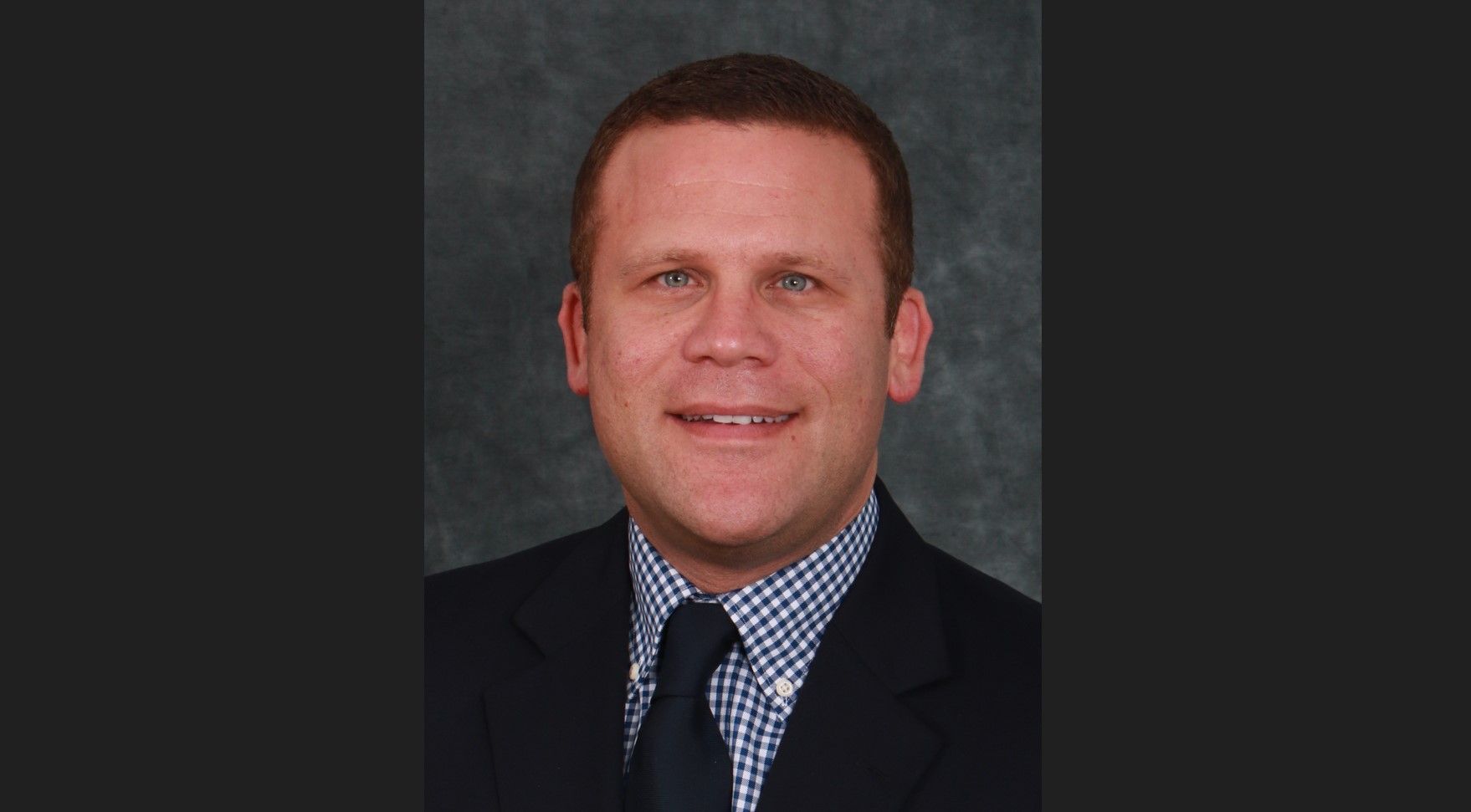
     House Speaker Bob Cupp, R-Lima. Photo courtesy The Ohio Channel.

    U.S. Supreme Court appeal ‘a very real option’

    BY: SUSAN TEBBEN Ohio Capital Journal

    The Ohio House Speaker wrote a letter to members of his party claiming “intentional misinformation” and the “myth” of a deadline for congressional redistricting, and signaling an appeal to the U.S. Supreme Court.

    The Ohio Supreme Court turned down the most recent drafts of congressional district lines in the state, saying the partisan breakdown unduly favored Republicans and didn’t match the breakdowns of election results in the state.

    In the court decision, the court majority ruled that “within 30 days, the General Assembly must pass a plan that complies with the Constitution.”

    Speaker Bob Cupp, however, said in his letter to fellow Republicans that “out-of-state activists have peddled the myth” of a deadline this week.

    “It is false, has zero basis in fact, and either shows a lack of understanding of our legal system, or it is an attempt to intentionally sow confusion over the 2022 elections,” Cupp said in the letter, provided to media by a spokesperson.

    Cupp, a former state supreme court justice, then argues a deadline for new congressional maps “does not commence until all appeals are final,” including a deadline for appeal to the U.S. Supreme Court of 90 days from the date of the state supreme court decision.

    Cupp did not explicitly say the legislative leaders would be appealing to the U.S. Supreme Court, but said the General Assembly’s 30-day clock wouldn’t start until after the nation’s highest court decided not to review the appeal.

    When asked for clarification, a spokesperson for Cupp said a U.S. Supreme Court appeal “is a very real option that we have time to thoroughly consider.”

    The final date to appeal, Cupp states based on the state supreme court’s decision date of July 19, is Oct. 17.

    “So, there is no state constitutional requirement to draw new congressional districts for the 2024 election cycle before then,” Cupp wrote.

    This is the third time the General Assembly has been asked to redraw congressional maps. The last time the state supreme court rejected the maps, the General Assembly didn’t take action, and the effort moved, as was ordered by the Ohio Supreme Court, to the Ohio Redistricting Commission.

    No mention of U.S. Supreme Court appeal was brought up at that time, despite the fact that Cupp was House Speaker and co-chair of the ORC.

    After being rejected in January, new congressional maps were passed by the ORC in March.

    Cupp’s compatriot in the other legislative chamber, Senate President Matt Huffman, commented to media, saying no action is expected from the Ohio Senate on congressional maps.

    A spokesperson for Huffman did not comment other than to confirm the accuracy of a Dispatch story in which Huffman said the Ohio Supreme Court does not have the power to dictate the Ohio legislature’s duty in redistricting. He also said the U.S. Supreme Court could definitively answer the question of redistricting authority in Ohio.

    The ACLU of Ohio, which has been a party in several of the legal challenges to congressional and legislative redistricting, called Cupp’s legal argument a “gambit” at the “11th hour.”

    Freda Levenson, legal director for the ACLU of Ohio, said the Ohio Supreme Court “ordered the legislature, in no uncertain terms, to draw a map by tomorrow.”

    Because the OSC’s order to draw a new map ruled purely on matters of Ohio law, it is not appealable in federal court,” said Levenson. “So there is no legitimate way to try to extend the Ohio Supreme Court’s deadline.”

    Follow OCJ Reporter Susan Tebben on Twitter.

  • Texts, calendars, emails link DeWine to FirstEnergy’s bribery scandal

    Texts, calendars, emails link DeWine to FirstEnergy’s bribery scandal

    BY: JAKE ZUCKERMAN – Ohio Capital Journal

    Gov. Mike DeWine and his administration played a hands-on role passing an allegedly pay-for-play nuclear bailout and appointing an industry-friendly regulator who has since been accused of taking a $4.3 million bribe, documents and messages show.

    Calendar records show DeWine, a Republican, met repeatedly to discuss energy policy with FirstEnergy Corp. officials and at least once with GOP House Speaker Larry Householder, who has been criminally accused of taking a separate, multimillion-dollar bribe from the company to pass the bailout.

    Despite a cautionary letter from environmental groups and a 198-page dossier from his former campaign staffer warning against the move, DeWine appointed Sam Randazzo in 2019 to the head of the Public Utilities Commission of Ohio. FirstEnergy last summer admitted it paid Randazzo a $4.3 million bribe. Randazzo has not been charged with a crime and denies wrongdoing.

    Newly released text messages show FirstEnergy executives describing an open line with the administration on the selection and inside support from Ohio’s chief executive.

    “When the Gov Elect asked me about attributes, I listed integrity, work ethic, creativity, thick skin, circumspection in public statements,” FirstEnergy’s then CEO texted Randazzo about the open PUCO seat in December 2018, just before DeWine took office.

    “You fit all of those.”

     Former FirstEnergy CEO Charles “Chuck” Jones. Source: FirstEnergy, via Flickr

    In one text, FirstEnergy executive Mike Dowling credits DeWine and Lt. Gov. Jon Husted with performing “battlefield triage” to save Randazzo’s appointment before a key vote. Both DeWine and Husted have previously denied that a redacted version of the text message that appeared in criminal documents referred to them.

    Federal prosecutors accused House Speaker Larry Householder of secretly controlling a nonprofit that took $60 million from FirstEnergy. He allegedly used the money to enrich himself personally and politically and to ensure the passage of House Bill 6, which provided a massive bailout to two nuclear plants owned at the time by FirstEnergy. Householder was charged with racketeering and awaits trial. Two alleged conspirators pleaded guilty.

    FirstEnergy admitted last summer to the $60 million payment as well as a separate $4.3 million bribe to Randazzo just before he started as Ohio’s top utility regulator. The payment topped off $22 million in consulting fees to Randazzo since 2010 from the company.

    Court documents from prosecutors reveal no focus on DeWine, who has not been charged with any crime. However, a review of records turned over in subpoenas, public records requests for his official calendars by the Energy and Policy Institute, text messages attached to regulatory filings, and others show DeWine and his staff repeatedly influencing and shepherding HB 6 into law.

    On the campaign trail in July 2018, DeWine visited one of the nuclear plants that would receive a bailout, his official calendar shows. A month later, he met with FirstEnergy executives at their Akron headquarters. In October of that year, DeWine met with FirstEnergy at a fundraiser for Republican governors.

    FirstEnergy contributed about $1 million in total to DeWine’s campaign, political organizations supporting it, and to another nonprofit supporting his daughter’s campaign for county prosecutor, according to the Dayton Daily News.

    After winning a close race, DeWine, Husted, Jones and Dowling celebrated over dinner at The Athletic Club in Columbus. The next day, Jones sent Randazzo the text message (above) indicating they discussed the open PUCO seat.

    In January of 2019, the FirstEnergy officials texted one another trying to fill not just one but two open PUCO seats, all the while mentioning phone calls with “DeWine guys” about it.

    “That’s their plan but nothing certain until Sam’s [Randazzo’s] meeting [with DeWine],” Jones texted Dowling. “Four people in DeWine world, you, Sam, and I know about this.” The PUCO seats would eventually be filled by Randazzo with another commissioner renewed.

    Dowling relayed to the other two men a message from Josh Rubin — a DeWine 2018 campaign adviser and a FirstEnergy lobbyist. He said once Randazzo takes office, DeWine will “lean on him on everything.”

    Several texts focus on HB 6. The bill (and eventual law) would bail out FirstEnergy’s nuclear plants, subsidize two coal plants owned by other Ohio utility companies, and create a “decoupling” mechanism that effectively put ratepayers on the hook to guarantee certain revenue streams of FirstEnergy’s. Prosecutors estimate the bill as worth about $1.3 billion to the company.

    Two days before the bill was introduced, DeWine’s calendar shows a slot for an “Energy Discussion” at the governor’s residence. Later that month, after the bill was repeatedly criticized during an opponent testimony hearing at the statehouse, DeWine, Husted, Randazzo and various staffers all met up at 5 p.m. for what the governor’s calendar calls a “Nuclear Bailout Bill Discussion.”

    Over the next month, DeWine’s calendars show two entries for energy policy meetings, plus a call with Householder about HB 6, and another call on the bill.

    On June 9, 2019, DeWine showed signs of wavering.

    “Sam, what do we know about whether nuclear plants need this boost?” DeWine, using his personal email, wrote to Randazzo. “One editorial suggested testimony was not conclusive.”

    Dowling paid a visit to the governor’s residence the next day. Randazzo responded to DeWine’s email on June 11, casting doubt on the studies referenced in the editorials.

    On July 1, Dowling texted Jones.

    “Just had a long conversation with JHusted just now,” he said, going on to explain that Husted sought to extend the length of the bailout. “All is well.”

    Court records contain another text from Jones stating that “State Official 2,” later confirmed to be Husted, joined with others in “fighting to the end” for a beefier bailout.

    After a long slog, lawmakers passed HB 6 on July 23, 2019. DeWine signed it into law mere hours later.

     FBI agents remove boxes of materials from PUCO Chairman Sam Randazzo’s condo in Columbus Nov. 17, 2020. Photo courtesy of Daniel Konik/Statehouse News Bureau.

    Loyalty to staff and HB 6

    As the FBI made its first arrests, DeWine began a pattern of defending HB 6 on the merits and showing unflinching loyalty to his staffers, some of whom have ties to FirstEnergy.

    Householder, his political strategist, a prominent GOP lobbyist, and two FirstEnergy lobbyists were arrested and charged with racketeering in connection with HB 6 on July 21, 2020. The next day, DeWine stood by the law he signed.

    “Because people did bad things does not mean that the policy is not a good policy,” he said.

    He reversed himself the next day and called for a repeal of the bill.

    In October, FirstEnergy fired Jones, Dowling, and fellow executive Dennis Chack as it waged an internal investigation. The company fired another two executives days later “due to inaction and conduct that the Board determined was influenced by the improper tone at the top.”

    At this point, the public remained unaware of the multimillion-dollar financial arrangement between the embattled FirstEnergy and Randazzo. However, on Nov. 16, 2020, FBI agents were seen raiding Randazzo’s condo and removing boxes of material from inside. The next day, FirstEnergy submitted a little-noticed securities filing outlining the $4.3 million payment.

    Despite the images of FBI agents entering Randazzo’s condo, DeWine publicly defended his appointee.

    “We have no indication he’s under investigation or he’s the target of an investigation. We’ll wait until we find additional facts,” he said in a Nov. 17, 2020 news conference. “Look, the FBI many times will indicate if someone is a target. They have not indicated he’s a target. I have no reason to think he’s a target. I don’t know. So, we’re waiting for additional information, quite candidly. I hired him. I think he’s a good person. If there is evidence to the contrary, then we’ll act accordingly, but not going to act without facts.”

    Randazzo would resign three days after that statement.

    Mid-summer 2021, FirstEnergy signed a deferred prosecution agreement with the U.S. Department of Justice. The company agreed to pay a $230 million penalty and cooperate with investigators to avert a charge of honest services wire fraud.

    The agreement contained a lengthy set of facts from the company, stating it paid the $64 million in bribes in exchange for official action from Householder and Randazzo.

    Days after the agreement was announced, DeWine held a press conference on anti-hazing legislation. Reporters asked questions afterward about the agreement, including a line that refers to “State Official 1” and “State Official 2” lobbying to ensure Randazzo’s appointment. DeWine said he’s “not aware” of anyone in his administration, including himself, appearing in the document. Husted, in a statement, said he too “does not believe” he’s referenced in the document.

    Texts obtained by the Ohio Consumers’ Counsel from FirstEnergy and attached to a regulatory filing contain the unredacted version of the text, identifying DeWine and Husted by name.

    In 2017, a lobbyist named Dan McCarthy created a nonprofit entity called Partners for Progress to engage in “advocacy in support of nuclear power,” tax records show. FirstEnergy would later admit to paying $25 million to Partners for Progress, some $15 million of which went to Householder’s nonprofit.

    DeWine hired McCarthy as his legislative director in 2019, around the time McCarthy stepped down from the organization’s board. In February 2021, after media reports identified McCarthy’s role with Partners for Progress, DeWine defended McCarthy.

    “As far as I know, Dan McCarthy has been well-respected for many, many years, long before he started working for me as our legislative director, and I have faith in his integrity,” DeWine said.

    McCarthy resigned in September 2021.

    DeWine response

    In a phone interview, DeWine spokesman Dan Tierney said the OCC-obtained text messages and meetings listed by the Ohio Capital Journal contain no new information.

    The texts, he said, in fact show the lack of a role from DeWine and Husted within the scandal. He said prosecutors have not subpoenaed him or any of his employees.

    “This all along has been a Larry Householder scandal and a FirstEnergy scandal,” he said.

    When asked whether DeWine, a former prosecutor and attorney general, detected any sense of impropriety during all his contacts with Householder and FirstEnergy leading up to the passage of House Bill 6, he declined comment.

    Husted offered a similar comment through a spokeswoman, stating that “there is nothing new here” in the texts, emails and meetings.

    “This kind of advocacy is well within his responsibilities as a public official, and, as we know, the bill was ultimately passed with bipartisan support,” he said.

  • State health officials preach prevention as Monkeypox, COVID-19 continue spread

    State health officials preach prevention as Monkeypox, COVID-19 continue spread

    Blood sample tube positive with Monkeypox virus. Getty Images.

    BY: NICK EVANS – Ohio Capital Journal

    Ohio Department of Health officials emphasized calm and caution during an update Thursday. Cases of Monkeypox are on the rise nationally, and COVID-19 continues to spread as children prepare to return to school. Both present challenges, health officials explained, but the state is well-positioned to respond.

    Monkeypox

    Monkeypox cases so far have come primarily from to the community of men who have sex with men. The latest data from the CDC show 99% of cases affect people assigned male at birth, and for those cases with information about sexual activity, 99% report male to male sexual contact.

    As of Aug. 10, there are more than 10,000 cases of Monkeypox nationally. But since reporting it’s first case in June, Ohio Health Director Dr. Bruce Vanderhoff explained the state has confirmed just 75 cases.

    “Most of Ohio’s cases are in our large metro areas, with only a few cases reported in other jurisdictions,” Vanderhoff said.

    Unlike COVID-19, he said, Monkeypox spreads “mostly through close intimate contact with someone who has Monkeypox, most often through direct contact with the infectious rash, source scabs or body fluids from a person with Monkeypox or from respiratory secretions during prolonged face to face contact.”

    Because of those limits on transmission, Vanderhoff said the risk of contracting the disease remains low for most Ohioans. The biggest challenge Ohio faces is short supply of the Jynneos vaccine.

    “Because Ohio has had comparatively fewer cases than other states, our allocations have likewise been less than some harder hit states,” Vanderhoff said. “Rest assured that Ohio continues to actively advocate for more vaccines, and as more vaccine has become available has properly placed orders for the maximum allocated dose.”

    Between a shipment of more than 5,000 doses that arrived this week and more on the way, health officials expect to eclipse 13,500 doses soon. And that supply will stretch even further since the FDA approved a shallower, intradermal injection that uses about 1/5 as much of the drug.

    OhioHealth infectious disease medical director Dr. Joseph Gastaldo still urged caution.

    “I think it’s important for people to realize that if you get the vaccine it’s not a Monkeypox free pass,” he warned, “meaning that you still have to wait to be fully vaccinated, and that is two weeks after the second dose to have the maximum protection for Monkeypox.”

    COVID-19

    The CDC also announced new guidance for COVID-19 Thursday. Among the changes, people exposed to the virus can skip quarantine but need to wear a high-quality mask for 10 days and test on the fifth day. The CDC still advises people who have contracted the virus to isolate from others regardless of their vaccination status.

    Dr. Vanderhoff noted any health update where COVID-19 isn’t the first topic on the agenda is a good sign, but he stressed the virus is still circulating widely in the state. He insisted that getting fully vaccinated and boosted remains the best protection against severe disease.

    Despite new variant-specific boosters planned for this fall, Vanderhoff urged anyone who is currently eligible for a booster to get it rather than wait.

    “Waiting for that new booster may not however, be the best way to protect yourself now,” he said. “For older unvaccinated are not up to date on vaccinations and you’re at continued risk for more serious illness. I encourage anyone who’s not up to date with their vaccination, including those currently eligible for a first or second booster to seize this opportunity, to prepare for the fall.”

    He also said the percentage of kids entering kindergarten fully immunized has slipped the last few years. Vanderhoff diplomatically chalked this up to COVID-19 limiting opportunities for doctors’ visits or remote learning reducing parents’ sense of urgency. Later he acknowledged vaccine-skepticism is likely playing some role as well.

    Dr. Michael Forbes from Akron Children’s Hospital said they overcome that hesitancy by drawing connections to other everyday precautions.

    “The message to families that we really try to communicate is we try to prevent what’s preventable,” Forbes said. “That’s what we do when it comes to helmets, seatbelts. Bad things can happen and do happen. But as parents we have a duty to protect our children. And so having an effective, safe vaccine that prevents these common illnesses I think is really important.”

    Follow OCJ Reporter Nick Evans on Twitter.

  • Experts: Dems’ drug measures are good for seniors. But there are downsides

    Experts: Dems’ drug measures are good for seniors. But there are downsides

    BY: MARTY SCHLADEN – Ohio Capital Journal

    The sweeping Inflation Reduction Act passed by Democrats in the U.S. Senate on Sunday takes on an issue that Americans have been screaming about for years: the high cost of prescription drugs.

    But while it will bring immediate relief to millions of seniors, several experts have said it may dampen development of new drugs and new uses for existing ones. And, they say, it fails altogether in addressing one of the fundamental drivers of increasing drug costs for all Americans — the massive, non-transparent system of rebates charged by huge drug middlemen.

    “I would broadly characterize the package as a mixed bag with a lot of missed opportunities,” said Antonio Ciaccia, CEO of 46brooklyn Research, an Ohio-based drug-pricing data firm. 

    Along with its provisions to address climate change and to go after wealthy tax cheats, the bill seeks to ease drug costs for patients enrolled in Medicare, the federal health program that primarily benefits Americans over 65. 

    One of the most powerful ways it would do that is by capping out-of-pocket drug costs for seniors in Medicare Part D at $2,000 a year starting in 2025, the Kaiser Family Foundation reported

    “That out-of-pocket cap is amazing,” Ciaccia said. “You can’t imagine the number of seniors who are rationing their care, having family members who are having to pony up for treatment, sometimes forgoing it, taking out of their retirement in order to do it. So let’s be very clear. I think that policy is unbelievably good and necessary.”

    The bill also would also ease seniors’ burden by eliminating all out-of-pocket costs for vaccines starting next year. And it would eliminate the 5% copayment for seniors in the “catastrophic tier” of Part D starting in 2024. 

    Medicare recipients enter that tier after their putative out-of-pocket costs reach $7,050 (in 2022). But Medicare counts much of what drugmakers and others also pay while patients are in the so-called “coverage gap” toward their out-of-pocket expenses.

    In addition, the Senate bill would employ several mechanisms to control drug prices — but only for Medicare patients.

    Starting next year, it would require manufacturers to pay a refund if their price increases exceed the rate of inflation. That provision would apply to all medicines costing more than $100 per year.

    In 2026, the bill also would start targeting certain, high-cost drugs. 

    The system is a little complicated. But in a nutshell, it breaks drugs down into two categories — “small-molecule” drugs — think most of the traditional pills you take — and “biologics,” medicines consisting of more elaborate molecules that often have to be administered by injection or infusion.

    Based on their classification, the government would give makers of certain expensive drugs different periods of time after they receive FDA approval to sell their products at whatever prices they want. But after nine years, makers of some expensive small-molecule drugs would have to start selling them at progressive, steep discounts. Makers of some pricey biologics would have to start doing so after 13 years.

    Supporters of the Inflation Reduction Act describe what would happen after those exclusivity periods as “negotiation,” but drugmakers might not have much of a choice. As explained by KFF, the discounts are laid out in the bill, as are hefty fines for drugmakers who refuse to participate.

    Perhaps predictably, an industry group representing drug manufacturers isn’t happy with it.

    “Once the government can set prices for life saving medicines, it will demand even more control over the health care of American patients and the collateral damage from this bill will only grow,” Stephen J. Ubl, President and CEO of the Pharmaceutical Research and Manufacturers Association, said in an Aug. 7 statement. “There is still time to reject this partisan bill and work on bipartisan reforms that lower costs at the pharmacy and protect the hope patients have for new treatments. We urge the House to do what’s needed to stop this dangerous bill and deliver the kind of meaningful patient-centered reforms the American people are counting on.”

    That might be a self-interested argument. But some independent experts also raised concerns that the discounts spelled out in the bill would dampen investors’ enthusiasm for plowing money into pharmaceutical research. 

    Craig Garthwaite, director of the Program on Healthcare at Northwestern University’s Kellogg School of Management, wrote that in their first stages of development, ideas for new drugs often migrate from university laboratories to small companies. Those companies then try to attract venture capital from investors who know that such projects are often a bust, but some offer huge rewards, Garthwaite wrote late last month in the health publication STAT News.

    Only after these technologies prove promising are they bought by larger drugmakers who have the resources to conduct clinical trials, facilitate government approval, then mass produce and market the drugs, he wrote. Garthwaite argued that by limiting the ultimate profitability of some drugs, the new rule would limit the venture capital needed to fund innovation in its earliest stages. 

    “So the new legislative carve-out won’t save anyone,” he wrote. “Subsequent price controls will still erode startup valuations and therefore investment. Venture capital companies could no longer count on exiting their investments with the same level of returns because any future buyer would be staring down the price-control barrel.”

    However, others have argued that the scope of those controls would be limited. The legislation passed on Sunday calls for controls to be placed on 10 drugs in 2026, 15 in each of the two years after that and 20 in 2029 and each year after that.

    In its analysis, the Congressional Budget Office also said the bill’s impact on innovation would be miniscule, reducing the number of new drugs introduced over the next 30 years by just over 1%.

    But should the Inflation Reduction Act become law, it will take away what some experts see as a much more powerful tool to curb drug inflation. It would preserve protections huge drug middlemen enjoy from federal anti-kickback laws.

    The biggest three middlemen, known as pharmacy benefit managers, are all combined with major insurance companies and each corporation is among the 25 largest corporations in the United States. In Medicare, Medicaid and in the private insurance market, they decide which drugs are covered and they extract huge rebates from drugmakers in exchange for putting their products on lists of covered drugs, or formularies. 

    The transactions are non-transparent so it’s not known how much of those rebates the pharmacy benefit managers are passing along or how much they’re putting in their pockets. However, research has shown that inflating rebates have led to even greater inflation in the list prices. 

    Those are the prices you pay if you don’t have insurance. They’re also often what your copayments, coinsurance and deductibles are based on. And that’s not just for people on Medicare, that’s for everybody.

    The Trump administration proposed and then delayed a rule that would have effectively prohibited pharmacy benefit managers from extracting rebates from drugmakers in exchange for covering their drugs. After the Biden administration also delayed the rule, the bill passed by the Senate on Sunday would eliminate it altogether.

    Former FDA Commissioner Scott Gottlieb said that the big disparity between list prices and net prices for drugs was already a big problem and several provisions in the Senate bill likely will make it worse.

    “Because rebates often flow to insurers and not patients, this phenomenon partly unwinds the effects of community rating by requiring generally sicker patients taking expensive medications to pay more,” he wrote with Benedic N. Ippolito, a senior fellow at the American Enterprise Institute. “If anything, policymakers should be looking for ways to attenuate the large divergence between high list prices of drugs and lower post-rebate, ‘net’ prices.”

    Ciaccia, the Ohio drug pricing analyst, said the system in the United States has become so screwed up that it’s inevitable that the fixes for Medicare patients in the Inflation Reduction Act would come with costs elsewhere.

    “Let me ask you this: Why do we need these caps in the first place?” he said. “It’s because some of these medications are so over-inflated it’s ridiculous. It’s not realistic for (seniors) to obtain them without some sort of collateral damage due to our pricing system.”

    Follow Marty Schladen on Twitter.

  • Judge scolds former GOP chairman, forbids him from intimidating whistleblower

    Judge scolds former GOP chairman, forbids him from intimidating whistleblower

    Photo by Getty Images.

    BY: JAKE ZUCKERMAN Ohio Capital Journal

    A federal judge lambasted a suspect in a criminal public corruption case for posting a FBI informant’s social security number and address on the internet.

    U.S. District Judge Timothy Black said he finds it “entirely incredible” that lobbyist and former GOP Chairman Matt Borges accidentally posted the information of the whistleblower online, as Borges claimed.

    “Indeed, page 3 of the file alone includes [the informant’s] name, address, phone number, spouse’s name, spouse’s phone number, and [the informant’s] social security number, all of which are listed in large, bold font, at the very top of the page,” Black said, using the visual emphasis in his court order.

    “It is virtually impossible for anyone to scroll through the file and not see that it contains unredacted personal identifiers.”

    Federal prosecutors have accused Borges of participating in a scheme alongside former GOP House Speaker Larry Householder and three others to take $60 million from FirstEnergy Corp. and enrich themselves while ensuring passage of favorable legislation for the company.

    FirstEnergy has since admitted to giving $60 million to a nonprofit secretly controlled by Householder in exchange for his help passing House Bill 6 in 2019. Borges allegedly used $15,000 of the money to bribe a political operative for inside information about a campaign to overturn the recently-passed legislation via a ballot referendum.

    Borges worked as a lobbyist for a FirstEnergy subsidiary at the time, with deep Republican connections from his time running the state party.

    Prosecutors asked Black earlier this week to modify the conditions of Borges’ bond. They said an FBI agent noticed in June that Borges posted the informant’s employment file online, including his tax documents and photocopies of his social security card and driver’s license. They requested the judge block Borges from posting the information in a continued effort to intimidate a witness.

    In charging documents, the informant was not personally identified. However, consultant Tyler Fehrman has since acknowledged he’s the unnamed whistleblower in media reports.

    Prosecutors called Borges’ actions an “attempt to intimidate and retaliate against” the informant. They requested Black forbid him from posting Fehrman’s sensitive information online.

    Attorneys for Borges said he obtained the employment file via public records request and sharing the personal identifying information online was “inadvertent.”

    Black sided with prosecutors. Besides the financial risks of posting a social security number online, he said, “financial harm is by no means the most severe consequence that could result from publicly exposing and disparaging a confidential government source.”

    According to the prosecution, Borges told Fehrman that if he provided inside information from the campaign, Borges would give him a job or money to pay off his debts. Fehrman —who managed field workers soliciting signatures to put the repeal on the ballot — covertly recorded the conversation.

    “Borges further indicated that others are getting ‘fat’ off the HB 6 issue, so they might as well benefit, too,” prosecutors alleged in court filings.

     Screenshot of a text prosecutors say they obtained from Matt Borges.

    Fehrman declined the bribe, according to prosecutors. Borges, in a text message, responses with an order to “No matter what — don’t ever tell anyone about our conversation from earlier.” At the behest of FBI officers, Fehrman went on to accept the bribes and provide information to Borges, who allegedly shared information with others involved in protecting the newly passed HB 6.

    The file containing Fehrman’s information appeared on a website Borges created to raise funds for his legal defense. Borges, on the site, accuses the prosecutors of running a “politically motivated” prosecution and claims he told the prosecutors to “go f*ck themselves” when offered a plea deal.

  • Climate change is already costing cities. It’s going to get much worse

    Climate change is already costing cities. It’s going to get much worse

    Human-caused climate change is accelerating – and Ohio’s cities and towns are going to have to pay big money to cope with it, a new report says. Source: Wikimedia Commons

    BY: MARTY SCHLADEN – Ohio Capital Journal

    Ohio’s cash-strapped cities and towns are going to need to find billions more a year to keep pace as challenges from climate change intensify over the coming decades, according to a new analysis.

    Climate denialists have long ignored the overwhelming scientific consensus around global warming. That got a little harder last year when the International Panel on Climate Change last year analyzed 14,000 studiesand concluded that human activity is causing global warming and that we’re locked in to seeing it worsen over the next 30 years.

    And the warming has taken on a more visceral cast over the past week, with 100 million Americans under heat warnings, Central England smashing heat records after 250 years of record keeping, and as much of the rest of the Northern Hemisphere sizzles as well.

    Of course, hot summers aren’t the only consequence of climate change. Increasing mean global temperatures have a lot of knock-on effects and cities — including those in Ohio — are having to deal with them.

    “Communities across Ohio have been coping with increasing temperatures, flooding, erosion, and climate-related extreme weather events for years,” the report by the Ohio Environmental Council, Power a Clean Future Ohio, and Scioto Analysis that was issued Wednesday said. 

    It added “These climate damages are projected to only intensify in approaching decades, generating new costs associated with climate-driven disaster recovery and adaptation, as well as creating a major strain on already overstretched taxpayers and cash-strapped local governments. Unless we see drastic changes at every level of government to address carbon emissions in the next few years, these impacts will only continue to worsen — and the cost to address them will skyrocket.”

    The report looked at the available literature on climate-related phenomena such as more-intense precipitation, worse algal blooms, and more and hotter days. Then it applied them to Ohio cities to estimate what adapting to the phenomena will cost annually by 2050.

    The estimate: at least $1.8 billion to $5.9 billion per year in 2021 dollars.

    “This represents a 26% to 82% increase of current spending levels for environment and housing programs for local governments in Ohio over a 2019 baseline, for just 10 of the 50 climate impacts identified in Ohio,” the report said. “Policymakers should know that these costs will not instantly appear in mid-century, but in most cases will start to accumulate this decade and steadily increase until they reach the projected midcentury estimates.”

    Some of the increased expenses with which Ohio communities will have to contend if global temps rise by 2 to 3 degrees Celsius by 2100:

    More air conditioners in schools, operating more cooling centers and paying for more electricity — Currently, the typical school district installs air conditioning when there are at least 32 school days when temperatures exceed 80 degrees F. By 2025, school districts across the state are expected to have 36 to 46 such school days per year, the report said, and the number will continue to increase from there.

    By 2050, installing air conditioners where they’re needed in urban, poor districts in cities like Cincinnati, Columbus, Cleveland, Akron, Dayton and Toledo is expected to cost between $41 million and $200 million, the report said. 

    In addition to those costs, local governments will be called upon to open cooling centers for people without air conditioning more often and they’ll have to pay more for electricity to keep those and other government buildings cool. Wednesday’s report estimates that will result in tens of millions more in annual expenses for local governments.

    Road repair — Extreme heat, rapid freeze-and-thaw cycles and more intense storms all damage roads. The report estimates that such additional maintenance will cost $170 million to $1 billion a year. 

    And that’s extra damage to roads that are already in bad shape.

    “In 2021, Ohio’s roads received a ‘D’ rating from the American Society for Civil Engineers,” Wednesday’s report said. “The scorecard also notes that 17% of Ohio’s roads are in poor condition and the average Ohio motorist pays an extra $500 per-year in costs due to driving on damaged roads.”

    According to the report, local governments are expected to need to spend more than $3.2 billion annually by 2030 just in order to catch up on deferred maintenance projects and begin to address future maintenance needs.

    Protecting drinking water — Algal blooms introduce toxins into important Ohio sources of drinking water, particularly Lake Erie. Global warming exacerbates such blooms in at least two ways: It causes more intense storms that wash more fertilizer into the water, which, because it’s warmer, promotes more algae growth.

    Lakefront cities such as Toledo, Sandusky, Lorain and Cleveland will have to pay $580 million to $2.2 billion more a year by 2050 to protect their water supplies, the report said.

    Stormwater management — As anyone who’s lived through severe flooding can attest, it can cause huge amounts of damage, disruption and threaten people’s lives and health. The report estimates that Ohio municipalities will have to lay out an additional $140 million to $150 million per year by 2050 to upgrade their systems to deal with more, and more-intense, storms brought about by climate change.

    The analysis lays out many other areas where costs are expected to increase — and it raises the question of who should pay them.

    “Instead of relying on taxpayers to bear these costs, policymakers could consider alternative funding sources, such as holding accountable the corporations most responsible for causing and exacerbating climate change, and ensuring they pay their fair share of the costs of adaptation and resilience, just as many Ohio communities have held opioid manufacturers accountable for the costs of the opioid crisis,” it said.

  • Republicans in Congress shy away from campaigning on national abortion platform

    Republicans in Congress shy away from campaigning on national abortion platform

    BY: JENNIFER SHUTT – Ohio Capital Journal

    WASHINGTON — Republicans, hoping to flip control of Congress in the November elections, appear to have decided against campaigning on a unified abortion platform that would specify exactly what conservatives plan to do if given control of the U.S. House and Senate.

    Yet Republicans in Congress have written dozens of proposals that, if passed, would restrict abortion nationwide. GOP lawmakers this session have introduced more than 153 abortion-related bills that party leaders could point to as evidence of what Republicans would try to pass on the national level if they trounce Democrats at the polls.

    They include legislation that would define life as beginning at the moment of fertilization, prohibit insurance coverage for abortions, and make it a crime punishable to up to five years in prison for doctors who perform abortions after a heartbeat is detected, generally at about six weeks.

    But so far, Republicans have opted against a cohesive national campaign strategy on abortion, following the decision by the U.S. Supreme Court in June to overturn the landmark 1973 Roe v. Wade case. Many Senate Republicans are brushing aside questions about whether they would take up a nationwide abortion bill, citing as a hurdle the Senate filibuster that means bills need 60 votes to advance.

    Republican leaders are leaving it up to each House or Senate candidate to tout their own bills and views while the party wrestles with whether the matter should be left solely to state lawmakers or if Congress has a role to play.

    “It’s one thing that we are debating within the conference,” Iowa Republican Sen. Joni Ernst said of a nationwide abortion bill. “But at the same time, most of us do believe that the Dobbs decision was the right decision, and it’s returning that authority to our state and local governments. That’s our system of federalism.”

    Rep. Cathy McMorris Rodgers, a Washington Republican who has become one of her party’s leading voices on abortion, said during a brief interview the GOP won’t put forward a nationwide abortion policy ahead of the midterms.

    “We’re not in a position to move anything and the U.S. Supreme Court really sent it back to the states,” she said.

    But McMorris Rodgers didn’t rule out Republicans pushing nationwide legislation after the election if they regained control of Congress.

    “Not before the election,” she said, later adding “Well, yeah,” when asked if Republicans would put forward legislation afterward if they won.

    Back to the states

    Some Republicans have repeatedly said their opinion of the ruling on abortion in Dobbs v. Jackson Women’s Health Organization is that it sent the issue back to the states. Others have said it’s a topic for Congress to debate as well.

    The Supreme Court’s decision overturning the constitutional right to an abortion that stood for nearly 50 years said “the authority to regulate abortion is returned to the people and their elected representatives.”

    House GOP Whip Steve Scalise, a Louisiana Republican, said during a press conference in June shortly after the ruling was released that the decision “finally allows states and Congress to” pass new abortion legislation.

    But House GOP Leader Kevin McCarthy, of California, when asked what exactly Republicans would do on abortion, was vague, saying “we will continue to look wherever we can go to save as many lives as possible.”

    McCarthy did mention a bill from Missouri Republican Rep. Ann Wagner, though he didn’t say exactly which of her bills he’d bring up.

    Wagner is the primary sponsor of legislation that would require doctors to provide health care to “any infant born alive after an abortion” or attempted abortion. But she’s also sponsored several other bills related to abortion.

    Congress passed a similar bill, from Ohio GOP Rep. Steve Chabot, two decades ago. The legislation, titled the Born-Alive Infants Protection Act of 2002, passed the House on a voice vote and the Senate by unanimous consent.

    Senate Republicans insist there’s little chance of abortion legislation moving ahead.

    Florida GOP Sen. Rick Scott, chair of the National Republican Senatorial Committee, said he expects every candidate will decide how they want to talk about abortion.

    Fellow Floridian Sen. Marco Rubio, who is in a tight race against Democratic House Rep. Val Demings, said “Republicans will have different views about what restrictions and what the law should be.”

    “There are issues that are relevant to it that we can have a debate on here, but we have a filibuster that would make it impossible to pass a bill into law,” Rubio said.

    Louisiana Republican Sen. John Kennedy, who faces a relatively easy reelection campaign in the deeply red state, agreed with Rubio that any GOP abortion legislation is unlikely to move past the filibuster.

    “There aren’t 60 votes to do anything on the floor of the United States Senate with respect to abortion, pro abortion, anti-abortion, just anything to do with abortion,” Kennedy said.

    “What folks who feel strongly on both sides of the issues need to do now is go back to their states and, not put on a show, but put on the case,” he continued. “They’ve got to convince their state legislatures.”

    Retiring Missouri Sen. Roy Blunt said the issue belongs at the state, not the federal level.

    “I’ve always thought the best place to deal with this was at the state legislative level and that’s what I still think,” Blunt said.

    Senate Minority Leader Mitch McConnell, a Kentucky Republican, has said it’s “possible” that a GOP-controlled Congress could pass a nationwide abortion ban, though he’s sought to downplay the likelihood.

    McConnell said he would absolutely keep the chamber’s legislative filibuster in place, meaning the only way a nationwide abortion bill could get through is with a Republican super majority or some Democratic support.

    “We don’t want to break the Senate and that’s breaking the Senate,” he said of removing the filibuster.

    Referendum on abortion?

    The vastly different views on abortion as well as party leaders’ approach to campaigning on the issue has led Democrats to turn the midterm elections into something of a referendum on abortion.

    “This fall, Roe is on the ballot,” President Joe Biden said the day the Supreme Court released its decision overturning the 1973 Roe v. Wade ruling that established abortion as a constitutional right. “Personal freedoms are on the ballot. The right to privacy, liberty, equality, they’re all on the ballot.”

    Biden added that this November, voters “must elect more senators and representatives who will codify a woman’s right to choose into federal law once again, elect more state leaders to protect this right at the local level.”

    Tying the results of the midterm elections to abortion could be risky for Democrats, especially considering the president’s party almost always loses seats during the midterm elections.

    But the vast majority of Democrats have echoed Biden, telling voters that this November has become about more than who controls the U.S. House and Senate.

    “This is the future that MAGA Republicans clamor for; where women and same-sex couples are branded as second-class citizens,” Senate Majority Leader Chuck Schumer said on the floor. “If they succeed, they’ll take our country down a dark path from which there may be no return.”

    Democrats in Congress have voted on bills showing exactly how the party hopes to ensure patients throughout the country can terminate a pregnancy, or travel freely to states where the procedure remains legal.

    They’ve also brought up bills to ensure the right to same-sex and interracial marriages as well as the right to decide if and how to use contraception.

    Republican leaders, for the moment, don’t plan to say exactly which bills they’d vote on if they regain control of Congress.

    “They’re very nervous,” Virginia Democratic Sen. Tim Kaine told States Newsroom. “And their polling should tell them that, because we’re seeing this as dramatically affecting the polls in a number of our races.”

    Kaine played down the idea that making the midterms something of a referendum on abortion access could be problematic if Republicans regain control of Congress and then say the results show American voters want a nationwide abortion law.

    “Oh, they’re gonna do that anyway. Rock solid guarantee, no matter how the election goes,” Kaine said. “We’re very certain that’s coming and we’re trying to do all we can electorally and otherwise to head that off.”

    While Kaine expects voters will pick representatives based on more than abortion, he does expect the Supreme Court’s decision will drive voter turnout for Democrats.

    “And that’s why my Republican colleagues do not want to be talking about this or create any kind of a party plan that everybody’s supposed to go for,” he said.

    Senate Majority Whip Dick Durbin, an Illinois Democrat, criticized Republicans for not being clear with voters about how they plan to address abortion if given control of Congress.

    “The Republicans, if you’ll notice, have been surprisingly quiet, in my estimation, in reaction to Dobbs,” Durbin said. “I think they understand that these opinions may serve their base, but they don’t serve the party or the electorate at large.”

    Maryland Democratic Sen. Chris Van Hollen said the abortion ruling is one of a number of critical issues that voters will focus on this year, though he added, “it’s not the only issue on the ballot.”

    “I think the Dobbs decision is one of them, reproductive freedom is certainly a part of that. But it will also be a referendum on the kind of government you want, whether you want extremists like the MAGA crowd in the Congress,” Van Hollen said. “And it’s also going to be a debate on what we’re doing that’s within our power to reduce prices, like cutting the costs of prescription drugs.”

    Sen. Bob Casey, a Pennsylvania Democrat, said “most Americans know there’s a fork in the road and there’s basically two choices.”

    151 bills

    So far this Congress, Republicans have introduced 153 bills addressing abortion, with 94 in the House and 59 in the Senate.

    Wagner’s bill has the most co-sponsors with 203 GOP backers.

    Other legislation with broad Republican backing includes a bill from New Jersey Rep. Christopher Smith that would permanently prevent the federal government from spending money on abortions with an exception for rape, incest or the patient’s life. The legislation would also prohibit qualified health plans from including coverage for abortion, according to a summary.

    West Virginia Rep. Alexander Mooney sponsored a bill that would define life as beginning at “the moment of fertilization, cloning, or other moment at which an individual comes into being.” The bill clarifies that “nothing in this Act shall be construed to authorize the prosecution of any woman for the death of her unborn child.”

    And legislation from Pennsylvania Rep. Mike Kelly would make it a crime for health care providers to perform abortions after a heartbeat is detected, typically around six weeks. Doctors who perform the procedure would face up to five years in prison, a fine, or both if convicted.

    The bill creates an exception for a patient whose life is endangered by a physical diagnosis or injury, but not a “psychological or emotional” one.


  • Ohio Capital Journal wins five Society of Professional Journalists awards

    Ohio Capital Journal wins five Society of Professional Journalists awards

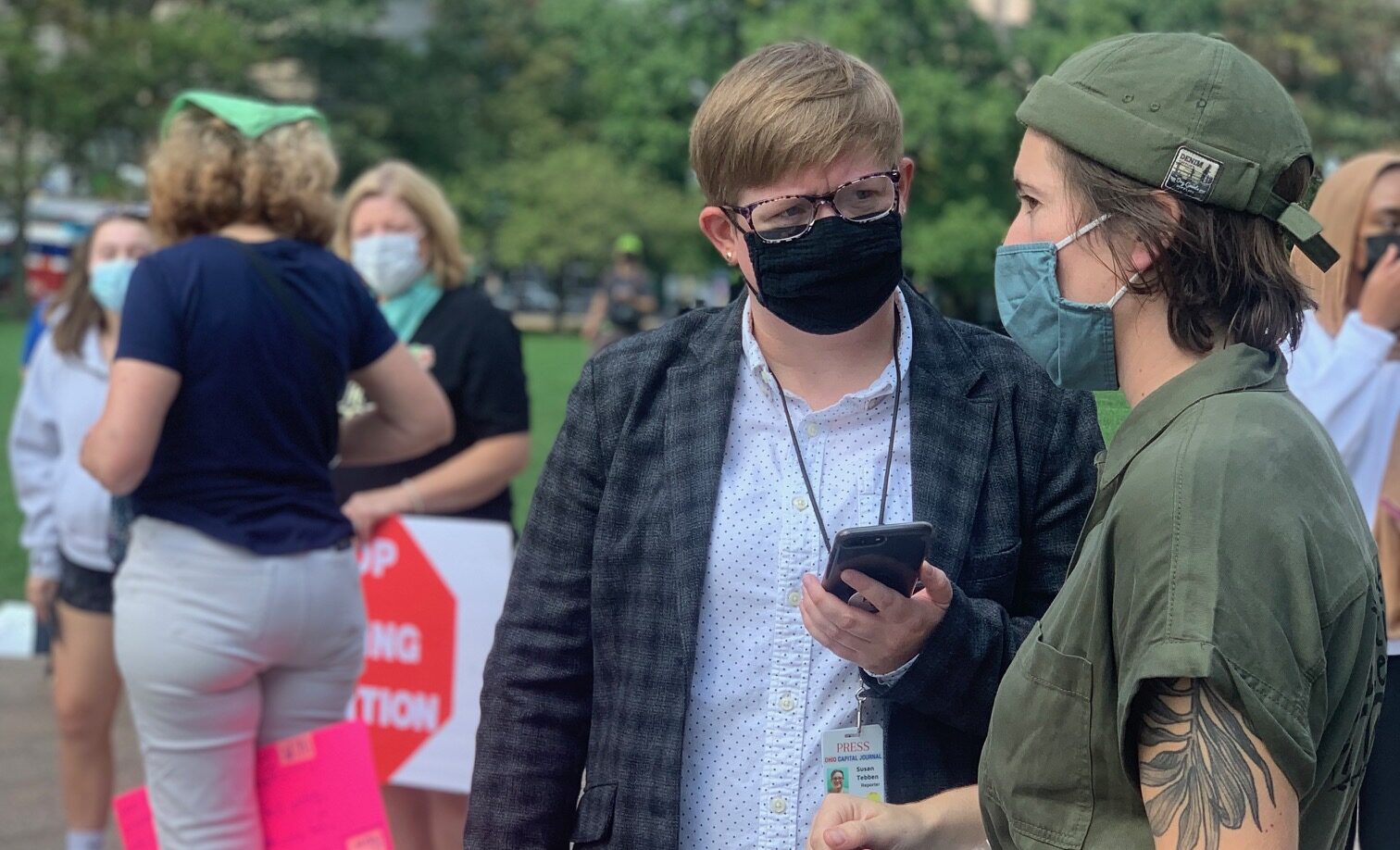
    OCJ Reporter Susan Tebben, left, interviews an activist during a protest at the Statehouse. Photo by David DeWitt, OCJ.

    LOVELAND MAGAZINE NOTE: If I could, and I cannot think of a quick way tonight, I would tell readers how long we waited to have good journalists tell our readers what was going on at the Ohio State House. I do know that before I discovered the Ohio Capital Journal we had published Loveland Magazine for many, many years and search and searched all those many years for a way to connect Loveland to their state government and its impact on our lives. With much gratitude and appreciation, I congratulate the Journal staff who have been honored with these prestigious awards.

    David Miller, Editor and Publisher


    BY: OHIO CAPITAL JOURNAL STAFF – Ohio Capital Journal

    In the “Ohio’s Best Journalism Contest” from the Society of Professional Journalists, the Ohio Capital Journal won five awards, including three first place finishes and two in second place. The contest covered stories and editorial from 2021.

    In digital media categories, OCJ Reporter Susan Tebben took home two first-place awards, one for best education issues reporting and one for best government/political reporting. Tebben also nabbed a second-place finish for best news story.

    OCJ Reporter Jake Zuckerman won first place for best investigative reporting, and OCJ Editor David DeWitt won second place for best editorial/criticism writing.

    We are incredibly honored and grateful for this recognition from our fellow journalists. We are also incredibly grateful for the support we receive from our readers and Ohioans across the state.

    Below we will share the award-winning entries.

    If you’d like to support our work, please follow us on Facebook and Twitter, share our free newsletter subscription with family and friends, and consider making a tax-deductible donation.

    OCJ Reporter Jake Zuckerman

    Best Investigative Reporting – First Place – Jake Zuckerman

    Stories produced within eight days of the Jan. 6 raid on the U.S. Capitol: They include interviews with an Ohio woman who led her paramilitary unit into the building and an Ohio man who kicked in a Capitol window. A third uncovers how a state school board member organized a bus trip to ferry Ohioans to the rally.

    Ohio bartender and her ‘militia’ drove to D.C. to join the Capitol breach

    Ohio man joins raid on U.S. Capitol: ‘I shouldn’t have kicked in the window’

    Ohio Board of Ed member organized bus trip to D.C. for “Stop the Steal” rally

    OCJ Reporter Susan Tebben

    Best Government/Political Reporting – First Place – Susan Tebben

    Ohio government has been in turmoil amid the pandemic, attacks on democracy, and redistricting. One Ohio lawmaker called to charge Ohio Gov. Mike DeWine with terrorism over pandemic public health measures. An Ohio Board of Education member speaks on participating in the Jan. 6 “Stop the Steal” rally that led to the raid on the U.S. Capitol. And redistricting turned into a mess in 2021 despite Ohio Constitutional reforms passed by voters. 

    A legislator wanted to charge Gov. Mike DeWine with terrorism. The prosecutor wants his money back.

    Ohio Board of Education member speaks on participation in ‘Stop the Steal’ event

    Sausage-making: Redistricting hearings continue, public asks for transparency and accountability

    Best Education Issues Reporting – First Place – Susan Tebben

    Public education under attack: This series of stories highlights various attacks on public education, from a state school board member accusing the Ohio superintendent of education of being paid by Bill Gates, to the movement to ban race-based focuses in Ohio schools, to investigative reporting showing very few actual complaints about divisive race-based focuses in education.

    State school board member asks Ohio supt.: ‘Are you paid by Bill Gates?’

    State Board of Ed members support banning racial focus in Ohio schools

    State receives very few complaints on ‘divisive’ racial education concepts

    Best News Story Series – Second Place – Susan Tebben

    Three separate stories covering the developments in Ohio gerrymandering: Ohio Republicans on the redistricting commission passing gerrymandered maps; the Senate President defending that gerrymandering, and testimony about redistricting gathered in committee.

    Republican majority gerrymanders Ohio for another four years

    Huffman defends his maps, redistricting process despite no bipartisan support

    Redistricting process remains ‘fluid’ in joint committee

    OCJ Editor-in-Chief David DeWitt

    Best Editorial/Criticism Writing –  Second Place – David DeWitt

    Gerrymandering pushes politicians to extremes, denies voters their voice, opens the door to corruption, radicalizes political discourse, kills compromise, and disintegrates democracy. Gerrymandering poisons everything. Nevertheless, Ohio’s Republican leaders have been playing political games with redistricting and cheating voters by gerrymandering their way to undue power. OCJ Editor David DeWitt takes them to task for this anti-democratic, unpatriotic attack.

    How cheating voters with gerrymandering poisons everything

    Betraying voters, Ohio Senate President Huffman and House Speaker Cupp declare moral bankruptcy

    Ohio GOP leaders broke promises, failed us all by creating more rigged maps

  • ‘Look beyond our age:’ Three Democratic teenagers run for Ohio House

    ‘Look beyond our age:’ Three Democratic teenagers run for Ohio House

    Sam Cao, 17, at left, seen with Sam Lawrence, 19, at right. The two teenaged Sams are running as Democrats for seats in the Ohio House. Source: Sam Lawrence.

    BY: JAKE ZUCKERMAN Ohio Capital Journal 

    Sam Cao worked out a plan with his principal and superintendent. They had to figure out how Cao could potentially balance constituent work in the Ohio House of Representatives with classwork at Mason High School.

    At Miami University, Sam Lawrence mulled a similar plan for his upcoming sophomore year. Ohio University’s Rhyan Goodman is likely doing the same for his junior year.

    The three Democrats would be quite young for elected office. Cao is 17 but turns 18 before Election Day, which allows him to run; Lawrence is 19; Goodman was 19 when he announced his run in February.

    If elected, they could shape state policy on everything from Ohio’s $74 billion biennial budget, civil and criminal justice, women’s rights, gun policy and countless others. All three are running in districts where Republicans have recently won with commanding margins, leaving them with uphill paths to office.

    They can serve in wars and vote. They can’t lawfully buy a drink. And they don’t think their age should preclude them from public office.

    “The one thing I’d like to point out is it’s not no experience; it’s different experience,” Lawrence said.

    “I would like to ask every one of our legislators if they were attending school while all these terrible school shootings are happening. They were not in school when we had these high-powered assault weapons that could mow down tens of children at a time. Those people don’t have those life experiences.”

    Some current incumbents started their terms just a few years older. Sen. Niraj Antani, R-Miamisburg, started in the House in 2018 at 23 years old. Rep. Jena Powell, R-Arcanum, first won in 2018 at 24. Rep. Thomas Hall, R-Madison Twp., won office in 2020 at 25. Rep. Bride Rose Sweeney, D-Cleveland, won in 2018 at 26.

    Several (older) Democrats asked about the youthful insurgents rebuffed concerns of a lack of life or work experience from the candidates. They also rejected the trend as any signs of a party unable to attract more established candidates. Instead, they characterized it as a reflection of members of a new generation who are aghast at increasingly extreme legislation coming from the Statehouse and inspired enough to seek to affect change on their own.

    “They’re going to be limited based on their life experiences, but at the same time, there is something romantic about it,” said Dennis Willard, a Democratic political consultant.

    “In a sane world, this might seem insane. But were not living in a sane world with the Ohio Legislature. I know who I’d vote for.”

    There’s some historical precedent too. U.S. Sen. Sherrod Brown, the dean of Ohio’s struggling Democratic Party, won his first state House race at 21 in 1974. In 2000, 18-year-old Derrick Seaver won a seat as a Democrat (he switched parties a few years later).

    In an interview, Seaver, now 40 and the director of the San Jose Chamber of Commerce, expressed ambivalence about teenagers running for office. Youth has its perks — young people can be listeners and learners who bring new perspectives to older and pastier general assemblies. Plus, the media attention they attract can make the difference in tough races.

    However, they’re less situated to understand the nuances or interconnectedness of public policy, he said. Plus, if they lose an election, they don’t have a college degree or developed work experience to fall back on.

    “I will say that since that time, and I don’t want this to come across as discouraging, but certainly I feel that maybe I should have waited until I was older,” he said.

    Sam Cao

    Ohio’s new 56th House District contains swaths of Warren County including the cities of Lebanon and Mason. More than 62% of its voters are Republican, according to Dave’s Redistricting App.

    The incumbent, Rep. Paul Zeltwanger, was among the first Republicans to openly embrace conspiracy theories surrounding COVID-19 and later joined in a quixotic and failed gambit to impeach Gov. Mike DeWine. Constitutional term limits preclude him from seeking reelection.

    Cao grew frustrated when COVID-19 grew so prevalent in the county that his high school closed its doors when it ran out of healthy substitute teachers. He tried to contact Zeltwanger, to no avail. Then he tried to contact the Democrat running for the seat, only to learn no such person exists. He credits his AP Government teacher with encouraging him to take a shot for himself.

    To prepare, he’s looking to history. For one, there are his role models — Brown, the U.S. Senator; Robert Kennedy, the liberal icon and former U.S. Attorney General; and William Proxmire, another U.S. Senator who famously replaced the demagogic Sen. Joe McCarthy and declared his predecessor a “disgrace to Wisconsin, to the Senate, and to America.”

    Cao has also been seeking guidance from the last four Democrats who tried and failed to win the seat.

    “You know what you’re entering, kid?” he said, relaying their advice.

    “We call this the arena for a reason. You’re a minnow. And sharks come in. These legislators at the Statehouse, they’re not playing with you. They could eat you up.”

    His path to the general election ballot is no guarantee — he’s facing Joy Bennett, a freelance writer, in the looming Aug. 2 primary.

    In an interview, he boiled his policy goals down to three items. For one, he wants to vote against abortion restrictions and gun rights expansions, which are likely to come in the GOP-dominated legislature. For two, he wants to improve the state’s infrastructure — one example being a lack of roads leading to his own high school, the largest in the state, causing regular traffic jams. Third, he wants to support legislation introduced by Sen. Tina Maharath (another young and Asian-American Democratic lawmaker) to develop curriculum teaching Asian-American history in school classrooms.

    “Look beyond our age,” Cao said. “I know our age is like, the wow factor or the pizazz factor about who we are as candidates, but I want you to look at the policies. I want you to look at what values we stand for.”

     Sam Lawrence, at left, and Sam Cao at right. Source: Sam Lawrence.

    Sam Lawrence

    In Hamilton County, Lawrence is running against Rep. Sara Carruthers, a two-term incumbent Republican. It’s a similarly tough district for Democrats — more than 60% of its voters are registered Republicans, according to Dave’s Redistricting App.

    His goals in office include protecting abortion access for women, legalizing and taxing marijuana for recreational use, bringing intrastate train access to Ohio, and expanding clean energy generation like wind and solar in Ohio.

    He said a House full of only 19-year-olds would likely destroy the state. But having a few of them around has its value — who better to represent the interests of young Ohioans? Who better to understand the realities of seeking student loans in an inflationary economy? Or evaluating recently passed legislation that allows teachers to carry arms in Ohio, which he called “incredibly unpopular” among young people.

    He considers former presidential candidate and current U.S. Secretary of Transportation Pete Buttigieg a role model. He has knocked on doors for House Minority Leader Allison Russo, D-Columbus, and volunteered for Congressman Tim Ryan’s U.S. Senate Campaign as well.

    “Something everyone should know about us: We are taking this extremely seriously,” he said. “There is a reason that this Democratic process is in place. There is a reason that, by law, you are allowed to run at my age. There is a reason that people have won at my age. I think we should test that theory.”

    Rhyan Goodman

    Of the three teenagers, Goodman has the best shot at winning as far as the raw demographics go. His Athens County district splits 52-45 for Republicans.

    He’ll face Rep. Jay Edwards, R-Nelsonville, a successful fundraiser and former member of House leadership seeking his fourth term in office. Edwards has won in a landslide every election since 2016.

    Goodman doesn’t have any campaign website that could be located. He did not respond to calls or text messages seeking an interview.

    According to The Athens News, he registered to run in February at 19 years old using his college dormitory as his residence.

    His nascent political career has already met scandal. In April, he resigned from Ohio University’s student senate before facing an impeachment trial. According to The New Political, a student publication, Goodman was accused of coordinating an effort to remove former Treasurer Simar Kalkat from her position. He allegedly encouraged student senators to accuse Kalkat of intimidation.

  • DeWine re-ups anti-abortion lobbyist, COVID skeptic on Ohio Medical Board

    DeWine re-ups anti-abortion lobbyist, COVID skeptic on Ohio Medical Board

    Michael Gonidakis. Photo from the Ohio Medical Board.

    BY: JAKE ZUCKERMAN – Ohio Capital Journal

    Ohio Gov. Mike DeWine plans to re-appoint a longtime anti-abortion lobbyist and COVID-19 skeptic to the Ohio Medical Board, a spokesman said Monday.

    Michael Gonidakis, 48, a lawyer and president of Ohio Right to Life, will serve his third five-year term on the board, which is charged with licensing and disciplining physicians and other health care providers.

    “I’m honored that the governor has confidence in me to serve,” he said in an interview. “I think there’s no greater service than public service, and I encourage everybody to find a board or commission or way to give back to the state of Ohio.”

    Abortion rights advocates have criticized Gonidakis’ appointment in the past, claiming his anti-abortion lobbying intractably clashes with his state responsibilities. More recently, the U.S. Supreme Court’s overturning of Roe v. Wade in June allowed a new abortion restriction in Ohio to take effect that gives enforcement authority to the state medical board.

    Ohio’s new abortion law, enacted hours after Roe’s demise, prohibits the procedure starting at about six weeks after a woman’s last period, with narrow exceptions to save the life of the mother. This exemption requires physicians to document their beliefs in writing regarding a woman’s medical emergency and report it to the Ohio Department of Health. The Ohio Medical Board can revoke or suspend a physician’s license for noncompliance, or order the state attorney general to initiate a case seeking up to a $20,000 fine.

    Gonidakis sits on the medical board as one of three members who “shall represent the interests of consumers,” per state law. At least two of those members “shall not be a member of, or associated with, a health care provider or profession.”

    Besides his anti-abortion advocacy, state lobbying records show Gonidakis has registered to lobby for an array of health care clients before state lawmakers and the executive branch during his time on the board.

    For instance, he has represented eight medical marijuana companies: The Source HoldingsCannaNat TheraputicsCielo ProcessingNorth Coast TherapeuticsOhio ReleafGreenleaf GardensThe Pharm, and Marijuana Policy Group.

    His other health care clients have included WebMD Health Corp., Comprehensive Pain ManagementHealth Compliance Associates, and Proove Biosciences.

    A spokeswoman for the state medical board declined to answer whether Gonidakis is complying with the requirements of the consumer representative board seat, only noting that the governor appoints members of the board.

    Dan Tierney, a DeWine spokesman, said the appointment doesn’t create any conflict.

    “With respect to abortion or marijuana, neither of these have been an issue related to Mr. Gonidakis’ service in his first two terms,” he said. “We trust they will not be an issue in his third term either, as the vast majority, if not almost all, of medical licensure issues are unrelated to abortion or medical marijuana.”

    He added the sentiment applies to Gonidakis’ other lobbying clients’ industries as well.

    Gonidakis said he recuses himself on issues relating to abortion and medical marijuana when they come up before the Medical Board. He said he believes he’s following the statute, given his clients likely don’t qualify as a “health care provider.”

    COVID skeptic

    A review of Gonidakis’ comments on social media about COVID-19 show a pattern of skepticism around lockdowns, masks, closing schools, efficacy of vaccines, and vaccination policies.

    In February of 2021, Gonidakis shared a Fox News article quoting Dr. Anthony Fauci, the federal government’s top infectious disease expert, warning indoor dining is still unsafe after vaccination given high rates of COVID-19 spread at the time.

    “If this is accurate (and I do not believe it is), then there is absolutely no reason to get the vaccine … There is just no justifiable reason whatsoever,” he said.

    Around that same time, he shared an article citing a study suggesting hydroxychloroquine could help COVID-19 patients. The drug grew in popularity following praise from former President Donald Trump, despite multiple, large-scale, double-blind studies finding no benefit in treating COVID-19 and possible risk to patients.

    “Wonder how many Americans had to die because politicians and the media hated Trump so much & just rejected this drug because Trump promoted it???” he said.

    He said in an interview he’s not an “anti-vaxxer” and that he and his family are all vaccinated against COVID-19. He noted the Medical Board doesn’t create policy — it abides by state law. Of his tweets, he said he doesn’t retract any of his comments, but noted they come in his personal capacity and not as a member of the medical board.

    “Any Ohioan can be vaccinated and want to protect the health of their family but also question some of the politicians’ decisions that are being made,” he said. “At the medical board, we license and regulate doctors. We don’t set policy as it relates to pandemics.”