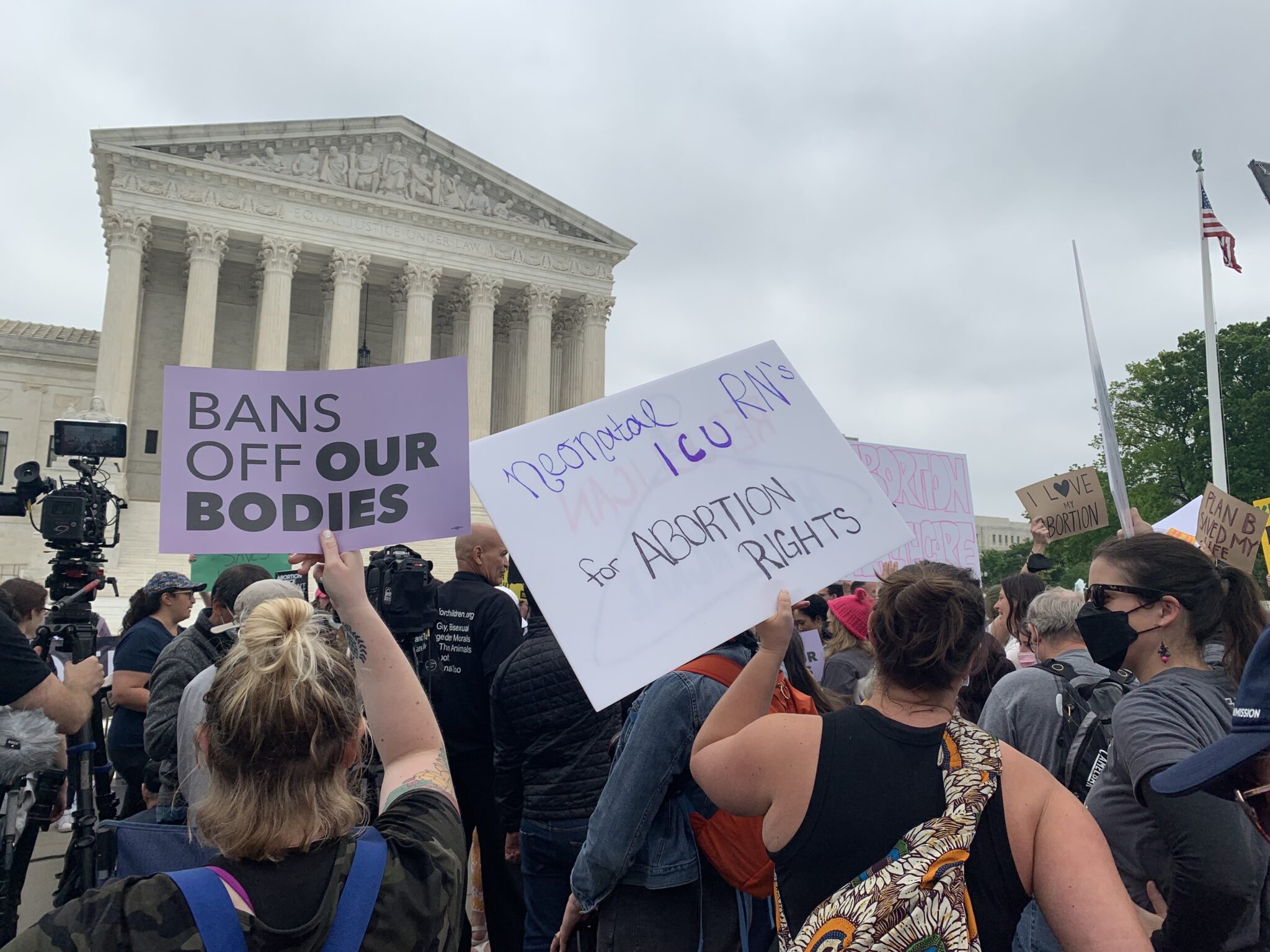
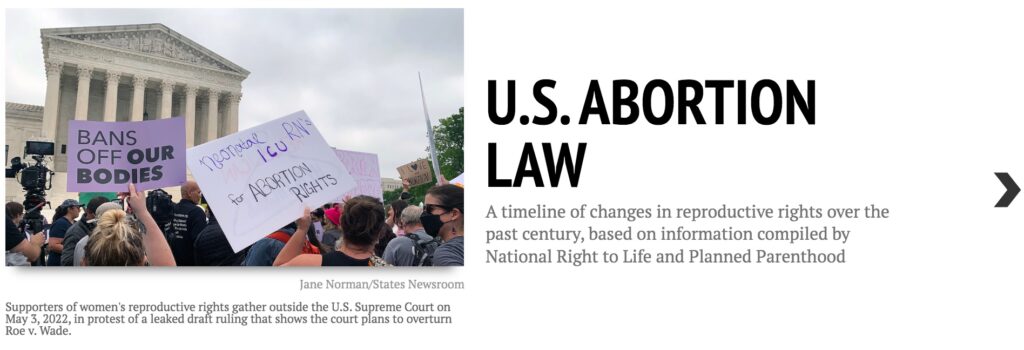
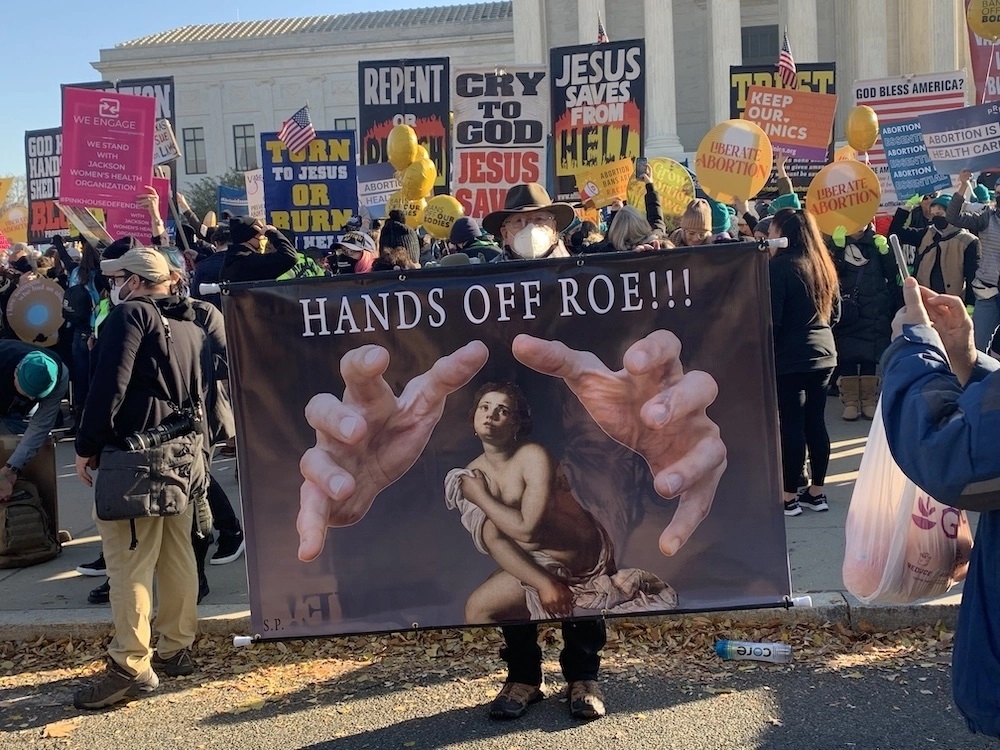
Protesters gathered at the statehouse to voice opposition to the Dobbs decision overturning Roe v. Wade. (photo by Nick Evans)
The Ohio Supreme Court has denied an attempt by abortion clinics to stop a six-week abortion ban from being enforced.
In a Friday ruling, the court denied a motion for an emergency stay of Senate Bill 23, legislation signed into law in 2019 that banned abortion up to six-weeks gestation.
The lawsuit is still ongoing, but denial of the emergency stay means abortion clinics won’t be able to conduct abortions past six weeks as the case continues. The announcement did not indicate whether the denial was unanimous.
The court asked for responses by Thursday to the lawsuit’s request to stay the law, and received briefs from state officials, prosecutors and academics.
In a “friend of the court brief” filed Thursday, professors of public health, sociology, epidemiology and public affairs from The Ohio State University and the University of Cincinnati joined with the ACLU and Planned Parenthood in pushing for an end to Senate Bill 23, which was implemented on Friday, hours after the U.S. Supreme Court overturned Roe v. Wade.
“Instead of reflecting the Ohioan majority view that supports abortion rights, SB 23 caters to the minority fraction of Ohioans that are unsupportive of these rights,” the brief states.
The researchers cite polling data on support of abortion rights from three different universities: Suffolk University, Baldwin Wallace University and Quinnipiac University. All of the surveys found a majority of survey-takers supported abortion rights, and the professors argued that the polls proved that public opinion is on the side of abortion rights.
“While abortion attitudes arise out of complex combination of interlocking feelings toward gender, religion, politics, morality, science and many other facets, SB 23 allows from none of this nuance,” the professors wrote.
Prosecutors from Cuyahoga County and Franklin County aren’t going to stand in the way of the lawsuit. Both Michael O’Malley and Gary Tyack filed documents with the court saying they “do not oppose” granting an emergency stay of the law.
O’Malley previously signed on to a letter with other national prosecutors and attorneys pledging not to enforce abortion bans following the Supreme Court decision.
Attorney General Dave Yost also responded to the lawsuit, calling the request for emergency stay of the law “substantively and procedurally flawed,” citing the Roe v. Wade ruling last week in Dobbs v. Jackson Women’s Health Org.
“With this holding, the court extricated itself from having to repeatedly decide policy matters that the Constitution leaves to the states and the political branches,” Yost wrote.
Any contention that Ohio’s constitution holds the right to abortion is “indefensible,” the attorney general stated, “no matter the theory of constitutional interpretation one might embrace.”
The sponsor of legislation that would ban nearly all abortions in Ohio said babies conceived via rape or incest still have a right to life.
Rep. Jean Schmidt, a Loveland area Republican, said on conservative talk radio earlier this week that her bill is likely to pass in the legislative session after the November elections.
“I do believe we have the votes in both chambers, and we have the full support of the governor on this bill,” she said.
The bill also creates a new misdemeanor crime of “promoting” abortion, for those who make, sell or distribute drugs or devices used to perform illegal abortions. Schmidt said in the interview this could be used to target some of the companies (including in Ohio) that have announced they will cover costs of employee travel to seek an abortion as needed.
When pressed by 700WLW host Bill Cunningham on whether Ohio should pass legislation banning birth control pills or condoms, she said she’ll listen to both sides of the debate.
House Bill 598, which Schmidt introduced, would ban most abortion in Ohio. Current Ohio law allows for abortions up to six weeks after a woman’s last period. The proposed legislation does not provide exceptions for pregnancies conceived by rape or incest.
Providing any abortion under the bill could lead to a fourth degree felony charge. The law allows the accused to mount a defense, however, if they only did so to save the life of the mother. That physician would need to provide written certification of the woman’s medical need along with that of another physician from a separate practice.
Likewise, the legislation requires at least two physicians present during the abortion: one to perform the abortion in the manner that provides the “best opportunity for the unborn child to survive,” and another to care for the fetus.
Schmidt drew national attention in April when she referred to a hypothetical 13-year-old’s pregnancy spawned by rape as an “opportunity.” Her recent comments, however, come after the U.S. Supreme Court last week overturned a landmark 1973 ruling that established a constitutional right to abortion. That decision wiped out the federal protection and returned control over abortion to the states.
A spokesman for Gov. Mike DeWine did not dispute Schmidt’s characterization of DeWine’s support for her bill, and noted that the governor has previously expressed support for conceptually similar legislation. Senate President Matt Huffman, R-Lima, said this week he expects an abortion ban of some sort to pass in late 2022.
Schmidt’s remarks indicate no signs of a softened position, and a sense of opportunity after the removal of a major roadblock to restrictive abortion laws. They, and Cunningham’s questions, have been edited here for length and clarity.
Cunningham: What about rape and incest [as a potential exception to a ban on abortion]?
Schmidt: “Rape and incest is an ugly, ugly, ugly act of violence, and that woman is truly harmed and scarred, and those wounds will never go away and we need to make sure that she has all of the love and help and support. But to end the pregnancy of the child is not going to erase those wounds or those scars. That child still has the right to life.”
So, as a leader in the House of Representatives, you would not vote to ban birth control pills in Ohio?
“You know, that’s another issue for another day, and I’m going to have to listen to both sides of that debate. But right now, what I’m really concerned about is the life of the child, and the fact that we have the opportunity in Ohio to protect it from its conception until its natural death. That’s what I’m most excited about.”
Would you vote against gay marriage in Ohio?
“You know, Bill, that’s another decision for another day. The issue right now is abortion, and that’s one I want to make sure sees its end in Ohio in a very quick fashion.”
[Cunningham for 90 seconds talks about various alternatives to surgical abortion, ending in a statement that companies are starting to “pay” their employees $4,000 to travel to more liberal states that allow them to obtain an abortion and other “workarounds”.]
Do you know what I’m saying?
“If those companies want to do that, they better make sure that they’re complying with the laws of the states that allow them to do that. Because in House Bill 598, it says anybody that promotes an abortion will be under the issues of criminal activity. They might have a problem with sending somebody outside the state with a paycheck in hand, because that would be – in some legal eyes – promoting abortion.”
Doctors fighting to keep their patients alive are worried about new abortion-related paperwork and legal advice that would hold up necessary care for their patients.
Consulting lawyers and keeping complicated documentation is a part of life now that the U.S. Supreme Court overturned Roe v. Wade and Ohio put a six-week abortion ban in place.
“If (patients) are in the midst of a pregnancy loss and a heartbeat is present… we then have to do the same paperwork for someone who was having an elective termination (abortion),” said Dr. Amy Burkett, an OB/GYN hospitalist in Northeast Ohio.
Doctors face potential criminal charges and risks to their medical licenses because of what they say are unclear regulations and specifications on abortion. Beyond that, the changes to the health care landscape nationally and in Ohio create an environment where doctors who know a pregnancy isn’t viable may have to watch a parent carry the pregnancy anyway.
“Being forced to go down the path is just an unequivocal nightmare, especially if you think of someone going through an entire pregnancy against their will when they know the fetus is going to die,” said Dr. David Hackney, maternal fetal medicine specialist in the Cleveland area, and chair of the American College of Obstetrics and Gynecologist’s Ohio chapter.
Hackney, who works with high risk pregnancies and diagnoses birth defects, said abortion bans can increase the complication rate in pregnancies merely by increasing the number of pregnancies coming to term.
Abortion for *lethal* fetal anomalies is now *illegal* in Ohio
I’m a high-risk obstetrician here. I diagnose birth defects
So some point soon I may look someone in the eyes & say that they, against their will, will carry to term, undergo delivery & then have their child die
— David N Hackney MD, FACOG (@DavidNHackney) June 27, 2022
As Roe v. Wade was overturned Friday and Ohio implemented its six-week abortion ban, Hackney was on call, and went to sleep that night unsure how he would proceed with medical care the next day.
“It’s a Friday night, and all of a sudden the legal ground has changed entirely beneath my feet,” Hackney said.
With cases that can include time-sensitive care and bleeding that must be dealt with urgently, Hackney said not having a plan in place can cause distractions with dangerous impacts on infant and parent health. That plan may now have to include referrals to other health systems, and even other states for legal options.
“When it comes to a lot of these legal issues, the most important thing to have is a plan before something awful happens,” Hackney said. “We are even now still working out the details and trying to figure out processes.”
Abortion bans could have impacts on pregnancy-related procedures that have nothing to do with abortion as well, according to doctors. Dr. Tom Burwinkel, a reproductive endocrinologist who also works on in-vitro fertilization, says bills like HB 598 — a proposed complete abortion ban in Ohio — could cause legal confusion and liabilities for facilities storing embryos or working with those embryos.
Because the bill, which is currently sitting in a House committee, says an “unborn child” is defined at the time of fertilization, embryos that are damaged even accidentally or through natural occurrences in the IVF process could be held against the doctors conducting the work.
“If we have embryos stored and something happens to the liquid nitrogen tanks, are the physicians and the people that own the facilities on the hook for the loss of thousands of embryos?” Burwinkle posed.
Though IVF isn’t impacted by the six-week abortion ban, Burwinkle worries about the future of the IVF field and other pregnancy medicine, as laws and bills in the state focus on ideological ideas of life rather than the medicine involved.
“Obviously the legislature wants to take things a step further … and that’s somebody imposing their religious beliefs on others. I thought this country was founded on religious freedoms,” Burwinkle said.
Comments made by U.S. Supreme Court Justice Clarence Thomas in support of overturning Roe v. Wade are giving physicians further reason to be concerned about the future of gynecology, especially contraceptives.
Burkett said it’s important for the public to understand that contraceptives are not considered abortion medication, even as legislation might couple things like Plan B with abortion-inducing drugs, and misinformation exists coupling IUDs with abortion.
“IUDs are not considered abortion medications,” Burkett said. “Plan B is also not considered an abortion medication. Neither are medically considered abortifacients.”
Misinformation about contraceptives does not just impact the public who may not have done enough research, but a part of legislation sponsored by non-medical professionals who may not be listening to the medical community. Hackney said ACOG representatives are always willing to serve as a resource for legislators.
“In general, most of this legislation happens without meaningful, or certainly not with mainstream medical input,” Hackney said.
Duke’s parent company made $820 million in profit in the first quarter of 2022 after netting about $3.6 billion last year. It paid its shareholders $3.1 billion in dividends in 2021 and paid its CEO $16.4 million in salary.
Ohio utility companies have asked state regulators for permission to raise home gas, electric and water costs on more than 2.75 million Ohio customers.
Those charges could be spread between customers of Columbia Gas, AES Ohio, Duke Energy, and Aqua Ohio. The utilities, all investor-owned, are collectively asking for another $400 million in annual charges.
Any base rate increases require the approval of the Public Utilities Commission of Ohio, which is headed by five commissioners chosen by the governor for five-year terms. The PUCO’s staff review the companies’ requests and pose recommendations to the commissioners, who decide what the utilities can ultimately charge their customers.
“It is bad timing for utilities to be seeking rate increases at the PUCO, with consumers already hurting from soaring energy prices and inflation,” said Bruce Weston, executive director of the Ohio Consumers’ Counsel, a state agency that represents residential ratepayers in PUCO cases.
“Ohio should lead with its heart and keep Ohioans connected to their utility services.”
They also come at a turbulent time for the commission. Its former chairman resigned in 2020 after FBI agents were seen raiding his home. Last summer, the utility FirstEnergy Corp. alleged in court documents that it paid him a $4.3 million bribe for regulatory favors. He has denied wrongdoing and has not been charged. The U.S. Department of Justice twice subpoenaed the PUCO last year for records related to the case.
Two commissioners previously worked for the companies they now regulate. Commissioner Dan Conway previously represented American Electric Power as an attorney in private practice. Commissioner Lawrence Friedeman has worked for IGS Energy, Vectren Energy Delivery of Ohio, Columbia Gas Services, and the Ohio Gas Association.
Thus far, the PUCO staff has recommended granting slimmed-down versions of rate hike requests from Columbia Gas, Duke and Aqua Ohio. The AES case awaits a key ruling from a PUCO judge. None of the four has reached a final decision.
A rate freeze would be very bad for customers. It would be damaging to the company’s credit ratings and make it difficult, if not impossible, for the company to provide reliable service.
– AES Ohio attorney at a PUCO hearing last month
Columbia Gas
Columbia Gas asked the PUCO to allow a $221 million annual rate increase for its natural gas distribution service. This would take the form of a fixed fee increase, up from $16.75 per month to $46.31. According to analysis from the Ohio Consumers’ Counsel, that could increase to an $80 fixed cost per month in five years.
PUCO staff identified some evidence of the company padding its costs in their report. When PUCO staff reviewed Columbia’s cost data provided by the utility to justify the hike, they found the company included $304,000 in costs for a workout facility and locker rooms at its downtown headquarters. The report also found an instance where the Columbia acquired five “thermal cameras” for COVID-19 temperature checks, each at a cost of $14,995. PUCO staff called the spending “significantly excessive” compared to a handheld thermometer.
The PUCO staff recommended the commissioners approve a more modest base distribution revenue increase of between $35 million and $58 million per year. The OCC urged the PUCO to go even lower, proposing a $9.8 million increase.
The proposed increase was the subject of a handful of sparsely attended public hearings last month. Evidentiary hearings start next month. They’ll be followed by a round of briefings before a final decision, according to a PUCO spokesman.
NiSource, the utility’s parent company, made $431 million in profits in the first quarter of 2021. Last year, it paid its CEO $6.6 million, and paid its shareholders $345 million in dividends.
Company spokesman Eric Hardgrove declined to answer specific questions about the gym or the thermometers.
“Columbia is committed to our customers and the communities we proudly serve,” he said. “To continue to provide safe, affordable and reliable natural gas service, we must continue to invest in our system to upgrade aging infrastructure, just as investments are made in bridges, roads and other infrastructure in our cities, towns and communities. In addition, Columbia offers a wide variety of energy assistance, energy efficiency, payment plans, and PIPP to help customers afford their utility bills.”
Duke Energy
Duke Energy, which services 700,000 customers around Cincinnati, proposed raising both its electric rates and its gas rates. (It has comparatively few gas customers).
On the electric side, the company requested a 10% base distribution revenue increase, which comes out to about $55 million per year.
According to the OCC, this means a typical residential customer will see a monthly base distribution charge increase from about $37 to $49, costing roughly $144 per year.
PUCO staff recommended a more modest increase of about .33% to 3%, or about $2 million and $15 million.
On the gas side, Duke also filed a pre-application with the PUCO to raise its natural gas rates. However, this is in its early procedural stages and wouldn’t take effect until at least 2023.
For electric costs, the PUCO is holding public hearings next month before an evidentiary hearing, which could take a week or so. Then comes a round of court filings and a commission decision. A PUCO spokesman guessed a decision could come mid-fall at the earliest.
The utility’s parent company made $820 million in profit in the first quarter of 2022 after netting about $3.6 billion last year. It paid its shareholders $3.1 billion in dividends in 2021 and paid its CEO $16.4 million in salary.
Company spokeswoman Sally Thelen said Duke is making smart investments to provide “safer and more reliable and secure” energy to customers while “diligently lowering operation and maintenance” costs. She said Duke is allowed to earn a fair return on its investments.
“We know how vital electricity is to our customers, communities and region, and that energy is a significant monthly expense for our customers,” she said. “We also know that higher bills are never embraced. That’s why we continue to work hard to keep our costs down. We remain committed to helping our customers who may be experiencing financial hardship and struggling to pay their everyday expenses and energy bills. Duke Energy continues to support its customers, and connect them with available assistance and offer tools and programs – including flexible payment plans – to help manage their energy bills.”
AES Ohio
AES Ohio — formerly known as Dayton Power and Light, which serves 527,000 western Ohio customers — asked for a 49% base distribution revenue increase worth about $121 million per year.
According to the OCC, this would raise an average customer’s bill by about $13.42 per month.
The utility’s parent company, AES, has faltered compared to its peer companies, reporting a $409 million net loss in 2021, as it paid its CEO $14 million in salary. Addressing the PUCO, AES Ohio’s CEO testified to the company’s “very fragile” financial condition, according to the Dayton Daily News.
In July 2021, the PUCO staff initially recommended a rate increase to boost AES’ base distribution revenues by at least $61 million. However, staff have since sided with arguments raised by the OCC and said the company’s 2009 agreement with the commission blocks the company from raising its rates.
The question was put before a PUCO judge at a hearing last month. Jeff Sharkey, an attorney representing AES Ohio, made several arguments against the existence of a rate freeze, including that state law doesn’t give the PUCO the power to order one in the first place. He said the utility has already struggled with reliability. A failure to increase its revenue could harm its credit rating, which threatens the company’s service.
“A rate freeze would be very bad for customers,” he said, according to a transcript of the hearing.
“It would be damaging to the company’s credit ratings and make it difficult, if not impossible, for the company to provide reliable service.”
The case awaits a final decision from the PUCO. Company spokeswoman Mary Ann Kabel defended the rate increase request, stating it covers the cost of grid investments.
“Since our last distribution rate case in 2015, the updated distribution base rates would allow us to recover for investments required and are already completed as a result of the devastating 2019 Memorial Day tornadoes,” she said. “It also allows us to continue performing important activities, such as enhanced tree trimming to reduce the likelihood and length of outages. Over the years, AES Ohio has taken the necessary steps to keep rates reasonable through efficient distribution operations to meet the growing needs of our customers. Today and with the proposed increase we continue to have with the lowest distribution rates of the investor-owned electric utilities in Ohio.”
Aqua Ohio
Aqua Ohio, a subsidiary of Essential Utilities, provides treated water for about 150,000 Ohioans. It proposed to the PUCO a base distribution revenue increase of about $8.3 million (12%). Staff counter-proposed a $2.3 million to $4.1 million revenue increase.
The application is still pending review.
An unopposed settlement agreement was filed this month by all parties to the case. That settlement awaits approval from the commission. It calls for a rate hike, though less than the company originally requested. It also calls on the company to fund a $20,000 account annually via its shareholders as a bill-pay assistance program for low income customers, and to start disclosing the number of residential service disconnections per year.
Aqua Ohio’s parent company, Essential Utilities, made nearly $200 million in profits last quarter and $432 million in profits in 2021. Spokesman Jeff La Rue defended the proposed rate increase.
“Aqua has invested more than $147 million in water since our last rate case,” he said. “That investment is important to ensure safe and reliable services as well as regulatory and environmental compliance. Our rate case is an attempt to recover a portion of that investment.”
Local legal officials say they and other city attorneys and county prosecutors in the U.S. will not make abortion ban enforcement a priority.
Zach Klein, city attorney for the city of Columbus, and Cuyahoga County Prosecutor Michael O’Malley signed on with more than 60 other prosecutors throughout the country, pledging not to use their offices’ resources to enforce abortion bans.
“We will continue to use our prosecutorial discretion to put the safety and security of Columbus residents first by allocating our resources to target the most serious crimes facing our community,” Klein wrote in a statement.
The city attorney’s office does not prosecute felony offenses, of which most abortion-related charges would be. Those would fall under the Franklin County Prosecutor’s Office.
However, legislation currently being considered by the Ohio legislature could include misdemeanor charges, such as a charge of “promoting” abortion, and the city attorney plans to keep from using his resources on those charges as well, a spokesperson for Klein said on Tuesday.
“The announcement that the City Attorney’s Office will not prosecute abortions shows women, health care providers and residents where we stand should these cases come before us,” said communications director Pete Shipley.
Franklin County Prosecutor Gary Tyack did not respond to requests for comment as to whether or not he supported the letter. Republican Hamilton County Prosecutor Joe Deters has indicated he would enforce the ban.
The letter, which was created on June 24 and is still being updated with more attorneys signatures as of Tuesday, says the attorneys “cannot stand by and allow members of our community to live in fear of the ramifications of this deeply troubling decision.”
“Laws that revictimize and retraumatize victims go against our obligation as prosecutors to protect and seek justice on behalf of all members of our community, including those who are often the most vulnerable and least empowered,” the letter states.
Though the attorneys didn’t all agree on a moral level about abortion, they agreed individual beliefs shouldn’t dictate the justice system.
“But we stand together in our firm belief that prosecutors have a responsibility to refrain from using limited criminal legal system resources to criminalize personal medical decisions,” the letter stated.
Currently in Ohio, abortion is legal up to six-weeks of pregnancy. Legal ramifications of the law are focused on the medical professionals conducting abortions, not on those receiving the abortions. Criminal and civil penalties could be leveled against doctors.
A bill that sits in the legislature awaiting committee passage would ban abortion entirely, with no exception for rape or incest, and create penalties for “promotion” of abortion as well.
COLUMBUS, OH — JUNE 24: Rebecca Molnar of Hilliard (left) acknowledges support from a passing car from a small group of protesters gathering after the Supreme Court announced the reversal of Roe v. Wade, June 24, 2022, at the Ohio Statehouse, Columbus, Ohio. (Photo by Graham Stokes for the Ohio Capital Journal.)
COLUMBUS, OH — JUNE 24: Christy Hahn of Columbus holds up her sign to passing cars from a small group of protesters gathering after the Supreme Court announced the reversal of Roe v. Wade, June 24, 2022, at the Ohio Statehouse, Columbus, Ohio. Hahn, who has three daughters and six grandchildren, said it was important to come out to protest because “the court is eating away women’s rights bit by bit.” (Photo by Graham Stokes)
COLUMBUS, OH — JUNE 24: A young woman who chose not to give her name joins a small group of protesters gathering after the Supreme Court announced the reversal of Roe v. Wade, June 24, 2022, at the Ohio Statehouse, Columbus, Ohio. When asked why it was important to come out a companion answered “because today the constitutional rights were take away from 50% for the population.” (Photo by Graham Stokes)
COLUMBUS, OH — JUNE 24: Rebecca Molnar of Hilliard joins a small group of protesters gathering after the Supreme Court announced the reversal of Roe v. Wade, June 24, 2022, at the Ohio Statehouse, Columbus, Ohio. (Photo by Graham Stokes)
COLUMBUS, OH — JUNE 24: A sign on a statue announces a rally for later in the day after the Supreme Court announced the reversal of Roe v. Wade, June 24, 2022, at the Ohio Statehouse, Columbus, Ohio. The statue of an adult female figure of Peace, a palm of peace grasped in her hand, draws a little girl close to herself to confide that the greatness of the nation is in her peaceful pursuits. (Photo by Graham Stokes)
COLUMBUS, OH — JUNE 24: Christy Hahn of Columbus (left) gives a thumbs up to a passing car from a small group of protesters gathering after the Supreme Court announced the reversal of Roe v. Wade, June 24, 2022, at the Ohio Statehouse, Columbus, Ohio. Hahn, who has three daughters and six grandchildren, said it was important to come out to protest because “the court is eating away women’s rights bit by bit.” (Photo by Graham Stokes)
COLUMBUS, OH — JUNE 24: Rebecca Molnar of Hilliard (center) signals to a passing car from a small group of protesters gathering after the Supreme Court announced the reversal of Roe v. Wade, June 24, 2022, at the Ohio Statehouse, Columbus, Ohio. (Photo by Graham Stokes)
COLUMBUS, OH — JUNE 24: An abortion rights supporter joins a small group of protesters gathering after the Supreme Court announced the reversal of Roe v. Wade, June 24, 2022, at the Ohio Statehouse, Columbus, Ohio. (Photo by Graham Stokes)
COLUMBUS, OH — JUNE 24: A small group of supporters of abortion rights gathering after the Supreme Court announced the reversal of Roe v. Wade confronts a counter protester, June 24, 2022, at the Ohio Statehouse, Columbus, Ohio. (Photo by Graham Stokes)
COLUMBUS, OH — JUNE 24: A small group of supporters of abortion rights gathering after the Supreme Court announced the reversal of Roe v. Wade, June 24, 2022, at the Ohio Statehouse, Columbus, Ohio. (Photo by Graham Stokes)
Protesters gathered at the statehouse to voice opposition to the Dobbs decision overturning Roe v. Wade. (photo by Nick Evans)
Tim Ryan addressing the crowd outside the statehouse. (photo by Nick Evans)
Ohio U.S. Sen. Sherrod Brown speaks at a rally for abortion rights at the Ohio Statehouse. Photo by Nick Evans, OCJ.
Over the weekend protesters rallied in demonstrations large and small voicing their opposition to the U.S. Supreme Court’s decision overturning Roe v. Wade.
The Attorney General
Saturday afternoon a couple dozen people gathered near the end of a sleepy street in Beechwold. Demonstrators brought bullhorns, pots and pans, even a vuvuzela, and organizers handed out pamphlets describing what areas are and aren’t public property. Then they marched up a narrow side street to Attorney General Dave Yost’s home.
Protesters demonstrating outside the home of Attorney General Dave Yost. (Photo by Nick Evans, OCJ.)
“After his workday, he comes home, kicks his feet up, has real nice evening,” organizer Mandy Shunnarah-Reed told the group before they set out. “Meanwhile, the rest of us have to live with the consequences of the decisions he’s made about our bodies and our livelihoods, 24-7, 365. We don’t get to just not worry about it, because it’s not business hours.”
“So that is why we are annoying him on a Saturday,” she said.
The group grew to about 50 and they made a racket of chants, whistles and smashing cookware at the foot of Yost’s driveway while a security agent from the AG’s office looked on. The cacophony was short lived though — after about twenty minutes they learned Yost wasn’t home.
Some Ohioans employed similar tactics to voice opposition to COVID-19 restrictions and to intimidate then-health director Amy Acton early in the pandemic. But Katie McKeel and her husband John were quick to draw a distinction.
Katie carried a sign that read “my body, my rights, my vote, my voice will be heard in 2022.” But the “22” was taped on. She first made the sign in 2018 for the women’s march in Washington D.C.
“If my right to my choice and my self-autonomy and what I do with my own body is not as important as the airspace of our elected officials, I find that to be completely out of whack,” Katie said.
“We haven’t threatened Dave Yost. Amy Acton got death threats,” John chimed in. “That’s a big difference.”
Christy Williams came to the protest with her daughter, and she argued that banning abortions won’t reduce the number that occur, it will just make them more dangerous. Like the McKeels, she believed their right to protest should take precedence.
“This is a civil right,” she said. “You can do this.”
The Statehouse
Sunday morning thousands of people turned up at the Statehouse for a rally put on by the Ohio Democratic Party. Notably, although not surprisingly, many of the groups spanned generations. Mothers with daughters and even granddaughters showed up together waving handmade signs. Picking up on that, U.S. Sen. Sherrod Brown noted up he was there with his wife, his daughters and grandkids. Brown told the crowd “we need a plan,” and argued for electing two new Democratic U.S. Senators and maintaining the Democratic majority in the House.
“If we can carry out this plan, by this time next year the Senate and the House of Representatives will have codified Roe v. Wade,” Brown argued.
The problem is, picking up Senate seats while keeping the House is a pretty tall order for a midterm election amid persistent inflation. The court’s decision to overturn Roe surely changes the political calculus, but it’s unclear how much.
The other issue, as people like Nina Turner have pointed out, is that Democrats already have control of all the levers of power they need to codify abortion protections — they simply haven’t acted because some Democratic senators oppose ending the filibuster.
Speaking afterward, Brown acknowledged some members of his caucus are “not in the right place” when it comes to the filibuster, but he insisted with two new members the party would act.
“If we have two more Democrats, we will change the filibuster rules, so that a majority can speak,” Brown said. “All we’re asking for is majority rule.”
One candidate looking to flip a Senate seat in Brown’s plan spoke to the crowd as well. Ohio Democratic U.S. Senate nominee Tim Ryan described the whiplash of marching to the Supreme Court building on Friday to protest with his 18-year-old daughter, in D.C. for an internship, alongside fellow congresswomen who were part of the fight that led to Roe in the first place.
“This is a struggle,” Ryan said. “This is a struggle for this election, and the next election, and the next election in the decades to come because we’re gonna turn this around, and we’re gonna make sure that this never happens again.”
Tim Ryan addressing the crowd outside the statehouse. (Photo by Nick Evans, OCJ.)
Ryan acknowledged afterward that some voters might feel pessimistic in light of Democrats’ unwillingness to roll back the filibuster and take action to protect abortion access at the federal level. But he urged them not to check out.
“So I would say you have a chance now,” Ryan said. “We are where we are. You have a chance to actually make that difference right here in Ohio.”
While Ryan and Brown made the case for federal action, Democratic gubernatorial nominee Nan Whaley made a more immediate, explicit argument.
“Ohio is ground zero for this fight,” Whaley insisted. “We are one of the largest states in the country where abortion is on the ballot.
Whaley called Gov. Mike DeWine the “most anti-choice governor in the country” and chastised him for urging people to be civil in the wake of the decision. What’s civil about taking away rights, forcing women to maintain a pregnancy or risk dying on an operating table she asked.
Like Brown and Ryan she drew a bright line from the court decision to the ballot box.
“This is not a drill. This is not a hypothetical,” Whaley told the crowd. “Our lives and our children’s lives are on the line. I refuse to go back and I know I am not alone.”
As Ohio Attorney General Dave Yost filed court motions to enact Ohio’s six-week abortion ban, a motley bunch of protesters gathered near the Ohio Statehouse on Friday in a tiny sliver of shade cast by the William McKinley statue.
They held signs declaring “abortion is healthcare” or “abortion is a human right.” Another read “our democracy, it is broken.”
Ohio Attorney General Dave Yost. (Photo by Justin Merriman/Getty Images)
Cheri Wells stood next to her one-year-old daughter, Lux, who was strapped into a stroller.
“I brought my daughter down here because this absolutely has everything to do with her, too,” she said.
“It’s taking away her rights to overturn Roe vs. Wade, as well,” she said. “I mean, it’s all about controlling women, period.”
Advocates surge ahead
Advocacy groups and leaders for and against abortion spoke out on the U.S. Supreme Court’s ruling overturning the nationwide right to abortion included in Roe v. Wade.
Religious and anti-abortion groups praised the decision that overturned abortion legalization that had been in place since the early 1970s, and continued their push for prohibitions in Ohio.
“Ohio Right to Life encourages our pro-life legislative majorities and Governor DeWine to be ambitious and end abortion once and for all in our great state,” said anti-abortion lobby Ohio Right to Life’s president Michael Gonidakis.
The anti-abortion groups have state leaders on their side, as Gov. Mike DeWine promised backing for the six-week ban that has been tied up in federal court, and Attorney General Yost put the wheels in motion for that ban to become effective.
In a motion filed less than an hour after the Dobbs decision was released by the U.S. Supreme Court, Yost’s office asked to dissolve the injunction that kept the state abortion ban from going into effect in 2019 when it was passed by the Ohio General Assembly.
“Because there exists no just reason for delay, defendants respectfully request this court immediately dissolve the preliminary injunction and dismiss this case,” Yost wrote in the motion to the U.S. District Court for the Southern District of Ohio.
Later Friday night, a court granted the motion, and Gov. Mike DeWine signed an executive order permitting the Ohio Department of Health to set rules for the law.
Those in the pro-abortion realm are not sitting on their laurels after the much-anticipated decision came through.
In a Friday afternoon press call, members of Planned Parenthood of Ohio said while the ruling had been expected, even before a draft opinion leaked to the public, the results were no less devastating.
“Ohioans should not have to figure out how to safely provide health care for themselves,” said Iris Harvey, president and CEO of Planned Parenthood of Greater Ohio. “It’s an attack on your rights, an attack on your privacy and your freedom.”
Though abortion is now legal at six weeks rather than 20 weeks after a missed period, pro-abortion advocates maintained a message that until a court rules or another ban is put in place, abortion is still legal in the state of Ohio.
Case Western Reserve University law professor Jessie Hill, who has worked on cases defending reproductive rights, said there “are still legal moves to be made” and lawyers intend to continue pursuing options.
One way in which Hill said abortion advocates can move forward is by giving advice that is protected under the First Amendment.
“The state can not, as a general matter, ban truthful, factual information,” Hill said.
Working within the state’s legal system is also in the playbook to keep abortion legal.
“Our in-state strategy ensures that we protect the Ohio Supreme Court, which has been a backstop for securing reproductive justice,” said Rhiannon Carnes, co-founder and co-executive director of the Ohio Women’s Alliance Action Fund.
The group is working with partners to “implement harm reduction measures to ensure that people who need an abortion can obtain the essential health care they deserve,” according to a statement by the OWA. A “voter education plan is also” being launched as the August 2 primary and November general election approach.
“We are all coming together to build independent political power against those stigmatizing abortion and forcing their political objective on our lives and bodies,” Carnes said in the statement.
One Small Step
In the Ladies Gallery at the Ohio Statehouse, a group of anti-abortion activists held a press conference to applaud the Dobbs decision. The room, set aside to honor the achievements of women in Ohio politics, regularly hosts events of all kinds, but the setting wasn’t lost on the speakers.
Beth Vanderkooi of Greater Columbus Right to Life described abortion as a “systemic injustice” meant to discriminate against women.
“True advocates for women’s rights would work together to bring down these injustices rather than tell women that their path to equality, to liberty and to freedom, rests on the dismembered bodies of their dead children,” she said.
The organizers sought to cast Friday’s decision as a watershed achievement for civil rights, comparing it to the reversal of Dredd Scott and Plessy and invoking the words of Martin Luther King, Jr. They also propped it up as a landmark historical event on the order of the moon landing or D-Day.
“It’s one small step for babies,” Created Equal vice president Seth Drayer insisted, “one massive leap for humankind, because Dr. King famously said that injustice anywhere is a threat to justice everywhere.”
While abortion advocates prepare for their next moves, Created Equal’s president Mark Harrington said their fight was far from over. Invoking Winston Churchill, he called the Dobbs decision “the end of the beginning.”
That posture certainly means advocating for greater restrictions or even the elimination of abortion at the state level, but given Justice Clarence Thomas’ suggestion that the court should next revisit rulings on the legality of same-sex marriage and relationships, as well as contraceptives, some worry the right to an abortion is far from the only one under threat.
Despite promising continued action, Harrington distanced his organization from Thomas’ remarks.
“The idea that one justice which we may or may not agree with on these other issues, says that from the bench in his opinion, doesn’t really matter unless the court actually has a case,” Harrington said. “And there’s no future that I can see where that’s actually going to occur in the short term.”
While Harrington and others who spent years fighting abortion look to the future with the wind in their sails, people like Cheri Wells are looking ahead with uncertainty. The leak of Justice Samuel Alito’s draft opinion in Dobbs may have undercut the shock of the decision, but the despair is just as deep.
“For some reason, in the back of my mind,” she said, “I thought someone was gonna save us.”
Now that Roe v. Wade has been overturned by the U.S. Supreme Court, the Ohio legislature is set up to move forward with abortion bans in the state.
The U.S. Supreme Court ruled Friday morning that “The Constitution does not confer a right to abortion; Roe and Casey are overruled; and the authority to regulate abortion is returned to the people and their elected representatives.”
Legislative leaders said they were prepared to wait until the decision was released before moving forward with legislation to eliminate abortion services. As of Friday night, abortion is legal in Ohio up to six weeks into a pregnancy.
“The most important thing that Ohioans need to know today is that abortion is still legal in Ohio,” said Kellie Copeland, executive director of Pro-Choice Ohio. “There are nine clinics across the state and several in neighboring states that can safely and legally provide abortion care for patients. Today’s ruling is devastating, but it is not the end.”
Gov. Mike DeWine agreed that it would be “prudent” to wait until the Dobbs decision was made, and implement the previously-passed six-week abortion ban before moving on to new legislation.
“While noting those conditions, the Governor has expressed support for additional legislation depending on the details of the Dobbs decision,” a spokesperson for DeWine told the OCJ.
The Ohio Policy Evaluation Network, a group of researchers working with The Ohio State University, the University of Cincinnati and Case Western Reserve University, said in a fact-sheet that it expects Ohio to ask for immediate implementation of the six-week abortion ban enacted in 2019.
The ban does not include exceptions for rape or incest, and only allows doctors to present an “affirmative defense,” legal arguments that could only come into play after a doctor has been charged with an offense, if the life of the pregnant person was at risk at the time of the abortion. The defense only works if the abortion happened in a hospital, and does not allow for risks that involve mental health.
Columbus-area OB/GYN Dr. Anita Somani said a ban at six weeks could eliminate the chance of an abortion before a pregnant person is aware of the pregnancy.
“If you don’t know you’re six-weeks pregnant, and you find out at eight or 10 weeks, then you have to look at going to a neighboring state,” Somani said. “At that point, you have to have money and time, as a patient, when you may have other children or just can’t afford it.”
The most recent abortion trigger ban, House Bill 598, was introduced by state Rep. Jean Schmidt, R-Loveland, would make abortion a fourth-degree felony, and promotion of abortion a misdemeanor offense.
The charges are targeted at the medical professionals providing the abortions, and provides no exemptions for cases of incest or rape. “Affirmative defenses” would be allowed in cases where the pregnancy presented a serious risk to the pregnant person.
Civil lawsuits could also be filed against physicians who perform abortions under the bill, and medical licenses could be at risk.
Senate President Matt Huffman celebrated the decision as “a long overdue turning point in our nation’s history.”
“I look forward to reviewing the specific details in the opinion, so that as we move forward, any legislation we pass in the Ohio Senate follows the guidance of the court, protecting life, and upholding the Constitution,” Huffman said.
House Speaker Bob Cupp said in a Friday statement that the “process of reviewing the decision is underway, including what steps should be taken at the state level and the timeline for doing so.”
“We will be working closely with Governor DeWine, Attorney General Dave Yost and our colleagues in the Ohio Senate on this matter,” Cupp’s statement read.
DeWine has been consistently pro-life in his support of legislation and funding choices, including an executive order that allocated $3 million in Temporary Assistance for Needy Families (TANF) dollars to organizations who assisted pregnant Ohioans without promoting abortion as an option.
Attorney General Dave Yost said the decision “returns abortion policy to the place it has always belonged: to the elected policy branches of government.”
“Roe was poorly reasoned, a doctrine of shifting sands that invited perpetual litigation,” Yost said in a statement.
Meanwhile, the impacts of abortion bans in the state could create significant health care barriers and increased transportation costs to access care, according to researchers. These impacts could disproportionately impact low-income communities and people of color.
Iris Harvey, CEO and president of Planned Parenthood of Greater Ohio, said the Supreme Court decision will give politicians power over Ohio bodies, including how they receive care.
“This dangerous and chilling decision can have devastating consequences in Ohio, forcing people to travel hundreds, sometimes thousands, of miles for care or remain pregnant,” Harvey said in a statement.
WASHINGTON — The U.S. Supreme Court on Friday overturned the 1973 Roe v. Wade ruling that established abortion as a constitutional right.
The decision by five of the Court’s nine justices will allow each state to set its own abortion laws, leading to a patchwork of access throughout the country. The result is expected to be an uptick in the number of women traveling out of state for abortions, as well as unsafe abortions in states where the medical procedure will now be banned or heavily restricted.
“We hold that Roe and Casey must be overruled,” Justice Samuel Alito wrote in his opinion, joined by Justices Clarence Thomas, Neil Gorsuch, Brett Kavanaugh and Amy Coney Barrett.
Chief Justice John Roberts filed a separate opinion concurring in the judgment about the Mississippi law at the center of the case, making that a 6-3 ruling, but not about overturning the constitutional right to an abortion, making that a 5-4 ruling.
“The Constitution makes no reference to abortion, and no such right is implicitly protected by any constitutional provision, including the one on which the defenders of Roe and Casey now chiefly rely — the Due Process Clause of the Fourteenth Amendment,” Alito continued.
“That provision has been held to guarantee some rights that are not mentioned in the Constitution, but any such right must be ‘deeply rooted in this Nation’s history and tradition’ and ‘implicit in the concept of ordered liberty.’”
Justice Stephen Breyer wrote the dissent in the case for himself, Elena Kagan and Sonia Sotomayor.
“With sorrow — for this Court, but more, for the many millions of American women who have today lost a fundamental constitutional protection — we dissent,” he wrote.
The new status of abortion access on a state-by-state basis, Breyer wrote , “says that from the very moment of fertilization, a woman has no rights to speak of. A State can force her to bring a pregnancy to term, even at the steepest personal and familial costs.”
Breyer later added, “Whatever the exact scope of the coming laws, one result of today’s decision is certain: the curtailment of women’s rights, and of their status as free and equal citizens.”
Twenty-two states have laws that would restrict when and how a patient can terminate a pregnancy, according to the Guttmacher Institute, a reproductive health and rights organization.
Arizona, Michigan and Wisconsin are among the 10 states that have pre-Roe abortion bans that are now expected to take effect. Thirteen states — including Idaho, Louisiana, Missouri and Tennessee — have laws enacted since Roe that will be “triggered” by the court’s decision.
A dozen states, including Maine, Maryland, Nevada and Washington, have laws that would protect abortion access up to the point of viability, usually 22 to 24 weeks into a pregnancy.
Colorado, the District of Columbia, New Jersey, Oregon and Vermont have laws that protect abortion access throughout a pregnancy, according to the Guttmacher Institute.
Thomas targets birth control, same-sex marriage
Justice Thomas wrote his own concurring opinion, arguing that since the court has overturned the constitutional right to an abortion, which was grounded in the 14th Amendment and the due process clause, other cases that have been rooted in the same right to privacy could all be reconsidered.
Those include:
The Griswold v. Connecticut case from 1965 that said states couldn’t bar married couples from making private decisions about birth control use.
The Lawrence v. Texas case from 2003 that said states couldn’t criminalize consensual sexual relations between same-sex partners.
The Obergefell v. Hodges case from 2015 that legalized same-sex marriage.
“For that reason, in future cases, we should reconsider all of this Court’s substantive due process precedents, including Griswold, Lawrence, and Obergefell,” Thomas wrote.
Thomas also wrote of the Dobbs case that “The resolution of this case is thus straightforward. Because the Due Process Clause does not secure any substantive rights, it does not secure a right to abortion.”
Reaction pours in
The Center for Reproductive Rights, which brought the case to the Supreme Court, rebuked the Republican-nominated justices for ending the right to an abortion.
“The Court’s opinion delivers a wrecking ball to the constitutional right to abortion, destroying the protections of Roe v. Wade, and utterly disregarding the one in four women in America who make the decision to end a pregnancy,” said Nancy Northup, president and CEO of the Center for Reproductive Rights.
“Utter chaos lies ahead, as some states race to the bottom with criminal abortion bans, forcing people to travel across multiple state lines and, for those without means to travel, carry their pregnancies to term — dictating their health, lives, and futures. Today’s decision will ignite a public health emergency,” Northup continued.
Susan B. Anthony Pro-Life America, an anti-abortion group, celebrated the decision, while its president called for “an entirely new pro-life movement” to begin.
“Today’s outcome raises the stakes of the midterm elections. Voters will debate and decide this issue and they deserve to know where every candidate in America stands,” Marjorie Dannenfelser said in a statement. “Federal as well as state lawmakers must commit to being consensus builders who advocate for the most ambitious protections possible.”
Mississippi ban
The court heard two hours of arguments in December in Dobbs v. Jackson Women’s Health Organization, which arose after Mississippi enacted a law that banned the vast majority of abortions after 15 weeks of pregnancy.
U.S. Solicitor General Elizabeth B. Prelogar, who argued on behalf of the federal government as a “friend of the Court,” said that the “real-world effects of overruling Roe” and the 1992 Planned Parenthood v. Casey decision that affirmed the right to an abortion “would be severe and swift.”
“Nearly half of the states already have or are expected to enact bans on abortion at all stages of pregnancy, many without exceptions for rape or incest,” Prelogar said. “Women who are unable to travel hundreds of miles to gain access to legal abortion will be required to continue with their pregnancies and give birth, with profound effects on their bodies, their health and the course of their lives.”
Mississippi Solicitor General Scott G. Stewart argued the nine justices should not only uphold Mississippi’s 2018 law, which had yet to go into effect, but overturn the two cases that have kept abortion access legal for nearly 50 years.
“Roe versus Wade and Planned Parenthood versus Casey haunt our country,” he said. “They’ve poisoned the law.”
Abortion rights history
The Supreme Court first ruled that a pregnant person has a constitutional right to abortion in the 1973 Roe v. Wade case that stemmed from a Texas woman being unable to access an abortion in her home state. The decision was 7-2.
Justice Harry Blackmun wrote that the right to an abortion stemmed from the right to privacy under the 14th Amendment. But the court ruled that a person’s fundamental right to terminate their pregnancy must be weighed against the government’s interest in protecting the person’s health and potential life.
The court established a trimester framework that determined when and how governments could impose regulations on abortion access.
In the 1992 Planned Parenthood v. Casey case, a 5-4 ruling, the court upheld a constitutional right to an abortion. But the decision overturned the trimester framework, instead setting viability, about 22 to 24 weeks into a pregnancy, as the line for government regulation.
The court said a person had a right to an abortion before viability without undue interference from the government. After reaching a point of viability, states can regulate abortion as long as it doesn’t affect a person’s health or life.
In the plurality opinion, Justice Sandra Day O’Connor wrote that “Some of us as individuals find abortion offensive to our most basic principles of morality, but that cannot control our decision. Our obligation is to define the liberty of all, not to mandate our own moral code.”
In a dissenting opinion, Justice Thomas wrote for himself, Antonin Scalia and two others that they would have overturned Roe v. Wade, saying the issue in the case was “not whether the power of a woman to abort her unborn child is a ‘liberty’ in the absolute sense; or even whether it is a liberty of great importance to many women. Of course it is both.”
“The issue is whether it is a liberty protected by the Constitution of the United States. I am sure it is not,” he wrote.
Will court survive a ‘stench’?
During oral arguments in December in the Mississippi case the justices ruled on Friday, Justice Sotomayor expressed concern over how the court overturning cases that established abortion access as a constitutional right would impact its reputation.
“Now, the sponsors of this bill, the House bill in Mississippi, said we’re doing it because we have new justices. The newest ban that Mississippi has put in place, the six-week ban, the Senate sponsor said we’re doing it because we have new justices on the Supreme Court,” Sotomayor said.
“Will this institution survive the stench that this creates in the public perception that the Constitution and its reading are just political acts?”
Justice Kagan questioned whether the court overruling Roe and Casey would lead Americans to view the court as “a political institution that will go back and forth, depending on what part of the public yells the loudest or changes to the court’s membership.”
And Justice Breyer read from a decision the entire Supreme Court issued in Casey about when and how justices should overturn watershed cases to avoid a situation that “would subvert the Court’s legitimacy.”
“They say overruling unnecessarily and under pressure would lead to condemnation, the Court’s loss of confidence in the judiciary, the ability of the Court to exercise the judicial power and to function as the Supreme Court of a nation dedicated to the rule of law,” Breyer read.
The Mississippi law at the center of the argument allowed abortions after 15 weeks in cases of “severe fetal abnormality” or medical emergency, but it did not include exceptions for rape or incest.
At the time Mississippi Gov. Phil Bryant signed the bill in March 2018, the 15-week threshold was the earliest abortion ban in the nation.
That has since changed, with several states enacting laws restricting abortion below that benchmark, including an Oklahoma law that makes abortion a felony punishable by up to 10 years in state prison, a maximum fine of $10,000, or both.
Abortion rights organizations have filed lawsuits to stop many of those new laws from going into effect on the basis that they violated the constitutional right to an abortion that the court undid this week.
Politico leak
The Supreme Court majority opinion released Friday is similar to a draft version, led by Justice Alito, that was leaked to Politico in early May.
The leak was broadly criticized by Republicans, who at the time didn’t want to talk about the implications of the court overturning Roe, while Democrats rebuked the conservative justices for the expected decision.
Senate Majority Leader Chuck Schumer, a New York Democrat, held a floor vote in May on a bill that would have codified a nationwide right to an abortion.
That legislation couldn’t get past the chamber’s 60-vote legislative filibuster.
Maine Sen. Susan Collins and Alaska Sen. Lisa Murkowski, both Republicans who expressed frustration with how the Trump-nominated justices portrayed their view of Roe as a settled precedent during their confirmation processes, voted against the bill.
West Virginia Democratic Sen. Joe Manchin did as well.
Manchin said in a statement Friday that he was “deeply disappointed that the Supreme Court has voted to overturn Roe v. Wade.”
“I trusted Justice Gorsuch and Justice Kavanaugh when they testified under oath that they also believed Roe v. Wade was settled legal precedent and I am alarmed they chose to reject the stability the ruling has provided for two generations of Americans,” Manchin continued.
Two Ohio Department of Health employees lost their jobs after the publication of a newsletter with notice of a training program for a drug used in medical abortions. One was fired, another resigned.
Jessica Warner, who worked in the sexually transmitted infections unit of the Bureau of Infectious Diseases, authored the department’s STI prevention training newsletter each month. It went out to clinical care providers and local health departments that focus on STIs and HIV in Ohio.
In the May edition of the newsletter, Warner included an item about looming deadlines for a program through the University of Chicago that trains clinics on providing mifepristone. The drug is usually prescribed for women who experience a miscarriage or seek to induce an abortion within 10 weeks of gestation.
The mifepristone reference in the newsletter spans about 20 words in length and occurs halfway through.
“The Mifepristone item in the newsletter is in direct conflict with the agency’s mission and is an embarrassment to ODH,” reads a human resources report on Warner’s firing, which Warner provided to the Ohio Capital Journal.
Warner was fired Friday. Her supervisor, Karen Nicosia, received a five-day suspension, according to ODH. Nicosia’s supervisor, Laurie Rickert, resigned effective as of Friday. Both Nicosia and Rickert could not be reached for comment.
HR investigators asked Warner if she knew that her “advocacy” on mifepristone is not supported by the agency, according to a memorandum of their findings that Warner provided. They wrote that she’s aware of ODH’s “posture” on abortion issues. They asked if she believed the topic of abortions was contrary to ODH’s mission.
“I would hope not,” Warner responded. “It is a public health issue and as public health workers, it would be counterproductive to ODH’s mission to not support health care initiatives … I did this intentionally and did nothing wrong in sharing public health care community resources to health care providers.”
Screenshot of HR documentation provided by Jessica Warner. Investigators circled the newsletter item that sparked her ouster from ODH.
While ODH’s memorandum on Warner’s conduct describes ODH’s anti-abortion stance, few outside the department were aware it exists. For instance, the two bipartisan leaders of the House Health Committee said they didn’t know ODH had a formal position on abortion. Lobbyists for both Planned Parenthood, which supports abortion, and Ohio Right to Life, which does not, said in interviews they were unaware as well.
Warner, an ODH employee since June 2019, sent her last newsletter out at 9:24 a.m. on May 6. Eleven minutes later, Nicosia texted Rickert warning that the newsletter included a mention about a “funding opportunity to expand access to abortion medications.” Rickert, who was on jury duty, couldn’t respond until 10:45 a.m. Warner, at Nicosia’s behest, sent out a “corrected” version without the “abortion-related content” at 11:34 a.m.
While the mifepristone item drives much of the HR investigation’s focus, the report also lays out elements of various editions of the newsletters that ODH took umbrage with.
For instance, ODH questioned Warner about newsletter pieces noting National Masturbation Month; Honor Our LGBT Elders Day; International Day Against Homophobia, Panseuxual and Panromantic Visibility Day; SLAM (Sexuality, Liberators, and Movers); Black and Blue – Suicide in our own Leather, Kink and Queer Communities; and National Condom Month.
Warner said the investigators were particularly interested in the masturbation month element. As she told them, masturbation acts as a preventative to reduce STI transmission. It also functions as a sexual alternative for people who test positive for an STI who don’t wish to spread it to others. Nicosia made similar comments in her interview with HR.
During the interview, Warner noted she knew that ODH couldn’t work with Planned Parenthood or award it any grants. The investigators asked if she knew why.
The mifepristone bit overshadowed a grim snapshot of STIs in Ohio noted in Warner’s newsletter. Syphilis, it states, is rising across Ohio in adults and newborn babies of infected mothers. Total syphilis cases increased 46% over a three-year period, and congenital (spreading to a fetus) cases increased from 19 in 2019 to 48 in 2021 — a 152% leap.
The technical answer: In 2016, Gov. John Kasich signed a GOP-backed law requiring ODH to ensure that its various programs to combat diseases like HIV or cervical cancer didn’t award grants to organizations that perform or promote “nontherapeutic” abortions. The law was upheld in 2019 by a federal appellate court in a challenge brought by Planned Parenthood of Greater Ohio, which provides abortions along with many other services like cervical cancer screenings and HIV testing.
Warner, however, answered that it’s because politicians’ “ignorance and opinions get in the way of providing access to necessary health care to Ohioans.”
Investigators later said Warner “displayed contempt and disrespect to elected leaders” in response to her questioning.
ODH did not respond to a list of specific questions for this article. Ken Gordon, a department spokesman, said the department generally doesn’t comment on personnel matters. However, he said ODH “disagrees with the characterization of why the employee was terminated.” He declined to answer follow-up questions.
“As to the issue of abortion, the department follows applicable laws, including Ohio Revised Code 3701.034, which prohibits the use of funding to promote nontherapeutic abortion,” he said.
Warner’s firing occurred amid a fever pitch of the fight over abortion access in America. The newsletter itself came out three days after the news outlet Politico obtained a leaked, draft version of a Supreme Court decision that reportedly had the votes to overturn Roe v. Wade. She was fired in late June. The Supreme Court is expected to issue its final opinion in the case by month’s end.
Nicosia noted the timing in her interview with ODH and accused Warner of being an advocate. Warner said she was doing her job as a public health worker.