Tag: Ohio Capital Journal

  • Docs dispute AG’s claim that Ohio law allows 10-year-olds to get abortions

    Docs dispute AG’s claim that Ohio law allows 10-year-olds to get abortions

    Ohio Attorney General Dave Yost. (Photo by Justin Merriman/Getty Images)

    BY: MARTY SCHLADEN – Ohio Capital Journal

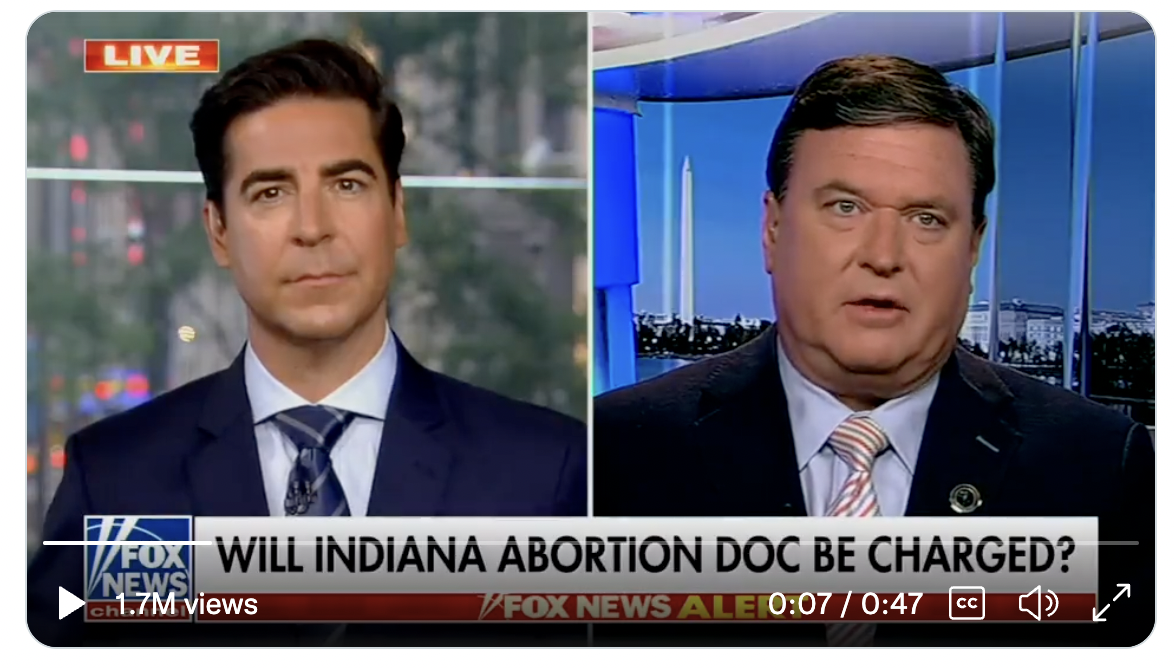
    A defiant Dave Yost on Wednesday told News 5 in Cleveland “I never apologize for speaking the truth” when asked if he should apologize for an interview he did on Fox News a night earlier.

    That was when he raised doubts with host Jesse Watters that a 10-year-old Ohio rape victim had actually been forced to go to Indiana for an abortion as a consequence of a highly restrictive abortion law that Yost had supported.

    Less than 24 hours later, Yost’s doubts were proven to be unfounded when The Columbus Dispatch reported that a 27-year-old man had been arrested on charges of raping the child. But in addition to expressing unfounded doubts, Yost appears to have made at least two serious factual errors in that three-minute Fox interview.

    First was his insistence that the Ohio Bureau of Criminal Investigation hadn’t processed a rape kit in the case, and that cast serious doubt on whether the incident ever happened. Turns out that the state’s own Child and Adolescent Sexual Abuse Protocol lays out many circumstances under which a child victim wouldn’t have a rape exam.

    But much more significantly, Yost also claimed that if a 10-year-old gets pregnant in Ohio, she can still get an abortion under exceptions regarding the health of the mother.

    “Ohio’s heartbeat law has a medical emergency exception,” Yost told Watters. “It’s broader than just the life of the mother. This young girl — if she exists and if this horrible thing actually happened to her, it breaks my heart to think about it — she did not have to leave Ohio to find treatment.”

    That statement was quickly amplified on social media. But two Ohio OB-GYNs — doctors who are required to follow the new law — disputed that analysis on Thursday.

    The dispute appears to hinge on who knows more about the risks of pregnancy — Yost, or doctors who care for pregnant patients.

    One instance under which the law says abortions are allowed after six weeks is if there’s a “medically diagnosed condition that so complicates the pregnancy of the woman as to directly or indirectly cause the substantial and irreversible impairment of a major bodily function.”

    That sheds little light on how old mothers have to be under the law to face such risks, said Jason Sayat, a Columbus OB-GYN.

    “It states specifically ‘medically diagnosed condition’ and as far as I can tell, adolescent pregnancy is not a medically diagnosed condition that’s listed,” he said.

    Maria Phillis, a Northeast Ohio OB-GYN who is also a council chair with the American College of Obstetricians and Gynecologists, explained that the law makes two types of exceptions for the health of the mother.

    One is an emergency: an imminent threat of death or severe, lasting health problems for the mother. Phillis said such a situation could include “somebody who’s imminently bleeding out on the table, or having a stroke or cardiac arrest — things that are like, imminently if I don’t do something right now, somebody’s going to suffer death or severe consequences.”

    The other exception is if there’s a medically diagnosed condition that can “cause the substantial and irreversible impairment of a major bodily function.”

    Both Phillis and Sayat said such a situation can arise with very young mothers — and with a lot older ones, too. 

    “Pregnancy itself overall is a risk for anyone who enters it,” Phillis said. “It completely alters the broad physiology of the body. It alters the heart function… It alters kidney function. It alters a number of different body systems and folks that have preexisting disease or complications are at a higher risk of bad outcomes.”

    The youngest mothers are at higher risk for early births, restricted fetal growth, and a condition known as preeclampsia. They’re also at higher risk for postpartum depression — although the Ohio law expressly says it “does not include (an exception for) a condition related to the woman’s mental health.”

    Pregnant girls face those risks, but Phillis and Sayat said other groups of expectant women face elevated danger as well.

    “There are risks like that associated with any number of things,” Phillis said. “Just being African American puts you at risk for some of those same things. Just being obese puts you at risk for some of those things. Just being above 35 puts you at risk for some of those things.” 

    She added that being very young “certainly is a higher-risk pregnancy than for someone who is older and more mature, but it’s a little harder to say that this specific thing — her age — is going to put her at a higher risk than other conditions, say chronic hypertension, chronic diabetes. It’s hard to really put that together.”

    So are the dangers faced by very young mothers greater than those faced by other groups?

    “It’s really hard to compare,” Phillis said. “Most studies, when they look at different risk groups, are taking one thing at a time. Compiling risks, it’s always difficult to say… I would not feel comfortable doing a direct comparison. We’re really not set up to say who has the most risky pregnancy.”

    Despite making the claims he did on Fox, Yost’s office didn’t answer Thursday when asked to explain how the risks faced by pregnant girls who are very young are legally distinguishable from those faced by other women. He also refused, as has Gov. Mike DeWine, to say at what age he believes adolescents should be required to have their rapists’ babies. 

    Sayat, the Columbus OB-GYN, said laws like the one DeWine and Yost support are too blunt of instruments to govern doctors’ work.

    “That’s why we practice the medicine that we do,” he said. “If it was clear-cut and pregnancies were black and white, we wouldn’t have to do the training that we do or be prepared for all the different types of scenarios and emergencies we do.”

    Meanwhile, Indiana Attorney General Todd Rokita pushed Yost’s criticisms of Caitlin Bernard — the Indianapolis OB-GYN who first disclosed the 10-year-old’s abortion — to another level Thursday. Rokita said he was investigating Bernard with an eye toward taking her license or filing criminal charges, but was vague about what rules or laws she might have broken. 

    Also Thursday, Sen. James Lankford, R-Okla., blocked a bill that would have protected women’s and girls’ rights to cross state lines to get an abortion, as the Ohio 10-year-old did.

    Phillis, the OB-GYN from Northeast Ohio, said such things are driving colleagues out of the profession and limiting options for pregnant women and girls.

    “I really worry about my patients,” she said. “It’s a dangerous time to be alive in Ohio.” 
    Follow Marty Schladen on Twitter.

  • U.S. House passes bill expanding health care, benefits for veterans exposed to burn pits

    U.S. House passes bill expanding health care, benefits for veterans exposed to burn pits

    BY: JENNIFER SHUTT – Ohio Capital Journal

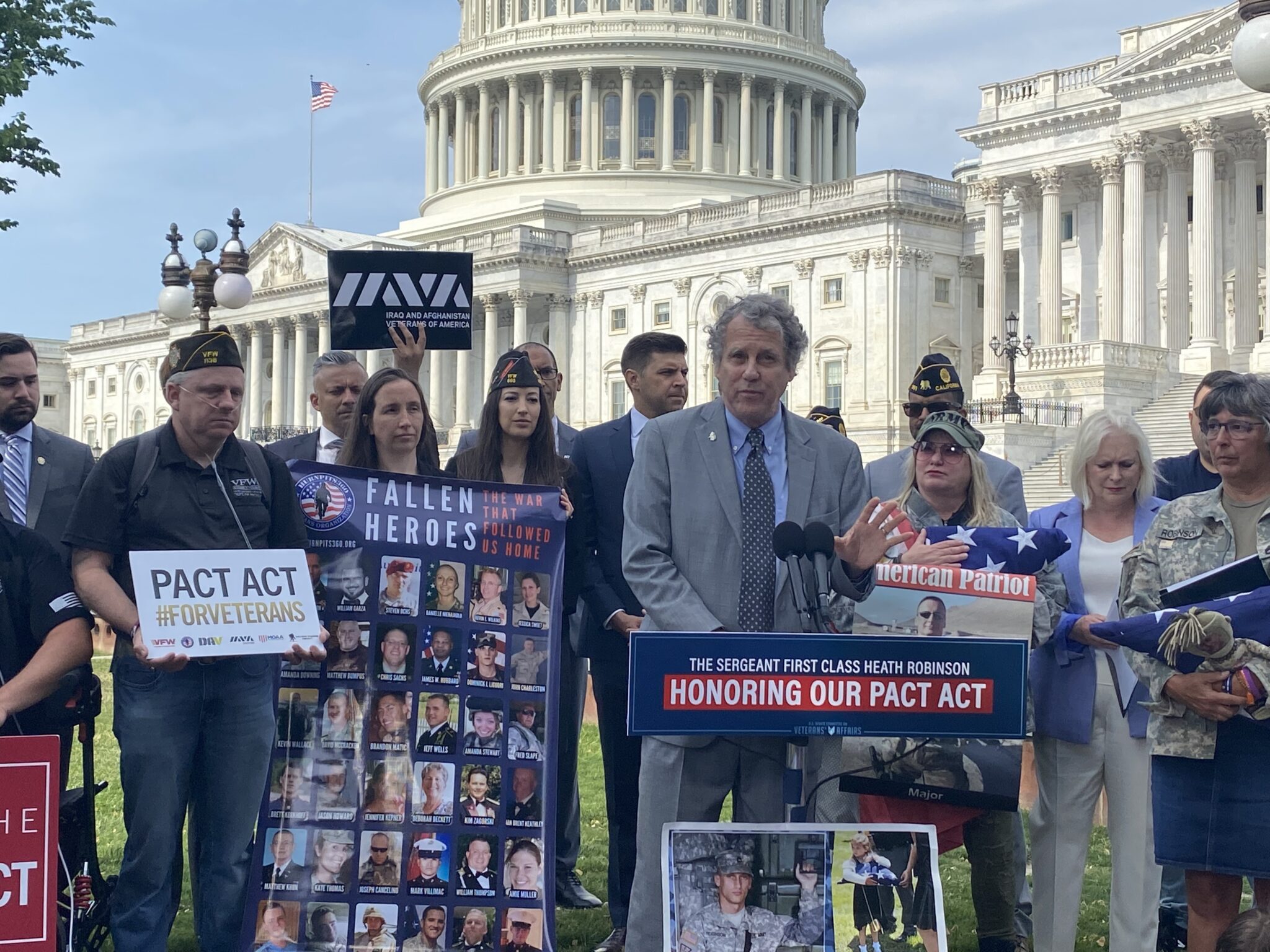
    Ohio Democratic Sen. Sherrod Brown speaks at a press conference on legislation to provide health care for veterans exposed to burn pits on June 7, 2022. Susan Weber Zeier of Sandusky is on the far right of the photo. Photo by Jennifer Shutt, States Newsroom.

    WASHINGTON — The U.S. House overwhelmingly approved a bipartisan bill Wednesday to expand health care and benefits for veterans exposed to burn pits overseas, sending the package back to the U.S. Senate after making a minor change.

    Senators, who broadly support the landmark package led by Montana Sen. Jon Tester and Kansas Sen. Jerry Moran, are expected to quickly clear the measure for President Joe Biden’s signature. The House vote was 342-88.

    Biden, who has linked his son Beau’s death from a brain tumor in 2015 to exposure to burn pits, has repeatedly called on Congress to address the illnesses and deaths linked to toxic exposure.

    “What I found with my son, what I found with my friends, what I found with the generation of Vietnam: There’s this notion that you shouldn’t ask for anything,” Biden said in March while at a resource center in Fort Worth, Texas.

    “You should be asking. You should be letting us know. You should let us know what is bothering you, what is the problem, because we owe it to you,” Biden continued.

    Delayed by dispute

    The Senate approved the legislation last month following an 84-14 vote, but House approval was delayed while members of the Veterans’ Affairs Committees worked out a dispute over a provision designed to boost staff in rural areas.

    The language would have allowed the U.S. Veterans Affairs Department to buy certain health care providers out of their contracts if they took offers to work for at least four years at “rural or highly rural facilities.” The provision also said that the money for the buyouts “shall not be considered a taxable benefit or event for the covered health care professional.”

    Lawmakers on the U.S. House Ways and Means Committee cited a so-called blue slip issue, since a tax provision cannot originate in the Senate.

    After substantial back-and-forth about how to fix the problem, the House Rules Committee opted to remove the provision this week, before sending a new, slightly altered bill to the floor.

    Bipartisan acclaim

    House debate on the legislation Wednesday was broadly bipartisan, with the vast majority of lawmakers speaking in support of the package.

    Rep. Mariannette Miller-Meeks, an Iowa Republican, said she has “seen firsthand the effects that toxic exposure has had” on her fellow service members following her 24-year military career.

    “Exposure to these substances can lead to severe, life-altering disease,” Miller-Meeks said.

    “However, under the current system at the VA it can be extraordinarily costly, time-consuming and in some cases impossible for a sick or disabled veteran to prove that their condition is related to the toxins to which they were exposed during their military service.”

    The bill the House passed Wednesday, she said, would help to end that by requiring the VA to deliver health care and benefits to veterans exposed to toxins “in a responsible, fair way.”

    Arizona Democratic Rep. Ruben Gallego, a Marine Corps infantryman who deployed to Iraq in 2005, said the legislation was overdue and desperately needed.

    “Too many veterans live in fear that their next doctor’s appointment will reveal an illness that in addition to harming their health could drive them into bankruptcy because the VA refuses to care for them,” Gallego said. “I am one of those people that does have that fear.”

    The legislation, named for deceased Sergeant First Class Heath Robinson of the Ohio National Guard, would expand eligibility for VA health care to more than 3.5 million veterans exposed to burn pits since 9/11.

    It would add 23 illnesses to the list of toxic-exposure-related ailments presumed to be connected to military service, ending the need for veterans with those conditions to try to prove to the VA their illnesses were linked to their deployments.

    The package would direct more resources to VA health care centers, employees and claims processing as well as federal research on toxic exposure.

    The measure would also expand presumptions for veterans exposed to Agent Orange, a chemical the U.S. military used during the Vietnam War. American Samoa, Cambodia, Guam, Johnston Atoll, Laos and Thailand would all be added to the list of locations where veterans are presumed to have been exposed to the chemical.

  • Indiana Attorney General targets abortion doctor who helped Ohio 10-year-old rape victim

    Indiana Attorney General targets abortion doctor who helped Ohio 10-year-old rape victim

    Indiana Attorney General Todd Rokita went on Fox News announcing legal investigation of doctor who shared Ohio 10-year-old’s abortion story

    Staff Report from Ohio Capital Journal

    Indiana Attorney General Todd Rokita is investigating the Indiana abortion doctor who brought to light the case of a 10-year-old rape rape victim who was unable to get an abortion in Ohio, he told FoxNews commentator Jesse Watters Wednesday night.

    State law requires doctors performing an abortion on anyone younger than 16 to file a report with the Indiana Department of Health and Indiana Department of Child Services within three days.

    Rokita said in his letter he is awaiting responses from both agencies.

    “As the attorney for the state of Indiana, my office needs these documents and proofs in order to execute the requisite legal protections for the people of Indiana, and perhaps more importantly, to ensure the public’s confidence in your agencies regarding this horrible matter,” the letter to Holcomb said.

    Rokita told FoxNews commentator Jesse Watters Wednesday night his office is investigating the Indiana abortion doctor who brought the case to light nationally. But he provided no details during the appearance.

    “And then we have this abortion activist acting as a doctor with a history of failing to report. So we’re gathering the information,” Rokita said on air. “We’re gathering the evidence as we speak, and we’re going to fight this to the end, including looking at her licensure. If she failed to report it in Indiana, it’s a crime for – to not report, to intentionally not report.”

    Indianapolis obstetrician-gynecologist Dr. Caitlin Bernard was first quoted by the Indianapolis Star about being contacted by a doctor in Ohio when the child couldn’t get an abortion there because she was just past the state’s six-week ban. After Republicans questioned the veracity of the claim in recent days, the alleged perpetrator was charged with rape and arraigned Wednesday in Columbus.

    Police in the case said the girl’s mother contacted authorities June 22 and the abortion was performed in Indianapolis June 30.

    Failure to file the proper paperwork is a misdemeanor and Rokita also said it could impact Bernard’s medical license.

    Indiana Right to Life in 2018 accused eight abortion doctors of not filing the appropriate documents for young girls receiving abortions – including Bernard. Indiana’s online license search shows no discipline for Bernard.

    The Indiana General Assembly is set to return July 25 for a special session on abortion and tax refunds.

    The Indiana Democratic Party released a statement that said “Attorney General Todd Rokita is looking to sue a doctor for saving a young girl’s life. The Indiana Republican Party believes rape survivors – including minors – should be forced to give birth to their rapist’s baby. Their agenda is dangerous and too extreme for Indiana.”

    This story originally appeared in the Indiana Capital Chronicle.

  • Ohio Republicans’ attempted erasure of a 10-year-old rape victim is incredibly sick and disturbed

    Ohio Republicans’ attempted erasure of a 10-year-old rape victim is incredibly sick and disturbed

     Left to right: Republican Ohio Gov. Mike DeWine, Republican Ohio Attorney General Dave Yost, and Republican U.S. Congressman Jim Jordan. Official photos.
    Ohio Capital Journal Editor-in-Chief David DeWitt

    A Guest Column by David Dewitt

    The first and most important thing to recognize right now is that a heinous, violent crime was committed on a 10-year-old Ohio child, and thankfully justice has now found the alleged perpetrator.

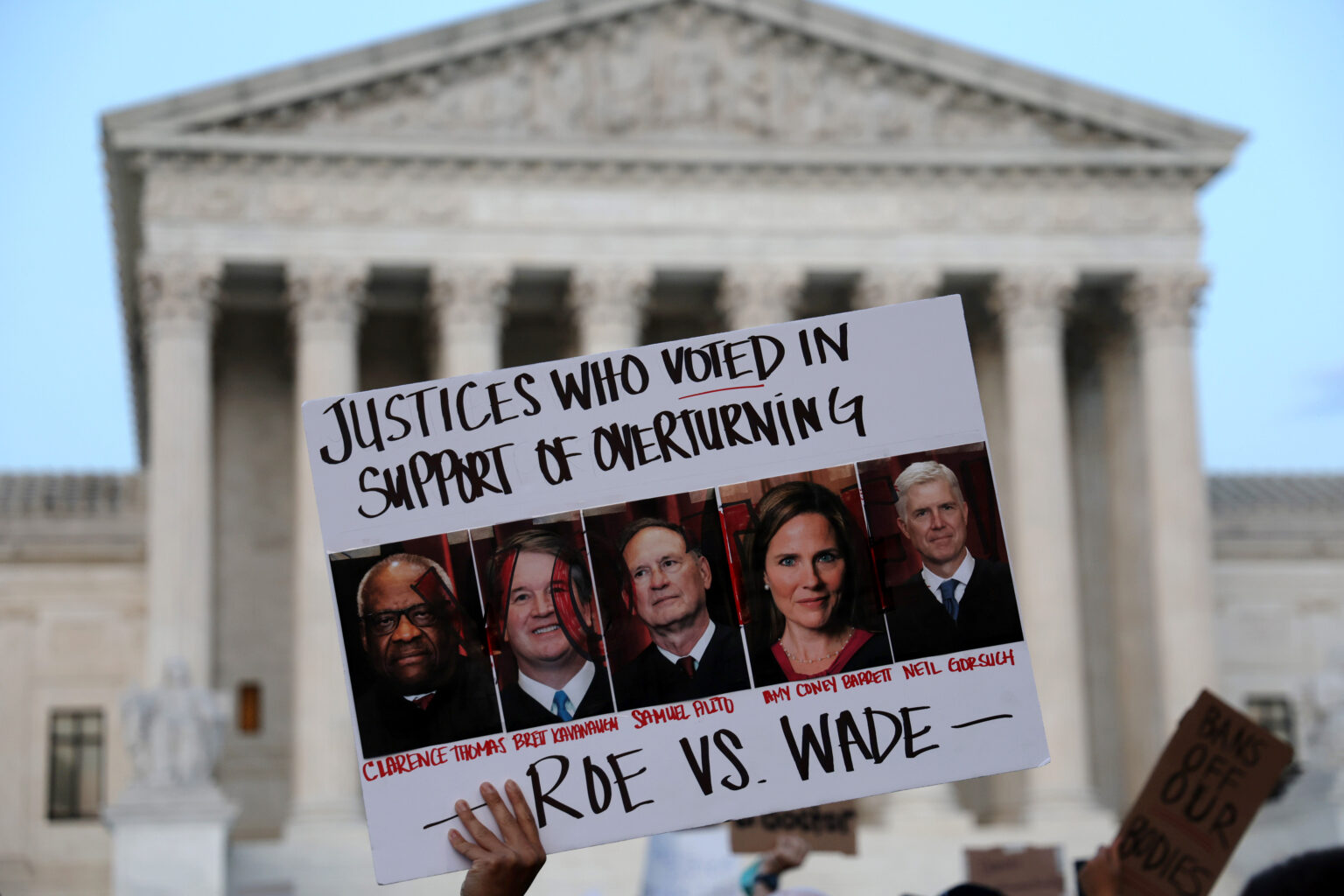
    Columbus man was indicted Wednesday in a case that made national and international headlines about 10-year-old girl who had to travel to Indiana for an abortion after Ohio’s abortion ban went into effect following the U.S. Supreme Court overturning Roe v. Wade.

    The story is horrifying and tragic. She has experienced enormous trauma. My heart breaks for her, and I’m very grateful to all the hard-working professionals out there providing her and her family assistance in what must be a truly awful time.

    Republican Ohio Gov. Mike DeWine and his spokesman responded to the story by ignoring questions about whether children should be forced to have their rapists’ babies. Then DeWine allies contacted members of the press, asking how sure they were that the case of the pregnant 10-year-old even happened.

    The Washington Post, the conservative Daily Caller and other media outlets published stories saying that the case was unverified. The Wall Street Journal Editorial page suggested the story was a “fanciful tale.” The National Review’s Michael Brendan Dougherty referred to the case as “a fictive abortion and a fictive rape.”

    Republican Ohio Attorney General Dave Yost went on Fox News Monday to raise further doubts. He said he works closely with law enforcement authorities and he’d gotten “not a whisper” about the case.

    Hamilton County Republican Party Chair Alex Triantafilou on Twitter called the case, “A garbage lie that a simple google search confirms is debunked.”

    State Rep. Brian Stewart tweeted the Washington Post story saying he “wouldn’t trust an abortionist to tell me whether the sky is blue.”

    Ohio U.S. Rep. Jim Jordan tweeted, “Another lie. Anyone surprised?

    None of them had the patience to verify for themselves with certainty the truth of the matter before going public on a massive, self-serving scale.

    The propaganda erasing this 10-year-old’s existence was so swift it spread out over right-wing social media like a blanket. Those advocating the truth of her story — privately already confirmed for some of us, and crushing to hear about — were subjected to wild-eyed mockery and ridicule.

    It’s incredibly disturbing that the default position of so many sick and twisted people — including Ohio’s most prominent Republican elected officials — is to very vocally and very publicly question whether the rape and impregnation of a 10-year-old child ever happened.

    DeWine, Yost, and other Ohio Republicans hurt a traumatized child once by forcing her to flee the state in order to receive health care; then they hurt her again by peddling propaganda erasing her; now they’re hurting her a third time by refusing to acknowledge and apologize for their actions.

    This case was never implausible. In 2020, the most recent year for which statistics are available, 52 girls aged 14 and younger had abortions in Ohio, according to the state department of health. A review of just the city of Columbus’ police log since March 15 uncovered 59 reports of sexual assaults of girls 15 and younger that, based on the information available, could have resulted in pregnancy.

    Nevertheless, the wheels and integrity of local journalism spun and uncovered the truth, with the Columbus Dispatch breaking the news of confirmation of the case.

    But after the confirmation broke Wednesday, DeWine’s spokesman, Dan Tierney, again refused to comment on whether child rape victims should be forced to carry their pregnancies to term.

    Ten-year-olds who become pregnant are by definition rape victims. But Ohio’s abortion law signed by DeWine doesn’t make exceptions for rape and incest.

    Yost’s office didn’t respond Wednesday when asked whether he believes child rape victims should be forced to carry pregnancies, nor whether it was important to believe stories about sexual violence. Instead he put out a statement applauding the arrest.

    Yost offered no correction, no apology, and showed no contrition for going on national television to try to erase the lived experience of a child rape victim.

    They behave on a base level so repugnant and removed from the general good-heartedness of most Ohioans it’s almost unfathomable.

    “Apologize for what? Questioning a newspaper story?” Yost, Ohio’s top law enforcement officer, said about a case in his own county.

    DeWine, Yost, and other Ohio Republicans hurt a traumatized child once by forcing her to flee the state in order to receive health care; then they hurt her again by peddling propaganda erasing her; now they’re hurting her a third time by refusing to acknowledge and apologize for their actions.

    These powerful Ohio Republican politicians have thoroughly and completely shed themselves of any sense of shame or conscience.

    They’re disgusting and disgraceful; callous, careless and cruel.

    This is a matter of basic human decency, good faith and sensitivity on the most fundamental level of society.

    If they are willing to try to erase the traumatic story of a 10-year-old rape victim, whose pain and suffering will they not try to ignore and erase?

    They behave on a base level so repugnant and removed from the general good-heartedness of most Ohioans it’s almost unfathomable.

    I honestly don’t know how they sleep at night, or look at themselves in the mirror in the morning.

  • OSU study: Contraception used to control when families have children, not prevent them

    OSU study: Contraception used to control when families have children, not prevent them

    Getty Image

    BY: SUSAN TEBBEN – Ohio Capital Journal

    In the U.S., contraception is being used for pregnancy prevention along with other medical conditions. Meanwhile, an Ohio State University study showed other countries are using birth control not as a way of avoiding having children, but as a way of inserting control into the family planning process.

    The report, which was published in a recent edition of Studies in Family Planning, pored over data going back 50 years in health surveys done in Africa, Latin America, the Caribbean and Asia.

    Analysis of the surveys showed 10% to 15% of the increase in contraception use came from women who wanted to have children in the next two years, according to the study’s lead author, Mobolaji Ibitoye, a postdoctoral student with Ohio State’s Institute for Population Research.

    The evidence refuted a so-called “contraception revolution” in those counties, which argued that contraception was being used for the sole purpose of reducing the amount of children parents are having.

    “The revolution is that women can now carry through on what they want because of modern contraceptives,” said study co-author and OSU sociology professor John Casterline, in a release announcing the study.

    The survey didn’t touch on other medical uses for oral contraception. Women’s health advocates are concerned that future abortion bans, including those in Ohio, may impact contraception since the U.S. Supreme Court overturned Roe v. Wade. 

    Contraception can be used to decrease the risk of ovarian cysts and pelvic inflammatory disease, according to the Cleveland ClinicMedical studies have also shown certain contraceptions can decrease the risk of endometrial cancer, ovarian, ectopic pregnancy, a pregnancy in which the egg implants outside of the uterus, making it inviable.

    Follow OCJ Reporter Susan Tebben on Twitter.

  • Retired teachers go to court for Ohio pension records

    Retired teachers go to court for Ohio pension records

    BY: MARTY SCHLADEN – Ohio Capital Journal

    An analyst working for Ohio retired teachers went to court last week seeking records relating to the state pension funds. 

    The analyst is trying to determine whether teachers’ pension money is being squandered on high-fee “alternative” investments such as private equity and hedge funds. He is also investigating whether external consultants directing such investments are also being paid by the firms in which retirement system money is being invested.

    Edward Siedle is president of Benchmark Financial Services, which investigates pension funds on behalf of their members. Last week, former Ohio Attorney General Marc Dann filed for a writ of mandamus on Siedle’s behalf to get records from the State Teachers Retirement System. 

    If successful, Ohio’s 10th District Court of Appeals will order the teachers retirement system, or STRS, to turn over a boatload of documents relating to its investments.

    In an interview, Dann said Siedle has been seeking the records since last year.

    “We’re not some gadfly trying to throw a wrench in the operation of STRS,” Dann said. “These are members of STRS who hired a professional to analyze the work that STRS is doing on their behalf. We want documents that will help that expert give an honest and accurate analysis.”

    He added, “To the extent that they say our requests are trade secrets or are too voluminous, it makes you think maybe they don’t want us to look so closely at this.”

    However, STRS spokesman Nick Treneff said that his agency has been working with Siedle and has already turned over many records.

    “We did try to work with Siedle on his request,” Treneff said.

    In a report last year, STRS said it had already turned over a boatload of information.

    “Over a period of three months, from February to May 2021, STRS Ohio sent 24 emails and a thumb drive to counsel, amounting to 812 documents and over 22,000 pages,” it said, adding that remaining requests are “overly broad.”

    Lawyers for Ohio state agencies commonly use such language in response to records requests. It will be up to the court to determine whether in this case STRS is using it, as Dann says, to stonewall. 

    But the stakes are pretty high.

    STRS is managing $92 billion on behalf of 166,000 active members. And, as benefits have become stingier, some of those members have become suspicious that the agency is making dubious investments through politically connected entities.

    The governor and the leaders of the General Assembly appoint “investment experts” to the STRS board of directors, and many of the state’s retired teachers believed the investments made on their behalf have underperformed.

    The distrust was evident in a newsletter written last August by Robin Rayfield, executive director of the Ohio Retired Teachers Association.

    “STRS has overstated investment returns while under-reporting the fees and costs associated with those investments,” he said.

    Part of the distrust surely stems from the fact that the pension fund stopped paying cost-of-living increases in 2017 — although it is planning a 3% increase this year.

    Treneff, the STRS spokesman, said the freeze was due to new rules set down by the legislature in 2012. State and local governments were still reeling from the Great Recession and there were nationwide concerns about unfunded pension liabilities.

    The retired teachers association points out that the General Assembly hasn’t increased its contribution rate to the pension fund in 38 years.

    But it did act to shore STRS up by cutting benefits. The cost-of-living hike was cut from 3% to 2% and teachers were made ineligible for any increases until they’ve been retired for five years. 

    The General Assembly also required that the system have enough assets to pay off any liabilities within 30 years. In 2017, when the fund didn’t appear likely to meet that requirement, the living increase was suspended. 

    Treneff said it was due to reduced investment-return assumptions, longer lifespans and lower-than-expected payroll growth.

    “That was painful for sure,” he said. “It wasn’t an easy decision.”

    But with five STRS employees making salaries and bonuses totaling more than $500,000 in 2020 — and with 64 making more than $200,000 the same year —  frustration and suspicion among Ohio teachers and retirees was perhaps predictable.

    And, with the U.S. Securities and Exchange Commission in January finding a raft of problems with the transparency and honesty of private equity funds, it’s also probably understandable that pension fund members have turned their suspicions on its alternative investments.

    Treneff, the system spokesman, was quick to point out that those investments are providing the system’s second-best returns. 

    The best? The American stock market. 

    Over the past decade, it has provided a 14.8% return on investments, while the system’s alternative investments have provided 11.84% once fees are subtracted, Treneff said.

    So why make a substantially worse-performing investment with teachers’ money? To avoid putting too many eggs in one basket, Treneff said.

    “The goal is to build this (pension) fund as fast as you can without taking wild risks,” he said, adding, “you don’t want one downturn in the stock market to destroy you.”

  • DeWine: No comment on abortion ban that forced a child to Indiana

    DeWine: No comment on abortion ban that forced a child to Indiana

    BY: MARTY SCHLADEN – Ohio Capital Journal

    t appears that a 10-year-old rape victim had to leave Ohio for an abortion. But Ohio Gov. Mike DeWine isn’t commenting on the fact that a law he signed making that necessary if she didn’t want to become a mother.

    Shortly after the U.S. Supreme Court overturned Roe v Wade and cleared the way for the law to take effect, the child was on her way to Indiana for an abortion because she couldn’t get one in Ohio, an Indianapolis OB-GYN told the Indianapolis Star. The doctor, Caitlin Bernard, told the paper that an Ohio child-abuse doctor had called, saying the child was six weeks and three days pregnant and needed help.

    That was three days after the six-week limit the DeWine-signed law places on abortion in Ohio. It makes no exceptions for women and children who are victims of rape and incest.

    The story has made national news. But DeWine seemed unprepared Wednesday to discuss whether legislation he championed is forcing children out of state if they don’t want to have their rapists’ babies.

    “Yeah, first of all, I have no more information than you do or anybody does. Reading in the in the paper, it came came as you know, from a story out of out of Indiana from from a doctor over there,” he said as part of a rambling answer to a question from the Cincinnati Enquirer, according to a transcript.

    DeWine went on to say it was “gut-wrenching” as a father and grandfather to think about a 10-year-old being raped, and that he hoped the doctors caring for her reported the assault to law enforcement. But he didn’t address the fact that a law he signed put girls like her in such an onerous situation.

    In a follow-up on Thursday, DeWine Press Secretary Dan Tierney was asked whether the governor thinks juvenile rape victims who become pregnant should be able to get abortions, or whether he believes they should be forced to carry their pregnancies to term. Tierney didn’t answer directly.

    “You have access to Governor DeWine’s recent comments on these issues, including that the only information available on the Indiana matter was from Indiana media reports,” Tierney said in an email. “I do not have further comment for you beyond yesterday’s remarks and the Governor’s numerous and extensive comments since the” Supreme Court decision overturning Roe v Wade.

    While DeWine and his spokesman underscored that media reports were all they knew about the incident involving the Ohio 10-year-old, there have been warnings that something like this was likely to happen.

    Shortly after DeWine signed the six-week ban in 2019, CBS News reported on an Ohio 11-year-old who was repeatedly raped by a 26-year-old, impregnating her. If the Ohio law was cleared by the Supreme Court, the story said, the girl could be left with few options after six weeks of pregnancy. 

    The story also describes victim-blaming the child experienced at a “pregnancy care center.” It cited a police report quoting an employee describing the 11-year-old rape victim as “rebellious” and that she “refuses to listen to her mother and runs away from home all the time.”

    At six weeks, as many as a third of women don’t know they’re pregnant, and it’s a safe bet that even fewer girls do. And while statistics on pregnancies resulting from rape are sparse, it seems likely that Ohio and other states that don’t allow abortions in cases of rape or incest are going to force more children into the most difficult of situations.

    The U.S. Centers for Disease Control and Prevention estimates that about 18 million women experience vaginal rape in their lifetimes and that almost 3 million become pregnant from it. The 2018 research from which those statistics were drawn said it was “the first in over 20 years to offer a nationally representative prevalence estimate of (rape-related pregnancy) of U.S. women…”

    That’s an apparent reference to a 1996 paper published in the American Journal of Obstetrics and Gynecology. It was based on a three-year survey of 4,008 women that sought to determine “the prevalence and incidence of rape and related physical and mental health outcomes.”

    Its findings relating to young rape victims are not reassuring.

    “Among 34 cases of rape-related pregnancy, the majority occurred among adolescents and resulted from assault by a known, often related perpetrator,” an abstract of the study said. “Only 11.7% of these victims received immediate medical attention after the assault, and 47.1% received no medical attention related to the rape.” 

    It added that almost a third of adolescent rape victims didn’t know they were pregnant for 12 weeks — more than double the point at which their abortions would now be illegal in Ohio.

    “A total 32.4% of these victims did not discover they were pregnant until they had already entered the second trimester; 32.2% opted to keep the infant whereas 50% underwent abortion and 5.9% placed the infant for adoption; an additional 11.8% had spontaneous abortion,” the paper said.

    DeWine and his spokesman were reluctant this week to say whether he thinks young rape victims should be forced to carry pregnancies to term. But his office earlier this month confirmed his support of a bill restricting abortion in Ohio even further — and also making no exceptions for rape and incest.

    For Aileen Day, communications director for Planned Parenthood Advocates of Ohio, DeWine owns the consequences of the abortion bills he signs — whether he addresses them directly or not.

    “DeWine signed the six-week ban into law and he is the reason the 10-year-old Ohioan had (to) jump through repeated obstacles to get the health care she needed,” Day said in an email. “It is truly disgusting that he’s not being held accountable for all the harm he has caused Ohio. DeWine’s team has bragged that he is the most anti-abortion governor in Ohio’s history and his history backs that up by signing 10 dangerous abortion restrictions and bans into law.” 

    Follow OCJ Reporter Marty Schladen on Twitter.

  • Biden unveils executive order on abortion access, cites case of 10-year-old Ohio rape survivor

    Biden unveils executive order on abortion access, cites case of 10-year-old Ohio rape survivor

    BY: JENNIFER SHUTT – Ohio Capital Journal

    WASHINGTON — President Joe Biden, who has repeatedly been criticized as slow to respond to a widely expected U.S. Supreme Court decision that ended the nationwide right to an abortion, signed an executive order Friday that could preserve some access to abortion in states where the procedure remains legal.

    Biden in a White House speech also brought up the case of a 10-year-old rape survivor from Ohio who was forced to travel out of state to access abortion care in Indiana, questioning if that’s actually the will of a majority of the state’s residents.

    “Does anyone believe that it’s Ohio’s majority view that that should not be able to be dealt with? Or in any other state in the nation? A 10-year-old girl should be forced to give birth to a rapist’s child?” Biden said. “I can tell you that I don’t. I can’t think of anything that’s much more extreme.”

    Ohio Republican Gov. Mike DeWine declined to comment on the state law’s impact in the case this week, saying he had read about it in the paper. He did say he found it “gut-wrenching” that a man raped a child.

    Biden, who began his speech from the White House’s Roosevelt Room more than 30 minutes late by talking about the morning’s jobs report, said the fastest way to reestablish nationwide protections for abortion is by voting in November’s midterm election.

    “Based on the reasoning of the court, there is no constitutional right to choose  —  the only way to fulfill and restore that right from women in this country is by voting,” Biden said. “We need two additional pro-choice senators and a pro-choice House to codify Roe at federal law.”

    Biden acknowledged the frustration and anger many abortion rights advocates and Democrats expressed after he gave a speech the day of the Supreme Court decision, calling on Americans to vote on the issue in November.

    He doubled down on that message during his remarks Friday, saying the Supreme Court opinion in the case, Dobbs v. Jackson Women’s Health Organization, “made clear it will not protect the rights of women.”

    “It’s my hope and strong belief that women will in fact turn out in record numbers to reclaim the rights that have taken from them by the court,” Biden said, opting not to call on men, who are needed for pregnancy to take place, to turn out at the ballot box.

    Executive order

    Biden’s executive order would direct the U.S. Health and Human Services secretary to make sure abortion medication “is as widely accessible as possible,” according to a White House fact sheet.

    The president has also “asked the Chair of the Federal Trade Commission to consider taking steps to protect consumers’ privacy” when seeking information about abortion services and will request HHS “consider additional actions” to protect “sensitive information related to reproductive health care.”

    As part of those efforts, the administration has posted websites to try to help patients protect information their cell phones may store about reproductive health care and about the type of health care records that are protected under the federal law known as the Health Insurance Portability and Accountability Act, or HIPAA.

    The White House is hoping to combat misinformation that has become more common since the Supreme Court’s ruling, with Biden directing the HHS secretary, the attorney general and chair of the Federal Trade Commission “to consider options to address deceptive or fraudulent practices, including online, and protect access to accurate information.”

    The executive order, Biden said, would direct the federal government to look into tech privacy.

    “Now when you use a search engine, or the app on your phone, companies collect your data, they sell it to other companies and even share it with law enforcement,” Biden said. “There’s an increasing concern that extremist governors and others will try to get that data off of your phone, which is out there in the ether, to find what you’re seeking, where you’re going and what you’re doing with regard to health care.”

    House to vote on abortion access

    The Democratic-controlled U.S. House is set to vote on two bills next week addressing abortion access, though it’s unlikely either will get past the U.S. Senate’s legislative filibuster.

    The first bill, the Women’s Health Protection Act of 2022, would reestablish a nationwide right to an abortion. The second bill, the Ensuring Access to Abortion Act of 2022, would block state governments from making abortion travel illegal and protect health care providers in states where the procedure remains legal.

    Congress is also slated to have a series of hearings on the impact of the Supreme Court’s decision to overturn Roe v. Wade, including next week in the U.S. Senate Judiciary Committee as well as the Senate Health, Education, Labor and Pensions panel.

    Washington state Democratic Sen. Patty Murray, chair of the HELP panel, said in a written statement Friday following Biden’s speech that while the executive order is an important step, the “fight is far from over.”

    “The reality is that the President’s executive authority is limited — so the surest way to protect every woman’s right to abortion is electing two more pro-choice Democratic senators and protecting our pro-choice majority in the House so that we can codify Roe,” Murray said.

  • Judge rejects bid to settle FirstEnergy bribery suit with shareholders elsewhere

    Judge rejects bid to settle FirstEnergy bribery suit with shareholders elsewhere

    FirstEnergy’s headquarters in Akron. Source: Google Maps.

    BY: JAKE ZUCKERMAN – Ohio Capital Journal

    A federal judge in Akron has refused to dismiss a lawsuit between FirstEnergy Corp. — which has admitted that it bribed two top Ohio politicians with $64 million — and some of its shareholders.

    U.S. District Judge John R. Adams denied a motion Tuesday, filed jointly by the company and its investors, asking him to dismiss the case in light of a proposed settlement preliminarily agreed to by another federal judge.

    Adams accused the parties of “forum shopping,” or looking for a friendly judge given his previous skepticism of the settlement. He also implicitly accused FirstEnergy of protecting its former CEO’s riches, and the plaintiff’s lawyers of cashing in without properly investigating the company’s scheme.

    The lawsuit traces back to the 2019 passage of state House Bill 6, which included several provisions favorable to FirstEnergy worth an estimated $1.3 billion to the company. This included a massive, ratepayer funded bailout for nuclear plants it owned at the time.

    FirstEnergy admitted in a deferred prosecution agreement last summer that it engaged in the bribery operations, with money flowing from the company to entities controlled by Ohio House Speaker Larry Householder and Public Utilities Commission of Ohio Chairman Sam Randazzo. Householder awaits trial and has pleaded innocent. Randazzo has not been charged and maintained his innocence.

    The agreement required the company to admit to a lengthy proffer of facts, cooperate with ongoing criminal probes, and pay a $230 million penalty to avoid a criminal charge of wire fraud.

    Shareholders have brought three derivative suits against the company over their losses incurred by the scandal — one in state court and two in federal court. In March, FirstEnergy announced it reached a settlement with the shareholders. It called for the company to oust six board members and receive $180 million from company insurers.

    U.S. District Judge Algenon L. Marbley preliminarily approved the settlement in May but said he had no authority over other judges’ cases.

    In Adams’ order Tuesday, he expressed incredulity at the lack of investigative efforts from the plaintiffs and the lack of consequences for some of the defendants.

    The shareholders’ lawyers have claimed, defending the proposal, that this would be the largest settlement of its type in Ohio.

    Big whoop, Adams said.

    FirstEnergy already paid a $230 million penalty, he said. The case record indicates shareholders lost more than $1 billion in value when the news of the initial criminal arrests in the scandal broke and the company’s share price plummeted. The insurance payout is a fraction of these losses. He noted that the small army of plaintiffs’ lawyers on the case could take a sizable chunk of the proposed settlement.

    “Given that counsel is permitted under the settlement to seek up to $48,600,000 in attorney fees, it is hardly surprising that the parties would seek out what they believe to be a more favorable forum,” he said.

    He also noted a finding in a recent regulatory audit that found FirstEnergy could have reclaimed some of the $55 million it paid to then-CEO Chuck Jones during the roughly three-year span of the criminal allegations. Though the company fired Jones, it never invoked the contractual provision allowing it to reclaw the compensation, the audit found.

    In his order, Adams also cited uncomplete exchange of evidence between parities, no testimony under oath from any defendants, and an incomplete forensic examination to identify “possible missing communications” from Jones’ phone.

    While FirstEnergy as a company faces criminal consequences, its executives to date have not. The deferred prosecution agreement the company entered, meanwhile, doesn’t specifically identify who organized the bribery operation.

    Earlier this year, Adams refused to allow any settlement — and at one point stormed off during a hearing — until someone in the case admitted who specifically orchestrated the bribery operation. Counsel representing plaintiffs identified both Jones and fellow executive Mike Dowling as the central operators. The two men are named defendants in the shareholder lawsuit.

    John Camillus, an attorney and “liaison counsel” for some of the plaintiffs, declined to comment.

    A FirstEnergy spokeswoman declined to comment.

    Follow OCJ reporter Jake Zuckerman on Twitter

  • The bedeviling details: Roe decision leaves Ohio health providers scrambling

    The bedeviling details: Roe decision leaves Ohio health providers scrambling

    BY: MARTY SCHLADEN – Ohio Capital Journal

    Abortion foes celebrated victory in a 50-year fight on June 24, when the U.S. Supreme Court overturned Roe v Wade and allowed states to severely restrict — or even eliminate — women’s access to abortion. But for those who care for pregnant women, the ideological victory posed a swarm of burdensome questions they haven’t begun to answer.

    Jason Sayat, a Central Ohio OB-GYN, said the Friday the decision came down started as any other. He and his colleagues juggled a full office load with duties in the labor-and-delivery ward. 

    “Then we were hit with the information that Roe v Wade was reversed,” he said, describing how through the rest of the day they dealt with not just patients’ medical conditions, but also their fears about what the cancellation of a constitutional right to abortion meant for them.

    Within hours, the confusion increased when Attorney General Dave Yost filed a motion to lift an injunction against a 2019 Ohio law prohibiting abortions after six weeks of pregnancy — a point at which as many as a third of women don’t even know they’re pregnant

    Sayat said “it really put things dramatically and quickly into focus in terms of how these restrictions were well in place within hours.”

    The six-week ban is far from the only abortion restriction that could be coming down the pike in Ohio. One lawmaker says she has the votes and support of Gov. Mike DeWine to ban almost all abortions, even in the case of rape or incest.

    The flurry of anti-abortion laws and proposals has Ohio’s major health systems on their heels. 

    Individual practitioners such as Sayat, who declined to name his employer, are saying they need to know that Ohio health systems will have their backs in the months ahead. But he said that as of last week, “we’re still waiting for directives.”

    He explained that while the political debate over abortion tends toward the simplistic, caring for pregnant women in the real world is anything but.

    For example, Ohio’s six-week law allows later abortions if there’s a “medically diagnosed condition that so complicates the pregnancy of the woman as to directly or indirectly cause the substantial and irreversible impairment of a major bodily function.” But who determines whether those conditions have been met? The Department of Health? The police?

    “What this has all come down to is the violation or disruption of personal medical decision-making between the decisions of the patient and their trusted health care team or physician,” Sayat said. “It’s so individualized and complex that laws like this can’t apply to that. It’s not as black-and-white.”

    And, he said, in situations where continuing a pregnancy is incompatible with the health of the mother, doctors and patients need to be able to make decisions “without fear of reprimand or imprisonment on felonious charges.”

    The American Medical Association didn’t mince words in the wake of the Supreme Court decision overturning Roe v Wade.

    The organization “is deeply disturbed by the U.S. Supreme Court’s decision to overturn nearly a half century of precedent protecting patients’ right to critical reproductive health care — representing an egregious allowance of government intrusion into the medical examination room, a direct attack on the practice of medicine and the patient-physician relationship, and a brazen violation of patients’ rights to evidence-based reproductive health services,” AMA President Jack Resneck Jr. said the day of the decision. “States that end legal abortion will not end abortion—they will end safe abortion, risking devastating consequences, including patients’ lives.”

    Ohio’s major hospital systems — operating in a state dominated by anti-abortion officeholders — have been much more cautious in their public statements. 

    The Capital Journal last week asked them four questions:

    • Will your organization provide out-of-state abortion care to your employees should they need it?
    • Will it defend practitioners making medically sound decisions — for example, terminating a pregnancy to protect the mother — to the fullest extent should they be accused of violating current or future restrictions on abortion in Ohio?
    • Are you concerned that current or future restrictions might make it more difficult to attract and retain talented practitioners?
    • Does your organization believe that, in restricting abortion, lawmakers and the courts are inserting their religious beliefs into the doctor-patient relationship?

    Many responded by saying they don’t have any answers yet. Tausha Moore of Toledo-based ProMedica gave a typical response.

    “Regarding your inquiry, we are in the process of evaluating recent changes to better understand the impact they will have on health care in the communities we serve,” she said in an email.

    Marti Leitch of Ohio State’s Wexner Medical Center made a similar statement.

    “Ohio State is closely examining the decision from the Supreme Court and changes in state law,” she said. “If necessary, the medical center and College of Medicine will make adjustments to be in compliance with the law.”

    Dorsena Drakeford of Cleveland’s MetroHealth also said her system is also reviewing the situation.

    Amanda Nageleisen of the University of Cincinnati Health System also said it was continuing to review the situation, but “We remain deeply committed to the sanctity of the patient-health care provider relationship and will balance patients’ and health care providers’ interests in accordance with all federal and state laws.”

    It appears that a big question the state’s hospital systems are grappling with involves ending pregnancies when they’re deemed medically necessary.

    “While OhioHealth hospitals and clinics have not and do not provide elective termination procedures, we acknowledge that there are times when the life and safety of a patient may be threatened by acute medical complications, even early in pregnancy,” spokeswoman Stephanie Stanavich said in an email. “We will continue to offer care to our patients within the confines of any new regulatory landscape and always within the best practice standards of care.”

    As the big hospital systems formulate their policies, Sayat, the OB-GYN, said he hopes they keep practitioners in mind.

    “I think that the biggest part is that we as providers need to feel supported and feel like we have the resources to navigate the complexity of scenarios we’re presented with,” he said.