Tag: Ohio Capital Journal

  • GOP passes bill aiming to root out ‘suspected’ transgender female athletes with genital inspection

    GOP passes bill aiming to root out ‘suspected’ transgender female athletes with genital inspection

    BY: MORGAN TRAU –  Ohio Capital Journal

    The following article was originally published on News5Cleveland.com and is published in the Ohio Capital Journal under a content-sharing agreement. Unlike other OCJ articles, it is not available for free republication by other news outlets as it is owned by WEWS in Cleveland.

    House Republican lawmakers in Ohio passed a bill at 11:15 p.m. Wednesday night that would ban transgender girls and women from participating in high school and college athletics. It also comes with a “verification process” of checking the genitals of those “accused” of being trans.

    “I struggle to understand why we keep discussing bills focusing on children’s genitals.”

    Rep. Dr. Beth Liston

    The ‘Save Women’s Sports Act,’ or House Bill 61, wasn’t supposed to be on the schedule for legislators originally. However, at the last minute, Republican representatives added the language to a completely different bill.

    Read on at Ohio Capital Journal…

  • Jean Schmidt’s newest ‘divisive concepts’ bill enters Ohio House

    Jean Schmidt’s newest ‘divisive concepts’ bill enters Ohio House

    Prohibits all Ohio schools from “teaching or providing training that promotes or endorses divisive or inherently racist concepts.”

    BY: SUSAN TEBBEN –  Ohio Capital Journal

    The newest bill to regulate school curriculums and keep out what legislators see as “divisive concepts” entered the Ohio House on Tuesday.

    State Reps. Jean Schmidt, R-Loveland, and Mike Loychik, R-Bazetta, brought House Bill 616 to the State and Local Committee, which prohibits all Ohio schools from “teaching or providing training that promotes or endorses divisive or inherently racist concepts.”

    Though the co-sponsors said they want to deputize the State Board of Education with making decisions about what those concepts would be, the bill includes “critical race theory,” a misnomer used by conservatives to refer to the teaching of race in American history, and name the “1619 Project,” a New York Times project that laid out the chronology of slavery and racism, as concepts that would be prohibited under the bill.

    “Diversity, equity and inclusion learning outcomes” (DEI) are also named as “divisive or inherently racist concepts” under the bill. When asked to explain DEI and why it’s being prohibited, Loychik connected DEI to “critical race theory,” saying the two are connected based on research he and Schmidt had made.

    “The word ‘critical race theory’ was not very well accepted at that point in time, so it was re-developed into DEI – diversity, equity and inclusion – and based off our research, like I said before, it’s very, very similar to the teachings under critical race theory,” Loychik told the committee.

    DEI trainings have been used in schools to train employees about learning disparities that can happen in education.

    The well-known conservative public policy think tank The Heritage Foundation connects CRT and DEI, saying diversity trainings “pressure employees to become activists or to discuss controversial topics in the workplace.”

    Part of the bill prohibits teaching kindergartners about topics related to gender.

    “It ensures that sexual orientation and gender ideology are not taught in kindergarten through third grade,” Loychik said. “Starting in fourth grade it must be age appropriate.”

    Loychik has made his feelings on gender in schools clear through posts on his Twitter, in which he said “the left thinks a 6-year-old should be able to change their gender but an 18-year-old shouldn’t be able to buy a firearm,” and asks for support not to allow “teaching transgenderism or allowing teachers to discuss their sex life with kindergarteners.”

    Under the newest bill, the State Board of Education would also be required to “establish a procedure by which individuals may file complaints against a teacher, school, administrator, or school district superintendent alleging a violation of the bill’s prohibitions and to adopt rules to govern the implementation of and monitor compliance with the bill’s provisions,” according to Legislative Service Commission analysis of the bill.

    Democratic committee members pushed back on the bill’s language, decrying it as “censorship” and questioning the vague language used, and the state board of education’s role in defining the off-limits topics in school curricula.

    “That’s the responsibility of legislators to define these terms,” said state Rep. Mike Skindell, D-Lakewood.

    The co-sponsors said they would be willing to consider amendments to the bill, but said the focus of the bill is on curriculum, not disciplinary regulations or hallway disagreements.

    Loychik said the school district’s role would be to address disciplinary problems, and “hall monitors” could deal with school-day disagreements regarding “divisive concepts.”

    Schmidt said “invited guests,” such as state legislators, would be allowed to “talk about what they want to talk about,” because it’s not a part of the curriculum, answering a question from state Rep. Tavia Galonski, D-Akron.

    “There is a lot to discuss in the schools, and by no means would any kind of prohibition or any type of censorship be the answer for it,” Galonski said.

    Education groups like Honesty for Ohio Education have criticized the bill as a “nationally coordinated educational gag order.”

    This is the third “divisive concepts” bill to come through the Ohio legislature, with the last bill receiving heavy criticism after one of the co-sponsors said equal time should be given on both sides of Holocaust lessons. Neither bill has passed through the General Assembly.

  • After Uvalde massacre, Ohio GOP hurtles toward arming state’s teachers

    After Uvalde massacre, Ohio GOP hurtles toward arming state’s teachers

    BY: JAKE ZUCKERMAN Ohio Capital Journal

    The Ohio Senate advanced fast-tracked legislation Tuesday that would allow local boards of education to permit teachers to carry guns in classrooms.

    Passage would eviscerate current law in Ohio that allows teachers to arm themselves only after completing more than 700 hours of police training and receiving approval from their local school board.

    Under House Bill 99 — which was largely rewritten and unveiled at the hearing — a school board could allow teachers to arm themselves. The latest version doesn’t specify any minimum amount of training hours, although it states that four hours must be “scenario-based or simulated training exercises.” Instead, it says teachers would need to undergo “initial instruction and training” to carry a weapon that “shall not exceed” 24 hours. From there, the teacher would need annual recertification training which “shall not exceed” eight hours.

    A local board of education would need to opt in to allow its teachers to arm themselves. That board could choose to mandate additional training, but it wouldn’t be required. The training required in the legislation includes the “scenario-based” training, “tactical live firearms training,” and “realistic urban training.”

    Earlier versions of the bill established a minimum of 20 hours of training, plus concealed carry training (another eight hours). It also called for more specific, somewhat warrior-like training requirements.

    “On signal, take a flanking step while drawing and fire three rounds into the preferred area. Upon completion, take appropriate post-shooting actions,” reads a training requirement of the House-passed version of the bill. “The distance from the target shall be thirty feet, the time allowed shall be eight seconds, and the number of rounds allowed shall be three.”

    The Senate committee vote comes on the heels of the May 24 shooting in Uvalde, Texas, in which a teenager purchased two assault style rifles that he used to kill 19 young children and two teachers. Seventeen others were wounded.

    At Tuesday’s hearing, two men spoke in support of the bill. The rest of the four hours were occupied by dozens of teachers, teachers’ union officials, anti-gun violence activists, and a Fraternal Order of Police lobbyist, all testifying in opposition.

    The teachers who testified argued it’s unrealistic to think an educator would react prudently and fire accurately at a shooter in a chaotic and precarious situation after mere hours of training. They’d need to execute keen marksmanship in a fraught situation to avoid hitting their own students. Several noted the bill makes no consideration as to how teachers must store the weapon, which could yield a flood of gun violence of its own.

    At times, Sen. Frank Hoagland, a Republican who chairs the committee that reviewed the bill, struggled to rein in the testy crowd. After hearing the hours of testimony in opposition to the bill, Republican Senators passed it regardless. The vote was a flex of political power, and drew shouts of “Shame! Shame!” from the crowd.

    Hoagland, and Sen. Terry Johnson, the number two Republican on the committee, both declined interview requests after the hearing. The legislation will likely go to the Senate floor for a vote Wednesday. The House could, in theory, accept the Senate’s changes on the same day and send the bill to Gov. Mike DeWine.

    Republicans in the Ohio House passed HB 99 earlier this year on a 59-33 vote (Republican Rep. Gayle Manning joined Democrats in opposition). Tuesday’s vote came in lieu of the typical process of holding several hearings on a bill before a roll call. Several speakers said they were unable to procure a copy of the latest version of the bill before Tuesday’s hearing.

    As of 2019, 18 states allow anyone with permission from school authority to carry a weapon, according to the National Conference of State Legislatures.

    The idea, which gained popularity after a spate of school shootings in the U.S., is broadly unpopular with educators. In a 2019 national survey of 2,926 teachers, more than 95% indicated they don’t believe teachers should carry a gun in the classroom. Even among the 16% of respondents who were gun owners, only 11.5% of them said being armed while teaching should be a part of teacher’s duties. Gallup polling from 2018 found 73% of teachers oppose the idea.

    More Ohioans died from guns last year than any year on record from the Ohio Department of Health’s data warehouse. Earlier this year, analysis in the New England Journal of Medicine found that firearms have overtaken vehicle crashes as the leading cause of death for American children, teens and young adults.

    In the gun friendly and Republican-dominated legislature, the policy response has included eliminating training and background check requirements to carry a concealed weapon; and eliminating a duty to retreat before responding to a perceived attack with deadly force.

    At Tuesday’s hearing, Rob Sexton, a lobbyist with the Buckeye Firearms Association, argued in support of the bill. He said it gives students a “fighting chance” in the face of a shooter. Rep. Thomas Hall, R-Madison Twp., who sponsored the bill, told Senators at a previous hearing the legislation is about clearing up Ohio law.

    “I’m not here to argue whether or not guns should be in schools,” he said. “I’m here to help clarify a gray area in law that will give schools the tools to protect their students if they wish to utilize them.”

  • Lawmakers propose new ‘self-defense’ high school graduation requirement

    Lawmakers propose new ‘self-defense’ high school graduation requirement

    State Rep. Tom Young, R-Washington Township.

    BY: NICK EVANS –  Ohio Capital Journal

    New legislation from Ohio state Reps. Tom Young, R-Washington Township, and Andrea White, R-Kettering, would require next year’s class of high school freshmen to take a course on recognizing and responding to threatening situations in order to graduate. The idea for the so-called “Student Protection Act” came from a number of recent high school graduates as part of an extracurricular project.

    Abby Purdy described how the proposal came from conversations she had with fellow Olentangy High School students Sydney Schultz and Vaidehi Patel about walking to their cars after work in the dark.

    “Everyone had very similar fears, and it kind of just sprouted from there,” Purdy explained. “We had a survey and many of the responses conveyed the same fears and we felt that self-defense would be the best way to help people feel that they have the tools to protect themselves.”

    Patel, Purdy and Schultz repeatedly invoked the idea of self-defense, as did the bill’s sponsors, but that’s a bit of a misnomer. Speaking afterward, Young acknowledged they struggled with how best to describe the course’s aims, but he was clear they’re not envisioning some sort of martial arts training.

    “No, this is not Tae Kwon Do, throwing people across a mat or anything like that,” he explained. “It’s raising an awareness on how to prevent and then respond to an aggressive situation — mentally, and perhaps a way to get out of a situation.”

    Rep. White emphasized the importance of teaching students how to respond to bullying and assault.

    “These behaviors should never be tolerated or allowed to go unreported,” she said. “And reinforcing this message with our young people while equipping them with the defensive tactics and proactive strategies that they can use to help protect themselves and avoid dangerous situations is critical.”

    Although the measure isn’t explicitly meant to teach students how to respond to a school shooting, last week’s shooting at an elementary school in Uvalde, Texas looms large. Young offered hopes that the coursework they’re proposing might discourage violence indirectly.

    “I would hope that this would not only raise awareness to prevent things happening to yourself and how to de-escalate, but also hopefully being aware of their classmates or somebody who’s struggling, that it opens up a dialog.”

    Young and White want districts to bring in school resource officers or certified self-defense instructors to provide demonstrations of self-defense. The legislation is silent, however, on who qualifies as an outside instructor or what form their demonstrations should take. Because the course will be part of the health class, teachers will also have to complete a course in self-defense training, but it’s up to the districts to determine which programs qualify.

  • Newly revealed texts suggest regulator knew rate hike was improper

    Newly revealed texts suggest regulator knew rate hike was improper

    FirstEnergy’s headquarters in Akron. Source: Google Maps.

    Former PUCO chair also said he knew FirstEnergy could keep the money

    BY: MARTY SCHLADEN – Ohio Capital Journal

    More evidence emerged Friday that Ohioans for years have faced questionable utility increases that were granted out of possibly dubious motives.

    On June 19, 2019, FirstEnergy’s leaders were furiously pushing what would later be called one of the biggest bribery and money laundering schemes in Ohio history. The same day, the Ohio Supreme Court struck down a big rate increase the Public Utility Commission of Ohio had granted to FirstEnergy three years earlier, saying it was illegal.

    In reference to the ruling, then-FirstEnergy Vice President Michael Dowling exchanged texts with Asim Haque, who until several months earlier had been chairman of the PUCO, the entity that regulates monopoly utilities such as FirstEnergy.

    One of Haque’s messages suggests that he knew a rate increase he voted to allow FirstEnergy to implement was illegal, but that the Akron-based utility would be allowed to keep the $460 million it had already collected.

    “And knowing that it would likely be found illegal and could not be refunded, I knew you would hold onto the funds,” Haque wrote in the text, which was first reported by Eye on Ohio and the Energy News Network.

    The news organizations received the texts as part of a records request. The Office of Ohio Consumer Counsel, the state’s official watchdog, first obtained the messages. It provided copies to the Capital Journal as part of a separate request.

    In an email, Haque said that he was only joking.

    “My text exchange with Mike Dowling was tongue-in-cheek based on my previous contentious interactions with him and the company,” he said. “You will see at the bottom of the text message(s) that I say that I’m kidding. FirstEnergy was not a fan of mine, and the notion of my picture in the halls of their Akron headquarters would have been especially absurd.”

    The last part was a reference to a separate text in which Haque told Dowling he “was the regulator who annoyed you most” but because of the rate increase Haque supported, “I should have a small picture in memoriam within those hallowed halls in Akron.”

    However, it’s hard to see comments about supporting a likely illegal, non-refundable rate increase as a joke, said Rob Kelter, an attorney with the Environmental Law and Policy Center, which has opposed many FirstEnergy revenue requests.

    “It’s one thing to make a joke about your picture being in the hallowed halls in Akron and he was kidding around,” Kelter said Friday. “But as far as that one key comment that he knew it would likely be declared illegal, that it couldn’t be refunded? That’s unacceptable.”

    In a regulatory filing, the consumers’ counsel said something similar.

    “Distressingly, we learned from FirstEnergy’s (text messages) that it apparently was known within the PUCO that the (rate increases) would likely be found illegal and that, even so, FirstEnergy would get to hold onto the funds because they could not be refunded to consumers.”

    FirstEnergy spokeswoman Jennifer Young said in an email that she couldn’t comment because of ongoing litigation.

    To justify his support for the increase, Haque, the former regulator, said FirstEnergy had asked for one worth $4.5 billion, while the one he supported was worth much less. He added, “it was above all a sensible decision and it was right for Ohio consumers, as I explained in my concurrence to the decision…”

    The Supreme Court, however, didn’t agree, and subsequent investigations of the increase raise even further questions.

    Called a “distribution modernization rider,” the increase was supposed to raise money to upgrade the electrical grid. But the order allowing it didn’t place many restrictions on how the money could be spent.

    It said that grid modernization could be expensive, and that the funds could be used to pay for it directly. But then it added that FirstEnergy could use the huge new pot of cash to support grid modernization “indirectly.”

    We “recognize that the (subsidiaries) and FirstEnergy Corp. may use revenue from Rider DMR to indirectly support grid modernization investments …,” the filing allowing the rate hike said. “Such steps should lower the cost of borrowing the funds needed to invest in grid modernization and may include reducing outstanding pension obligations, reducing debt, or taking other steps to reduce the long-term costs of accessing capital.”

    It’s not clear FirstEnergy did even that. It placed some of the funds into a pool from which utilities the company owned in other states could borrow. And a subsequent audit said that FirstEnergy didn’t track the money from the rate increase, so it’s impossible to say how it was spent.

    And, because the PUCO didn’t build in a refund mechanism, the $460 million FirstEnergy collected from the rate hike is part of $1.5 billioncollected from illegal, but non-refundable utility hikes granted by the PUCO since 2009.

    In not building in a refund mechanism, the PUCO said not that it was trying to protect consumers, but the monopoly utilities. Making the rate increases “subject to refund would be counterproductive and impose additional risks on the Companies,” the PUCO wrote in an order.

    Kelter, of the Environmental Policy Law Center, said he could only partly believe Haque’s claim that he was joking with Dowling the day the Supreme Court struck down the rate hike.

    “You can give Chairman Haque the benefit of the doubt that some of that was in jest,” Kelter said. “But not the part about what he did for them in terms of getting them the money knowing that their order was likely to be overturned — doing that anyway so that they could collect the money for a few years in the interim.”

    In the same message, Haque, an appointee of former Gov. John Kasich, hinted at worse things to come.

    Haque concluded the text by saying, “It’s up to chair Randazzo now to find a path for you.”

    That was a reference to Sam Randazzo, current Gov. Mike DeWine’s appointment to chair the PUCO. Randazzo later resigned after the FBI searched his Columbus condo amid revelations that FirstEnergy paid him more than $4 million just before he became the state’s top utility regulator. That was part of $22 million the utility had paid to entities controlled by Randazzo over the years.

    While he was supposed to be regulating utilities, FirstEnergy said Randazzo played a role in writing House Bill 6, of which federal investigators said FirstEnergy and its associates corruptly plowed $61 million into its passage and received a $1.3 billion ratepayer bailout in return.

    Former Ohio House Speaker Larry Householder, R-Glenford, and four associates were charged in the case. Dowling and Randazzo have not been charged and deny wrongdoing.

  • House bill would make voters choose safety measures in schools

    House bill would make voters choose safety measures in schools

    Getty Image

    BY: SUSAN TEBBEN – Ohio Capital Journal

    A bill that may be up for a vote soon in the Ohio House would put the decision of whether or not to have a school resource officer up to the voters in each school district.

    House Bill 501 seeks to change Ohio law that the sponsors of the bill say doesn’t define “school safety and security,” though it does include mental health services, safety training and safety personnel.

    School resource officers, which are typically certified law enforcement officers use through an agreement with the officer’s police or sheriff’s department, would be included in the “safety personnel” part of Ohio law, under the new bill.

    If passed, the bill would leave that school safety and security definition up for voters by authorizing school boards to levy property tax “for the specific purpose of providing for SRO services, as opposed to safety and security in general,” according to an analysis of the bill by the Legislative Service Commission.

    Municipalities and townships will also be able to levy property taxes “for the specific purpose of funding SRO services for school districts located within their territory” under the bill, according to the LSC.

    The bill had its third hearing in House Ways and Means Committee on Tuesday, with no testimony and not changes to the SRO part of the bill. Committee chair state Rep. Derrick Merrin said the bill may be voted on at the next committee meeting.

  • Dems flip abortion fight, seek to legalize abortion in Ohio

    Dems flip abortion fight, seek to legalize abortion in Ohio

    BY: SUSAN TEBBEN – Ohio Capital Journal

    Ohio House legislators say the intend to flip the legislative narrative in the state, pushing for a state constitutional amendment legalizing abortion in opposition to the many bans being considered.

    State Reps. Michele Lepore-Hagan, D-Youngstown, and Jessica Miranda, D-Forest Park, face a hard fight to get the measure through a General Assembly currently encompassed by a Republican supermajority, and one that has introduced multiple “trigger” bans that, if passed, would take effect in the event the U.S. Supreme Court decision in Roe v. Wade is overturned or changed.

    Under the amendment, which would be voted on by Ohioans if passed by the House and Senate, surgical and medical abortion services would be cemented into the Ohio Revised Code, along with contraceptives.

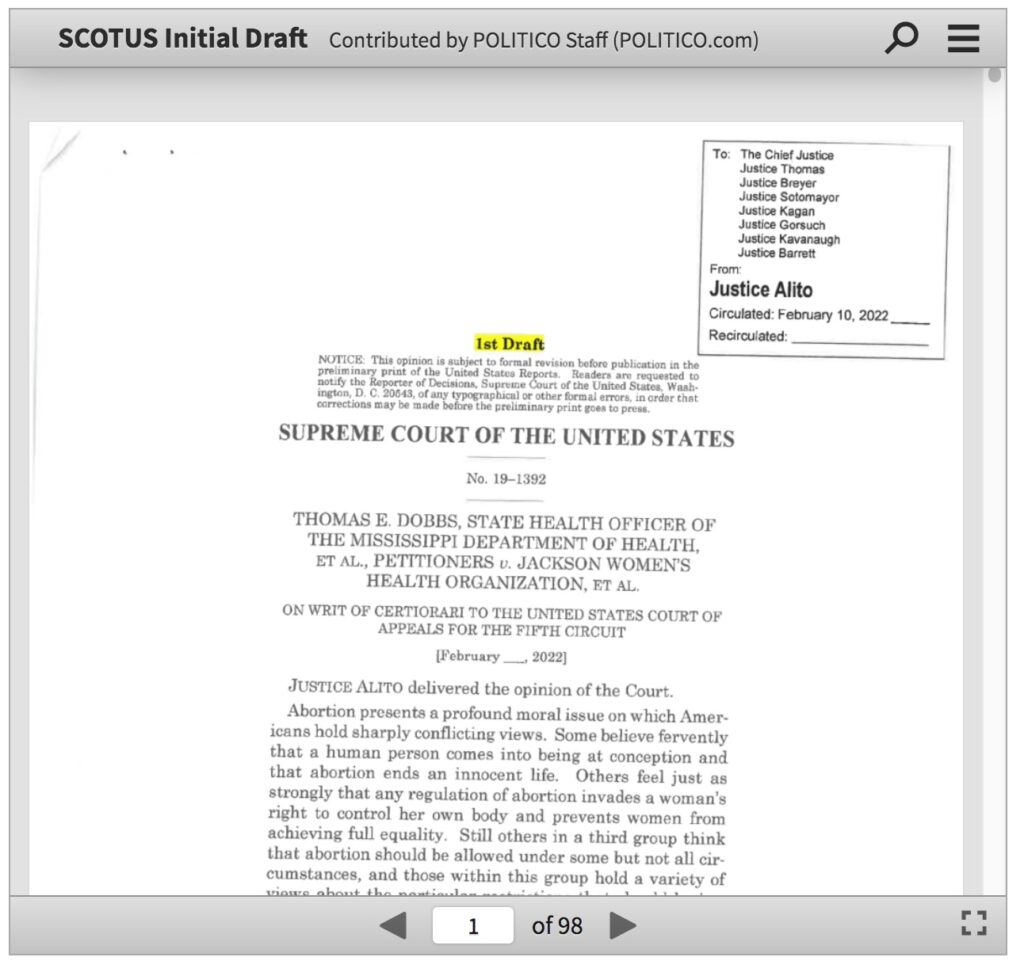
    The representatives said the attempt at an amendment came after a draft ruling from U.S. Justice Samuel Alito implied a future ruling that could limit or eliminate abortion legality nationwide. The opinion, though not the final opinion of the court, “presents a 50-year reversal on safe and legal access to abortion in the United States,” Lepore-Hagan and Miranda stated in announcing their proposed amendment.

    “I will not stand by and allow political extremists to take us back to a time where individuals were unable to make their own health care decisions and access the care they need in their communities,” Lepore-Hagan said in a statement. “No one should be forced to carry a pregnancy against their will.”

    A constitutional amendment requires a three-fifths vote of the legislature for passage, and has to be received 90 days before an election to be placed on the ballot.

    A companion resolution is also planned in the state Senate, led by state Sens. Nickie Antonio, D-Lakewood and Sandra Williams, D-Cleveland. Success in the Senate would depend on Republican support, just as a win in the House would.

    “In overturning a woman’s right to choose, I share the concern that we will have laid a roadmap to upend other civil rights, including protections for the LGBTQ community,” Antonio wrote in her own statement.

    Sponsors of the amendment are still in the process of gathering co-sponsors, and drafting bill language, after which it will be formally introduced and moved to a committee.

  • Ohio Redistricting Commission resubmits maps already rejected as illegal by supreme court

    Ohio Redistricting Commission resubmits maps already rejected as illegal by supreme court

    BY: SUSAN TEBBEN – Ohio Capital Journal

    The Ohio Redistricting Commission Thursday voted to resubmit maps to the Ohio Supreme Court that the court has already rejected as illegal and unconstitutional partisan gerrymandering.

    The commission once again passed its third map 4-3 along party lines, with the exception of Republican Auditor Keith Faber, who said he voted no for the same reasons he voted against the map originally, claiming favoritism for Democrats.

    Republicans voting for the maps were Ohio Gov. Mike DeWine, Secretary of State Frank LaRose, state Sen. Rob McColley and state Rep. Jeff LaRe (sitting in for Senate President Matt Huffman and House Speaker Bob Cupp respectively).

    With a U.S. District Court promising to order the third set of maps to be put in place for the 2022 election, the commissioners saw fit to push those maps back into play, despite not one but two rejections by the state’s highest court.

    Indicating the action that was forthcoming from the commission, LaRose read a two-page statement he said explained the “logistical realities” of administering an Aug. 2 primary.

    He said the third map is already programmed in county boards of elections systems, which was done at his order, and he said he “would not instruct the boards to deprogram Map 3 before May 28, risking that the new map could be invalidated with no immediate options to administer a primary election.”

    “Therefore, Map 3 is the only viable option to effectively administer a primary election on Aug. 2, 2022,” LaRose told the commission on Thursday.

    In pushing for passage of the maps, McColley said these maps would be “only for use in the 2022 election.”

     State Rep. Jeff LaRe and state Sen. Vernon Sykes talk during Thursday’s meeting of the Ohio Redistricting Commission.
    (Photo: Susan Tebben, OCJ)

    The constitutional amendment overhauling redistricting processes in the state spelled out the commission’s ability to pass partisan four-year maps or bipartisan 10-year maps. It does not specify a two-year option, which critics say spells trouble in the supreme court battle.

    “We will continue to look at our legal options, and possibly this would only be a two-year map and we will work to get better maps in the future,” said Jen Miller, executive director of the League of Women Voters of Ohio. “But the redistricting commission can’t decide to adopt a two-year map.”

    The Ohio Supreme Court rejected the maps on March 16 for the same reason it rejected all other maps: partisan favoritism.

    “Substantial and compelling evidence shows beyond a reasonable doubt that the main goal of the individuals who drafted the second revised plan was to favor the Republican Party and disfavor the Democratic Party,” the majority wrote in their opinion on those maps.

    Court justices also rejected the maps after they were slightly changed by GOP mapmakers and submitted as the fourth map from the Ohio Redistricting Commission. Huffman introduced revised Map 3 on March 28, after he said it became clear the independent mapmakers maps were not going to be completed on time.

    On Thursday, the Democratic members of the commission, seemingly building up arguments against being held in contempt by the Ohio Supreme Court, introduced changes to a proposed map drawn by independent mapmakers in late March. That map had previously been dismissed by Republican members of the commission who claimed it unduly favored Democrats and didn’t address all the constitutional and court-ordered changes required of new state House and Senate maps.

    House Minority Leader Allison Russo brought up the maps, as she did in a letter earlier Thursday, asking for proposed amendments to the map by Thursday afternoon.

    She told the commissioners those items had been identified and addressed prior to Thursday night’s meeting. No other commission members submitted amendments, she said.

    But Republican commissioners were quick to express their dissatisfaction with these maps during the meeting, even as revised.

    McColley referenced an affidavit by independent mapmaker Dr. Douglas Johnson, saying Johnson acknowledged the maps were not done when he and Dr. Michael McDonald left their posts on March 28, having had their plan dismissed by the commission.

    Russo pushed back on the assertion, saying the maps were finished, but were only “double-checked” after completion.

    “To be clear, this map is finished,” Russo said.

    The Johnson/McDonald map was turned down again by the ORC on Thursday, with a party-line 5-2 vote.

    Russo read a statement at the end of the night, calling the latest journey to Map 3 “a bad-faith effort to punt (Republican) responsibility to another entity,” meaning the federal court.

    “The events that led us back here were not committed through incompetence,” Russo read from the statement. “We are here purposefully.”

    LaRose and DeWine were missing from the commission meeting after a recess following the vote to adopt the third map. Spokespersons said they had other commitments, and because the commission did not have any other voting items, they chose to leave before the meeting adjourned, and before media could ask any questions.

    DeWine’s spokesperson, Dan Tierney, said it was “simply impossible to adopt any map or resubmit any map that an election could be run on August 2.”

    Asked why the commission didn’t meet earlier than two days before the deadline, Tierney said there were “issues coming to compromise.”

    The maps now go to the Ohio Supreme Court for consideration and court challenges, which seem likely.

    As the commission’s newest co-chair, LaRe said with a map passed to cover only the next two-years, the commission still needs to continue its work.

    “We’re only talking about the ’22 election, so there’s more work for the commission to do,” LaRe said. “We’ve got to look at the next election cycle, so we’re not done yet.”

    He did not give a timeline on when the commission will begin working on the next election.

  • U.S. Senate to try again on abortion rights after bombshell disclosure of draft opinion

    U.S. Senate to try again on abortion rights after bombshell disclosure of draft opinion

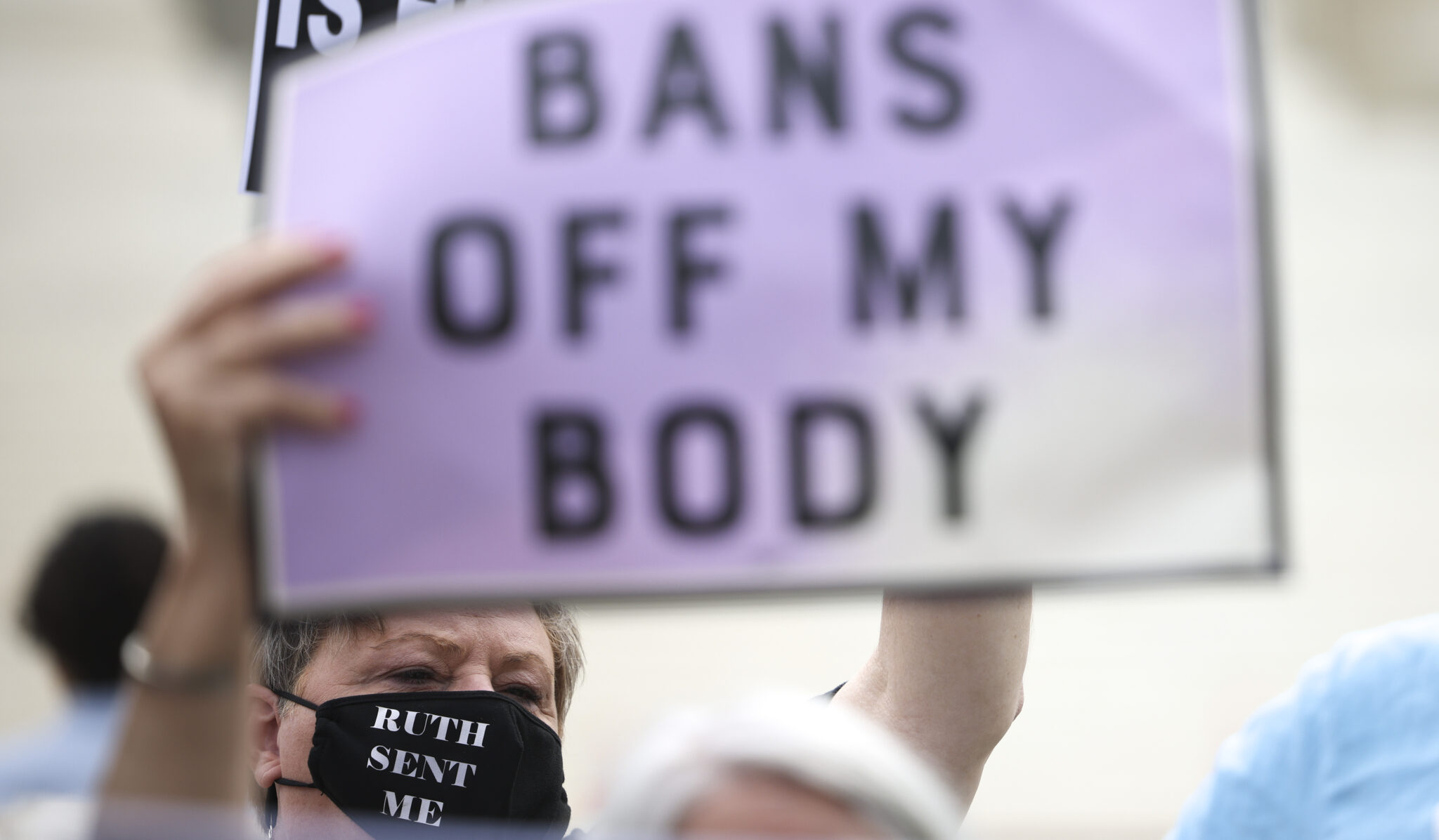
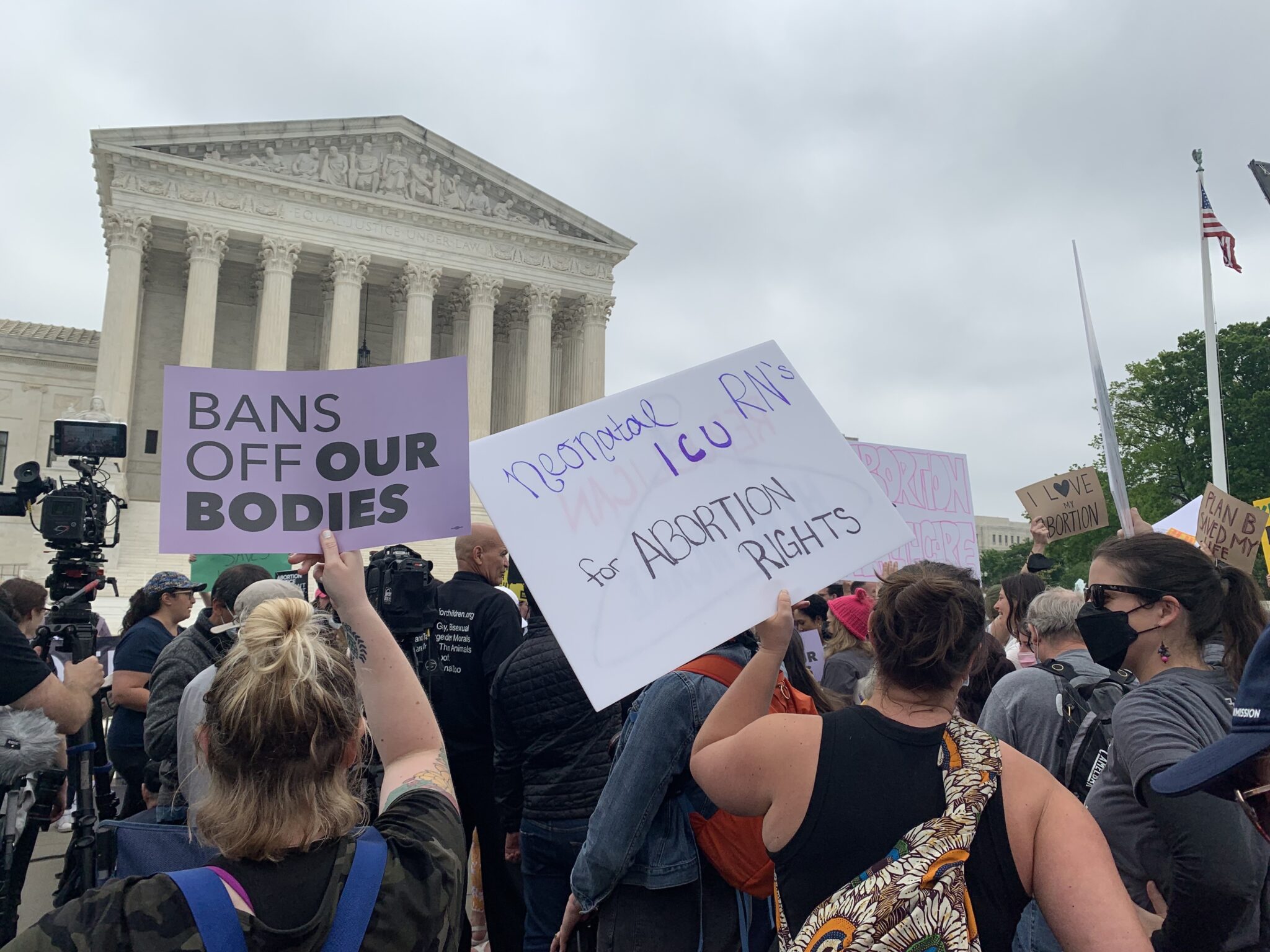
    Abortion rights activists protest outside the U.S. Supreme Court Tuesday. Photo by Jane Norman, States Newsroom.

    BY: JENNIFER SHUTT – Ohio Capital Journal

    WASHINGTON — U.S. Senate Democrats on Tuesday pledged a new vote codifying the right to an abortion after publication of a draft court ruling that showed the Supreme Court on track to overturn the landmark Roe v. Wade abortion decision.

    Democrats, who likely won’t have the votes to advance that bill, also predicted that abortion will emerge as a major issue in the upcoming midterm elections for members of Congress.

    Their comments came as abortion rights supporters across the United States reeled in reaction to the disclosure of the initial draft U.S. Supreme Court opinion, led by Justice Samuel Alito and leaked to Politico. While the court ruling is not final until published, the draft states that earlier abortion decisions “must be overruled.”

    Senate Majority Leader Chuck Schumer, a New York Democrat, said Tuesday he plans to release a new bill this week that senators will vote on next week to codify Roe v. Wade.

    But in the evenly divided Senate, it will run into problems getting past a legislative filibuster that requires 60 votes for legislation to advance.

    Were Roe v. Wade to be struck down by the court, which is dominated 6-3 by conservatives, the question would be left up to states, and more than two dozen Republican-led states have been racing to enact abortion bans and restrictions.

    Supreme Court Chief Justice John Roberts said the draft, published on Monday night, was authentic, though he cautioned it wasn’t the final opinion, and said he’d directed the Marshal of the Court to investigate the leak.

    Republicans called for the Justice Department to also investigate how the draft made its way to two journalists, saying the leak was a violation of the court’s judicial process.

    Roberts said the leak of the document was wrong.

    “Court employees have an exemplary and important tradition of respecting the confidentiality of the judicial process and upholding the trust of the Court,” Roberts said in the statement. “This was a singular and egregious breach of that trust that is an affront to the Court and the community of public servants who work here.”

    The court is expected to release its official ruling in the case, Dobbs v. Jackson Women’s Health Organization, within the next two months, though many organizations have long expected the six conservative justices to at least pare back the constitutional right to an abortion.

    Democratic senators on Tuesday said a final decision undoing the constitutional right to an abortion the Supreme Court established five decades ago would be unacceptable and harmful to women.

    Montana Democratic Sen. Jon Tester said letting each state, once again, set its own abortion laws would be a “step in the wrong direction.”

    “I think that a woman’s right to choose, a woman’s right to make their own health care decisions is really fundamental to who we are as a nation,” Tester said.

    Washington Democratic Sen. Patty Murray criticized the conservative justices for moving to undo nationwide protections for people seeking to terminate a pregnancy.

    “We do not want this to become a country where women are forced to remain pregnant no matter their personal circumstances and yes, we are talking about situations like rape and incest,” Murray said.

    “A country where extreme politicians will control patients’ most private decisions. A country where for the very first time ever the next generation of women will have fewer rights than their mothers.”

    Michigan Sen. Gary Peters, chair of the Democratic Senatorial Campaign Committee, said abortion rights will become a “major issue” in November’s midterms elections.

    “We’ve seen legislation being passed in state legislatures across the country to limit reproductive freedom for women. But there was always the belief that Roe versus Wade was there,” Peters said. “If Roe versus Wade is overturned, it’s a completely different ballgame.”

    60 votes needed

    In the Senate, Democrats would need 60 senators to vote to get past the legislative filibuster and actually pass legislation codifying abortion access throughout the country. Those votes would be required to end debate and move on to final passage, which is a simple majority vote.

    Peters, asked if Democrats could somehow get to a 60-seat majority in the midterm elections, said “it would be pretty difficult to get there.”

    While the entire U.S. House — an increasing number of whom represent gerrymandered districts — will be up for reelection in November, just one-third of the U.S. Senate will face voters.

    This year that will be 35 seats, with 14 occupied by Democrats and 21 filled by Republicans.

    The Cook Political Report with Amy Walter rates five of those races — Arizona, Georgia, Nevada, Pennsylvania and Wisconsin – as “toss up.” Florida, North Carolina and Ohio are classified as “lean Republican.”

    Senators’ positions 

    Georgia Sen. Raphael Warnock said he’s going to “do everything” he can to “support reproductive rights.”

    He’s one of many Senate Democrats who support eliminating the filibuster.

    “No Senate procedure should get in the way of basic civil rights — voting rights, reproductive rights,” Warnock said.

    Arizona Democratic Sen. Mark Kelly isn’t as convinced that the Senate should change its procedures, but didn’t rule out backing a change to how bills are processed.

    “If there is a proposal to change the rules, I will make a decision on what is in the best interest of the country and the folks I represent in Arizona,” Kelly said.

    Fellow Arizona Democratic Sen. Kyrsten Sinema doesn’t back such a change and neither does West Virginia Democratic Sen. Joe Manchin III.

    That means Senate Democrats don’t have the votes during this Congress to codify abortion rights or change the rules to make it easier to pass abortion rights legislation.

    If Democrats lose control of the Senate following the midterm elections, Republicans are expected to keep the filibuster in place.

    Minority Leader Mitch McConnell, a Kentucky Republican, said Tuesday he would “absolutely” commit to keeping it intact.

    “We don’t want to break the Senate and that’s breaking the Senate,” he said.

    McConnell declined to answer questions on how a final Supreme Court decision overturning Roe v. Wade would affect women throughout the country or whether he’d bring legislation to the floor to address federal abortion laws.

    “All of this puts the cart before the horse,” he said.

    National Republican Senatorial Committee Chairman Rick Scott, a Florida Republican senator, declined to say if the Supreme Court overturning abortion as a fundamental right would affect the election.

    “I think this is an important issue to many people, but so is inflation, so is crime, so is the border,” Scott said. “So, these are important to people and people are gonna be passionate about this. And we ought to be passionate about what we believe in.”

    Scott — who infuriated many fellow GOP senators earlier this year when he released an 11-point plan without leadership approval — declined to say if the GOP would try to pass a bill banning abortion nationwide if they gain control of the Senate in the midterms.

    “We’ll worry about that next year,” Scott said.

    ‘Inconsistent’ justices

    While many Senate Republicans oppose abortion rights and would support the Supreme Court overturning Roe v. Wade, two expressed frustration with the possibility.

    Maine Republican Sen. Susan Collins — who voted to confirm Neil Gorsuch and Brett Kavanaugh, but not Amy Coney Barrett— said in a statement that “If this leaked draft opinion is the final decision and this reporting is accurate, it would be completely inconsistent with what Justice Gorsuch and Justice Kavanaugh said in their hearings and in our meetings in my office.”

    Collins declined to answer reporters’ questions throughout the morning, simply saying she’d released a statement.

    Alaska GOP Sen. Lisa Murkowski — who supported Gorsuch and Barrett, but not Kavanaugh — told reporters that certain justices voting to overturn precedent would erode her confidence in the court.

    “If in fact this draft is where the Court ends up being, it has rocked my confidence in the court. That is because I think there were some representations made with regards to precedent and settled,” said Murkowski. “Comments were made to me and to others about Roe being settled and being precedent.”

    When the Senate took a procedural vote in February on a House-passed bill that would codify the right to an abortion, Collins, Murkowski and Manchin all voted against moving to final passage.

    Schumer said he expects a new vote could be different from the one taken just over two months ago.

    “It’s a different world now, the tectonic plates of our politics on women’s choice and on rights in general are changing,” Schumer said.

    “Every senator, now under the real glare of Roe v. Wade being repealed by the courts, is going to have to show which side they’re on. And we will find the best way to go forward after that. But don’t think that what happened two (months) ago will be exactly the same.”


  • A judge ordered Dewitt McDonald released last month, so why is he still in prison?

    A judge ordered Dewitt McDonald released last month, so why is he still in prison?

    Getty Images.

    BY: NICK EVANS Ohio Capital Journal

    Right now, Dewitt McDonald is sitting in prison at Richland Correctional Institution even though late last month a judge ordered his release.

    McDonald’s case goes back to a 1994 drive-by shooting in Sandusky that left one woman dead. Prosecutors claimed McDonald was in the car, and they charged him with aiding and abetting the crime. McDonald has maintained his innocence.

    A jury nevertheless convicted McDonald in 1995 and he was sentenced to life with no eligibility of parole for 20 years.

    “Dewitt McDonald has now been incarcerated 27 going on 28 years without even one hearing giving him access to parole,” his attorney Kimberley Corral explained.

    And therein lies the controversy that led to Erie County Judge Tygh Tone issuing a March 29 writ of habeas corpus to McDonald. That order directed officials to release McDonald from prison. Attorney General Dave Yost’s office is appealing to keep him behind bars, and sued Judge Tone in a state appeals court for good measure.

    The state’s aggressive pursuit of the case is notable given the underlying facts of the case. In his federal filings for relief, McDonald’s attorneys raise a number of reasons they say to doubt McDonald’s guilt. It’s not clear, they argue, that he was in the car at the time of the shooting or even that bullets fired from the car killed the victim, Vivian Johnson. Prosecutors secured McDonald’s conviction largely on the testimony of a woman named Krista Harris.

    During the first grand jury hearing, Harris said McDonald was with her at the time of the shooting, and the grand jury didn’t recommend charges. Before the second grand jury, her story flipped and they returned an indictment.

    A few years later though, she told state investigators that county prosecutor Kevin Baxter had coerced her into providing false testimony in McDonald’s case and one other by threatening her with criminal charges. She also alleged Baxter coerced her into an ongoing non-consensual sexual relationship. Baxter’s brother Edward corroborated Harris’ story. Baxter himself denied it.

    Yost’s office declined to comment on McDonald’s case, “given the pending litigation in the Erie County Court of Common Pleas, the 6th Circuit Court of Appeals and the Ohio Supreme Court.”

    The state’s central argument for why McDonald hadn’t gotten a parole hearing comes down to arithmetic. The Ohio Department of Rehabilitation and Corrections contends McDonald won’t be eligible for a parole hearing until he’s served 36 years, because they’re stacking the terms for other offenses on top of the 20 years listed in his sentencing documents.

    “So, all of the sudden, his term is 36 to life,” Corral said, “which was just a decision by an administrative agency. It was not supported by any court order.”

    After she filed a motion to clarify, the court came down on the side of McDonald — he should be eligible for a parole hearing after 20 years. That was in November of 2020. The state’s subsequent appeals to the circuit and supreme court were unsuccessful. In December last year, McDonald still hadn’t gotten a parole hearing, so Judge Tone issued another order, this time directing the parole board to hear his case “immediately.”

    Instead, the state pushed the court to dismiss McDonald’s appeals. Two months later Judge Tone issued the order to release McDonald.

    In the current appeal, Yost’s office contends the habeas order is invalid because it originated in Erie County rather than Richland County where he was incarcerated. In response, Corral agrees that state law requires a habeas claim be filed where an inmate is held, but said that McDonald was being held in the Erie County jail at the time she filed. The state argues back that he was only in Erie County temporarily for a court hearing. They also contend the case can’t be transferred to Richland County.

    “If you follow the state’s logic,” Corral argued, “the state has the sole authority to move prisoners around from county to county. They could defeat every single habeas ever filed by just moving someone after the litigation is complete.”

    “That can’t possibly be the procedure intended by the legislature, and that’s not what courts have held in the past,” she continued.

    As it stands, McDonald’s case is a mess.

    The circuit court, faced with the state’s appeal of Judge Tone’s habeas decision and a writ of prohibition against the judge, sidestepped the matter and sent the case back to the trial court for the Tone to explain his decision or rescind it. Meanwhile McDonald’s defense has appealed to the state supreme court.