Tag: Ohio Capital Journal

  • Poll: 60% of Ohio GOP primary voters say election was stolen

    Poll: 60% of Ohio GOP primary voters say election was stolen

    BY: JAKE ZUCKERMAN – Ohio Capital Journal

    Nearly two in three Ohio Republicans likely to vote in the upcoming primary election believe the election was “stolen” from President Donald Trump, according to polling conducted late last month.

    Of 800 “likely” voters sampled in late January, 62% said they believed the election was stolen and 29% believed there was “some fraud” but President Joe Biden won. Only 8% indicated Biden won with “no fraud.”

    Top issues from voters in the poll, conducted by the firm Fabrizio Lee on behalf of a PAC supporting U.S. Senate Candidate J.D. Vance, included “border security and immigration” (16%), followed by “election and voting security” (13%) and several economic areas like inflation, taxes, government spending and jobs (all around 11%).

    “While every single message tests well, the best of the bunch are cutting federal aid to localities that allow non-citizens to vote, requiring proof of citizenship to get public assistance, and allowing border states to complete the border wall with Mexico,” the polling states, in advice to Vance.

    There’s no evidence to suggest the election was stolen. Trump’s administration officials have said there was no fraud at enough scale to sway the election, as have state audits and media investigations. However, Trump and his allies in politics and media have insisted the 2020 election was fraudulent regardless.

    In the U.S. Senate GOP primary for the open seat to be abdicated by incumbent Sen. Rob Portman, nearly all the leading candidates — Josh MandelVanceMike Gibbons, and Jane Timken — have embraced Trump’s claim that the election was stolen.

    Only Sen. Matt Dolan, R-Chagrin Falls, has unequivocally rejected the election fraud theory and called out leaders who “perpetuated lies.” The recent polling shows 15% of his likely voters believe the election was stolen.

    “Dolan voters differ greatly from the rest of the electorate, but they are only 3% of the vote,” the polling states.

    The polling was first reported and obtained by Politico last week. Fabrizio Lee earned a “B/C” grade from FiveThirtyEight, a data-driven politics blog that rates pollsters based on their methodology and historical accuracy.

  • Confidence wanes in legislature’s ability to pass new congressional map

    Confidence wanes in legislature’s ability to pass new congressional map

    BY: SUSAN TEBBEN – Ohio Capital Journal

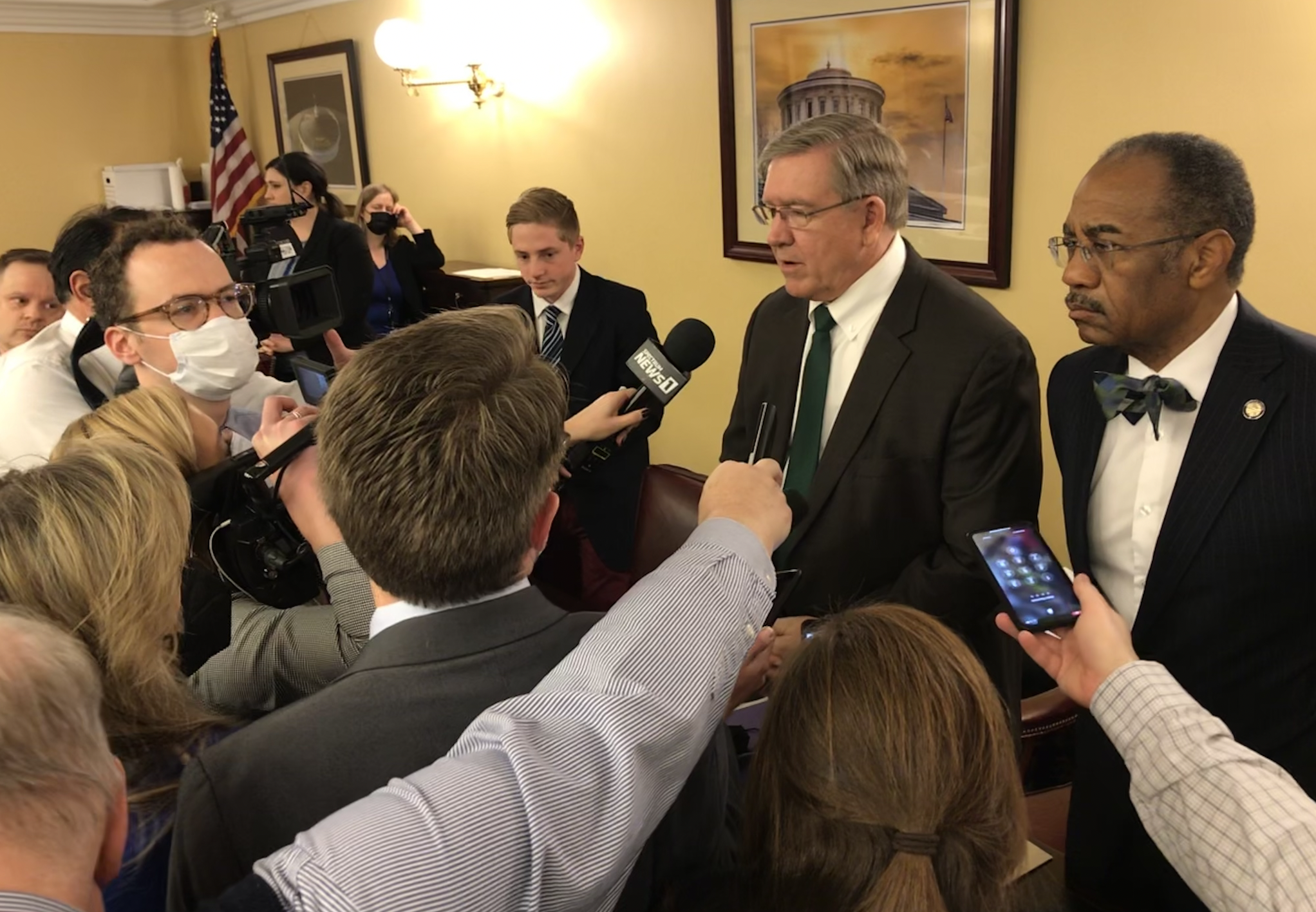
    House Speaker Bob Cupp, center right, and state Sen. Vernon Sykes, far right, co-chairs of the Ohio Redistricting Commission, speak to media after a January meeting to restart the legislative redistricting process. The process is set to start again next week. (Photo: Susan Tebben, OCJ)

    The tide seems to be turning on congressional redistricting, with legislative leaders saying the process lacks needed support in the General Assembly, and will likely head back to the Ohio Redistricting Commission.

    A day after legislative maps were sent back to the ORC for a third time, a co-chair of that commission says the congressional map is headed that way as well.

    House Speaker Bob Cupp told media at the Statehouse on Tuesday that a two-thirds vote would not be possible in the legislature, which is necessary to be able to pass a congressional map in the General Assembly.

    Because of that lack of support, a redistricting plan could not include an emergency clause, which would be needed for the plan to take effect immediately. The legislature was on the clock to pass a revised plan by Feb. 13 (Super Bowl Sunday), and for that plan to become effective in time for the May primary.

    Bills typically take effect 90 days after the governor’s signature, which would conflict with the primary deadlines.

    A spokesperson for Senate President Matt Huffman said because a commission vote doesn’t need an emergency clause, “it makes sense for the congressional map to go to the commission” if a two-thirds vote isn’t possible.

    House Democrats said the GOP made agreement difficult, having never shared a Republican proposal with the other party.

    “Democrats cannot support a map that we have not seen,” Maya Majikas, deputy communications director for the House Democratic Caucus, told the OCJ.

    Yesterday, House Minority Leader Allison Russo spelled out her expectations for the congressional redraw, which included work by the General Assembly.

    “There is a clear path to producing a fair, constitutional map that allows for the equal representation that all Ohio voters deserve. Now, it is the duty of this General Assembly to uphold our Constitutional responsibility and deliver a fair map,” Russo said in a statement.

    Democrats in both chambers spent Tuesday pushing their proposal for congressional districts, releasing a map with a GOP majority 8-7 split. One district covering Cuyahoga County is considered Dem-leaning, according to the caucus numbers, but only gives Dems a 50.9% to 49% advantage.

    Should the legislature continue to hold until the Feb. 13 deadline, the Ohio Redistricting Commission will have 30 days to come up with a congressional plan to replace the one rejected by the court.

    This deadline comes alongside a Feb. 17 deadline for the commission to submit a third version of the legislative district plan to the Ohio Secretary of State’s office, and submit it back to the court for review.

    In their Monday decision striking down the newest version of the legislative maps, the Ohio Supreme Court said they maintain jurisdiction over the maps. They also addressed the timeline for the May primary and 2022 elections in their decision.

    Republican members of the redistricting commission had asked the court to decide the case by Feb. 11 or to hold their decision until after the 2022 general election, using the now-rejected plan until that time.

    In their 4-3 decision, the majority justices on the court said the General Assembly “has the authority to ease the pressure that the commission’s failure to adopt a constitutional redistricting plan has placed on the secretary of state and on county boards of elections by moving the primary election, should that action become necessary.”

    Secretary of State Frank LaRose’s office confirmed that it is solely on the legislature to decide when an election conducted, though the secretary of state can advise them on “cascading events” that would be impacted by changing an election, according to spokesperson Rob Nichols.

    There is precedent for moving an election day, as LaRose did during the COVID-19 pandemic.

    In the ORC response to objections to the legislative maps, the commission laid out the impact the redistricting maelstrom may have on the 2022 election season.

    “Ohio’s expansive early voting framework amounts to an election season that begins with early in-person and absentee voting 29 days before the primary,” they wrote in court documents.

    That date would be April 5 this year, meaning before that date county boards of election need to print and prepare ballots under Uniformed and Overseas Citizen Absentee Voting Act (UOCAVA), for which federal law requires boards to begin mailing the ballots at least 45 days before the primary.

    Those ballots need to be sent by March 19 this year.

    “Though the General Assembly can, and has, temporarily amended Ohio law to move some of Ohio’s election deadlines for the primary election, the federal UOCAVA deadline is set by federal statute (and) it cannot be moved by the General Assembly or the Secretary,” the ORC wrote.

    Without districts to determine the voting precincts for those uniformed and overseas citizens, the ballots can’t be sent.

    Still, LaRose has only asked the General Assembly for the authority to shift some administrative deadlines having to do with the primary, not to move the election entirely.

    “His job right now is to administer an election on May 3,” Nichols told the OCJ.

    LaRose is also a member of the Ohio Redistricting Commission, so he’ll be multi-tasking as the redistricting process continues.

  • What’s next for congressional redistricting

    What’s next for congressional redistricting

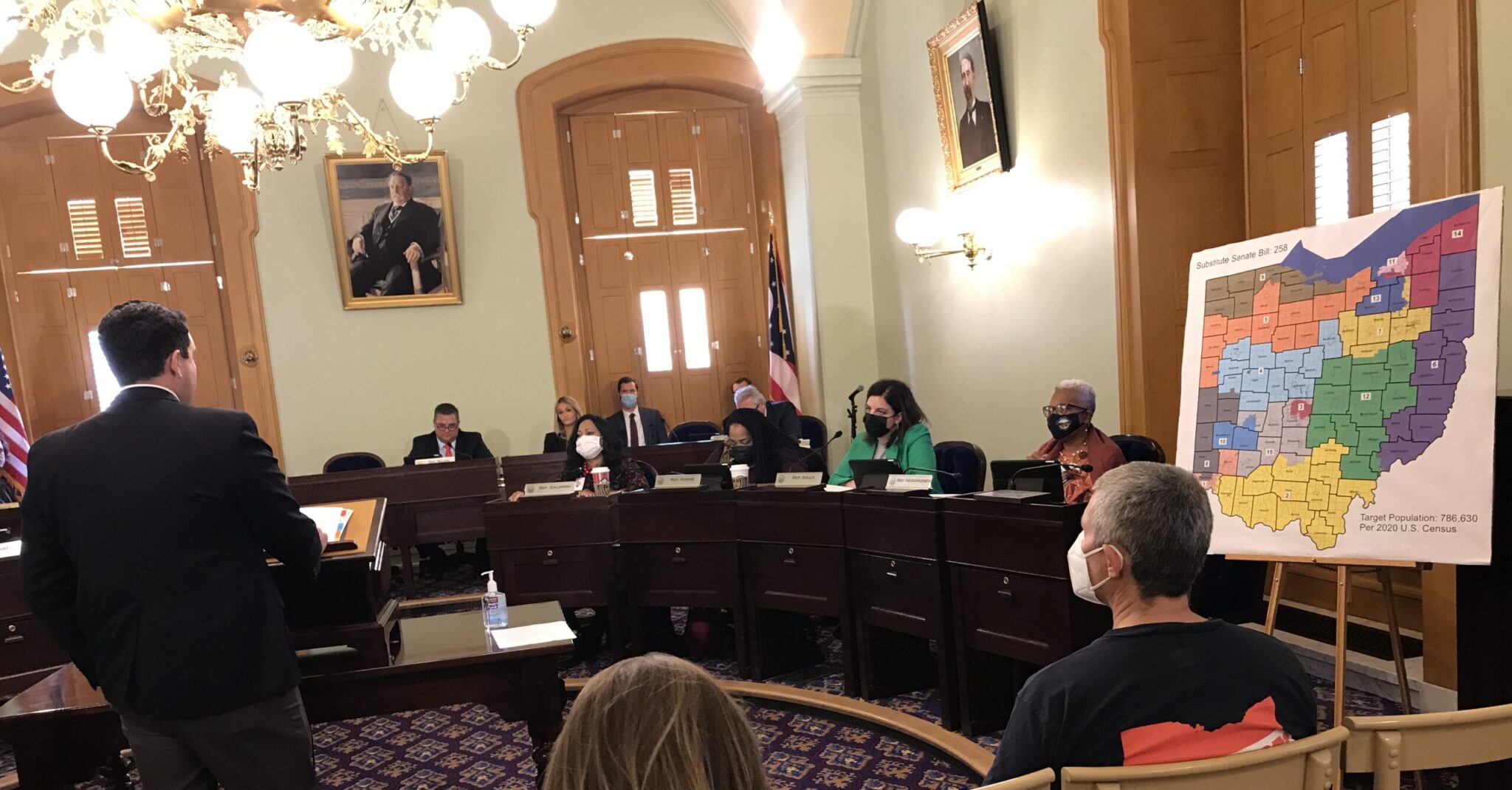
    State Sen. Rob McColley, R-Napoleon, presents congressional redistricting maps to the House Government Oversight Committee on November 17. (Photo: Susan Tebben, OCJ)

    BY: SUSAN TEBBEN –  Ohio Capital Journal

    This week the process begins again of trying to draw congressional districting lines in Ohio.

    The Ohio Supreme Court started its year sending the state legislature back to the drawing board on congressional redistricting, after rejecting the map passed in November by the GOP supermajority.

    With a one-week timeline for the legislature to come up with a plan, committees are convening with that specific purpose.

    Starting Tuesday morning in the Ohio House’s Government Oversight Committee, representatives will hear about House Bill 479, a bill led by state Rep. Scott Oelslager, R-North Canton, which is up for a possible substitution, meaning it could include the new House proposal for congressional districts.

    That bill was the vehicle for the House’s proposal last time around, but it was overtaken by the GOP’s Senate Bill 258, which was quickly adopted by the legislature as the official redistricting plan.

    The same day the House considers its own redistricting effort, the Senate General Government Budget Committee will be looking at Senate Bill 286, state Sen. Rob McColley’s bill for congressional redistricting.

    McColley, R-Napoleon, was the lead on SB 258, the map that would eventually be rejected as unconstitutional by the state’s high court.

    The senate committee accepted testimony on the bill for its first hearing on Tuesday, and a possible vote is indicated for Wednesday’s meeting of the General Government Committee. No testimony or vote is indicated for the House Bill, and the committee is not set to meet again this week.

    If either of the bills pass through committee, it would move on for a full House and/or Senate vote. Both chambers are scheduled to have sessions on Wednesday, with the House set to meet at 1 p.m. and the Senate to meet at 1:30 p.m.

    The House has an “if-needed” session on the calendar for 1 p.m. on Thursday, which could mean the Senate will pass a redistricting plan on Wednesday and send it to the House for agreement on Thursday.

    The legislature has until Feb. 13 to pass a plan. In order for the plan to take effect for 10 years, bipartisan support is needed, which would have to include 33% of Democrats in both the House and Senate. If the legislature can’t get bipartisan support, the map would be in place for four years, pending supreme court approval.

    A new plan from the legislature would have to have an emergency clause attached to it in order to take effect before the May 30 primary. Typically, without an emergency clause, a bill passed by the General Assembly goes into effect 90 days after the governor signs it.

    If the legislature doesn’t bring a plan to a vote by the deadline, the process heads back to the Ohio Redistricting Commission, who would have another 30 days to come up with a plan.

    The ORC just finished revising legislative maps, which were once again invalidated in a Monday ruling by the supreme court.

    The 4-3 decision by the court found the revised maps had similar violations as the original maps, with the court still finding issues with the revised maps in terms of partisan favoritism.

    The ORC now has until February 17 to revise the legislative maps for a third time.

  • Ohio Supreme Court invalidates legislative maps for second time

    Ohio Supreme Court invalidates legislative maps for second time

    BY: SUSAN TEBBEN  Ohio Capital Journal

    The Ohio Supreme Court has sent back the state’s legislative redistricting maps yet again, rebuffing GOP claims that they attempted to bring about a partisan balance.

    “The (Ohio Redistricting Commission’s) choice to avoid a more proportional plan for no explicable reason points unavoidably toward an intent to favor the Republican Party,” the majority wrote in a Monday ruling.

    In a 4-3 split, Chief Justice Maureen O’Connor, Justice Michael Donnelly, Justice Melody Stewart and Justice Jennifer Brunner ordered that the Ohio Redistricting Commission convene for the third time and “draft and adopt an entirely new General Assembly-district plan that conforms with the Ohio Constitution.”

    The ORC now has until Feb. 17 to file a new plan with the Ohio Secretary of State’s office, and a copy with the court by the next morning.

    “We retain jurisdiction for the purpose of reviewing the new plan,” the majority stated in the Monday opinion.

    The court previously rejected the map approved by the commission in September, giving the ORC 10 days to revise the maps. After adopting a new map with a 5-2 party-line vote, the group sent the court a map with a 57-42 split in the House, and a 20-13 split, keeping the GOP majority in both chambers. Several districts were considered “toss up” districts, despite the GOP calling them “Democratic leaning” during their map presentation.

    The GOP said they had made their best attempt at meeting the 54-46 split the supreme court had asked for, with House Speaker and commission co-chair Bob Cupp saying the court was not asking for perfection, but for an attempt at less partisanship.

    The court called up the partisanship standard in their majority opinion on the revised maps, once again observing that the maps were made with GOP favoritism in mind.

    The majority torched mapmakers Ray DiRossi and Blake Springhetti for using the previously invalidated map as a starting point for the revised map, and said that was not what the court wanted when they struck down those maps.

    “DiRossi and Springhetti started with the same plan that we invalidated and then merely adjusted certain districts just enough so that they could nominally be reclassified as ‘Democratic-leaning,” the majority of the court wrote.

    It was clear, according to supreme court justices, that the commission knew the approach of starting with the invalidated map and switching some competitive Republican districts to competitive Dem-leaning districts “would have the dual effect of eliminating weak Republican districts and creating weak Democratic districts.”

    “This was not the process that our decision contemplates, and the commission’s awareness of the partisan effects supports an ‘inference of predominant partisan intent’ similar to the one we found with respect to the original plan,” the majority justices wrote.

    Justices Sharon Kennedy, Patrick DeWine and Patrick Fischer all dissented for many of the same reasons they disagreed with the majority in invalidating the previous legislative maps.

    “It is apparent that in disregard of constitutional standards, four members of this court have now commandeered the redistricting process and that they will continue to reject any General Assembly-district plan until they get the plan they want,” Kennedy and DeWine wrote.

    Kennedy and DeWine argued that the court overextended its power in invalidating the map as a whole, and that the revised map, in their eyes, does not violate the partisanship standard within the constitution. They said the court should “not demand exact proportionality when there is scant evidence that it is possible to draw districts that are exactly proportional to the partisan preferences of Ohio voters” without violating other constitutional map-drawing requirements.

    DeWine, who is the son of ORC member and Governor Mike DeWine, chose not to recuse himself from the case, saying he saw no conflict of interest in judging the case.

    Fischer agreed in a separate dissent that the majority “does not follow the text of the Ohio Constitution.”

    “The majority opinion again attempts to exercise authority not granted to this court by the state Constitution,” Fischer wrote.

    Because the majority opinion does not allow the map to stand as a four-year map, as the constitution states happens with a simple majority vote for adoption, Fischer said invalidating the maps “impinges upon the citizens’ right to vote in two General Assembly elections according to the terms of (redistricting constitutional amendment) Article XI.”

    He also argued that the constitution does not define the “threshold to having been drawn ‘primarily to favor’ a political party,” yet another reason he said the court should not be making the blanket decision to invalidate the maps.

    Fischer accused the majority justices of being “seemingly more interested in making policy than enforcing the Constitution’s text as written.”

    Objections will be allowed in this third attempt, just as they were in the second revision of the map. Those wanting to file an objection to the map have three days after the plan is filed with the court.

  • Ohio Supreme Court allows Dems’ redistricting objection

    Ohio Supreme Court allows Dems’ redistricting objection

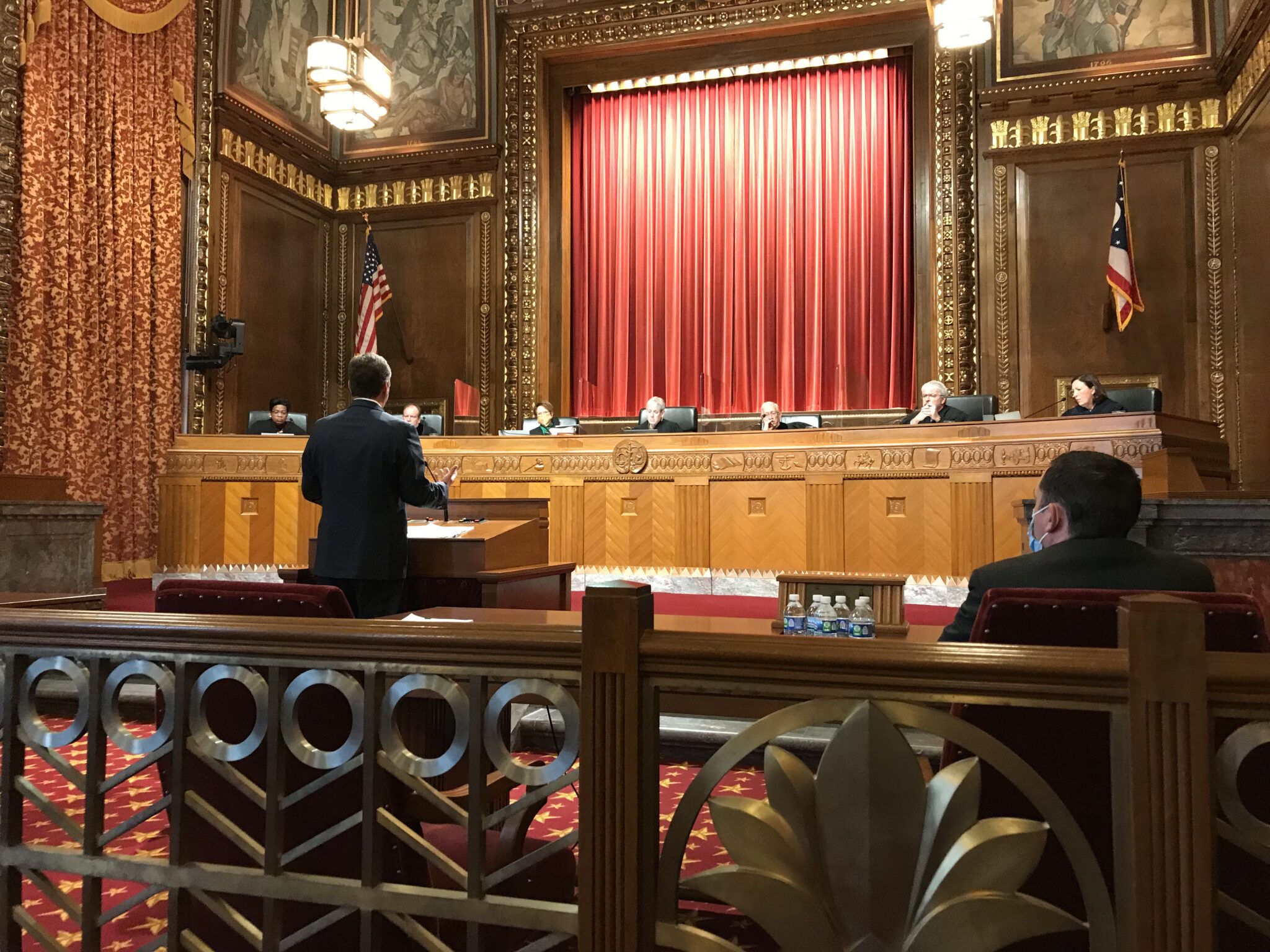
    Attorney Phillip Strach speaks before the Ohio Supreme Court, arguing for the constitutionality of legislative district maps. The court heard arguments on three cases asking it to reject the maps approved in September. (Photo: Susan Tebben, OCJ)

    BY: SUSAN TEBBEN – Ohio Capital Journal

    The Ohio Supreme Court has rejected a request by the state’s Attorney General to reduce Democratic redistricting leaders’ court filing to a “friends of the court” brief.

    In a short ruling released Friday evening, the court denied a motion to convert the brief, filed by Ohio Redistricting Commission co-chair state Sen. Vernon Sykes, D-Akron, and House Minority Leader and commission member Allison Russo, D-Upper Arlington.

    Russo and Sykes filed the objection to the newest legislative redistricting maps without an attorney, which they said was the fault of Attorney General Dave Yost. The Democrats say he refused to allow them to consult attorneys for the Ice Miller law firm.

    Yost asked that the brief be considered amicus of “friend of the court” brief rather than an official response by state officials. “Friend of the court” briefs are typically filed by non-parties in lawsuits, who want to provide the court input but aren’t necessarily connected to the case.

    The ruling by the supreme court did grant Yost’s motion for “limited intervention” in the case, meaning he maintains his position as a legal representative for all state officials in the lawsuits. Yost told the court the limited intervention was needed “to protect his powers as Chief Law Officer of the State of Ohio.”

    He said Russo and Sykes are being sued in their official capacities, therefore filing court documents saying they don’t have an attorney undermines his authority.

    Russo and Sykes are both mentioned in the lawsuit as members of the Ohio Redistricting Commission, along with Governor Mike DeWine, Senate President Matt Huffman, House Speaker (and commission co-chair) Bob Cupp, Secretary of State Frank LaRose and Auditor Keith Faber.

    Chief Justice Maureen O’Connor was the only justice to differ from the majority in the ruling. O’Connor, it was noted, would have denied the motion for Yost to intervene in addition to denying the conversion of the Democratic brief.

    Russo released a statement saying she was “relieved to see that a fair process is continuing in the courts.”

    “Now, we wait the Court’s decision on the submitted maps and let the process play out with greater transparency,” Russo said in the statement.

    The Ohio Redistricting Commission revised the legislative maps with a 5-2 vote along party lines in January after the court sent them back to the drawing board, calling their original plan unconstitutional.

    Republicans commission members responded to objections made by the League of Women Voters, the Ohio Organizing Collaborative and a group of Ohio residents. They said they made appropriate attempts to get to the court’s desired 54% GOP to 46% Dem split, based on statewide voter preferences for the last 10 years.

    The maps sent back to the court have a 57-42 split.

  • Who funded Ohio Statehouse politics in 2021?

    Who funded Ohio Statehouse politics in 2021?

    Getty Images.

    BY: JAKE ZUCKERMAN – Ohio Capital Journal

    Education and construction unions, natural gas utilities, the beer and wine industry, optometrists, car dealers, telecommunications firms, nursing home operators, doctors’ associations and others dumped money into lawmakers’ accounts in 2021.

    These funds set the stage for the maiden elections on yet-to-be finalized maps setting the district lines. (The Ohio Supreme Court overturned the GOP-passed maps last month, determining them to be an unlawful gerrymander. The court is currently reviewing a revised proposal).

    Republicans trounced Democrats in terms of fundraising by just about any measurement.

    The largest donors contribute disproportionately to Republicans. The largest fundraisers in the General Assembly are all Republicans. And bank accounts controlled by the party itself tower over their Democratic counterparts.

    Political campaigns cost money. Sometimes, a lot of money. Here’s who’s providing it.

    Largest PAC contributors 

    These are some of the largest, non-individual donors to Ohio lawmakers through 2021. This list doesn’t include accounts affiliated with the state Democratic and Republican parties.

    • Political Education Patterns, an arm of the International Union of Operating Engineers, is typically one of the most prominent Ohio donors but has not yet filed a full 2021 report. Using data reported by candidates (instead of the PAC itself), the organization contributed about $564,000.
    • Affiliated Construction Trades, comprised of several different unions, contributed about $561,000.
    • The Ohio State Association of Plumbers and Pipefitters gave $338,625.
    • The Wholesale Beer & Wine Association, through its PAC, gave $280,000.
    • The Ohio Credit Union Legislative Action Committee gave $203,718
    • NiSource PAC, whose namesake is the parent company of Columbia Gas, gave $144,225
    • The Ohio Bank PAC gave $121,000
    • The Ohio Optometry PAC gave $109,000.

    Biggest fundraisers

    These are the largest fundraisers in the House and Senate in 2021. They are all Republican, part of a pattern of the party significantly outraising Democrats by almost any measure.

    The filings can give an indication of who may be jockeying for influence or a leadership position within their caucuses.

    • Senate President Matt Huffman, R-Lima: $875,000
    • Rep. Jay Edwards, R-Nelsonville: $429,000
    • Sen. Stephanie Kunze, R-Hilliard: $370,000
    • House Speaker Bob Cupp, R-Lima: $331,000
    • Rep. Tom Patton, R-Strongsville: $300,000
    • Sen. Kristina Roegner, R-Hudson: $233,000
    • Rep. Jason Stephens, R-Kitts Hill: $233,000
    • Sen. Jay Hottinger, R-Newark: $228,000
    • Rep. Phil Plummer, R-Dayton: $219,000
    • Sen. George Lang, R-West Chester Twp.: $218,000.

    Big individual donors

    As has been true in the past, several nursing home operators have served as the General Assembly’s largest benefactors.

    For instance, the Ronald Wilheim, CEO of the Communicare nursing home chain, and his wife contributed $92,000 to six Republicans through the year. Brian Colleran, CEO of Foundations Health Solutions chain of nursing homes, and his wife contributed $80,400. Colleran’s business partner Daniel Parker contributed nearly $27,000. (These donations come atop contributions from three separate PACS representing the industry.)

    Other notable, large donors to legislative and statewide candidates include:

    • Members of the Haslam family, some of whom own the Cleveland Browns, contributed more than $58,000 to various Republicans. James Johnson, another Browns owner, contributed another $13,000 as well.
    • The namesake family of The George Group (real estate) gave $42,000 to Republicans — $40,000 of which went to Rep. Jay Edwards
    • Virginia “Ginny” Ragan, one of the most prolific GOP donors in Ohio politics, gave $65,000, all to Republicans.
    • Regina Mitchell, of Warren Fabrication, gave $43,000 to three Republicans
    • Albert Ratner, of RMS Investment Group, and his wife gave nearly $59,000, almost exclusively to Republicans
    • Abigail and Leslie Wexner, who gave $54,000 to Republicans

    Republicans clobber Democrats

    Whichever way you cut it, Republicans wield a powerful cash advantage over Democrats.

    As Cleveland.com reported, Republicans running for the Supreme Court outraised Democrats on a sixfold margin. In the Legislature, it’s a tenfoldmargin.

    The filing period captures the year leading up to redistricting but before the Ohio Supreme Court overturned a map proposal that would have likely expanded and cemented in a Republican supermajority.

    In the gubernatorial race, incumbent Gov. Mike DeWine raised about $7 million compared to his primary challengers: about $1.2 million from Renacci (roughly $1 million of which came from personal funds) and $624,000 from Joe Blystone. On the Democratic side, former Dayton Mayor Nan Whaley raised $2.4 million, compared to former Cincinnati Mayor John Cranley, who raised about $1.9 million.

    In the race for chief justice of the Ohio Supreme Court, Justice Sharon Kennedy raised about $332,000 compared to about $164,000 for Justice Jennifer Brunner.

  • DeWine can’t run from energy bailout bribery scandal as dirty laundry keeps piling up

    DeWine can’t run from energy bailout bribery scandal as dirty laundry keeps piling up


    COMMENTARY

    by MARILOU JOHANEK – Ohio Capital Journal

    Follow the money. Its corrupting influence runs through all the great scandals piling up in Ohio under Republican rule. From the biggest online charter school rip-off of tax dollars to the largest public corruption indictment in state history, money has paved the way to epic wrongdoing under GOP management. Find out who in Columbus is greasing palms, funding campaigns and writing public policy for private interests, and you’ll also discover who is standing in line with their hand out willing to reciprocate with public favors.  

    But when people in high places slip on hubris and expose brazen graft at public expense — and they always do — the swarm of politicians who were only too happy to pocket donor checks and look the other way scatter like insects under a rock that’s been lifted. Republican Gov. Mike DeWine is one of those spooked bugs racing away from his political entanglement in the blockbuster bribery and money-laundering case that goes to trial this year. Three of the four indicted individuals who will be in court on federal racketeering charges — in connection with a billion-dollar ratepayer bailout of two nuclear power plants to benefit FirstEnergy and its affiliates — donated thousands to DeWine’s gubernatorial campaign. 

    So did the Akron-based energy giant at the heart of the bailout scheme. FirstEnergy has legendary pull with pliable politicians. 

    The state’s largest electric utility pumped $1 million into groups backing DeWine in 2018, according to a Dayton Daily News investigation following the money. The company also pumped big bucks into groups helping his daughter’s failed campaign for county prosecutor. DeWine hired multiple administration staffers and advisors with close ties to FirstEnergy, including a former top aide linked to one of the dark money groups implicated in passage of the bailout legislation (House Bill 6) written for and by the utility. 

    The governor also appointed and steadfastly supported Ohio’s former top utility regulator, now accused of profiting in association with the FirstEnergy scandal. DeWine knew of Sam Randazzo’s deep business relationship with the utility when he chose him at the urging of company executives. In a seemingly flagrant quid pro quo, the governor’s pick for the powerful chair of the state utilities commission pocketed a massive sum of money from FirstEnergy just weeks before his appointment. 

    But even damning disclosures of Randazzo’s $4.3 million utility bribe and his blatant efforts on behalf of FirstEnergy — constructing House Bill 6, delaying a company rate case, lobbying for legislation to save the utility millions — didn’t dissuade DeWine from expressing “great confidence” in his regulator. Even after the FBI raided Randazzo’s home as part of the FirstEnergy bribery probe and he resigned under a cloud of suspicion, DeWine praised him for doing “very, very good work as chair.” 

    Perhaps anticipating incredulity with that assessment, the Republican later suggested he was “open” to reforming the process for choosing state utility regulators. Eighteen months on, the DeWine-appointed nominating council that recommends PUCO candidates to the governor includes members tied to passage of the notorious bailout bill. 

    Even after the FBI arrested former House Speaker Larry Householder, who engineered approval of House Bill 6 and was subsequently charged with taking money to pass it, DeWine rejected an effort to repeal the corruption-ridden legislation. 

    “We need balance in our energy,” was all he could say about a bill passed with more than $60 million in bribe money. DeWine reversed himself but reiterated his support for FirstEnergy’s ultimate bribery goal — giving $1.3 billion in public money to two unprofitable nuke plants with new surcharges paid by everyratepayer in the state. 

    He had put the full weight of the governor’s office behind the nuclear bailout bill and signed the corrupt measure into law the very day it passed. The “energy” legislation championed by DeWine also put ratepayers on the hook to bail out two money-losing, hyper-polluting coal plants (one in Indiana) partially owned by other utilities and two FirstEnergy subsidiaries. Plus, the bailout boondoggle the governor couldn’t sign fast enough thoroughly gutted renewable energy and energy efficiency standards and removed all incentive to build more renewable energy projects in the state. 

    Those utility-written provisions have still not been repealed under a 2019 embarrassment that should have been scrapped outright. But the Republican-controlled legislature, complicit in the worst scandal “ever perpetrated against the people of the state of Ohio,” is content to become synonymous with corruption and fleece Ohioans on their monthly electric bills if that makes utility donors happy. The Ohio Manufacturers Association estimated electricity customers will pay a total of $1.8 billion in coal plant subsidies by 2030 — more than the cost of the nuke bailout — unless integrity intrudes on the General Assembly and House Bill 6 is fully repealed. 

    Don’t hold your breath. But remember, this outrage happened on DeWine’s watch and with his blessing. Ohioans didn’t know how crooked House Bill 6 was or how many politicians, including the governor, were willing to look away until federal prosecutors blew the lid off the alleged criminal enterprise to screw ratepayers in return for boosted political careers. DeWine is understandably trying to put as much distance as possible between his reelection campaign and the biggest open investigation of Statehouse corruption in the country. 

    But it’s hard to escape dirty laundry that keeps piling up when you can’t hide under a rock anymore.  

  • What’s at stake for Ohio families as the monthly child tax credit payment ends?

    What’s at stake for Ohio families as the monthly child tax credit payment ends?

    Commentary by Will PetrikOhio Capital Journal

    As we start the new year, parents are planning for the future and working hard to provide their kids a great quality of life. They’re facing challenges head on, including a surging pandemic, school closures and at-home schooling, and fewer affordable child care options.

    No child should go to bed hungry, and no parent should worry about keeping a roof over their head. But many of the same politicians who refuse to make the wealthy and corporations pay their fair share have failed to prioritize the stability, economic security, and dignity of children and families.

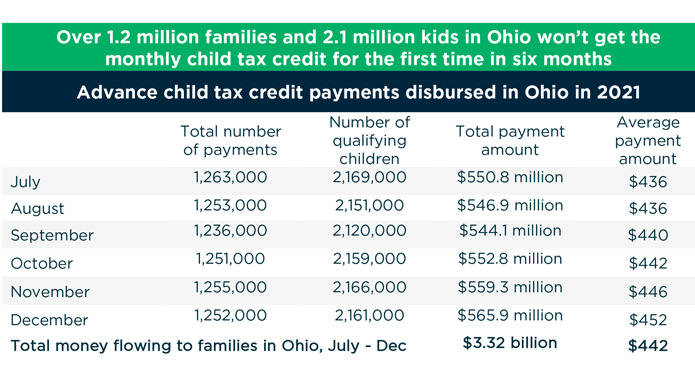
    The latest census data show an estimated 811,000 adults in Ohio didn’t have enough food to eat in the last week. An estimated 2.4 million adults had difficulty paying for usual household expenses in the last seven days. On top of that, Jan. 15 was the first time over 1.2 million families in Ohio didn’t get the monthly child tax credit payment since July 2021, because the Senate didn’t pass the Build Back Better legislation before the end of last year.

    The monthly payments provided many Ohio families relief from stress by helping them pay for the basics such as food, rent, clothing, phone, internet, and educational expenses. It helped more families get enough to eat and fewer adults with children reported having trouble paying for basic household expenses.

    The child tax credit helped Sophia Whitehouse, from central Ohio, start her own business providing mental health services to children. Before the child tax credit, it was nearly impossible to balance her work and care for her children.

    “The child tax credit has been a tremendous help paying for preschool and child care for my two kids under 5,” Ms. Whitehouse said. She said that losing the credit means she will have to sacrifice time dedicated to serving the community’s mental health needs, which will hurt her family’s income. “I will not be able to work as much, because I won’t have child care,” she said.

    Jason Carter and his wife live in Cincinnati. They had a baby girl at the end of July 2020. The monthly child tax credit payments provided a sense of peace for Mr. Carter and his wife because it was a chunk of money they didn’t have to stress about every month. “It helps us to survive, to plan and have hope for an improved quality of life in the future,” he said.

    Along with thousands of other Ohioans, Carter was laid off during the pandemic. He found a new job, but said it pays half as much. The child tax credit helped the Carters make up the difference. Now that payments have stopped, Mr. Carter said they could be forced to put some of their plans on hold, such as buying a new home.

    “This is a dream my wife and I have talked about for years, he said. “Now that we have our baby girl, we want to provide a home for her to grow up in, have a yard for her to run around in, to be happy, and to invest in ourselves. Without the child tax credit, the future we have dreamed about doesn’t seem as solid. It’s something that worries us. We’ve been working so hard to improve our quality of life. Now they throw another roadblock at us. How am I supposed to achieve the American dream?”

    https://youtube.com/watch?v=pNwZf7K4WrE%3Ffeature%3Doembed

    By letting 2021 end without passing the Build Back Better Act, certain Senators have pulled the rug out from under the Whitehouse family, the Carters, and millions of families across the country. Just as parents are facing increasing heating and food costs, they are losing the monthly child tax credit, which has provided Ohio families with an average of $442 a month since July of last year.

    “How am I supposed to achieve the American dream?”
     Source: U.S. Department of Treasury, “Advance Child Tax Credit Payments Disbursed each Month, by State,” accessed on January 10, July, August, September, October, November, and December https://bit.ly/2XGh9Gv

    The Senate must deliver for families. They must pass Build Back Better and make sure the expanded child tax credit is included in the legislation. Until they do, families will miss out on monthly tax credit payments that made a real difference in their lives.

    For Mr. Carter, Ms. Whitehouse, and millions of other parents and families across Ohio and the nation, there’s so much at stake. This is about security, opportunity, and parents’ dreams for the future. Our nation has the resources to provide stability and security for all families, but we now need the political will.

  • Ranking Dem says GOP attorney general blocked her from lawyers in redistricting suit

    Ranking Dem says GOP attorney general blocked her from lawyers in redistricting suit

    Ohio Attorney General Dave Yost. (Photo by Justin Merriman/Getty Images)

    BY: JAKE ZUCKERMAN – Ohio Capital Journal

    Columbus, Ohio – The ranking Democrat in the Ohio House said Attorney General Dave Yost has blocked her from legal representation as the Ohio Supreme Court reviews the latest redistricting proposal from state lawmakers.

    The Ohio Redistricting Commission voted 5-2 along party lines Saturday to send over a revised map after the court overturned its first effort, determining it to be an unconstitutional gerrymander.

    Democrats on the commission have previously been represented by their own counsel and submitted their own arguments — distinct from Republicans on the committee. House Minority Leader Allison Russo, D-Columbus, said in a statement Wednesday however that Yost has since blocked them from their legal representation. This comes as a deadline looms for the state officials to respond to objections to the GOP-approved map submitted for the court’s review.

    Through spokeswoman Maya Majikas, Russo said Yost is “denying” her “the ability to consult with her legal counsel,” two attorneys with the Ice Miller law firm in Columbus retained through the attorney general’s office.

    “Leader Russo is being denied her outside counsel representation at this stage of the litigation period,” Majikas said. “Ice Miller is not permitted by the AG to provide Democrats counsel/bills for any service to us.”

    Yost seemed to confirm Russo’s central claim through spokeswoman Bethany McCorkle on Wednesday evening.

    “The Ohio Supreme Court ordered the Commission to draw a new map, which is why one counsel will respond to the court on behalf of the entire commission,” McCorkle said. “None of the individual members will respond separately.”

    Democratic members of the commission are technically named as defendants in the lawsuit. However, their interests largely align with the plaintiffs — a spread of special interest and voting rights organizations — and against Republicans on the commission who defended the maps.

    This has put the Democrats in the unusual position of arguing, as a defendant in the case, that the court should do what the plaintiffs want.

    “The Republican Legislative Commissioners prepared maps so lopsided that Republicans are essentially guaranteed veto-proof majorities in the General Assembly no matter how many votes Democrats earn,” the Democrats’ lawyers wrote in court filings.

    The Supreme Court, overturning the legislative maps, found they likely guaranteed Republicans a supermajority in defiance of voter’s preferences, as required by the constitution. They ordered the commission to draw a map as close as possible to the state’s 54% Republican to 46% Democratic partisan tilt.

    The newest proposal would create a projected 57-42 split in the House and 20-13 split in the Senate, far more advantageous for Democrats than the original. However, the Democrats’ margins are much tighter. For instance, in the House, 12 of the “Democratic leaning” seats in the latest map could also be considered tossups, with a Democratic edge of only 50-51%. All of the GOP-leaning seats favor Republicans by more than 52%.

    The plaintiffs who challenged the first map filed objections to the Ohio Supreme Court over the edited version this week. They argued it still disproportionately favors Republicans in violation of anti-gerrymandering Constitutional amendment approved by voters.

    The Ohio Redistricting Commission — comprised of four, bipartisan legislative appointees along with the governor, state auditor and secretary of state — was ordered to respond to the objections by Friday.

    The commission itself is represented by two lawyers. The statewide officeholders and Republicans on the commission have their own lawyers as well. Even if, as Yost said, the commission’s members don’t respond individually, it’s likely that Republicans who control it will likely shape its arguments.

    Sen. Vernon Sykes, D-Akron, the other Democrat on the committee, did not respond to an inquiry to his office.