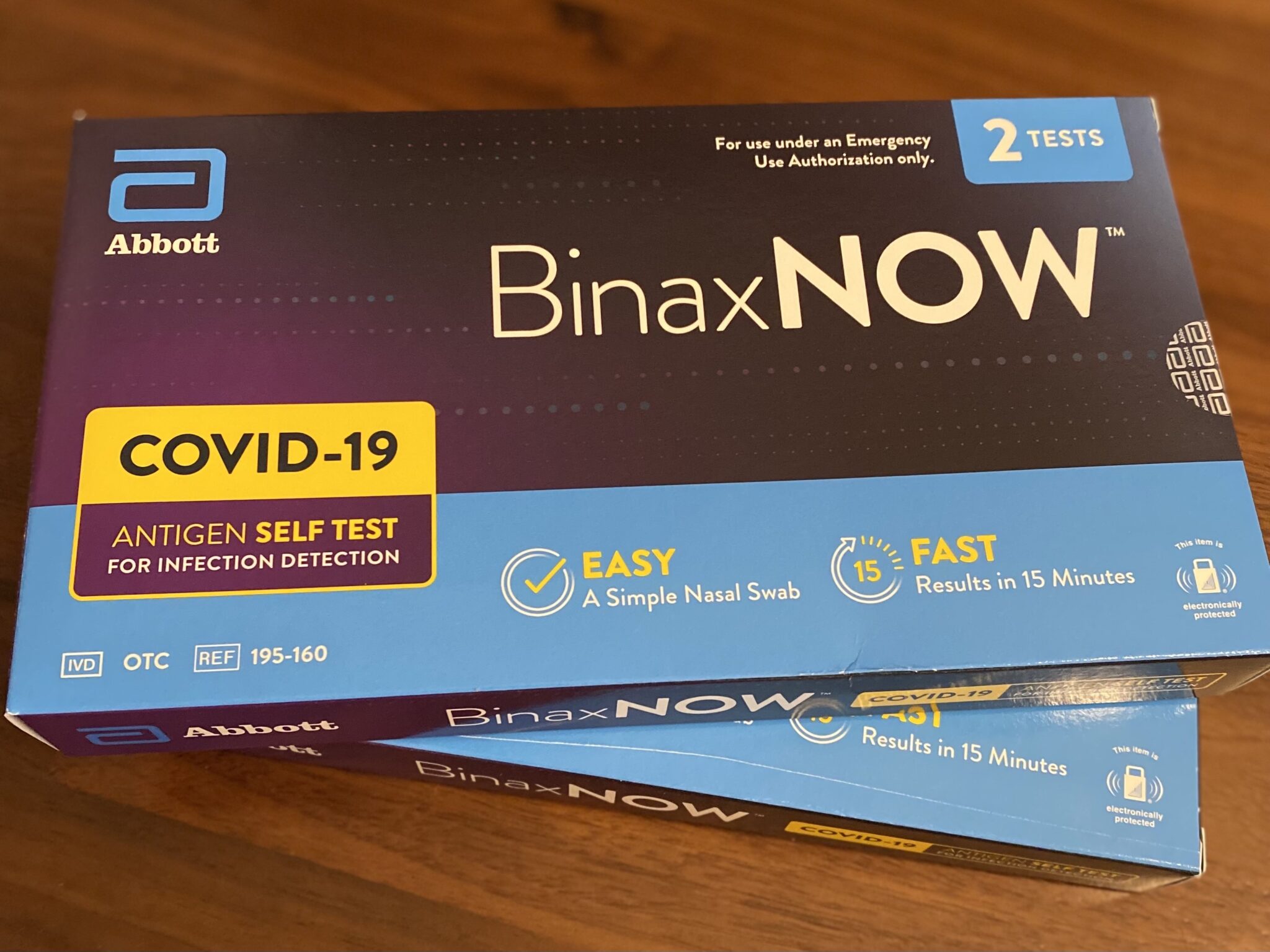
An at-home COVID-19 test kit. Photo by Laura Olson, States Newsroom.
Washington, D.C. – State health officials on Thursday welcomed the Biden administration’s plan to require private health insurers to reimburse Americans for the cost of rapid, at-home COVID-19 tests — though the officials also raised questions about whether the process will be burdensome.
Making those tests more accessible will allow Americans to get results quickly and in the privacy of their own homes. That change may encourage more people to swab their nose when they first notice potential symptoms, experts from the Association of State and Territorial Health Officials told reporters.
“In this next phase of the pandemic, rapid access to rapid testing will be key,” said Dr. Nirav Shah, director of Maine’s Centers for Disease Control and Prevention, adding that it can help to combat potential surges and to pinpoint infections quickly so antiviral treatments can be used.
But several challenges could limit the impact of the cost reduction.
That includes lingering problems with sufficient supplies, uncertainty about the details of the reimbursement process, and questions about any potential effect on the data that’s reaching state and local health departments about infections in their communities.
Official guidance in January
Under the proposal that President Joe Biden announced Thursday, three federal departments — Health and Human Services, Labor and the Treasury — will issue official guidance by Jan. 15 that will detail what exactly private insurers must cover when it comes to rapid COVID-19 tests.
Those insurers already are required to pay for the PCR tests that must be sent to a laboratory for processing and take longer for results.
The upcoming change requiring insurance coverage of rapid, at-home tests, won’t be retroactive. That means Americans who have been shelling out roughly $25 for a package containing two of the popular Abbott BinaxNOW rapid tests can’t submit receipts for tests they’ve already purchased.
Other details of that requirement were unclear Thursday, including if there will be any limitations on the number of at-home tests that must be covered.
While the Biden administration has sought to reduce supply bottlenecks in producing those tests, Shah said some states are still having difficulty acquiring large volumes of the Abbott at-home tests.
That brand, which has been found to be highly accurate, has been relied on heavily even as more options have come on the market. Part of that demand comes from familiarity: Those administering tests in large settings have become familiar with their use.
What if you test positive?
Another challenge with increasing the use of at-home tests will be ensuring that individuals know what to do if they test positive.
Michael Fraser, ASTHO’s chief executive officer, said state health officials have been discussing whether those at-home tests should include an insert to help explain who to call and other next steps, so that contact tracing can occur.
“There is some concern that with the increase in at-home testing, getting those results reported to state health departments might be difficult, because the result doesn’t automatically go to public health authorities,” Fraser said.
However, there won’t be many results to get to state and local health officials if Americans with private insurance balk at fronting the money for tests while they await reimbursement.
Shah said a more accessible model would be to have individuals show their insurance card at a pharmacy as they would when getting a flu shot or picking up a prescription, rather than being charged at the register.
Having to pay for the tests, then wait for repayment, “introduces an access challenge for a lot of folks,” he said.
The Biden administration also plans to boost the number of free at-home tests distributed at community health centers and rural clinics, though those are intended to aid those who are not covered by private insurance.
A bill involving resuscitation of infants after birth with an attachment targeting abortion providers is being criticized for the impact some say it would have on complicated but wanted pregnancies rather than on abortions.
Senate Bill 157, a bill labeled as a measure to track and prevent potential medical malpractice in what bill sponsors call “botched abortions,” had its second hearing in House Families, Aging & Human Services Committee on Thursday.
But bill opponents argue the regulations that would be required under the bill would make physicians question what to do in tragic situations where planned or wanted pregnancies go wrong.
Dr. Erika Boothman, an OB/GYN in Columbus, told the story of a patient she had whose water broke when the baby was “pre-viable,” according to Boothman, meaning “there is no chance of successful resuscitation of the baby if she were to deliver.”
The patient was offered labor induction to avoid possible infection and have delivery in a controlled setting. Boothman explained that “comfort measures and medications” could be offered for the baby, but resuscitation efforts would not only be futile but take the baby away from the parents after birth.
“(The patient) found comfort and the possibility of closure with the opportunity to hold her baby right after the birth, to be with her baby while she passed away,” Boothman said.
Resuscitation isn’t possible in a fetus younger than 20 weeks gestation, so she said the bill “addresses a non-existent problem.”
She submitted this story with her testimony on SB 157 to the House Families, Aging & Human Services Committee on Thursday, but before the committee began she spoke in a press conference with advocates from NARAL Pro-Choice Ohio.
“Whisking (the patient’s) baby away from her arms immediately after deliver to administer medications, perform chest compressions and attempt to put a breathing tube down her tiny throat is not was (she) or her newborn need,” Boothman said. “They need medical care guided by science and compassion, not dictated by state law.”
Under Senate Bill 157, resuscitation of any fetus born alive after an abortion is required in all cases. Pro-choice advocates and legal organizations argued that life-saving efforts are required in Ohio law already, so the bill is unnecessary.
Jaime Miracle, deputy director of NARAL, also spoke during the committee meeting, saying ambulatory surgical facilities who provide abortions also follow the law by calling 911 and dispatching an ambulance when a hospital is needed.
She called the bill a “failed attempt to stigmatize abortion providers” for a situation that is rare if present at all.
“This is not how abortion care works, this is not how anything is done, and they’re creating this paper dragon,” Miracle said.
State data is also collected on abortions induced in the state, including complications that present themselves during the abortion (including “failed abortions”), and “failed abortions” make up very few cases, and no cases were in viable pregnancies.
Abortion is legal in Ohio up to 22 weeks gestation.
The coronavirus continued a five-week surge in Ohio on Thursday, with state data showing worsening infection and hospitalization rates.
While time lag and a Thanksgiving holiday cloud the latest data, an average of about 5,000 Ohioans per day contracted COVID-19 at the end of November, compared to about 3,600 daily at the beginning of the month, according to an analysis of state health department data.
Of any 100 tests taken over the last week, more than 15 on average are coming back positive — a nearly peak level of test positivity.
Hospitalization data reflects the case increase. About 190 Ohioans were hospitalized per day in late November, compared to about 145 at the beginning of the month. More than 3,900 state residents are currently hospitalized with COVID-19, according to data from the Ohio Hospital Association, the highest rate since early January.
Hospitalization rates are up for every age cohort besides those 0-19 years old.
Speaking to reporters Thursday, Ohio Department of Health Director Dr. Bruce Vanderhoff emphasized the best way to ease the hospital burden is to seek vaccination — vaccinated people comprise less than 6% of those hospitalized with COVID-19. Short staffed and fatigued hospital systems, he said, need the support.
“The problem right now isn’t necessarily physical beds and physical capacity, but staff,” he said.
In terms of vaccination, Ohio continues to fare poorly. The state is the 10thleast vaccinated in the nation, according to data from the New York Times. About 58% of Ohioans are at least partially vaccinated against COVID-19, compared to 71% of Americans.
Death data tends to lag behind infection data by several weeks, and there’s no clear picture of how many deaths resulted from the ongoing case surge. However, a previous case surge peaked in mid-September. By October, roughly 80 Ohioans per day on average died of COVID-19, despite widespread availability of safe and effective vaccines. Less than 5% of those who died of COVID-19 were vaccinated, per state data.
Ohio has yet to detect any cases of the Omicron variant, though it could be silently spreading. State health officials in Minnesota said Thursday they detected the new variant in a local man who recently traveled to New York City. The CDC announced Wednesday that health officials in San Francisco detected the variant in a person who had recently traveled to South Africa, where the mutation is believed to have originated.
Ohio Gov. Mike DeWine has signed Statehouse Republicans’ congressional map for Ohio giving the GOP a substantial advantage, claiming that of all the maps presented it “makes the most progress to produce a fair, compact and competitive map.”
DeWine pointed to fewer county splits in the map and the number of Ohio cities the map keeps whole.
“With seven competitive congressional districts in the SB 258 map, this map significantly increases the number of competitive districts versus the current map,” DeWine said.
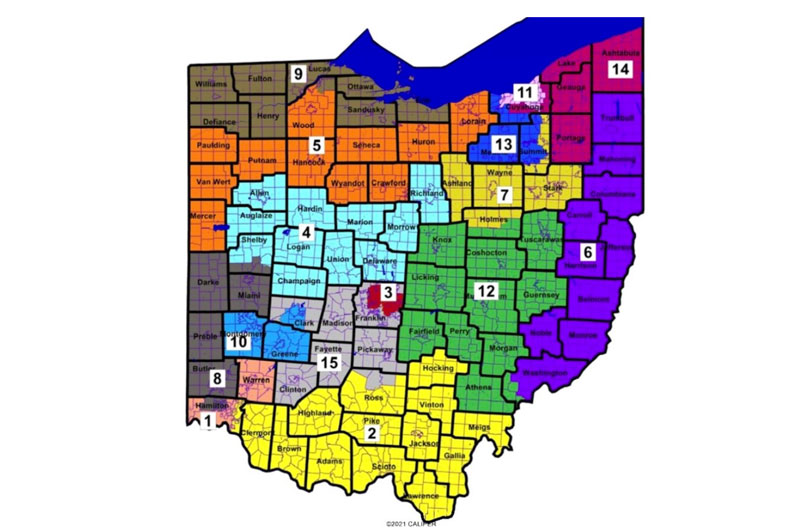
The GOP congressional map signed by Gov. Mike DeWine. (Right-Click to enlarge map)
Without bipartisan support, the map is slated to only be in place for four years. With DeWine’s signature, legal challenges are expected to be forthcoming. Statehouse legislative maps approved by the Ohio Redistricting Commission with only Republican support in September are facing legal challenges currently before the Ohio Supreme Court.
DeWine’s son, Justice Pat DeWine, has refused to recuse himself from the case, making Chief Justice Maureen O’Connor the potential swing vote on the constitutionality of the Republican plans that continue Republican supermajorities in the Ohio House and Senate and now an 11-2 advantage in congressional maps with two potential toss-up districts.
Ohio voters passed redistricting reform for state legislative maps in 2015, with more than 70% support, and congressional redistricting reform in 2018 with nearly 75% support. Those reforms called for maps that do not “unduly favor or disfavor” one political party or another.
The map approved Thursday in the House was introduced just Monday night as an amendment replacing the maps previously discussed in committee hearings. After the map was unveiled, it had one hearing in which a committee heard public comment. Every speaker was an opponent. The Princeton Gerrymandering gave the map a flunking grade.
An analysis of the map on Dave’s Redistricting App shows seven Republican districts, two Democratic districts and six districts listed as competitive for being within a 54-46 margin. Five in six of the “competitive” districts lean Republican, and the one that leans Democratic, Ohio’s 13th district, does so by 0.88%. It was passed along partisan lines in both the Ohio Senate and Ohio House this past week.
DeWine’s signing of the GOP congressional maps was criticized by anti-gerrymandering advocates.
“Once again, Gov. DeWine has failed to stand up to the extremists in his party. He could have rejected gerrymandered maps, but chose weakness instead,” said Desiree Tims, president and CEO of Innovation Ohio. “These rigged districts will lead to more extreme politicians who pass dangerous laws that devastate Ohio communities.”
The map will give Republicans 80% to 87% of Ohio’s congressional seats, the advocates noted, despite the fact that Republicans only win about 55% of Ohio’s statewide vote.
“Regardless of our skin color or zip code, everybody deserves to have a meaningful influence on our political process and choosing who gets to represent us,” said Jeniece Brock, Policy and Advocacy Director of the Ohio Organizing Collaborative. “By cracking and packing communities of color, this congressional map dilutes the power and voices of Black and brown Ohioans.”
Statehouse Republicans introduced a newly drawn map for Ohio’s districts in U.S. Congress Monday night that maintains a firm GOP majority.
While amendments are possible, the map is poised to pass out of a Senate committee Tuesday with a full Senate session to follow, and House sessions planned for Wednesday and Thursday.
Data behind the map were not made available Monday evening for full analysis, but it appears to show two safely Democratic seats based in Cleveland and Columbus and a majority of others being solidly Republican or leaning Republican and one district that could be a toss-up.
That district is one of three splitting Cuyahoga County, including the southwestern portions of it in a district with all of Medina County and Akron in Summit County.
Hamilton County is also split into three districts, with all of Republican Warren County connected to the city of Cincinnati and an eastern portion of the county included in a district that stretches east out to Meigs County. The map also takes a chunk out of central Hamilton County for a district that stretches along the western Ohio border from Butler up to Darke County.
Click to open in a new tab and view larger
While the center of Franklin County in the map would be a safely Democratic seat, outlying areas in a C-shape along the northern, western, and southern portion would be included in a Republican-leaning district that stretches westward to Clark County and southward to include Clinton, Fayette and parts of Ross County.
The map combines Montgomery County with Greene County and the central part of Clark, creates a district that stretches from Trumbull and Mahoning counties down along the Ohio River on the eastern border to Washington County, and puts Toledo and Lucas County in with Defiance, Williams, Henry, Fulton, Ottawa, Sandusky and Erie counties.
Statehouse Republicans claim the map presents seven competitive districts and noted that it keeps seven of eight of Ohio’s largest cities whole while dividing only 12 counties.
On Twitter, a number of Statehouse Democrats panned the proposal.
Without bipartisan support, Republican legislators could vote through four-year maps. Any maps will have to be approved by Gov. Mike DeWine. If four-year maps go through, court challenges are likely.
State legislative maps passed in September by the Ohio Redistricting Commission are currently before the Ohio Supreme Court after three lawsuits were filed against them. The court has four Republicans and three Democrats. Republican Chief Justice Maureen O’Connor ruled against Ohio’s current maps in 2012, and is considered a possible swing vote.
The Ohio Senate Local Government and Elections Committee hears from the public on two redistricting proposals, one from Senate Dems and the other from the Senate GOP on November 4.
The last of the General Assembly’s congressional redistricting public hearings in individual committees are this week, just as a joint committee starts work.
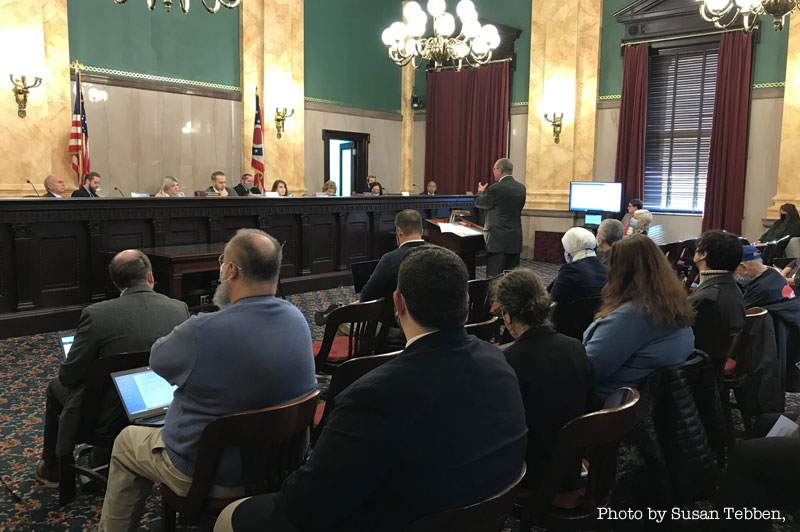
In Senate Local Government and Elections Committee on Tuesday, the last scheduled hearings on GOP and Democratic bills to change the congressional district maps in the state occurred, with much of the same criticism for the GOP map that anti-gerrymandering groups and Ohioans in target areas say don’t focus on fairness.
The Ohio Senate GOP’s congressional redistricting map proposal.
On Tuesday, Bellbrook resident Wendy Dyer spoke through tears about the volunteering she did to promote the petition that would eventually change the state constitution and the redistricting process as a whole. She said at that time she felt a sense of achievement and change in the state, something that’s now changed with the map proposals from the GOP.
“I thought Ohio had really accomplished something,” Dyer said. “Now I really just feel stupid that I honestly believed that my government would do the right thing.”
Anne Light Hoke, of Columbus, said she disagrees with the Senate Republican map that moves her from District 3 to District 15, which is nestled in with three other districts in Franklin County, but then stretches due south into most of rural Southeastern Ohio.
Hoke said as a resident of Columbus, she said she has “urban concerns” like public transportation, traffic congestion and police brutality.
“Although I was born in a small town, I no longer have small town concerns like broadband access, access to sewer systems and water systems, burning trash regulations and fracking,” Hoke told the committee members on Tuesday.
The public input is set to continue Wednesday morning in the House Government Oversight Committee on House Bill 479, the House GOP’s map proposal. As of Wednesday, the committee agenda had not changed to include a new map proposal from the House Democrats, introduced on Monday.
Also on Wednesday, the new joint committee on congressional redistricting is scheduled to meet for the first time at 2:30 p.m. in the Ohio Statehouse’s south hearing room. The two chairs of the House and Senate committees that have been hearing individual map proposals, state Rep. Shane Wilkin, R-Hillsboro and state Sen. Theresa Gavarone, R-Bowling Green, will be the co-chairs of the joint committee.
The joint committee is also scheduled to meet on Friday at 10:30 a.m., in the House Finance Room (Room 313).
A new bill specifying “blended learning” for the 2021-2022 school year has been approved by an Ohio Senate committee.
Senate Bill 229 is yet another bill meant to address the impact of the COVID-19 pandemic on student success and education, and was favorably passed in Senate Primary & Secondary Education Committee on Tuesday.
In the bill, school districts, including traditional public schools, STEM schools and community and charter schools, would have to have approval by the Ohio Department of Education to implement or discontinue a “blended learning model” by April 20, 2022. This is an extension of current law, which required the approval through July 1 of this year.
The blended learning model requires a school district to provide internet access and devices to each student using the model, and monitor and assess student achievement and progress while also communicating with parents or guardians about the progress.
A report must be submitted to the ODE by March 15 showing each school district’s total number of students in blended learning in 2021-22.
The bill also resets a measure passed through the budget bill, House Bill 110, which discounted standardized testing because of the pandemic’s disruption to education. Under current law, e-schools are required to disenroll a student who fails to take a state assessment for two consecutive years.
Under H.B. 110, that standardized testing rule was set aside and under the new bill, the exception would be extended through the 2022-2023 school year. This applies to any school who has an online school component.
Sen. Theresa Fedor, D-Toledo, accused legislators of creating the standardized testing amendment for e-schools as “problematic double-standard e-school favoritism.”
“If we’re going to provide flexibility and exemptions from standardized testing, it must be for all students no matter where they attend school,” Fedor said.
She brought up the latest court ruling requiring the defunct Electronic Classroom of Tomorrow (ECOT) to pay back $60 million in state funding it received after an investigation showed student engagement amounted to about an hour a day.
Fedor was the leader of a bill that attempted to change education laws in response to the pandemic, but her bill didn’t make it past the Ohio Senate.
She also attempted to add a provision to the blended learning bill on Tuesday that would allow public bodies, including school boards, to meet virtually if they chose to, but that measure was quickly tabled by the committee.
“I think people should be meeting in person,” state Sen. Andrew Brenner, R-Powell, the committee’s chair said. “I think that is pretty much what we’ve had conversations internally about, so I think we should leave it as it is.”
The amendment was tabled along party lines, but the bill itself was passed unanimously.
Both chambers of the Ohio General Assembly are plodding forward on legislation to waive training requirements to carry a concealed weapon.
While current law allows state residents to openly carry a weapon, it only allows those 21-and-up to obtain a concealed carry permit after completing an 8-hour training course and passing a background check.
House Bill 227 and Senate Bill 215, which contain some important differences, would waive these permitting requirements, including the training
The effort, if successful, would continue Ohio’s steady relaxing of its gun laws over the last 20 years, which has included launching the concealed carry program in 2004 that required 12 hours of training; passing “pre-emption” legislation in 2006 which blocks cities from enacting gun laws stricter than those at the state level; and removing the duty to retreat (passing “stand your ground”) in 2020, which removed the requirement for a person to seek retreat before responding to a perceived attack with deadly force.
On Thursday, the House Government Oversight Committee held its fourth hearing on the permitless concealed carry legislation.
Over several hours, members of Moms Demand Action, an anti-gun violence advocacy group, made their case against the bill. They argued it will inevitably increase rates of gun violence. The Ohio Attorney General’s Office reports roughly 1,200 concealed carry applications are denied each year for reasons set in code, like criminal histories, civil or temporary protective orders, or others.
What, they asked, will happen to those applicants if there’s no more licensing process?
“It allows guns in the pockets of lowlifes,” said Sieglinde Martin, an MDA member.
Micaela Deming, an attorney with the Ohio Domestic Violence Network, said domestic violence misdemeanor convictions and protective orders are the second highest reason that would-be gun owners fail background checks. Waiving the permitting requirements, she said, would mean the loss of a key screening mechanism to remove guns from these domestic offenders.
Gun lobbyists and enthusiasts argued that the public safety threat is overblown. Law breaking gun possessors, they said, will continue to break laws regardless of how strict or lax they are. The bill is about enshrining Ohioans rights under the Second Amendment of the U.S. Constitution.
“I don’t think there’s anything in the bill that says, ‘If you’re prohibited from carrying a [concealed] firearm, suddenly now you can’ — if you’re prohibited, you’re prohibited,” said Rep. Shane Wilkin, a cosponsor of the bill and committee chairman overseeing its hearings, in an interview.
“Those that are going to carry that are not mindful of the law regardless of what it is, are going to carry regardless.”
After the hearing, Wilkin said he didn’t know if the bill would be up for a vote at its next hearing but said he wouldn’t rule it out.
Lawmakers on the committee were generally warm to the legislation. Rep. Phil Plummer, R-Butler Twp., said it’s “kind of bizarre” that it’s legal to openly carry a weapon in Ohio, but becomes illegal if you put on a jacket that covers it.
Rep. Don Jones, R-Freeport, needled one witness who said states that legalized permitless concealed carry experienced higher levels of violent crime than those that did not. He asked whether that could be the effect of other legislation like legalizing marijuana for recreational use.
The Senate Veterans and Public Safety Committee, meanwhile, has held two hearings on similar legislation from Sen. Terry Johnson, R-McDermott.
A key difference from the House version: The Senate bill would also establish procedures for a pretrial immunity hearing for people facing criminal charges or a civil lawsuit related to their use of force in purported self-defense.
The hearing, which would come before any trial, provides a substantial advantage to the accused: It would tell the court to assume the accused used force in self-defense and requires prosecutors (in a criminal case) to prove beyond a reasonable doubt or plaintiffs (in a civil lawsuit) to provide “substantial evidence” that the person did not use force in self-defense.
If the prosecutor or plaintiff fails in this, the accused would be considered immune from the charge or lawsuit. If they succeed, the proceedings will then move toward a trial.
Although bill proponents say otherwise, courts have generally held that licensing requirements to carry concealed weapons do not violate the Second Amendment.
In a 2003 Ohio Supreme Court opinion (that preceded Ohio’s first concealed carry law), Justice Paul Pfeifer, writing for the majority, was blunt in a majority opinion.
“(The law) does not unconstitutionally infringe the right to bear arms; there is no constitutional right to bear concealed weapons,” he wrote.
“Like most rights, the right secured by the Second Amendment is not unlimited,” he wrote.
“(There is no constitutional) right to keep and carry any weapon whatsoever in any manner whatsoever and for whatever purpose.”
Ohio Attorney General Dave Yost is responsible by law to handle some of the administrative work in Ohio’s concealed carry program. In a statement, a spokesman said Yost has not yet taken a position on either bill and is actively monitoring them.
“By any measure, Ohio’s concealed-carry licensing system has succeeded in combining safeguards that protect the public and provisions that uphold Americans’ right to bear arms and protect themselves,” he wrote in the 2020 annual report on the program.
Twenty-one states allow inhabitants (residents only in North Dakota) to carry a concealed weapon without a permit, according to a count from the U.S Concealed Carry Association. This includes neighboring states of West Virginia and Kentucky.
Two Ohio House Republicans on Tuesday proposed legalizing marijuana for recreational use in Ohio.
In legislation that has not yet been formally introduced, Reps. Jamie Callender and Ron Ferguson pitched a program that would allow Ohioans 21 and older to purchase marijuana from licensed distributors or grow up to six plants in their home.
“Adults should be able to make decisions for themselves,” Ferguson said. “That’s what this bill is about.”
The bill would impose a 10% sales tax on marijuana. As drafted, 25% of the revenue would go to support law enforcement, and another 25% would go toward mental health services with a focus on substance use recovery efforts. Adults could lawfully possess up to five ounces of marijuana.
The sponsors acknowledged the bill’s trajectory would be somewhat dicey: They said the House Speaker is hesitant on the issue; the governor and Senate President have expressed more explicit opposition.
“[The Speaker] is generally unfavorable to recreational use,” Callender said. “However, he does read the tea leaves, and he is giving us a chance to prove that this is a reasonable option.”
Callender said there would be an expungement process outlined in the bill for people who have previously been convicted of certain crimes related to marijuana. He didn’t immediately offer specifics.
Outside organizers, in an industry-backed effort, are seeking to force the Legislature’s hand. In August, they received the green light from state officials to begin collecting the 133,000 signatures required to force lawmakers to consider the issue. Should lawmakers decline to do so, the issue would then be placed on the ballot for voters to directly weigh in.
Callender said his proposal could be a means to get ahead of the ballot referendum and give lawmakers more control over the final outcome, though he acknowledged the principal ideas in both are similar.
The idea can be lucrative for the state. Colorado, roughly half the population of Ohio, levies a 15% sales tax on retail marijuana, plus a 2.9% sales tax on marijuana sold in stores and a 15% wholesale sales tax. The state earned $387 million in marijuana tax revenue from calendar year 2020, according to state data. Michigan, which launched its recreational program in late 2019, received $45.7 million in tax revenue in fiscal year 2020.
Despite hearing public, firsthand accounts of sexual abuse from eight of at least 177 victims of Ohio State sports physician Dr. Richard Strauss, state Republican leaders indicated they never planned to pass introduced legislation that would allow his victims to hold the university accountable in court.
Both former House Speaker Larry Householder, R-Glenford, and current House Majority Leader Bill Seitz, R-Green Twp., said in recent statements they used the legislation and high-profile hearings to apply pressure on OSU to generate a larger out-of-court settlement for victims — not to guarantee anyone their right to a trial.
In interviews, five victims of Strauss’ abuse and several of their attorneys say they were never told of the purported strategy.
“Why f**k with victims in that way? That’s the most irresponsible thing I’ve ever heard.”
Mike Schyck, a two-time all-American wrestler for Ohio State
“Why f**k with victims in that way? That’s the most irresponsible thing I’ve ever heard,” said Mike Schyck, a two-time all-American wrestler for Ohio State, in a recent interview.
Schyck testified before lawmakers in 2019, recounting how Strauss sexually abused him during physical examinations. He said he thought the bill was an honest effort to change the law, not some kind of legal strategy.
“Why would you consider putting us through that?” he said.
Ohio law sets a two-year window within which adult victims of sexual abuse must file any civil lawsuits (child victims get a longer window). Strauss’ conduct occurred between 1979 and 1996, according to an OSU-commissioned, independent investigation.
“We [found] that university personnel had knowledge of Strauss’ sexually abusive treatment of male student-patients as early as 1979, but that complaints and reports about Strauss’ conduct were not elevated beyond the Athletics Department or Student Health until 1996,” the report states.
Victims filed a class action lawsuit that the Associated Press reports would grow to include about 400 plaintiffs. After the filing, an Ohio Republican introduced House Bill 249 in 2019 to allow a special exemption to this statute of limitations for Strauss victims. Last month, long after the bill died, U.S. District Judge Michael Watson dismissed the lawsuit, citing the statute of limitations. However, he lambasted Strauss’ “unspeakable sexual abuse” and how OSU “failed to protect these victims” in his opinion.
He placed much of the blame for his ruling at state lawmakers’ feet.
“If there is a viable path forward for plaintiffs on their claim against Ohio State, it starts with the legislature, rather than the judiciary,” he said.
Legislative leaders now admit they never planned to pass the bill.
The House Civil Justice Committee held six hearings on HB 249, hearing out victims, their wives, and parents. However, legislative leaders now admit they never planned to pass the bill.
“The reality is that the bill was introduced to provide the victims with a public forum to tell their stories and hope to persuade the university to settle with victims and bring some degree of closure to a very bad situation,” said Householder, then House speaker, in a statement.
Shawn Dailey, a former OSU wrestler and Strauss victim who testified before lawakers, said he was never told of this plan.
“That was someone else’s intent, perhaps, but it was never our intent,” he said.
Rocky Ratliff, an attorney representing Strauss victims and a victim and former wrestler himself, said he didn’t know of the strategy. Discussing it in an interview, he called Ohio lawmakers “pathetic.”
Rocky Ratliff, an attorney representing Strauss victims and a victim and former wrestler himself, said he didn’t know of the strategy. Discussing it in an interview, he called Ohio lawmakers “pathetic.”
During the hearings in 2019 and early 2020, athlete after athlete told lawmakers about how Strauss abused them, and the university failed to act on their complaints. Most all of them cried in front of strangers, lawmakers, TV cameras, and legislative staff.
They described to lawmakers abuses from Strauss like sodomy, forced masturbation, groping and fondling, usually during routine physicals required as a term of participating as a varsity athlete. Some described dealing with PTSD, broken relationships with parents and wives stemming from the abuse, trust issues causing fissures in personal relationships, alcoholism and more.
One former wrestler, Daniel Ritchie, described a series of escalating, unwanted advances from Strauss during annual physicals. When coaches ordered Ritchie to see Strauss for a shoulder injury his junior year, the appointment descended into Strauss stroking Ritchie’s genitals.
It was his first time telling his story publicly — until that point, he was only identified as a John Doe in the OSU lawsuit.
Ritchie explained to lawmakers how the abuse prompted him to quit wrestling. He couldn’t bring himself to tell his parents why. He lost his scholarship and his grades suffered, prompting him to take time from school.
In an interview, he expressed cycles of frustration at telling lawmakers his story on two occasions, retraumatizing himself for nothing.
“You have state government officials, and their sole job is to represent the people of their state,” he said. “When those people come before them and say, ‘We need your help,’ they didn’t help.”
Excerpt from Richard Strauss’ personnel file at Ohio State University. From Ohio State public records via public domain.
Applying pressure
The bill sponsor, Rep. Brett Hudson Hillyer, R-Uhrichsville, said he, in tandem with the victims, tried in good faith to pass House Bill 249. The legislation is extraordinarily narrow — it allows the Strauss victims, not any other sexual abuse or assault victims, to bring civil lawsuits against OSU even if the statute of limitations has passed.
In an interview, Hillyer said neither he nor the legislature should be blamed for the bill’s failure and Watson’s ruling against the plaintiffs. He insisted he fought in earnest to pass the bill but the votes just weren’t there. The bill never came up for a vote, which is usually a decision of the committee chairman in consultation with House leadership.
“I don’t think there was ever a time that leadership was heavily involved other than encouraging more hearings and asking Ohio State to do the right thing,” Hillyer said.
The chairman at the time, now-former Rep. Steve Hambley, R-New Brunswick, declined to answer questions and referred comment to Householder. He terminated a phone call when asked why he didn’t put the bill up for a vote.
Seitz, a powerful House Republican and Householder’s lieutenant overseeing the judicial committees at the time, didn’t play any public role regarding the bill. However, he recently wrote a letter, which he provided to the Ohio Capital Journal, in response to requests from Strauss victims to resurrect HB 249 in the current legislative session.
While he described Strauss’ conduct as “deplorable,” he said he opposed HB 249, which was “intended to apply pressure to Ohio State to come to the table and make meaningful settlement offers.”
Statutes of limitations, he said, ensure claims are brought when memories are fresh, evidence has not yet been lost, and defendants have a fairer opportunity to defend themselves against allegations that may be “tainted” by faded memories or misremembered events. Plus, he said, if lawmakers grant this extension, where does it end?
“It would have led to a flood of similar demands that the civil statute of limitations for damages be lifted as to lawsuits against churches, the Boy Scouts, the Girl Scouts, and any number of charitable institutions whose past practices facilitated abuse similar to the abuse that you suffered,” he wrote.
Householder rejected the notion that lawmakers failed on the bill; the votes just weren’t there, he said.
“The intent was to pass the bill if it had support. I guess the obvious questions are, why didn’t [the victims] settle once it was extremely obvious the bill was out of oxygen?” he said.
State Rep. Bill Seitz, R-Green Twp. Screenshot courtesy The Ohio Channel.
A heinous precedent
With a statute of limitations as a shield and a legislature signaling its unwillingness to get rid of it, OSU faced a lower liability risk than universities that recently found themselves in similar positions.
After a former OSU wrestler blew the whistle on Strauss’ conduct in 2018, a university-commissioned investigation by the Perkins Coie law firm established that Strauss abused at least 177 victims over 20 years. Even after the university forced Strauss out in 1997, it allowed him to voluntarily retire and keep his “emeritus” honorific.
Ohio State settled lawsuits with 185 Strauss victims, paying out a total of $46.7 million, about $252,000 per victim. They settled another roughly 45 claims through its “Strauss Individual Settlement Program,” according to a university spokesman. The settlement program contains a term that it’s not “an admission or evidence of any wrongdoing or liability on the part of Ohio State or of the truth of any of the allegations in the lawsuits.”
The terms of the settlement allow victims to speak about their abuse but prohibits them from any “disparagement of Ohio State’s handling of this matter since March 2018, of the terms of this settlement, or of the Program.”
The Michigan Legislature passed legislation that year to extend the state’s statutes of limitation, giving sexual assault victims more time to report and sue their accusers, according to Michigan Live.
The OSU saga, however, is unique in that Strauss died by suicide in 2005 — Tyndall and Nassar are still alive.
Robert Allard, an attorney representing several Strauss victims, said his clients were victims of direct contact abuse. He accused Wright and Schulte, an Ohio firm representing other victims who led negotiations with OSU for the settlement, of only representing voyeurism victims. The cheap settlements, he said, took pressure off state lawmakers to pass HB 249.
“The truth is that virtually all of those … who suffered actual sex abuse, i.e. forced masturbation, digital penetration and sodomy, have yet to receive anything remotely close to a fair offer for settlement,” he said. “OSU concocted a scheme designed to screw over true sex abuse victims and found a lackey to pull it off. The whole thing makes me ill. I have never before in my 25 years seen such Machiavellian behavior designed to violate sex abuse victims all over again.”
“The truth is that virtually all of those … who suffered actual sex abuse, i.e. forced masturbation, digital penetration and sodomy, have yet to receive anything remotely close to a fair offer for settlement,” he said. “OSU concocted a scheme designed to screw over true sex abuse victims and found a lackey to pull it off. The whole thing makes me ill. I have never before in my 25 years seen such Machiavellian behavior designed to violate sex abuse victims all over again.”
OSU spokesman Chris Booker called Allard’s allegation “patently false,” noting that individual settlement amounts are determined by an independent party without input from the university. He didn’t offer specifics as to what kinds of claims have been settled.
Richard Schulte, of the namesake firm, did not respond to repeated inquiries. He now represents sexual abuse survivors at a similar scandal emerging out of the University of Michigan.
“Our ongoing negotiations with Ohio State have resulted in a fair settlement process that acknowledges the harm inflicted on individual survivors and provides a pathway to healing,” he said in an OSU news release announcing some of the settlements. “Once again, Ohio State has stepped forward and done the right thing.”
Justice for some?
In 2019, House Democrats introduced more comprehensive legislation to address sexual assault in Ohio. It would have removed the criminal statute of limitations to prosecute rape, along with the civil statute of limitations. It also would have closed a loophole in Ohio law that shields men from prosecution if they rape their spouses.
The bill received one, perfunctory hearing in December 2020 with mere days left in the legislative session. House Democrats controlled 38 of 99 seats at the time, meaning they couldn’t pass any bills for the most part without GOP buy-in and acquiescence from the speaker.
Rep. Kristin Boggs, D-Columbus, sponsored that bill. She said the Democrats likely would have opposed HB 249.
“I 100% believe the victims of Strauss deserve justice, but so does everyone else,” she said. “The fact that this was only being carved out for a specific subset of victims, who by all accounts have suffered greatly due to these horrendous experiences perpetrated by this awful human, I don’t think that justified opening access to justice for them and denying it for everyone else.”
But Rep. Rich Brown, the ranking Democrat on the House Civil Justice Committee, said he figured Democrats likely would have voted for the Strauss bill, although they preferred Boggs’ bill. He said he regularly prodded Hambley to put the Strauss bill up for a vote, only to be told the “powers that be” weren’t having it.
“I feel sorry for the victims,” he said in an interview. “Their testimony in committee was powerful.”
The hearings
Over the course of six hearings, athlete after athlete recounted their abuse; how coaches and administrators ignored their complaints; and how the abuse caused lasting damage.
A swimmer detailed abuse that started with unwanted and inappropriate touching of his genitals. His career ended when Strauss attempted to forcibly sodomize him. He quit swimming, then quit school. He doesn’t trust doctors and won’t see them without his wife present.
A hockey player described how Strauss’ abuse started small and escalated over the years, culminating in the doctor touching and stroking his penis during a required physical. He told an athletic trainer who did nothing. He described himself as a “train wreck” afterward, losing an NHL deal before being diagnosed with PTSD.
“If someone had done something when I reported this 30 years ago, none of these other men here would have been abused,” he said. “Not a single one.”
A wrestler said he was molested 15 times by Strauss in the 1990s, sometimes at the doctor’s personal home. He said he has sought out therapy and contemplated suicide. He said he hasn’t had a physical in more than 20 years now.
“In my mind, I was raped, 15 times. Everybody knew,” he said. “I don’t know why this has taken so long, and all I can ask is just, please, vote and pass and say yes to 249 so this doesn’t happen again.”
A non-athlete student and former major in the U.S. Army said he was abused at Strauss’ clinic and complained to the university as late as 1995. Administrators, he said, told him no one had ever complained before about Strauss.
Brian Noethlich, an attorney representing an anonymous victim in the lawsuit, said his client was drugged and sodomized by Strauss.
“I’m haunted to this day by the image of all the blood,” he said, reading a statement his client wrote. “I was shocked and scared, in tremendous pain and didn’t know what to do.”
Courtesy of Mike Schyck, seen second from the left.
Lobbying
State lobbying records show Ohio State University registered two lobbyists to work on the bill; the Inter-University Council of Ohio, which represents Ohio schools, had another three.
Some of the plaintiffs’ firms followed suit.
Sharp Law, a firm representing several Strauss victims, hired GOP powerhouse lobbyist Neil Clark to lobby on its behalf. Clark would later be charged alongside Householder in the summer of 2020 for his alleged role in a bribery scheme operated through the House Speaker’s office. Prosecutors say he served as Householder’s proxy, controlling a dark money nonprofit. Both Householder and Clark (who died by suicide earlier this year) pleaded not guilty and denied accusations of bribery.
Clark represented a wide range of clients, and there’s no evidence to link the criminal scandal (mostly involving coal and nuclear bailouts) to the Strauss legislation.
However, Householder made statements through the media at the time calling on OSU to “do the right thing” and settle with the Strauss victims.
The groups do not disclose the sources of their funding.
An email obtained by the Ohio Capital Journal, written by a lobbyist registered alongside Clark to various attorneys representing Strauss victims, with the subject line “The Ohio State Accountability Project,” details a phone call from Kevin DeWine — a former lawmaker and cousin of the governor. The email states DeWine is a neighbor of Rick Schulte, who was the lead negotiator settling with OSU.
The email describes a “robo text” that went out to undisclosed recipients, and other strategies.
“Their PR focus is on making OSU uncomfortable rather than pushing for legislation although they understand that HB 249 provides a forum for more attention on the issue as well as increases in media coverage,” the email states.
Large insurance firms like AIG and Liberty Mutual Group registered to lobby as well; insurers generally oppose expansions of liability of institutions they cover. They didn’t respond to inquiries from the Capital Journal.
The Catholic Church, which has its own history of sexual abuse and subsequent coverups, registered two lobbyists on the bill as well. Jerry Freewalt, executive director of the Catholic Conference of Ohio, said they didn’t take a position for or against the bill.
“The Conference made some inquiries about the legislation and monitored it as we do with many other bills covering a wide-range of issues,” he said.
“A disservice to survivors”
Camille Cooper, vice president of public policy for the Rape, Abuse and Incest National Network, lobbies state legislatures around the U.S. to eliminate or extend their statutes of limitation for rape charges.
She said she has never heard of a bill used as leverage, as House GOP leaders described.
“It’s quite a disservice to survivors,” she said. “It takes a lot when they come down to the General Assembly to tell their story. That’s a little — I would call it cynical.”
She said there are complicated reasons victims don’t immediately come forward. Extensions of statutes of limitation don’t lower plaintiffs’ burden of proof, she said, they just let them come forward when ready.
“There are a lot of survivors who do not come forward for years, or even decades, especially if it’s due to power,” she said. “We shouldn’t leave the doors of justice open only just a crack.”
Camille Crary testified in support of the bill on behalf of the Ohio Alliance to End Sexual Violence. In an interview, however, she acknowledged constitutional problems with only extending the statute of limitation for Strauss victims instead of all victims of abuse.
She said among the problems with lawmakers’ inaction: it sends a signal to institutions that if they learn of a monster within their ranks, they only need to run out the clock a few years to escape liability. There’s no incentive to immediately correct problematic conduct as it arises.
She said among the problems with lawmakers’ inaction: it sends a signal to institutions that if they learn of a monster within their ranks, they only need to run out the clock a few years to escape liability. There’s no incentive to immediately correct problematic conduct as it arises.
Ratliff, the Strauss victim who sued the university as an attorney, explained the OSU strategy another way: “Deny it, cover it up, hope it never comes out, and if it does, just argue the statute of limitations.”
As for the lawmakers’ pressure play, Crary said it seems to assume that victims want to talk about their abuse publicly, which is not always true.
“I think it’s extremely presumptuous for any lawmakers … especially who didn’t work for victims, to say what is or is not beneficial for them,” she said.
Only one person publicly opposed the bill: Kevin Shimp, representing the Ohio Alliance for Civil Justice, which is comprised of the Ohio Chamber of Commerce, the Ohio Manufacturers Association and others.
“The alliance believes creating the potential for endless liability is not the appropriate balance because it only considers one party’s interest,” he said. “Passage of House Bill 249 would undermine the important goals of statutes of limitation by reviving claims that were not filed in criminal or civil court within the time frame required by statute.”
Predictable failure
Part of the plaintiff’s argument was that the statute of limitations on Strauss victims didn’t start at the time of their abuse, given OSU’s role concealing Strauss’ conduct.
But as Watson, the judge, ruled in his dismissal, plaintiffs knew of their injury, the identity of the perpetrator and his employee.
The lawmakers who could have solved the plaintiffs’ statute of limitations problem said they figured the lawsuit would fail without legislative action.
Seitz noted that the victims who held out against OSU’s settlement offer were left with nothing, “as most lawyers could have predicted.”
“Under the current statute of limitations, they would have expired, and unfortunately, these victims would not have an opportunity to have their day in court,” Hillyer said.