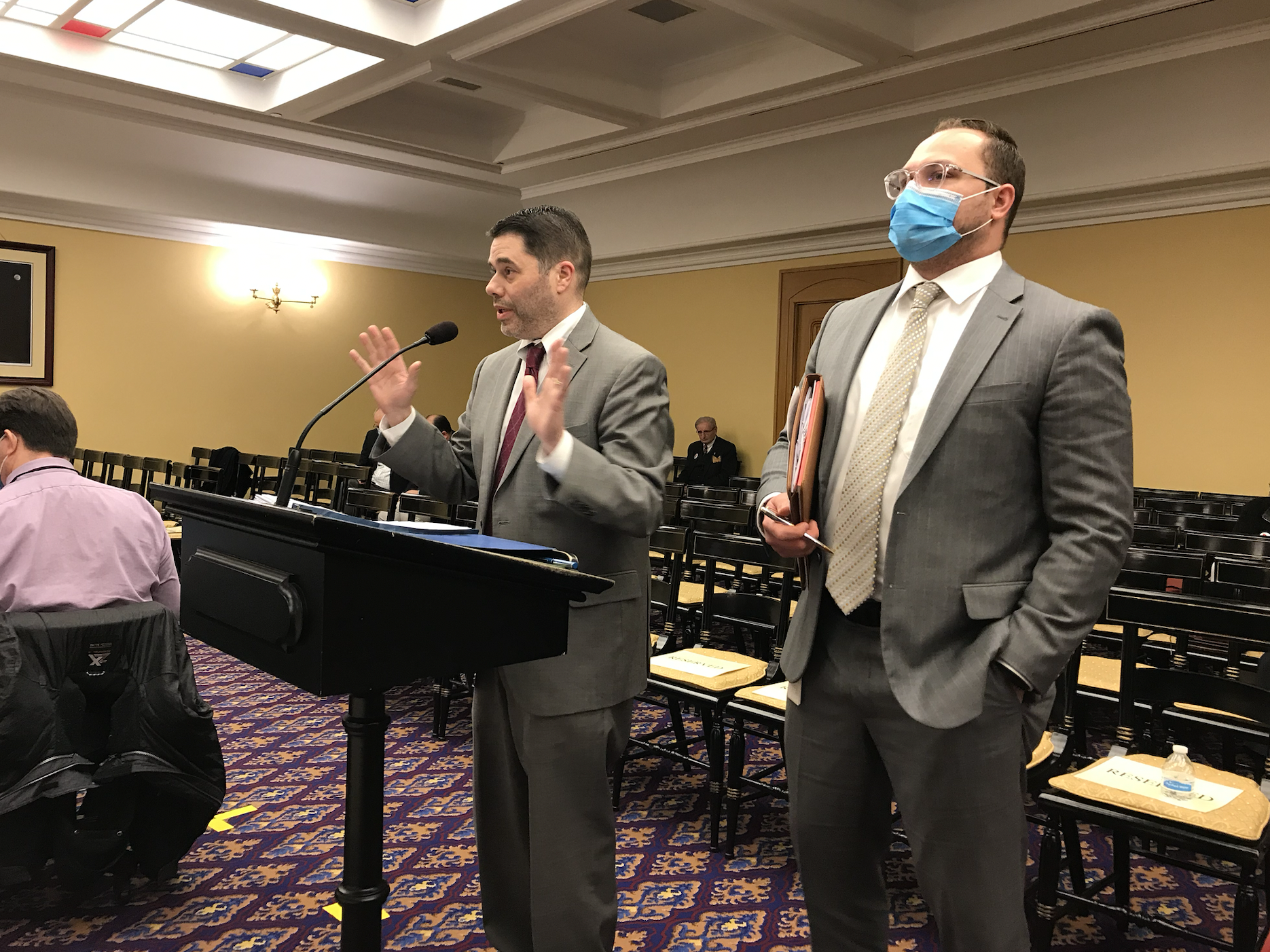
Republican mapmakers Ray DiRossi, at podium, and Blake Springhetti present the GOP legislative map proposals to the Ohio Redistricting Commission on Saturday. The commission passed the GOP maps on a 5-2 simple majority. (Photo: Susan Tebben, OCJ)
After two more days of discussion and debate, the GOP majority on the Ohio Redistricting Commission adopted four-year legislative maps Saturday night with a 5-2 simple majority, setting up the time table for potential objections and court review.
The Ohio Redistricting Commission meeting went into Saturday night after recessing Thursday and not meeting again until 2:30 p.m. Saturday afternoon.
Ohio House districts, as proposed by the GOP majority and adopted by the Ohio Redistricting Commission on Saturday. (Right-Click to open in a new tab to view larger)
During the Saturday afternoon session, Republicans and Democrats presented separate maps, though the Democratic co-chair of the commission, state Sen. Vernon Sykes, D-Akron, said the purpose of the Democratic caucus effort was not to present separate maps as much as it was an exercise to prove constitutionally proportional representation could be done.
It became clear as the day went along that disagreement was still threatening the process. House Speaker Bob Cupp said even in the last hour of the commission’s time on Saturday, when they recessed to discuss each plan, the co-chairs were discussing whether or not it was worth it to continue negotiations or try to amend the maps.
“A majority of the commission felt that that was just, while it may have been a good thing, was not possible to do,” Cupp said.
Earlier in the day, the Democratic co-chair said members of his caucus were still operating under the idea that agreement and common compliance to the constitution was at the end of the redistricting tunnel.
“Not until just a day or two ago was I told that there was a feeling that we could not meet the proportionality requirements,” Sykes said.
The Ohio Supreme Court told the commission they needed to come back with a map that followed Section 6 of the constitution, the part of the redistricting process that prohibits overt partisanship. The court said the commission had to endeavor as much as possible to get to a 54% Republican to 46% Democratic split in statewide voter preferences.
The Republican maps adopted had a 57 GOP to 42 Dem split in the Ohio House, and a 20 GOP to 13 Dem breakdown in the Senate. Four of the Democratic-leaning seats give the Dems a narrow 50-51% advantage, considered a tossup by many. All but one of the Senate seats in the plan were above 54%.
In the House, 12 of the “Democratic leaning” seats in the GOP plan could also be considered tossups, with a Dem favor of only 50-51%. All of the GOP-leaning seats favor Republicans by more than 52%.
The Democratic attempt had 45 Dem-leaning seats in the House and 54 GOP districts, with 18 GOP districts in the Senate and 15 Democratic districts.
After the vote, Cupp argued that while 54-46 was a goal expressed by the supreme court, perfection was not. He denied that the constitution or the court order spoke to an “absolute ideal,” instead saying the court wanted a plan to “closely correspond.”
“If the ideal is 55 House seats or 54 House seats, we have 57 leaning Republican,” Cupp said. “That is just three seats off and in a 99-member legislature, that is essentially 97% to the goal.”
The minority side released an opposition statement, read at the end of the ORC meeting by House Minority Leader-Elect Allison Russo, D-Upper Arlington, which accused the Republican commissioners of “a lack of political courage and a blatant disregard for the court’s order and the will of the Ohio voters.”
She also touched on the same concern that Democratic mapmaker Chris Glassburn brought up in the last few days of commission hearings, the “razor-thin margins,” those districts considered tossups, within the maps.
He spoke on the topic again, saying the Democratic proposal has less tossup districts, which leads to less concern that the Ohio Supreme Court could consider the map “asymmetrical” in its partisanship.
Ohio Senate districts, adopted by a 5-2 simple majority of the Ohio Redistricting Commission on Saturday. (Right-Click to open in a new tab to view larger)
Republican mapmakers Ray DiRossi and Blake Springhetti presented the map before the commission, saying they spent the week attempting to bring the maps into compliance with the constitution and the supreme court order.
“The decisions were centered around complying with the court order, and closely corresponding with Section 6, and we did this,” Springhetti told the commission.
The Republicans also released a statement to comply with a constitutional requirement explaining why a 4-year map was passed with a simple majority, rather than a 10-year, bipartisan map.
“The commission believes that the number of Republican-leaning districts and Democratic-leaning districts closely corresponds to strict proportionality, particularly in light of the distribution of voters and geography of Ohio,” the statement reads.
The adoption of the maps sends them back to the state’s high court for review, and sets the stage for a three-day window in which objections can be filed with the Ohio Supreme Court, who said in their decision rejecting the previous maps that they would oversee the process yet again.
Anti-gerrymandering groups have already come out in force against the maps, criticizing not only the final product but the lack of public process along the 10-day stretch.
“I knew it would be a challenge, but it certainly becomes a challenge when you don’t engage in a public process, when you don’t actually discuss regionally,” said Catherine Turcer, executive director of Common Cause Ohio.
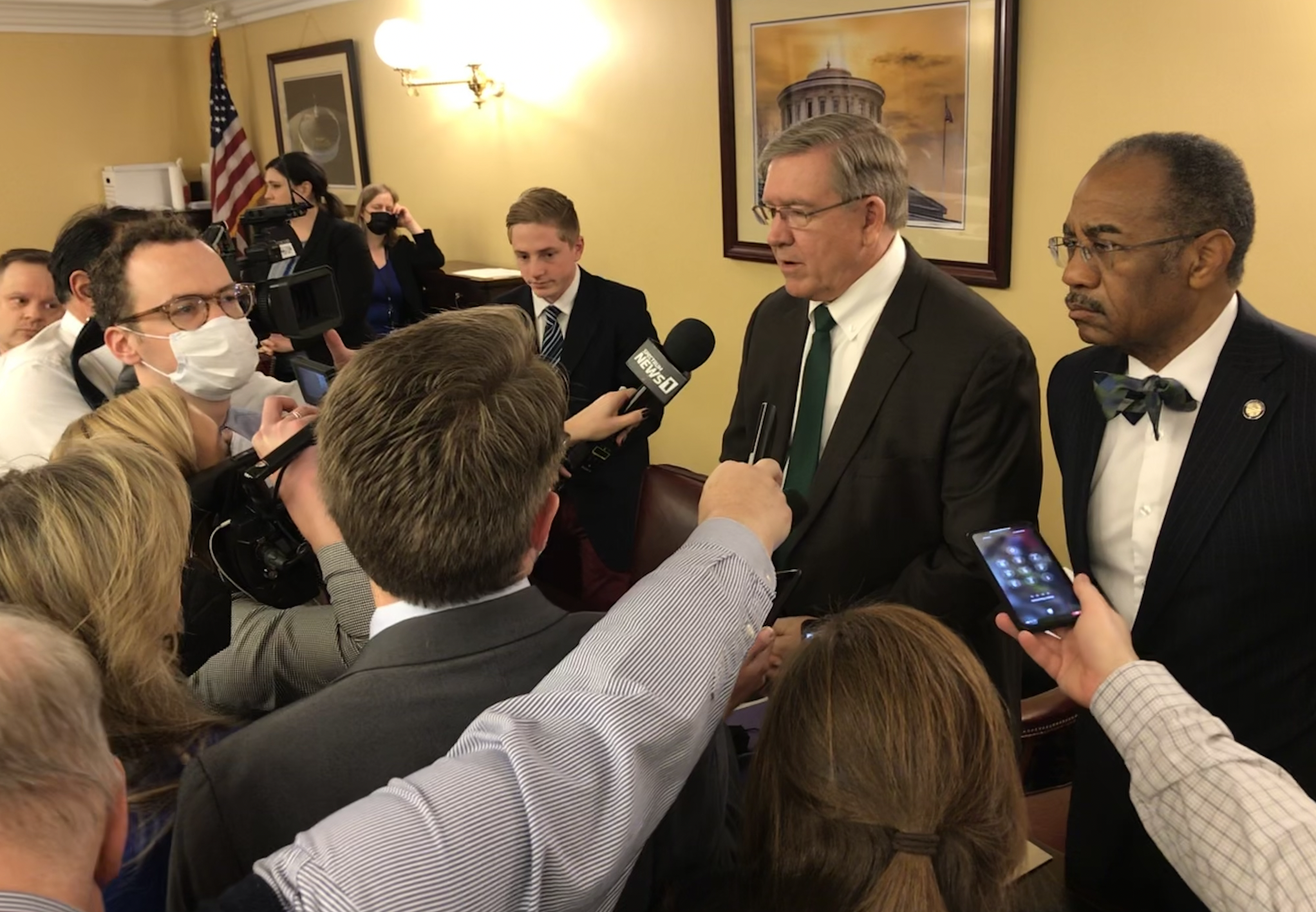
House Speaker Bob Cupp, center right, and state Sen. Vernon Sykes, far right, co-chairs of the Ohio Redistricting Commission, speak to media after Tuesday’s meeting to restart the legislative redistricting process. (Photo: Susan Tebben, OCJ)
The Ohio Redistricting Commission began anew on Tuesday, though the details of their newest legislative mapping process are still up in the air.
In its Tuesday meeting of the ORC, commission co-chairs House Speaker Bob Cupp and state Sen. Vernon Sykes said work to correct problems identified by the Ohio Supreme Court with legislative district maps has already begun between the Democratic and Republican caucuses.
The commission is working on a deadline of Saturday, which is 10 days from the date the supreme court made their decision. Cupp said the commission is keeping in mind meeting the deadline so that the maps can be considered for any objections, which have to be submitted within three days of map approval.
“This is a very time-sensitive matter, and we’re well aware of that,” Cupp said.
Secretary of State (and ORC member) Frank LaRose said more than one deadline needs to be met in the process.
“The General Assembly has ordered me to conduct an election on May 3, and I am committed to making sure that that happens,” LaRose told the commission. “But without finality on maps, that starts to become mechanically impossible very soon.”
Some deadlines are already doomed because of how much time the redistricting process has taken, LaRose said. This weekend is the deadline for the state to submit the Federal Write-In Absentee Ballot forms for the next election.
“That’s not going to be met because we’re not going to be ready to do that this weekend,” LaRose said.
Because of the timeline, LaRose said he’s asked the legislature for temporary authority to adjust the administrative deadlines between the candidate filing deadline at the beginning of February and the May primary.
The request is similar to the one approved under Senate Bill 258, the bill that approved the congressional district lines in November, that moved deadlines for the congressional elections.
However, Cupp said he doesn’t sense “any appetite to change either the filing deadline or the primary election,” even if administrative deadlines change.
The commission has about a week to come up with new maps that follow all constitutional regulations for redistricting, and aim for a 54% Republican/46% Democratic balance in the state aligned with statewide voter preferences. Sykes said the commission has agreed and shared data to be used in the mapmaking process, which will be the 2016 to 2020 statewide election data.
Cupp said the commission is committed to working toward that 54-46 ratio.
“(The supreme court has) determined that that needs to be closely followed,” Cupp said.
Last week, in a 4-3 decision, the state’s highest court rejected maps approved by the commission in September 2021. Justices in the majority vote said the commission did not even attempt to meet constitutional standards to create a map that doesn’t favor or disfavor one political party over another, or use the proper data to calculate the statewide voter preferences.
The court found that Cupp and Senate President Matt Huffman were the only two commission members “involved when the plan that was ultimately adopted was drawn,” and the principal mapmakers were not asked to comply with Section 6 of the constitution, which prohibits partisanship.
At the Tuesday meeting, Gov. Mike DeWine – father of Supreme Court Justice Patrick DeWine and dissenter in the redistricting ruling – took time to read over the court’s decision on legislative redistricting and level-set the commission on the task at hand. He said the commission should “take affirmative steps” to comply with the constitutional standards, and make certain everyone from commission members to staffers know they need to comply.
“So, anybody who is drawing a map, anybody who works with any members of this commission should be instructed by the individual commission members to do that,” DeWine said.
The newest member of the commission, newly minted Democratic Ohio House leader state Rep. Allison Russo, D-Upper Arlington, was sworn in to fill the position left vacant by former House Minority Leader Emilia Sykes. She said the commission should take its second chance at the maps “to do what is right by Ohioans and deliver bipartisan 10-year maps.”
“We should start with the assumption that it is absolutely possible, and move forward,” Russo said after the meeting.
Russo told commission members during the meeting and the press afterward that she is pushing for public meetings to be scheduled quickly before the ORC loses the opportunity.
The commission did not set up any future meetings or give any indication of how the map-making process is going during Tuesday’s meeting. Cupp said he and Sykes will be meeting to discuss a schedule for future meetings “as business would warrant us to.”
“Obviously this is a little uncertain process, it’s new,” Cupp said. “We’re kind of feeling our way as we go.”
Anti-gerrymandering advocates attended the meeting and said they were encouraged to hear the court’s expectations playing into the first meeting, but saw a lack of public input as the process started.
“It would be better to have an understanding of what maps they’re starting with, when hearings will be, how the public can participate, and so it’s my hope that even within the next 24 hours we get a lot more information,” said Jen Miller, executive director of the League of Women Voters of Ohio.
A think-tank in favor of Gov. Mike DeWine’s decision to end supplemental unemployment assistance despite a continued pandemic impacting the economy is yet again pushing the Ohio Supreme Court to support the decision. The governor himself is also weighing in.
The federal supplemental assistance from The CARES Act expired on Sept. 4, 2021 though DeWine ended it in Ohio on June 26, 2021.
In a court filing this week by attorney (and former state Senate president) Larry Obhof, the Buckeye Institute called the early ending of additional Federal Pandemic Unemployment Compensation (FPUC) “sound economic policy.”
The group argued in their second push for the court to land on the side of DeWine that “neither state nor federal law compels Ohio to continue participating” in the unemployment program.
“Federal law clearly indicates that states are free to participate and, if they so choose, to withdraw from the program as well,” the institute wrote in the Jan. 10 court filing.
Ohio residents Candy Bowling, Shawnee Huff and David Willis sued the DeWine administration in September to get the additional $300 monthly unemployment benefits reinstated, which they say are needed to help with household expenses such as rent, food and medical expenses since they were laid off due to the pandemic, according to their lawsuit.
What’s still up to the court to decide is whether the governor, not the state as a whole, was required to continue participating in the program. Obhof says in court documents that he is not.
“Because the Governor acted lawfully, the courts may not substitute their judgment for his policy decision,” he wrote.
The group argues, as DeWine did when he decided to cut the benefits, that the additional payments were “delaying employees’ return to work,” and ending the support brought more employees back, though businesses across the nation are still struggling to get back to full staffing.
“The Governor’s decision to end the additional FPUC payments was not a magic talisman for Ohio’s economy, but it was sound economic policy,” the institute wrote.
DeWine filed his own brief arguing a lower court’s ruling saying the governor shouldn’t have ended the assistance “rests on a misreading of a state law” requiring the director of the Ohio Department of Job and Family Services to adopt rules and regulations necessary to “secure to this state and its citizens the advantages” of federal statutes, in this case including the CARES Act funds.
“No state law – ‘long-standing’ or otherwise – compelled Ohio to participate in the program here at issue,” DeWine’s brief stated. “Because nothing compelled the governor to participate in the program, the governor’s withdrawal did not contradict any policy mandate from the legislature.”
DeWine’s son, Supreme Court Justice Patrick DeWine, recused himself from this case “to avoid any appearance of impropriety that might result from my father’s public involvement in this matter,” according to court documents.
In supporting the governor, the Buckeye Institute interpreted the additional unemployment benefits as a negative for the economy because Goldman Sachs economists cited in their brief estimated the median recipient of the benefits received “roughly 90% of their prior wage,” though it did not specify what the median wage for those beneficiaries was or whether it was enough to support Ohioans in essential ways.
The Buckeye Institute brief joined other Ohio groups who supported governor’s decision. In August of last year, the Ohio Chamber of Commerce, the Ohio Business Roundtable, the Ohio Restaurant Association, the Ohio Hotel and Lodging Association, the Ohio Grocers Association and the Ohio Trucking Association filed their own brief saying the FPUC benefits “will result in a scenario where many individuals will make more in unemployment than when working,” calling the staffing issues for businesses an “artificially created labor shortage.”
The groups levied their support once again in a Jan. 7 filing, which also included the Ohio Manufacturers’ Association, the Ohio Council of Retail Merchants and the Ohio Farm Bureau Federation.
In this filing, they made a matching argument with the Buckeye Institute that the governor is allowed to “exercise discretion regarding Ohio’s participation in federal programs.”
The state Supreme Court denied two attempts in the case to speed up the process of deciding the case, but has not set other deadlines in the case, including whether or not they will have an oral argument to hear from attorneys on both sides.
In the big picture of the insurrection, the criminal charges against Alexander Sheppard are unremarkable.
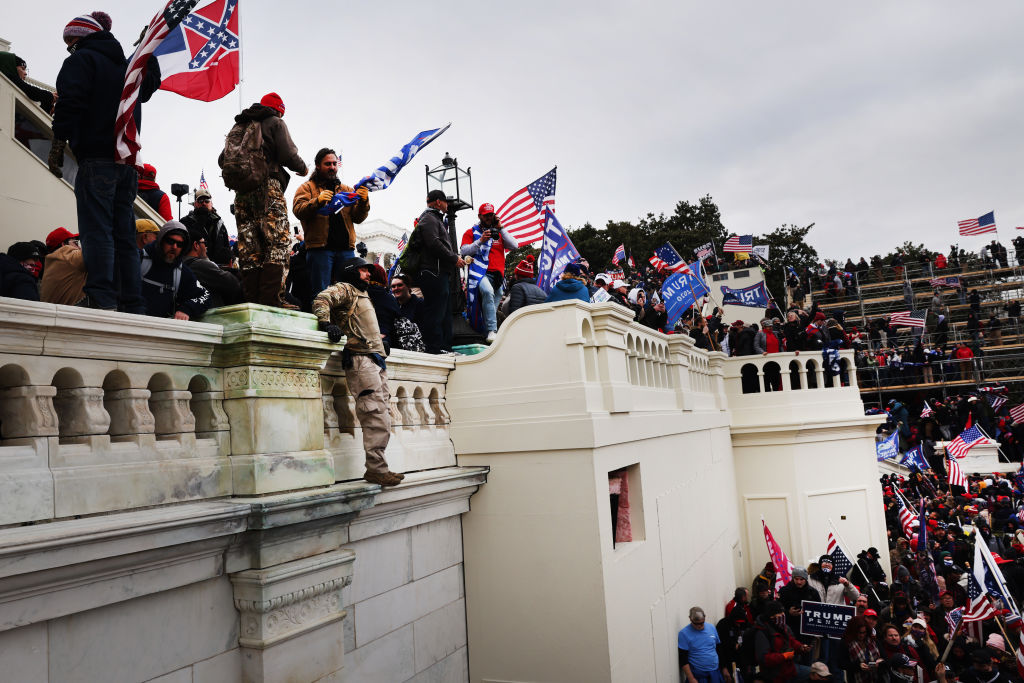
Federal prosecutors say Sheppard arrived in Washington D.C. from Powell, Ohio after posting on Facebook that the election was “RIGGED.” He faces five charges, including disorderly conduct in a Capitol building. He wasn’t accused of violence or destruction, but of joining the throngs of about 2,000 people who comprised a mob that stormed the Capitol in an attempt to forcefully block the U.S. Congress from certifying President Joe Biden’s 2020 electoral win.
Then-President Donald Trump and his allies hosted the Jan. 6, 2021 event, based on the central lie the election was fraudulently stolen from the incumbent. Trump said in a speech that day the attendees should “stop the steal” and “fight like hell” because they’re “not going to have a country anymore” if they don’t.
Sheppard, 21 at the time, was spotted in footage outside the House Speaker’s lobby just before a Capitol Police officer shot and killed Ashli Babbitt as she tried to climb through a transom window toward members of Congress.
In charging documents, prosecutors included a still photo from raw footage from a man named John Sullivan, who also breached the Capitol that day. About 80 seconds after the camera shows the included still frame of Sheppard — wearing a Trump red “Keep America Great” hat and navy blue hoodie, yelling at police officers blocking the door — Babbitt gets shot some 10 feet away.
Alexander Sheppard, pictured on right. Source: DOJ
A public defender representing Sheppard, who has pleaded not guilty, did not respond to inquiries, including whether Sheppard witnessed Babbitt’s shooting. A spokesman for the U.S. Attorney’s Office for the District of Columbia declined comment.
The episode is a reminder of the way Ohioans pockmarked events around the Capitol on an infamously seditious, chaotic and politically violent day of American history. At least 38 Ohioans were accused of crimes in connection with the riots. Six have pleaded guilty, mostly for comparatively minor offenses.
The Ohio cohort’s alleged conduct ranges from conspiring to plan the event with the Oath Keepers (a paramilitary group), to waging hand-to-hand combat with police officers and wrestling down barricades outside, to smoking joints and carrying a bottle of bourbon around the seat of government.
Many of the suspects filmed and photographed themselves throughout the day, which prosecutors relied on heavily in bringing charges against the defendants. Several signaled allegiances to QAnon, a sprawling, online conspiracy theory whose believers essentially say the Democratic Party runs a massive, Satan-worshipping child sex trafficking ring that only Trump can thwart.
A review of court documents, raw footage and news coverage shows the range of conduct Ohioans took part in that day.
Oath Keepers and the ‘stack’
A still from footage of the riots in Washington D.C. captures Jessica Watkins, 38, seen with several people in Oath Keepers regalia, heading up the Capitol stairs. Screenshot from YouTube, credit Ford Fischer / News2Share.
Some of the most serious charges of the day accuse several Ohioans who are Oath Keepers of conspiring to plan the events of Jan. 6. The Oath Keepers are a right-wing, anti-government extremist group within the militia movement comprised mostly of former law enforcement and military members. Twenty one members from multiple states were charged with various offenses.
They were seen in matching combat gear in a “stack” formation (hands on the shoulders of the person in front of them) moving up the stairs toward the east side entrance of the Capitol. Prosecutors have accused them of conspiring to plan a Capitol raid as far back as November 2020. On Jan. 6, they wore matching combat fatigues and ballistic helmets. They were unarmed, but prosecutors have alleged they had a “quick reaction force” at the ready to deliver guns if needed. A lawyer representing one defendant, however, said in court filings the ‘force’ was one overweight, old man and called the government’s claim a gross overstatement.
Jessica Watkins, a Champaign County bartender, ran a small group she called the “Ohio State Regular Militia” — a subset of the Oath Keepers that folded in with the larger unit that day.
“To me, it was the most beautiful thing I ever saw until we started hearing glass smash,” she said of the raid in a January 2021 interview with the Ohio Capital Journal “That’s when we knew things had gotten really bad.”’
Watkins characterized her participation as non-violent. Footage has since emerged, identified by amateur internet sleuths “Capitol Terrorists Exposers” and later published by The New York Times, showing her and other Oath Keepers in a crowd trying to push past the Capitol Police into the U.S. Senate.
“Get in there! They can’t hold us!” Watkins yells in the footage.
Jessica Watkins was charged with conspiracy for her role in the Capitol attack, alongside other Oath Keepers in military-style garb. New footage shows Watkins (and others linked to the group) pushing against riot police on Jan. 6, contradicting claims by her defense counsel. pic.twitter.com/blfDeeYaP2
Also in the clash were Ohioans Donovan Crowl and Sandra Parker, according to prosecutors. Bennie Parker, Sandra’s husband, stayed in communication from outside the building. All have pleaded not guilty.
“So can I bring my gun?” Bennie Parker allegedly texted Watkins before the riot, charging documents state.
‘Kill the tyrannical government’
Douglas Wright, of Canton, in a photo prosecutors say they obtained from his Facebook page. Source: DOJ
David Mehaffie, of Kettering, Ohio, acted as a quasi-commander during one of the most brutal clashes between rioters and police during the siege, according to federal prosecutors. Police had formed a human barricade against a door at an exterior terrace at the Capitol complex.
According to prosecutors, he left the scrum and spent 26 minutes above the fray “to coordinate the mob’s actions” by directing efforts and passing weapons around like stolen police shields.
“If you are going in, get on this side,” he yelled to rioters, according to footage obtained by prosecutors. “Push! Push!”
Capitol Police Officer Michael Fanone would later say he was electroshocked in the fracas involving Mehaffie. A woman named Rosanne Boyland, a pro-Trump member of the mob, died after she was trampled amid the chaos, according to the Huffington Post.
Mehaffie pleaded not guilty and awaits trial. His lawyer did not respond to inquiries. Other Ohioans were accused of violence elsewhere on the Capitol grounds.
Cliff Mackrell pushed, shoved, struck at, and peeled a gas mask from the face of a Capitol Police officer outside the building to expose him to various chemical irritants like tear gas in the air, according to footage obtained by prosecutors.
“Whatever it takes take for my country,” he said in the footage, per the DOJ. He posted on Facebook later that day that it’s our “literal jobs as Americans to kill the tyrannical government.”
Facebook messages later obtained by law enforcement quote Mackrell, a Wellington, Ohio man, as saying his head hurts because he was hit 10 to 15 times with a baton.
Mackrell has pleaded not guilty and awaits trial. His lawyer did not respond to an email.
“Yesterday wasn’t the end,” he said to the newspaper. “Yesterday was the first battle of the war. I promise you.”
In charging documents, prosecutors included a photo of him and other rioters with their hands on a metal barricade, seeking to overpower Capitol Police officers on the other side. In Facebook posts prosecutors say they obtained, Wright seemed to have foreseen clashes with law enforcement.
“WE ARE GOING TO HAVE TO FIGHT THE BLUE TOMORROW,” one message states (capitalization in the original).
“FROM WHAT I SEEN TONIGHT THE TEMPERS WILL BE UP TOMORROW AND POLICE LINES WILL BE BREACHED,” reads another.
Wright pleaded not guilty. His attorney did not respond to an inquiry.
Jared Hunter Adams, a Plain City, Ohio man, was accused of entering the building. Prosecutors say he brought two hunting knives to Washington D.C., but did not bring them with him into the building. They cited alleged comments from Hunter captured in footage as evidence to successfully quash a motion from Hunter to allow him to possess firearms while he awaits trial.
“Next time we won’t leave our guns at home,” he said on Jan. 6, per court documents.
Adams has pleaded not guilty. His lawyer, Joseph Roll Conte, declined to comment.
QAnon: Where we go one, we go all
Ohio woman Christine Priola, right, roamed the floor of the U.S. Senate during the Jan. 6, 2021 insurrection. She currently faces several criminal charges stemming from the event. She has pleaded not guilty. (Photo by Win McNamee/Getty Images)
Some Ohioans publicly signaled their adherence to QAnon, the online conspiracy theory that exploded in popularity during the pandemic
A Piqua, Ohio woman named Therese Borgerding was photographed holding a large “Q” (in the theory, Q is a high ranking anonymous government official who leaves cryptic messages for followers about Trump’s looming purge of detractors from the federal government) sign. She has pleaded not guilty. Her lawyer did not respond to an inquiry.
Timothy Allen Hart, a Dayton man, was photographed wearing a “Q” sweatshirt inside the building. Another, Ethan Seitz, saw a “militia” that “wants to storm the Capitol and take the building after Trump’s speech,” according to Facebook messages obtained by law enforcement included in charging documents. Along with posts stating that the people “will not allow our country to be stolen! #stopthesteal,” he posted a photo of himself the night before the riot from his hotel room.
The post states he’s in Washington D.C. and ends with QAnon’s unofficial mantra: “Where we go one, we go all.”
Another woman named Chrstine Priola was one of a smaller group of rioters who allegedly made it onto the floor of the U.S. Senate. Prosecutors say she wielded a sign reading “THE CHILDREN CRY OUT FOR JUSTICE” — QAnon followers often use vague references to protecting children as a coded means of attracting new followers. Shortly after the riot, Priola resigned from her role as a school therapist for the Cleveland Metropolitan School District, according to Cleveland.com. She resigned in a QAnon-tinged letter stating she was “switching paths to expose the global evil of human trafficking and pedophilia, including in our government agencies and children’s services agencies.”
Priola has pleaded not guilty. Her attorney, Charles Langmack, noted that discovery (the trading of evidence between the defense and prosecution) is ongoing and declined further comment.
The partiers
James Matthew Horning smoking what prosecutors say is a marijuana cigarette. He was also photographed inside the Capitol. Source: DOJ.
The Jan. 6 mob contained violent extremists, Trump zealots, an Olympic swimmer, men in costume, and a number of people who seemingly flowed into the building with a crowd.
However, there’s some evidence that people used the mayhem simply to catch a buzz in a government building.
“F**k it, smoking a joint on the Capitol steps right now,” wrote James Matthew Horning, who attended the protests with his daughter, according to prosecutors.
In a Facebook comment thread provided by a tipster to the FBI, a person asked Horning why he attended the protests. Horning listed three reasons.
“To participate in anarchy, to smoke weed in government buildings, [but] the real reason was to intimidate congress,” he wrote in a post detailed in the documents. “They have a 9% approval rating. We accomplished that. Maybe they will work on that because they know we could have got them and have mercy”
Columbus men Robert Anthony Lyon and Dustin Thompson attended the event, the latter of whom was accused of trying to steal a coat rack on his way out the door. Thompson bailed on the coat rack and fled when confronted by police, according to prosecutors.
Lyon was allegedly found to have marijuana, pipes, and bourbon in his bag — he was charged with crimes related to the insurrection, not the substances.
In another case, prosecutors alleged an Instagram video from an account called “brotunda” that appeared to show Hart smoking marijuana in the rotunda of the Capitol building.
“It can be inferred that Hart was smoking marijuana in the video due to the fact that the induvial who was taking the video was counting how many ‘joints’ were in the video and asked another individual if he smoked weed,” an FBI agent wrote in an affidavit.
Dr. Sherri Tenpenny testifies before the Ohio House Health Committee on June 8, 2021. During her presentation, she said vaccines are magnetizing to their recipients and “interface” with 5G cell towers. (Photo source: The Ohio Channel)
In June, Sherri Tenpenny, a state-licensed doctor of osteopathic medicine and notorious COVID-19 disinformer, baselessly claimed in a televised, government meeting that COVID-19 vaccines “magnetize” recipients and “interface” with cell towers.
The comment wasn’t an aberration from Tenpenny, who has in the past described vaccines as a tool of “depopulation.” The Ohio State Medical Board, an agency tasked with overseeing discipline and complaints of state physicians, still renewed her license in September as part what it called an “automatic” process of handling renewals.
Her renewal points to a bigger problem at the intersection of politics, mass media and public health: a loud, super minority of physicians has found ways to monetize lies about COVID-19 and vaccines that prevent it, and state medical boards are ill equipped to handle the problem, according to a report released earlier this month by the de Beaumont Foundation.
“During this ongoing public health emergency that has claimed more than 5 million lives globally, a small minority of physicians have exploited the credibility that comes with their medical licenses to disseminate disinformation to the public,” the report states. “Their lies, distortions, and baseless conspiracy theories have caused unnecessary suffering and death that are prolonging the pandemic.”
“Their lies, distortions, and baseless conspiracy theories have caused unnecessary suffering and death that are prolonging the pandemic.”
– de Beaumont Foundation
Only about 21% of state medical boards have taken any disciplinary action against a licensee for disseminating false or misleading health information, according to a survey conducted by the Federation of State Medical Boards. About 2 in 3 boards said they’ve noticed an increase in complaints on the issue.
Ohio’s medical board’s stated mission is to “protect and enhance the health and safety of the public through effective medical regulation.” Spokeswoman Jerica Stewart said state law allows the board to discipline doctors for making a “false, fraudulent, deceptive, or misleading statement in relation to the practice of medicine and surgery.” However, there’s a high standard of proof to meet. Tenpenny’s license, Stewart said, was automatically renewed, part of an automated process to keep up with the 92,000 licensees in Ohio. Tenpenny did not respond to an email.
“Ohio law prohibits the Medical Board from sharing details about received complaints and investigations even if a licensee chooses to publicly comment on their interactions with the board,” she said. “I’d also like to reiterate, a recent renewal does not prevent the board from taking future disciplinary action and does not mean that there isn’t an open investigation.”
The de Beaumont report criticizes boards that have “rubber stamped renewals for doctors who are in clear violation of medical standards, which allows them to do more harm with no questions asked.”
Medical boards have structural problems stopping them from disciplining disinformers, per the report. Their work is shrouded in secrecy, the problem is somewhat new and fast-evolving, and investigations are time consuming.
These claims fly in the face of real-world evidence showing vaccines are incredibly powerful protectors against serious health outcomes from COVID-19 like hospitalization or death. Likewise, researchers have found there’s no increase in mortality in vaccine recipients, and that recipients had lower rates of non-COVID-19 mortality after adjusting for age and other characteristics.
The de Beaumont Foundation, a public health advocacy group, commissioned polling on the issue from Morning Consult. Of 2,200 adult respondents, about 9 in 10 said physicians don’t have the right to “intentionally spread misinformation or false health information.” About 8 in 10 said they should be disciplined for doing so.
The case of congressional redistricting was heard by the Ohio Supreme Court on Tuesday, where arguments about reforms put in place by voters and the data used by the General Assembly to draw maps framed consideration of districts going forward.
Ben Stafford, an attorney representing the National Redistricting Action Fund’s challenge of the congressional maps approved in November, said the case centers on compliance with the constitutional reforms that revised the redistricting process, particularly the GOP majority’s use of partisanship in creating its map.
“This case is about how the General Assembly has thumbed its nose at these reforms and enacted a plan that palpably violates Article 19’s new anti-gerrymandering protections,” Stafford told the court.
Stafford said the 2021 enacted map has “extraordinary partisan skew,” with Republicans favored in 12 of 15 districts, amounting to 80% of congressional seats in the state. Using voting results as a starting point for analysis, as Stafford said should have been done, would have leveled out the district lean at 54% Republican, 46% Democrat, according to results of statewide races over the past decades.
“A plan where one party is favored to win 80% of the seats when it only wins 53 or 54% of that vote clearly favors that party,” Stafford said.
However, the attorney for the legislative leaders, Senate President Matt Huffman and House Speaker Bob Cupp, Phillip Strach, called the 2021 plan “the most constitutionally compliant of all plans before the General Assembly” because other plans presented “split more counties and other jurisdictions than the enacted plan.”
But Republican legislators who worked on drawing the maps also saw the redistricting process as a foregone conclusion, destined for a legal battle, according to Strach.
The attorney for Cupp and Huffman argued that based on the “political geography” of Ohio, the General Assembly could have drawn maps using no election or partisanship data whatsoever, and it still would have come up with a Republican majority, leading to accusations of GOP secrecy and scheming.
“And so, what the General Assembly decided this time was ‘look, we’re going to be sued no matter what, and so we’re going to make sure that we draw competitive districts,” Strach told the justices.
Strach was asked to address an expert witness for the map challengers in the case, a political scientist who ran the Ohio map through a redistricting program 5,000 times and never came up with the amount of Republican lean as the map approved by the state legislature.
The simulations were “deeply flawed,” Strach told the state’s high court, and dependent upon human intervention.
“At the end of the day, the computers draw what a human being tells it to draw, and so if you don’t tell the computer to use criteria that match what the General Assembly actually used, then what it will spit out is really just garbage,” Strach said. “It really is meaningless for any legal analysis.”
The idea of what data would be proper to use in redistricting was the subject of lengthy discussion during oral arguments on Tuesday, but the main conclusion attorneys on both sides came to was no database was better than another.
“Nobody agrees on what data to use,” Strach said. “It’s hard to use congressional districts data because it’s always changing. It’s easier to use statewide data.”
Challengers debated databases and which specific data to use, such as federal election results versus statewide results, but said the biggest problem with the 2021 plan was how map-drawers used the data they used.
Stafford said map creators for the GOP, namely Senate staffer Ray DiRossi and House mapmaker Blake Springhetti, had much more data than they let on publicly, but didn’t use it all in presenting the new map proposal.
“What was disclosed publicly was this cherry-picked measure, a measure designed to make the plan look more competitive than it actually was,” Stafford said.
Regardless of the measure or metric used, however, Stafford said the bias in the 2021 plan “remains the same.”
Supreme Court justices also jumped in on the debate of which data to use in forming congressional districts, with Justice Sharon Kennedy seemingly agreeing that the federal results made sense in drawing congressional districts.
“If you look at Ohio’s elections, and you look at your own datasets, more people turn out in Ohio to vote in federal elections than in statewide elections, by and large,” Kennedy said.
Justice Patrick DeWine spoke to the argument by map challengers who said the legislature erred in skipping the 2014 election results rather than using all election results for the last 10 years. DeWine said because the 2014 election was an election “unlike any other we’ve had in Ohio,” specifically the landslide victory by former governor John Kasich over Democratic challenger Ed Fitzgerald, it might not be prudent to include that data.
“I’m not sure which data set is best, I’m not sure the court could pick that, but it doesn’t seem immediately obvious to me that including several statewide elections in a year that was … probably the farthest from the norm we’ve had in Ohio in the last couple decades would make the data a lot better,” DeWine said.
Other justices explored the idea that reforms of the redistricting should have been the guideposts for mapmakers over database manipulation.
Chief Justice Maureen O’Connor posed the idea that the “intervening factor” in deciding how to draw maps was “the vote of the people.”
Strach argued that the previous map passed in 2011 and highly criticized for a lack of public accountability “was never overruled,” and O’Connor jumped in.
“Didn’t the people overrule it? Maybe not overrule it in front of us or another court, but the people in their vote overruled what had been done up to that point, did they not?”
Justice Jennifer Brunner touched on minority representation in redistricting, asking whether keeping to the constitution in terms of splits and keeping counties whole overrode the requirement to protect minority voting rights, specifically in Hamilton County.
Strach argued that under the 14th Amendment if the General Assembly had considered race, it would have violated “racial gerrymandering” prohibitions unless there was a “sufficient reason” to redraw districts, including a minimum of 50% Black population required to combine a district.
“There’s been no showing in this case, no allegation by anyone even in the legislative process that such a district could have been drawn, and so using race in Hamilton County would have violated federal law in this case, and that’s why it wasn’t done,” Strach said.
Just as it did in the legislative redistricting case, the court pondered the next steps if the map was rejected as violations of the constitution.
When Strach said being found in violation of the constitution would be “the end of the story” for congressional maps, O’Connor countered that by saying “it could go back to the drawing board,” something Strach said “could go on for quite a bit” or be taken over by federal courts.
Ohio Gov. Mike DeWine signed a new abortion law on Wednesday that looks likely to close Southwest Ohio abortion clinics.
DeWine signed Senate Bill 157 without further comment, along with several other bills that passed through the legislature in their last work week before the holidays.
The bill was condemned by abortion providers, who said not only that portions of the bill that direct doctors on the amount of care they should give babies born as a result of a “failed abortion” are already part of medical oaths and Ohio law, but that the bill would impact wanted pregnancies in which complications become a factor.
“At this moment, we’re at a crisis point for abortion access in Ohio and across the country,” said Kersha Deibel, CEO of Planned Parenthood Southwest Ohio. “…Stripping abortion care from Southwest Ohio will cause havoc that disproportionately impacts our communities.”
The Southwest Ohio region of Planned Parenthood also opposes the legislation because of changes to hospital transfer variance agreements between abortion providers and physicians, prohibiting for doctors who are funded by Ohio’s public medical schools from participating.
“There is no medical justification for disallowing qualified, experienced physicians from agreeing to provide backup coverage for abortion providers under a variance,” said Dr. Adarsh Krishen, chief medical officer for Planned Parenthood of Greater Ohio. “In fact, if the state was genuinely concerned for patient safety, such physicians would be ideal. Instead, this provision is only meant to make it more challenging for abortion providers to remain licensed and operational.”
The religious policy lobby Center for Christian Virtue praised the law and the potential shut down of Women’s Med Center in Dayton and Planned Parenthood of Southwest Ohio’s clinic, saying the state “has made a bold statement about where our values lie.”
DeWine did not comment on the bill with his announcement that the bill had been signed.
The bill is one of a few pieces of abortion legislation brought by the legislature this year. Another measure would make abortion illegal with the rollback of the U.S. Supreme Court decision in Roe v. Wade.
A group pushing for recreational marijuana in Ohio is one step closer to the ballot after the Coalition to Regulate Marijuana Like Alcohol submitted 200,000-plus signatures to state officials. Now county boards of elections begin the work of verifying signatures.
The coalition’s plan would allow Ohioans over 21 possess, use, and purchase cannabis. They propose a 10% tax on sales that would fund social equity and addiction programs. Another portion of that revenue would bolster the general funds of cities that choose to allow dispensaries within their borders. The plan would even allow adults to grow a limited amount of cannabis at home.
“The success of our petition drive shows just how eager Ohioans are to end prohibition and legalize the adult use of marijuana,” coalition spokesman Tom Haren said in a press release. “We look forward to receiving the results of the Secretary of State’s review, and are eager to begin working with legislators on this important issue.”
Signature gatherers overshot the required threshold of 132,877 by about 70,000 to provide a buffer for any signatures that get thrown out. So long as they meet the required overall number and get a designated portion from at least 44 of the state’s counties, the proposal goes to state lawmakers. If lawmakers choose not to approve the measure, the coalition has the chance to get another round of signatures to put their proposal on the ballot.
At this point, the ballot seems like the most likely path to approval, but that doesn’t mean the GOP-controlled legislature is blind to the shortcomings in Ohio’s existing marijuana program. Sen. Steve Huffman, R-Tipp City, has shepherded a measure through the Senate that would make significant under-the-hood changes to the state’s marijuana policy while leaving the overall structure intact. That bill passed the Senate last week.
But provisions like allowing homegrown marijuana are a non-starter for Huffman.
“Because that’s recreational marijuana,” Huffman said in a November interview about his bill. “If you’re going to grow five for your medical purpose, you know, the neighbor kids going to steal one, [and] you’re going to sell a couple.”
And Huffman isn’t alone. A recent poll conducted by Gongwer News Service shed light on how much the ground is shifting when it comes to marijuana — 43% of Republican lawmakers supported adult use, dead even with those who oppose it. But when it comes to homegrown marijuana, the GOP is far more unified in its opposition. When it comes to personal use, 64% of GOP members registered opposition and 86% said they are against people growing cannabis for commercial use.
Assuming the coalition’s signatures meet requirements, lawmaker have four months to act on their proposal.
The newest abortion bill to pass the Ohio House could spell the closure of Southwest Ohio clinics and the criminalization of doctors.
Despite multiple Democrat attempts to amend the bill and remove the language that would affect doctors’ ability to transfer patients from abortion facilities, Senate Bill 157 passed Wednesday afternoon along party lines, 59-33.
State Rep. Allison Russo, D-Upper Arlington, attempted to bring in the same amendment she tried to include in committee hearings on the bill, to remove the bill’s provision prohibiting physicians who are affiliated with and funded by public medical schools and institutions from having transfer agreement variances with abortion clinics.
This would effectively close clinics in Southwest Ohio, Russo emphasized in Wednesday’s House session.
“As a reminder to my colleagues, these consulting physicians that are required in order to get a variance from these transfer agreements, do not actually perform abortion services,” Russo said. “They are only consulted by the facility in the very rare case when there is an emergency and the need to transfer a patient to the hospital.”
After the bill was passed, Planned Parenthood’s Southwest Ohio region confirmed this would in fact be true, and is something they plan to fight against.
“Stripping abortion care from Southwest Ohio will cause havoc that disproportionately impacts our communities,” said Kersha Deibel, CEO of Planned Parenthood Southwest Ohio. “This isn’t the end, and we will continue to fight — abortion is still legal in Ohio.”
The organization said the closure of Planned Parenthood and Women’s Med of Dayton through this bill “would make Cincinnati the biggest metropolitan (area) in Ohio without an abortion provider.”
The bill was originally slated by sponsors to prevent doctors from allowing a fetus born alive after an attempted abortion to die without medical intervention, and to create another reporting system for “failed abortion” cases.
The chairman of the House committee that passed SB 157, state Rep. Susan Manchester, R-Waynesfield, stood in support of the bill on the House floor on Wednesday.
“This is an important piece of legislation that provides a system to protect infants that are born alive after an abortion by enforcing the administration of prevailing standards of care that apply to every child,” Manchester said.
Testimony made throughout the Senate and House committee process by abortion and pro-choice advocates focused on current law that already prohibits doctors from failing to provide care in a life-saving situation, and reporting requirements already in place by the Ohio Department of Health.
Opponents of the bill also said “failed abortions” are a rare occurrence, as shown by state data.
The bill became more controversial once the amendment on physician variance agreements was added, after which abortion advocates called the bill “dangerous,” even saying the bill would impact complicated pregnancies in hospitals, not just abortions in surgical facilities.
Another amendment tabled by the GOP majority attempted to remove the criminal charges physicians face for not following documentation procedure created in the bill. State Rep. Beth Liston, D-Dublin, presented the amendment just as she did in the previous House committee.
In the bill, doctors could face felony charges for failing to provide care to infants after an attempted abortion (something that is already a part of Ohio law), and for failing to file the proper paperwork on “failed abortions” as prescribed in the bill.
Liston said the bill impacts “futile” medical situations in which resuscitation of the baby isn’t scientifically possible and keeping the parent from holding the child only adds to the trauma of the situation.
“The only situations this bill impacts are those emergency circumstances where the woman’s life is at risk or there is a serious complication with the fetus,” Liston said. “These are desired pregnancies and devastating situations to all involved.”
State Rep. Kristen Boggs, D-Columbus, tried to add an amendment for workplace protection for pregnant Ohioans, and state Rep. Stephanie Howse, D-Cleveland, also tried to amend the bill to make workplace accommodations for pregnancies. Also attempted as an amendment was the inclusion of paid family leave, which has been a measure state Rep. Janine Boyd, D-Cleveland Heights, has championed for multiple general assemblies.
All amendments were tabled along party lines.
The bill is headed to conference committee because of a technical change added during hearings in the House Families, Aging & Human Services Committee, and could head to Gov. Mike DeWine’s desk in the next week.
DeWine has consistently approved of anti-abortion legislation, so it seems unlikely he will veto the bill.
Abortion is legal up to 22 weeks gestation in Ohio.
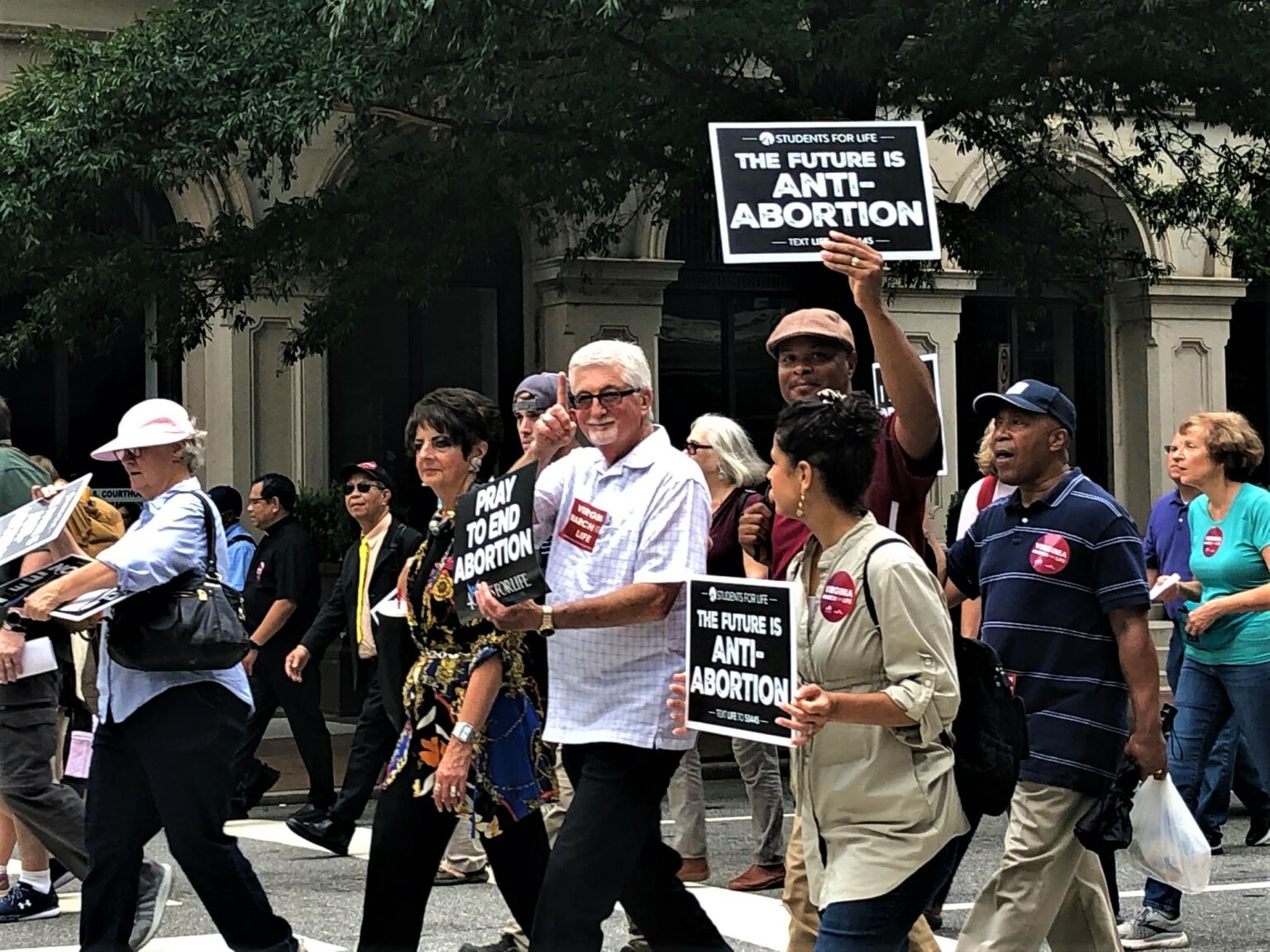
Anti-abortion demonstrators march. (Photo by Robert Zullo/ States Newsroom).
The Ohio House will consider a new abortion regulation that would keep some doctors from being able to work with abortion clinics and could cause felony charges for doctors working on complicated pregnancies.
Russo furthered an argument made by abortion rights proponents in previous testimony against the bill by saying the regulation “effectively bans and removes access to abortion,” particularly in Southwest Ohio, where two abortion clinics are located.
Senate Bill 157 passed through the House Families, Aging and Human Services Committee on Tuesday, approved along party lines. It has already been approved in the Ohio Senate.
The bill would expand the charge of abortion manslaughter, already on the books in Ohio, to include a physicians’ failure to “take measures to preserve the health of a child born alive after abortion,” according to the bill documents.
There is also a provision in the bill that requires the Ohio Department of Health to develop a “child survival form” for a physician to complete if a child is born alive after an attempted abortion, and for ambulatory surgical facilities to submit monthly and annual reports to the ODH.
The ODH already compiles an annual abortion report based on medical reports signed by physicians of abortions conducted in the state. The report also includes complications, including “failed abortions” that happen in the state and a narrative on the complications.
The bill’s sponsors referred to an abortion in which a child is born alive as a “botched abortion,” but state data shows the occurrence as a “failed abortion.” According to the most recent years of data on abortions in the state, “failed abortions” are rare, and did not happen in any pregnancies that were viable.
An amendment made while the bill was in the Ohio Senate prohibits physicians who are funded through a public institution’s medical school from being a part of abortion clinics written transfer agreement variances, which allow a patient to be transferred to a hospital where the physician practices in the case of emergencies.
Physicians who teach at public medical schools are also not allowed to serve as a consulting physician for abortion-related surgical facility, or the variance can be rescinded, according to the bill.
Democrats attempted to insert amendments into the bill, including one from state Rep. Allison Russo, D-Upper Arlington, that would remove the transfer agreements variance regulation. Russo furthered an argument made by abortion rights proponents in previous testimony against the bill by saying the regulation “effectively bans and removes access to abortion,” particularly in Southwest Ohio, where two abortion clinics are located.
“These are medically unnecessary agreements, but on top of that, because of the broad language, this does ban and remove abortion access for one part of the state in Southwest Ohio,” Russo said.
State Rep. Beth Liston, D-Dublin, introduced an amendment that would take away the word “health” from the bill, leaving the bill to involve a baby’s “life,” which Liston said gives doctors more freedom to do what they feel is best in complicated births and pregnancy plans. Her amendment also sought to remove a requirement that a physician be charged with a third-degree felony for failing to file forms.
“I think that these changes would minimize the downstream impacts and harm that we might see from this legislation in some small ways,” Liston said.
Both amendments were quickly voted down along party lines without further discussion.
The bill now heads for full House consideration, scheduled for 1 p.m. Wednesday.
Abortion is legal in the state of Ohio up to 22 weeks gestation.