Tag: Ohio Capital Journal

  • DeWine signs budget, blocks erasure of COVID-19 health violations

    DeWine signs budget, blocks erasure of COVID-19 health violations

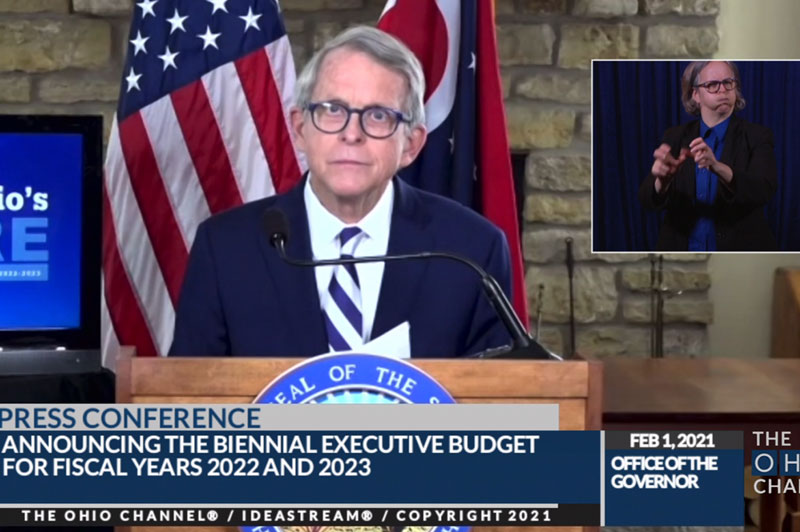
    Gov. Mike DeWine outlined his state budget proposal for fiscal years 2022 and 2023 in a February press conference.

    By Tyler Buchanan and Ohio Capital Journal

    Gov. Mike DeWine signed the $74 billion, two-year state budget into law, keeping in place nearly all of its signature policy positions and spending priorities while once again nixing an effort by Republican lawmakers to counter his administration’s methods of handling the deadly COVID-19 pandemic.

    The governor also vetoed an attempt by Republican lawmakers to give their party’s legislative leaders sole power to intervene in any potential redistricting lawsuits. The governor wrote in his veto message that this removal came at the request of Attorney General Dave Yost; voter rights groups and Democrats had also urged for the veto of this provision.

    As governor, DeWine has the power to issue “line-item vetoes” blocking specific provisions of the budget while signing his approval to the rest.

    In total, DeWine issued 14 such line-item vetoes among the more than 2,400-page budget bill. Lawmakers have the power to override any of these vetoes.

    Among the vetoes: A provision to vacate public health violations from businesses that were issued over the course of the pandemic. The budget item would have expunged all COVID-19 health violations, ended disciplinary actions in progress and ordered the state to repay any fines collected. Bars and restaurants which had their liquor licenses revoked — in some cases due to flagrant and repeated violations of the public health orders — would’ve had it reinstated.

    Gov. Mike DeWine signed the $74 billion, two-year state budget on Wednesday evening. Photo courtesy the governor’s office.

    In his veto statement, DeWine wrote that “Ohio law should not reward businesses and individuals that violated orders and rules adopted to protect Ohioans from the spread of COVID-19 by excusing their actions.”

    DeWine vetoed a provision which would have changed the state’s contracting process for a Medicaid managed care system.

    DeWine also vetoed provisions related to Medicaid program rates; an exemption of private schools from College Credit Plus laws; and quality controls of community schools.

    Unanswered veto requests

    While voter rights organizations scored a victory with the veto of the redistricting lawsuits provision, they were unsuccessful in pushing for vetoes of several other budget items condemned as being “anti-democratic.”

    This includes the budget eliminating the Citizen’s Education Fund and instituting a prohibition on elections officials collaborating with any “nongovernmental” entity for voter education purposes.

    There were other veto wishes that went unfulfilled. Democrats in the Ohio Senate wanted to see the governor remove the elimination of a cap on the number of EdChoice income-based vouchers awarded in Ohio and an income tax credit for private school tuition.

    Democrats in the Ohio House of Representatives, meanwhile, joined the Ohio Environmental Council in sharing concerns about budget language they fear would lead to oil and gas drilling in public park lands.

    Reproductive rights groups wanted to see DeWine take out provisions threatening the future of two Ohio abortion clinics. Innovation Ohio, a left-leaning policy group, was among the organizations drawing attention to the budget’s “medical practitioner conscience clause” allowing medical professionals to refuse treatment of patients if doing so would violate their personal moral or religious beliefs. Advocates believe this could lead to LGBTQ+ Ohioans being refused treatment.

    Policy Matters Ohio, a left-leaning think tank, called on the governor to remove proposed tax cuts that research has shown will largely benefit the state’s wealthiest earners.

    However, DeWine championed the 3% income tax cut in a news release announcing the budget signing.

    The Ohio Capital Journal will continue to provide coverage on the two-year state budget and the governor’s vetoes.
  • Ohio judge adds COVID-19 vaccination as terms of probation

    Ohio judge adds COVID-19 vaccination as terms of probation

    By Jake Zuckerman and Ohio Capital Journal

    A Franklin County judge recently began including vaccination against COVID-19 as a condition of defendants’ terms of probation.

    Common Pleas Judge Richard Frye said Thursday he added the vaccine as a condition on three cases this week of the roughly 20 sentences he imposed.

    He said he discussed the matter in open court with the defendants, and they attributed their unvaccinated status to procrastination. None raised any philosophical, medical or religious objection.

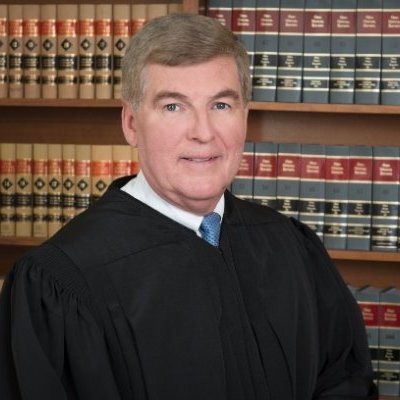
    Judge Richard Frye

    “It occurred to me that at least some of these folks need to be encouraged not to procrastinate,” Frye said in an interview. “I think it’s a reasonable condition when we’re telling people to get employed and be out in the community.”

    He declined to “speculate” what would happen if a defendant raised a medical, religious or philosophical exemption to vaccination, but said this is a different situation entirely than people who have simply put the matter off.

    An example: a man named Cameron Stringer entered a guilty plea for one charge of improperly handling firearms in a motor vehicle, for which he was sentenced to two years of probation (“community control,” as it’s known in Ohio).

    Stringer must submit to random drug screening; avoid further legal trouble; return a firearm in question to its rightful owner; and obtain a COVID-19 vaccine within 30 days and provide proof to the Probation Department, court documents show.

    It’s unclear how widespread this judicial practice is. Frye said he didn’t know if any other judges were doing anything similar. A spokesman for the Supreme Court, which oversees lower courts, said he didn’t know of any judges doing anything similar. However, he sent a link to a media report about a judge offering to shorten probation stretches for those who obtain a vaccine. 

    Gary Daniels, a lobbyist with the ACLU, expressed concern about the practice Thursday, comparing it to Ohio judges who have ordered defendants convicted of crimes not to procreate

    “It doesn’t have any real relationship to community control,” Daniels said of Frye’s practice, in a brief interview. 

    “At a minimum, it appears to be problematic.”

    Frye’s practice comes in a period of stagnation in a vaccination campaign against a disease that has killed more than 600,000 Americans. Despite a skyscraping death and morbidity toll; five $1 million lottery drawings for people who get vaccinated; and more than 6 months of availability, fewer than 48% of Ohioanshave started the vaccination process against COVID-19.

    “I just wanted them to be safe in the community,” Frye said.

  • Ohio House approves transgender sports ban for women’s athletics

    Ohio House approves transgender sports ban for women’s athletics

    By Tyler Buchanan and Ohio Capital Journal

    Ohio lawmakers approved a bill Thursday to allow college athletes to profit off their name, image and likeness, with Republicans adding an unrelated provision to ban transgender girls from competing in women’s high school and college sports.

    The last-minute addition of a provision dealing with the transgender sports ban set off a chaotic debate on the Ohio House of Representatives floor. Republican lawmakers defended the amendment as necessary to preserve the integrity and fairness of women’s athletics. Democrats condemned the effort as anti-LGBTQ+ and as being rushed through without a full legislative process.

    Gov. Mike DeWine too criticized the proposal.

    “This issue is best addressed outside of government, through individual sports leagues and athletic associations, including the Ohio High School Athletic Association, who can tailor policies to meet the needs of their member athletes and member institutions,” the governor said in a statement.

    The House provision was added to an otherwise bipartisan bill about college athletics which recently passed the Ohio Senate in a unanimous vote. 

    The House vote was 57-36, with one Republican joining the full Democratic caucus in voting against.

    Within hours, the Senate rejected the changes and worked to again pass legislation dealing with athletes benefiting from their personal “name, image and likeness” — without the transgender athletes amendment. Senators added this “NIL” language to an unrelated bill and included in a section dealing with the legalization of sports gambling. 

    The ball, so to speak, is back in the House’s court.

    Legislation to let college athletes benefit from their personal “name, image and likeness” — without losing their sports eligibility — has gained momentum in states throughout the country.

    Under the Ohio Statehouse proposals, college athletes would be able to sign endorsement deals with brands so long as the sponsorships do not conflict with deals already in place at their collegiate programs.

    “The example I would give is, if the school is a Nike school and the student gets an Adidas contract, they should be able to have that,” state Sen. Niraj Antani, R-Miamisburg, who first introduced the legislation, explained last week. “But they’re not going to be able to wear Adidas during a practice or during a media session that is an official team activity on or off campus.”

    With some states having already passed NIL bills, figures such as Ohio State University athletic director Gene Smith and head football coach Ryan Day have urged lawmakers to act quicklyso that programs like the Buckeyes would not face a competitive disadvantage with recruiting.

    As lawmakers consider the issue on a state-by-state basis, the National Collegiate Athletic Association is considering its own sweeping changes at the national level.

    The House amendment was introduced by state Rep. Jena Powell, R-Arcanum, who has repeatedly argued for the need to ban transgender girls from playing women’s  sports. She and fellow Rep. Reggie Stoltzfus, R-Paris Twp., are sponsors of the “Save Women’s Sports Act” which calls for the same ban as in Thursday’s amendment.

    Powell earlier criticized President Biden for selecting a Dr. Rachel Levine, who is transgender, to be the nation’s assistant health secretary.

    The Ohio Capital Journal previously reported there were five transgender girls who competed in women’s sports out of around 400,000 high school athletes in Ohio.

    A string of House Democrats spoke out against the amendment, including Minority Leader Emilia Strong Sykes, D-Akron, who called it a “poison pill” added to an otherwise agreeable bill.

    “This awful, terrible, disgusting, vile, worse-than-the-sticky-stuff-on-the-bottom-of-my-shoe amendment is in a bill that could have helped so many,” Sykes complained, noting it comes during Pride Month celebrating LGBTQ+ Ohioans.

    This story has been updated to include a statement from the governor.

  • Nearly a year after a racketeering indictment, Ohio House expels Larry Householder

    Nearly a year after a racketeering indictment, Ohio House expels Larry Householder

    By Jake Zuckerman and Ohio Capital Journal

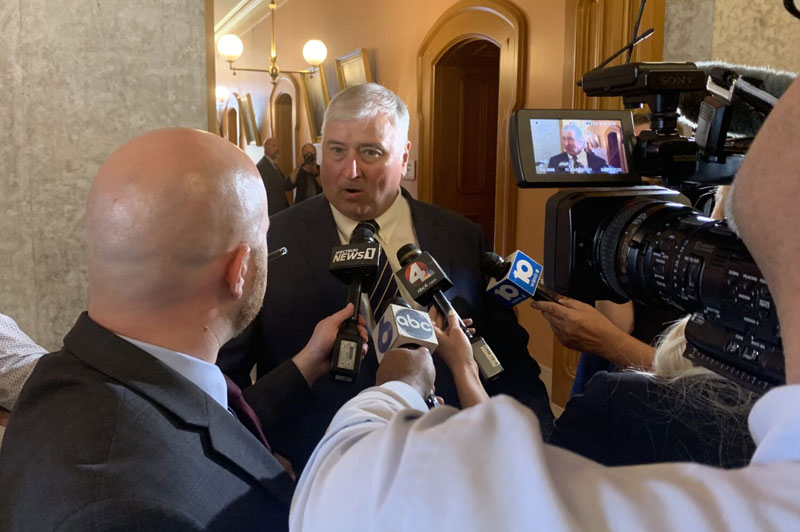
    Larry Householder addresses reporters June 16 after lawmakers voted to expel him from the General Assembly. Photo by Jake Zuckerman.

    Federal prosecutors accused the men of secretly accepting $61 million from FirstEnergy Corp

    The Ohio House voted Wednesday to expel Larry Householder, arrested on charges of public corruption nearly one year ago, from the chamber his Republican — and even some Democratic — colleagues thrice elected him to control.

    The expulsion could mark the end of Householder’s decades-long political career, which has included a previous tenure as speaker of the House in the 2000s that was derailed by a separate FBI investigation. No charges were filed.

    The House voted 75-21 to eject Householder. All but one Democrat voted in support.

    Wednesday’s vote extinguishes Householder’s political flame, but he remains innocent until proven guilty as his criminal trial draws nearer. Both he and former Ohio Republican Party chairman turned lobbyist Matt Borges await trial.

    Jeff Longstreth, Householder’s former political adviser, and Juan Cespedes, a lobbyist, both pleaded guilty to racketeering charges. Neil Clark, a lobbyist and once a towering figure in Ohio politics, was charged as well but pleaded innocent. He died by suicide before trial.

    Federal prosecutors accused the men of secretly accepting $61 million from FirstEnergy Corp via a dark money, pass-through entity. They allegedly used the funds for personal enrichment and to engineer the passage of House Bill 6, a coal and nuclear bailout worth an estimated $1.3 billion to the company.

    After his July 2020 arrest, House lawmakers quickly dethroned Householder as speaker. However, all but a handful of Republicans voted down an effort from Democrats to expel him. Speaking to House leadership on Tuesday, a confident Householder denied the allegations against him. On Wednesday, he listened from the House floor in silence as lawmakers publicly debated his fate.

    Those seeking his ouster emphasized the House is not a courtroom and thus can apply its own professional standards. They said the 43-page indictment and the plea deals entered into by two allies (and one dark money political entity) warrant his ouster from public office.

    “If selling legislation does not count as disorderly conduct, then frankly, nothing does,” said Rep. Brian Stewart, R-Ashville, who sponsored the expulsion resolution along with Rep. Mark Frazier, R-Newark.

    Rep. Kyle Koehler, a Republican who voted against HB 6, dismissed those trying to reduce Householder’s indictment as “allegations.” He identified himself as the anonymous “Representative 6” in the indictment itself, which describes the unnamed lawmaker subjected to political pressure funded by FirstEnergy for his vote.

    “These things occurred,” Koehler, one of few who have publicly demanded Householder’s ouster in recent months. “They’re not accusations. They’re not speculations.”

    Householder’s defenders argued it’s premature to punish Householder before he faces trial. Some argued that the allegations against him don’t qualify as “disorderly conduct,” the undefined Constitutional threshold for expulsion.

    “This is about due process. It’s about the Constitution. It’s not about that man sitting right over there,” said Rep. Al Cutrona, R-Canfield, pointing at Householder.

    What’s more, he won reelection in November, despite the indictment against him.

    “We do not get to choose who represents someone else’s district,” said Rep. Nino Vitale, R-Urbana, who chaired a committee specially created by Householder to review HB 6.

    At around 3 p.m., Householder began what would be his last floor speech of the 134th General Assembly.

    He reiterated a claim of his innocence, said that the allegations against him do not qualify as disorderly conduct, and criticized lawmakers for banishing from a chamber without gathering any evidence of their own.

    “I have not, nor have I ever, took a bribe, or provided a bribe,” he said. “I have not, nor have I ever, solicited a bribe. And I have not, nor have I ever, sold legislation.”

    After the vote, Householder approached the clerk and walked out from the chamber. He reiterated claims of his innocence to reporters gathered outside. There, he left open the possibility of a return to public office, and issued a warning to those who he feels crossed him.

    “Fellow elected officials who didn’t like public citizen Householder, are really not going to like private citizen Householder,” he said.

    This is a developing story and will be updated.

  • This rural county in Ohio has a COVID-19 case rate of zero

    This rural county in Ohio has a COVID-19 case rate of zero

    By Tyler Buchanan and Ohio Capital Journal

    Vinton County in rural Southeast Ohio was the last county in the state to record a positive case of COVID-19.

    It also appears to be the first without any cases remaining — at least for the time being.

    The sparsely-populated Vinton County has not been as hard hit by the pandemic as in other places of Ohio, and the recent data is the most optimistic yet.

    Over the past few weeks, not a single resident in Vinton County has tested positive for COVID-19. There has likewise not been a hospitalization since May 20.

    As of last Thursday, the county did not have any known active cases of coronavirus among its estimated 13,100 residents, according to the Vinton County Health Department.

    Vinton County’s location in rural Southeast Ohio.

    When the state health department published its most recent chart of county-by-county case rates, the one named for former Congressman Samuel Finley Vinton ranked the lowest. During the two-week period of May 19 through June 2, Vinton County didn’t recorded any new cases of the virus.

    Thus, the case rate was an even zero — the first county to achieve that since the early days of the pandemic.

    The next challenge? Boosting the county’s vaccination rate

    Vinton County has a history of figuring out creative solutions to problems. When the county suffered as a food desert, local officials secured grant funding to allow fresh produce to be sold at gas stations and at a drive-thru convenience store.

    Decades ago, the construction of a man-made lake threatened the survival of a historic covered bridge. The local agricultural society decided to save it, so a group of laborers spent two days moving the 25-ton bridge across the county. It now rests on the Vinton County Fairgrounds, where guests travel through it each July to reach the front entrance.

    Health officials are continuing to work toward getting residents vaccinated.

    The case rate may be promising, but the vaccination rate is hardly so. Only 30% of Vinton County residents have received at least one shot of the COVID-19 vaccine.

    The county lags behind the state percentages in every single age category, most alarmingly with the older demographic.

    Across the whole state, 77% of Ohioans aged 60 or older had received at least one shot as of June 4. In Vinton County, the number was just 59%.

    Part of the problem is geographic access. Vinton County has no hospital and only a few other medical care facilities. The health department is offering walk-in appointments at its location in the county seat of McArthur; there have also been shots offered at a local pharmacy and at a primary care clinic within the small village.

    Outside of McArthur, though, options have been limited. Vinton County is one of the least densely-populated counties in Ohio, and it is also among the most forested. Many residents live in very rural areas, traveling significant distances outside of the county for medical services and other errands in places like Chillicothe and Athens.

    The trip to and from the Vinton County Health Department, which now offers walk-in vaccine appointments, can require a round trip of more than an hour. That’s if fortunate enough to have transportation in the first place. There is little in the way of public transit in rural Ohio; those without vehicles or are too old to drive rely on transportation services provided by private companies as well as the senior citizens center in McArthur. Volunteers for the latter spend their free time driving elderly passengers to various appointments, grocery stores and 

    If it’s difficult for some residents to get to McArthur, health officials therefore strive to meet people where they are.

    Cassie Carver, a public health nurse for the Vinton County Health Department, said the department has been active in promoting the vaccine in the community. Officials have traveled to schools, churches and workplaces like area sawmills to educate on the importance of getting vaccinated.

    The health department recently hosted a mobile vaccination clinic at a farmers market in the smaller village of Hamden. Carver said the department plans to conduct more outreach during the upcoming summer months.

  • Ohio’s unvaccinated might be in as much danger now as they were in February. But state officials can’t directly track them

    Ohio’s unvaccinated might be in as much danger now as they were in February. But state officials can’t directly track them

    By Marty Schladen and Ohio Capital Journal

    More than 5 million Ohioans have started getting vaccinated against the coronavirus — and a few lucky ones will win a million bucks or a free ride to college for doing so.

    That has overall disease, hospitalization and death numbers plummeting as Ohio Gov. Mike DeWine ends covid restrictions on Wednesday. 

    But the 64% of Ohioans who haven’t begun their vaccinations appear to be in as much danger as they were in the deadly days of February. That’s when nearly 2,000 Ohioans were hospitalized with covid — about three times the 622 who were hospitalized with the disease on Tuesday.

    In other words, unvaccinated Ohioans might not be getting the right message from good coronavirus news because it doesn’t seem to apply to them. 

    Unfortunately, state health officials can’t say for sure.

    The Washington Post last week published a state-by-state analysis assuming that vaccinations were at least 85% effective at keeping people out of the hospital with covid. It recalculated covid metrics excluding 85% of vaccinated people and compared resulting rates to what they were for the general population before vaccines were widely available.

    Ohio came out in the middle of the pack, which isn’t great. It showed that among the unvaccinated, the state’s daily rate of covid hospitalizations of 40 per 100,000 people is similar to what it was for the population as a whole on Feb. 16.

    Most of Ohio’s neighbors have similar hospitalization rates among the unvaccinated. In Indiana, West Virginia and Kentucky it’s 40 per 100,000.

    Neighboring Michigan for months has been hammered with a fast-spreading variant and its unvaccinated population is estimated to have 60 hospitalizations per 100,000. Pennsylvania also has an unvaccinated hospitalization rate of 60 per 100,000, the analysis said.

    The analysis used conservative assumptions about how effective the vaccines are based on scientific data. Even so, they’re still just estimates.

    Tantalizingly, officials with the Ohio Department of Health have data about who’s sick and who’s been vaccinated, but not the technology to match them up. 

    “Within the disease reporting system (ODRS), there is a notation for whether someone is vaccinated or not,” spokeswoman Megan Smith said in an email. “However, it is not possible to run a report by vaccine status at the state level because of the limitations of the system.”

    Meanwhile, state leaders are continuing to try to persuade Ohioans to get vaccinated. They have credited the Vax-a-Million promotion for a 28% vaccination increase during the first two weeks of the promotion among people who could have gotten shots before it was announced.

    “Ohio’s Vax-a-Million drawing was designed to bring attention and excitement to vaccination efforts around the state,” ODH Director Stephanie McCloud said in a statement. “This data showing significant increases in vaccination numbers during the two weeks since the contest was announced demonstrates it is working. Vaccines are our best tool to return to the lives we remember from before the pandemic.”

  • Marriage shouldn’t negate rape, bill supporters say

    Marriage shouldn’t negate rape, bill supporters say

    By Susan Tebben and Ohio Capital Journal

    Supporters of a bill removing a loophole for spousal rape and sexual assault say the state needs to stop the double-standard that exists when it comes to sex crimes.

    Heather McComas-Harrison said she spoke from experience when imploring a House committee on Thursday to pass House Bill 121, to remove language in Ohio law that excepts spouses in offenses such as rape, sexual battery and gross sexual imposition.

    McComas-Harrison said it’s unfair that her husband shouldn’t be charged for sex crimes she said were perpetrated against her over many years and resulting in physical and emotional injuries, because of the mere existence of a marriage license.

    “Perfect strangers come across each other and one rapes the other, society gasps and is appalled and wants justice for the person who was raped,” McComas-Harrison told the House Criminal Justice Committee. “Yet when two people…have vowed to honor each other and the like, (they) have zero rights to justice when raped by their lifetime partner.”

    McComas-Harrison said it’s wrong of the state to allow a request for a divorce on the grounds of rape, but not give survivors rights or even the right of the spouse to receive treatment through the Ohio Department of Rehabilitation and Corrections.

    Micaela Deming, policy director and staff attorney for the Ohio Domestic Violence Network, said House Bill 121 gives equal access to the law for those experiencing rape, within marriages and outside of them.

    Citing a National Institute of Justice report, Deming said 40 to 45% of women in abusive relationships are sexually assaulted by their abusive partner, with more than half of those women assaulted multiple times. Even with these statistics, Deming said married women have less legal protection from rape than unmarried women.

    “Indeed, current law serves as a disincentive for women to enter into marriage, knowing that they will lose legal protection if their spouse decides to be violent,” Deming testified to the committee.

    Louis Tobin, executive director of the Ohio Prosecuting Attorneys Association, agrees that the presence of a legal document designating two people as spouses should not make the difference when it comes to sex crimes.

    “Ultimately, someone with a viable allegation of spousal sexual abuse should not be prevented from seeking and obtaining justice out of concern that some other individuals will try to abuse our criminal justice system by making false allegations,” Tobin testified to the committee.

    The law would also allow a person’s spouse to testify in the prosecution of those alleged crimes.

    Tobin was asked by state Rep. Bill Seitz, R-Cincinnati, whether, for example, a contentious divorce would be considered when looking at allegations of sexual misconduct against a spouse.

    “Down the line, somewhere in that 25-year period (the statute of limitations for rape in Ohio), they get divorced, they got fights over the kids, and the spouse says ‘well, here’s a wonderful idea, let’s run down to my friendly local prosecutor and charge this other spouse with spousal rape or gross sexual imposition,’” Seitz posed to Tobin.

    Tobin said in any legal case, an allegation still has to rise to the level of probable cause and eventually proof beyond a reasonable doubt, no matter the source of the allegation.

    “I think there’s no difference between a woman who was in a relationship 12 years ago showing up to make that allegation (and) a woman who was married 12 years ago showing up to make the allegations,” Tobin said. “Prosecutors have to sort that stuff out and just because you’ve got a marriage document, I think, doesn’t make the…rape or the sexual assault any different.”

    The bill is one of two currently circulating in the statehouse that address spousal rape, and another of several attempts to amend Ohio law on the topic.

  • K-12 funding boost headed to districts, ACT/SAT opt-out bill headed to the House

    K-12 funding boost headed to districts, ACT/SAT opt-out bill headed to the House

    By Susan Tebben and Ohio Capital Journal

    Columbus, Ohio – The Ohio legislature approved COVID-19 pandemic-related measures to bring more federal monies to K-12 schools, and the House will review another bill to reduce testing requirements for students.

    The Ohio Senate unanimously passed House Bill 170 on Wednesday, with the House promptly agreeing to the Senate’s version of the bill the same day.

    “Parents, teachers and students in the communities that we represent are depending on this,” said state Sen. Teresa Fedor, D-Toledo, during the Senate session on Wednesday.

    The bill provides a total of $857 million to the Ohio Department of Education in federal CARES Act funding to K-12 schools.

    Included in the bill is $7 million for duties performed by the Ohio National Guard during the pandemic, and $173 million for the state Department of Health to expand COVID-19 testing and support.

    Another $154.9 million will go to the Emergency Assistance to Non-Public Schools, and $633 million to the Elementary and Secondary Relief (ESSER) funds.

    The bill also permits the Auditor of State to audit the spending by the Ohio Department of Education and each school district for money appropriated for fiscal year 2021 and funds received via COVID-19 stimulus packages, the CARES Act and the American Rescue Plan.

    A piece of legislation helping students and their schools avoid using standardized testing as a metric of learning is on its way for a full House full vote.

    House Bill 82 was quickly passed out of the House Primary & Secondary Committee this week, moving forward a measure to allow students to opt out of state-funded administration of the ACT and SATs.

    There was no discussion of the bill before it was passed out of committee, but the bill had the support of the Ohio School Counselor Association and the Ohio Education Association. The bill’s sponsors, GOP state Reps. Jon Cross and Don Jones, said the stress of the tests on students and a trend in higher education of making ACT/SAT scores optional for admission make state spending on the tests unnecessary.

    Currently, all high school juniors are required to take a college admission test as part of the state’s College and Work Ready Assessment System. The state pays $40 per student for the ACT and $36.35 per student for the SAT, according to an analysis by the Legislative Service Commission.

    That amounts to $4.9 million in state spending in fiscal year 2019, most of which was used for the ACT.

    Should the bill be passed and go into effect during the 2021-22 school year, the first class to be allowed to opt out would be the class of 2026.

  • Consumer protection? New DeWine regulatory chief says most overcharges can’t be refunded

    Consumer protection? New DeWine regulatory chief says most overcharges can’t be refunded

    Getty Images

    By Marty Schladen and Ohio Capital Journal

    Gov. Mike DeWine’s latest appointee to lead Ohio’s scandal-plagued utility regulator last week raised concerns among some lawmakers and consumer watchdogs. She claimed that her agency has only a very limited ability to make electric companies refund billions in improper charges to ratepayers.

    There was always going to be scrutiny when Jenifer French made her first appearance last Wednesday before the Ohio Senate and Public Utilities Committee. 

    DeWine appointed her in March to chair the Public Utilities Commission of Ohio. DeWine’s first appointee, Sam Randazzo, resigned in November after the public learned that a lobbyist believed to be Randazzo got a $4.3 million payment from Akron’s FirstEnergy just as Randazzo took over as Ohio’s top utility regulator. 

    For its part, FirstEnergy last year fired its top executives after discovering the payment to Randazzo — and after federal prosecutors accused it of being at the center of a $61 million bribery scandal that resulted in a $1.3 billion bailout that greatly benefited FirstEnergy and associated companies.

    French, a former Franklin County Common Pleas judge, told the Senate committee that she wanted to use her background to restore public confidence in the agency. 

    But Sen. Mark Romanchuk, R-Ontario, wanted to get down to specifics.

    “You mentioned something about public trust and public trust, I believe, is fixing this refund problem,” he said. “Since 2009, there has been about about $1.5 billion that has been deemed improper at the court and that money was not refundable back to the ratepayers — the people who paid that money.”

    Romanchuk was referring to charges that the PUCO allowed, but that the Ohio Supreme Court later struck down as illegal. 

    The funds include $456 million FirstEnergy got, supposedly to modernize the utility grid. But at least some of the money was placed into a pool that FirstEnergy’s out-of-state utilities could borrow from. 

    Allowing electric companies to pocket improper proceeds from ratepayers is not a business-friendly practice, Romanchuk told French.

    “That was $1.5 billion that was pulled out of our economy, and I would argue that’s not a good thing as we compete with other states and other countries around the world,” he said.

    French replied, in essence, that while her agency has the power to allow rate increases, it has scant power to get the money back when the increases are ruled to be illegal. 

    At issue is why the PUCO, when it grants rate increases, doesn’t routinely say they’ll have to be refunded if the courts strike them down or if the utilities don’t use the money as they promise.

    “My understanding is that there are very limited circumstances in which the PUCO can set rates that are capable of being refunded at the end,” French said. “For the most part, it’s the call of the legislature.”

    Romanchuk disputed that. He pointed to a 2019 Ohio Supreme Court decision saying that if the PUCO had built a refund mechanism into the “rider” that allowed FirstEnergy to collect $456 million, it could have forced the company to pay it back when an audit showed the money wasn’t used for its stated purpose.

    The decision said that a 1953 law “bars any refund of recovered rates unless the tariff applicable to those rates sets forth a refund mechanism… FirstEnergy’s tariffs for the modernization charge, however, contain no refund mechanism.”

    French said she was unfamiliar with that decision. 

    A year before, the court said something similar in a case in which FirstEnergy was allowed to make yet another upcharge. In that case, the PUCO was asking that the company refund $43 million in “imprudent” purchases of renewable energy credits.

    Referring back to its 1957 Keco Industries v Cincinnati decision, the court said that refunds would amount to illegal “retroactive ratemaking” because the fees the utilities ended up collecting would differ from those filed in the original tariffs. In other words, once a rate is legally set, the PUCO can’t change it willy-nilly, the decision said.

    But the 2018 decision additionally said this: “FirstEnergy also asserts that the plain language of (the 1953 law) bars any refund in this case because the ($43 million) rider did not specify a refund process. We agree.”

    So why wouldn’t refunds be legal under Keco if a provision for them is a part of the original order?

    French said it was her understanding of the Keco case that unless a rate increase was of a special type — a “reconciled rider” — the only way refunds can happen is if the General Assembly changes the law.

    “If it is not provided for in a law… or a reconciled rider, refunds would require a statutory change,” she said. “I think the Supreme Court was very clear about that. If there are opportunities for us by statute to be permitted to determine whether a rider is refundable or not, certainly that is something we would look into.”

    That rationale can be hard to understand. In emails, PUCO spokesman Matt Schilling was asked why his agency doesn’t routinely make a refund mechanism part of any rate increase.

    He said the decisions to which French and Romanchuk were referring relied on two separate authorities. French was talking about the Keco decision, while Romanchuk was talking about a decision based on the 1953 statute, Ohio Revised Code 4905.32.

    Neither, however, uses the term “rider” and none of the subsequent Supreme Court decisions Schilling provided contains the term “reconciled rider.”

    The state’s official consumer watchdog, the Ohio Consumers’ Counsel, said nothing stops the PUCO from building refund mechanisms into rate hikes that are later ruled to be unlawful.

     “In the words of former Supreme Court Justice Paul Pfeifer, it ‘boggles the mind’ that Ohio consumers are denied refunds of utility charges after the court finds a PUCO order to be improper,” spokesman J.P. Blackwood said in an email. He added that PUCO commissioners seem to be substituting their own judgement for that of the Supreme Court. 

    “That PUCO commissioners have protected utilities more than consumers by not making certain charges refundable, further shows that the selection process for PUCO commissioners needs reform,” he said. 

    Last Wednesday, Sen. Teresa Fedor, D-Toledo, put those sentiments more succinctly.

    “It’s time for the board members of the PUCO to start siding with the citizens of Ohio,” she said.

  • With drawing days away, Ohio legislation seeks to stop Vax-A-Million program

    With drawing days away, Ohio legislation seeks to stop Vax-A-Million program

    By Tyler Buchanan and Ohio Capital Journal

    Five Ohioans who have been vaccinated against COVID-19 are about to win $1 million through a new vaccine lottery program, but a Republican lawmaker wants to call the whole thing off.

    State Rep. Jena Powell, R-Arcanum, is drafting legislation that would prevent the state from administering any vaccine lottery program. 

    Hundreds of thousands of Ohioans have already signed up for the Vax-A-Million lottery, which will begin May 26 and include five weekly drawings of $1 million prizes. Participants must be at least 18 years old and have received at least their first dose of the Pfizer-BioNTech, Moderna or Johnson & Johnson COVID-19 vaccine.

    State Rep. Jena Powell, R-Arcanum

    There is a separate lottery program for those between the ages of 12 and 17, with the teenage winners receiving a full ride scholarship to any Ohio college or university. 

    The prize money will come from federal relief funds that have already been allocated to the Ohio Department of Health.

    There is some early evidence that vaccinations have ticked upward since that announcement, and two other states have now introduced their own version of a vaccine lottery.

    The Vax-A-Million program has received plenty of attention since Gov. Mike DeWine first announced the drawings last week. The reaction from Ohio lawmakers has been universally negative; legislators from both political parties have condemned the idea as an ill-conceived waste of taxpayer money.

    “As elected leaders, we’re obligated to take seriously our duty to be good stewards of taxpayer dollars,” House Minority Leader Emilia Strong Sykes, D-Akron, said in a recent statement. “Using millions of dollars in relief funds in a drawing is a grave misuse of money that could be going to respond to this ongoing crisis. Ohioans deserve better than this. I do hope people continue to get the vaccine and help our state reach herd immunity so our economy and way of life can thrive again.”

    State Rep. Haraz Ghanbari, R-Perrysburg, issued a statement calling for “additional accountability” from the Ohio General Assembly regarding the Vax-A-Million program.

    Bills normally require a 3-month waiting period until being enacted. Powell’s legislation includes an emergency clause for it to go into effect immediately in order to “prevent the COVID-19 vaccination lottery from taking place.”

    Along with prohibiting Vax-A-Million, Powell proposes to redirect the funding used for these drawings toward either children’s mental health initiatives or to small business relief grants.

    Gov. Mike DeWine is pictured during a statewide address on the pandemic. He announced a Vax-A-Million vaccine lottery in order to spur Ohioans to get their COVID-19 shots Photo courtesy the Ohio Channel.

    The Ohio Capital Journal left a message with Powell’s office seeking more information about the legislation, which has not yet been formally introduced. Given the normal timeframe of the legislative process, the likelihood of this halting the Vax-A-Million drawings appears to be a longshot.

    Powell has been among the harshest critics of DeWine’s handling of the COVID-19 pandemic, repeatedly characterizing his aggressive steps taken to prevent the virus from spreading as curbing Ohioans’ freedoms. She has blasted attempts to mitigate the pandemic, from masks to social distancing, and spent much of 2020 undercutting the state health department’s messaging — even as the virus raged in her native Darke County late last year.

    Powell represents Darke and Miami counties in the Ohio House of Representatives’ 80th District. Both counties lag behind the statewide vaccination rate.

    As of Friday, nearly 44% of Ohioans had received at least one dose of the COVID-19 vaccine. Just 29% of those in Darke County had received one along with 36% in Miami County, according to Ohio Department of Health (ODH) data.

    “Ohioans don’t want giveaways to mask (DeWine’s) horrible policy for the past year,” Powell wrote on Facebook, “they want freedom.”