Ohioans can now secretly carry knives under a new law that took effect Monday.
Prior law prohibited anyone in the state from carrying a concealed “deadly weapon” other than a handgun. House Bill 140 codifies into the law that knives, razors, or cutting instruments not used as a weapon do not count as a “deadly weapon.”
Similarly, the new law allows for the manufacturing, sale and possession of brass knuckles, cestuses, billy clubs, blackjacks, sandbags, switchblade knives, springblade knives, gravity knives, and similar weapons.
The bill passed on a nearly unanimous vote in the Senate (one Democrat opposed) and roughly on party lines in the House where five Democrats joined all Republicans voting in favor.
“This is a great day for Ohioans who no longer have to worry that they might be arrested under a dangerously vague state law for carrying a common tool, their pocket-knife, concealed in their pocket,” said Doug Ritter, an advocate and founder of Knife Rights, an advocacy group.
Six House Republicans have introduced a knife pre-emption law. To date, the bill has not yet received a committee hearing.
Last week, a “stand your ground” law took effect in Ohio, which removes the legal requirement that a person reasonably try to retreat from a perceived attack before responding with deadly force. Such legislation has been associated with modest increases in violent crime and disparate treatment in the criminal justice system on racial lines, public health research shows.
Despite an accelerating vaccination effort, COVID-19 is on an upswing in Ohio.
There are currently 1,140 Ohioans in the hospital with COVID-19, compared to 839 on March 21.
Similarly, in mid-March, about 1,400 Ohioans were contracting COVID-19 per day on average. By the end of the month, the figure hit 1,700, according to data from the Ohio Department of Health.
The seven-day average test positivity rate — portion of diagnostic tests on a given day with positive results — reached 4.3% Tuesday compared to 3% in early March.
None of these indicators are anywhere near their winter peaks. However, their ticking upward comes despite efforts to slow the coronavirus’ spread through three COVID-19 vaccines authorized for use.
About 3.77 million Ohioans are vaccine-started as of Tuesday, according to ODH data. Roughly 2.2 million of them are fully immunized.
Variants of the new coronavirus that first emerged in late 2019 are likely fueling the spread.
All three ‘variants of concern’ monitored by the CDC (B.1.1.7; B.1.351; and P.1) have now been detected in Ohio, according to agency data. Two of the variants are about 50% more transmissible than the original strain, according to the CDC.
Since March 2020, nearly 19,000 Ohioans have died from COVID-19. More than 1 million have been infected.
Dr. Amy Acton, the former state health director who led Ohio’s pandemic response in its early months, announced Tuesday she will not enter the race to fill Republican Rob Portman’s seat in the U.S. Senate.
Acton was considered to be a potential leading candidate for the Democratic Party primary.
In a provided statement, Acton called it a “tremendous honor” to be considered for the race, but ultimately decided against committing t o a campaign.
“While I am not entering the race for U.S. Senate, I recognize there is a genuine longing for a fresh approach to leadership that is honest, collaborative, and empowering,” Acton wrote.
Acton was a little-known member of Gov. Mike DeWine’s cabinet until being thrust into the spotlight as the novel coronavirus spread throughout the country early last year.
She became a regular presence alongside DeWine at the daily coronavirus press conferences, using her experience as a former public health professor to clearly — and sometimes cleverly — describe the new virus to the general public.
Among the many health orders signed by Acton in those initial weeks were the shutdown of school buildings (Ohio was the first state in the U.S. to do so) and the postponement of the March primary election.
Acton was lauded throughout the state and in many national publications for taking aggressive steps to mitigate the spread of COVID-19. A Facebook fan club page grew to more than 100,000 members and Acton was even depicted on a bobblehead.
Within weeks, though, Acton begun facing an onslaught of criticism from those who argued the continued shutdown of certain businesses were devastating Ohio workers and owners.
A state senator posted to Facebook he would not let Acton, who is Jewish, turn Ohio into Nazi Germany. Another lawmaker repeatedly referred to her as a “dictator” and a “globalist.” Protestors gathered at Acton’s house on numerous occasions, with some bringing weapons and one man carrying an anti-Semitic sign.
Acton announced her sudden resignation as state health director in June. She stayed on for a few months as a paid, behind-the-scenes advisor to the governor on health issues.
By August, she was out of state government entirely. Acton returned to the Columbus Foundation, where she had worked previously before becoming state health director. She has rarely appeared in public or given interviews about the pandemic since then.
Portman surprised many by announcing in January he would not seek reelection to the U.S. Senate next year.
Acton was quickly viewed as a possible Democratic contender for the seat. Within weeks, she confirmed plans to step down from the Columbus Foundation in order to consider joining the race.
The 314 Action Fund, a political action committee dedicated to supporting scientists as political candidates, planned to spend millions of dollars backing an Acton campaign. The group commissioned a poll which found that two-thirds of Ohio Democrats viewed Acton favorably. Respondents gave her a slight edge over U.S. Rep. Tim Ryan, D-Niles, who is reported to be planning a run for the seat.
In the end, Acton decided against embarking on a career in elected politics. In the statement, she described there being a new hope felt in Ohio as the state emerges from a deadly pandemic that has killed more than 18,700 residents to date.
“The opportunity for repairing and reimagining is at hand: a rebirth for ourselves, our relationships, and for the institutions of our civil society,” Acton wrote. “What happens next isn’t the sole province of our elected officials. It is up to all of us. We must co-create an Ohio that ensures the enduring cultural values of kindness and justice for all.”
Republicans campaigning to replace Portman so far include former state party chair Jane Timken, former state treasurer Josh Mandel and entrepreneur Bernie Moreno.
A number of other Ohio politicians are believed to be eyeing the seat, including U.S. Rep. Steve Stivers, R-Upper Arlington; state Sen. Matt Dolan, R-Chagrin Falls; Republican author and venture capitalist J.D. Vance; and House Minority Leader Emilia Strong Sykes, D-Akron.
The national and state chapters of Planned Parenthood sued the state of Ohio Thursday over a law set to go into effect in mid-April that prohibits abortion services conducted through telemedicine.
The lawsuit regards Senate Bill 260, signed into law in January and banning an available telehealth option for what’s called a medication abortion. In a medication abortion, a two-pill regimen is given to a patient, as opposed to removing a fetus or fetal tissue surgically.
The telemedicine abortion law prohibits physicians from conducting abortions or providing abortion-inducing drugs to a pregnant person without the physical presence of a physician. Violating the law could result in a fourth-degree felony charge for the physician.
Currently, abortion in Ohio is legal up to 22 weeks gestation.
Ohio currently requires at least two visits to a health center before an abortion can take place, once for an ultrasound and discussion with a physician about the procedure, and another at least 24 hours later for the actual abortion.
With medication abortion, the second visit does not have to occur at one of Planned Parenthood’s ambulatory surgical clinics, but can instead happen at one of the health centers that may be closer to the patient, staffed with a nurse practitioner, midwife or advanced practice registered nurse on site, according to the clinics.
“Once at a health center services as a telemedicine medication abortion site, a patient is connected by videoconference with a physician located in Cincinnati, or in East Columbus, or Bedford Heights,” the lawsuit states.
The medicine is ingested “under observation by the physician,” and a health center staff member is present in person.
According to Planned Parenthood, the telehealth option helps, as it does in other medical fields, with medical care that could be limited in certain communities.
“Ohio is one of the most medically underserved states in the country, a problem particularly felt by Black communities, people of color, as well as the LGBTQ+ community in our state,” said Iris Harvey, president and CEO of Planned Parenthood of Greater Ohio, in a statement. “Telemedicine is key tool to address those disparities.”
The suit, filed in Hamilton County Court of Common Pleas because of the Planned Parenthood Southwest Ohio Region listed as a party, claims the law “irrationally prohibits abortion providers from using telemedicine to provide medication abortion to Ohioans.”
“SB 260 carries felony criminal penalties and draconian civil and professional sanctions for abortion providers who violate it,” the suit states.
The suit was filed against the Ohio Department of Health, ODH director Stephanie McCloud, the State Medical Board of Ohio, along with prosecutors of Hamilton County, Franklin County and Cuyahoga County, all of which have Planned Parenthood clinic locations.
The system of clinics is asking the court to prevent local prosecutors and state agencies from enforcing the law because it “blatantly violates the Ohio Constitution’s guarantees of substantive due process, equal protection and free choice in health care,” according to court documents.
The suit even claims abortion access would be cut off completely in Butler, Mahoning and Richland counties, which would go against current Ohio law allowing abortions for pregnancies up to 22 weeks.
The clinics also noted state officials’ praise of telemedicine in other types of medicine. The state has also passed legislation to lessen telemedicine regulations as they were attempting to ban the use of it in abortion services.
Telemedicine has become a hot topic amid the pandemic, as use of the services for everything from primary care to dentistry increased during stay-at-home orders and precaution protocols.
The lawsuit cited the federal Centers for Medicare and Medicaid Services, which called telemedicine “a cost-effective alternative” to traditional medical care.
The possibility of expanded passenger rail service in Ohio has some residents brainstorming how it might impact their lives.
A Columbus resident imagines being able to take a train to Chicago, a place they haven’t been “in ages.” A baseball fan from Dayton thinks he’d be able to attend games at Cleveland’s Progressive Field more often. A bicyclist considers the possibility of riding cross-state to another city then taking the train back.
These opportunities would still be years away from taking shape. The Biden administration wants to get the ball rolling on this idea as part of a $2 trillion infrastructure and jobs proposal made public on Wednesday.
The sweeping plan calls for making a variety of improvements to America’s transportation grid. The administration also wants improvements made to drinking water systems; high-speed broadband for all Americans; and rehabbing projects for millions of homes, commercial buildings, schools, hospitals, child care facilities, and federal buildings.
President Biden, a longtime Amtrak rider and supporter, wants to invest tens of billions of dollars to build new train routes throughout the country. His plan separately calls for more than $100 billion in spending toward repairing and modernizing other public transit systems.
In order to pay for this infrastructure package, Biden wants to raise the corporate tax rate and prevent companies from writing off expenses accrued from offshoring jobs.
Most notably for Ohioans is a proposal to build new Amtrak routes connecting Cincinnati, Columbus and Cleveland. The initial concept is to have three round trips per day, with stations in other communities placed along the route (such as Dayton).
Amtrak currently operates several routes which travel along the north and south edges of the state and its growth plan calls for increasing service along these routes. Additional routes connecting the Ohio’s largest cities would be a significant development, transit advocates and local officials believe.
“This is bold,” said Stu Nicholson, executive director of the transportation advocacy group All Aboard Ohio. “This is a huge, bold move in terms of both infrastructure overall and transportation in particular.”
It has been 40 years since Ohio last saw passenger trains on the “Three-C Corridor.” Bringing it back, Nicholson said, will have major tourism and economic ramifications for the state.
“Three trains a day doesn’t seem like a lot, but it’s three trains more than we have now,” Nicholson added.
City councils in Cincinnati, Columbus, Cleveland, Dayton and elsewhere have all passed resolutions in recent months supporting Amtrak rail expansion.
How Ohioans think they might benefit from expanded rail service
A zoomed-in look at Amtrak’s proposed service map impacting Ohio. Dark blue lines indicate existing services, while light blue and yellow lines indicate new or enhanced rail service.
The Ohio Capital Journal sought input from Ohioans on these proposals and asked on social media what they might use expanded passenger rail for.
Andrew Gutierrez, a resident of Cincinnati, said it would help with seeing family members during the holiday season.
“It would definitely make travel less stressful seeing in-laws in Cleveland, especially during the winter,” Gutierrez responded. “Maybe not quicker, but it’s at least an option.”
Leslie Hughes also said she would utilize passenger rail to travel from Franklin County to other states to see relatives.
“As a newly retired person, visiting family by train in nearby states would give me great hope for enjoying my later years,” she said.
I like the idea. It comes down to the execution – can intercity rail service be a reasonable, affordable, rapid alternative to personal cars or planes.
Columbus-Cleveland would be a game changer for football season. Columbus folks going to more Browns games, Cleveland folks going to more Buckeyes games. I’d love to not worry about getting behind the wheel after a game at First Energy 🍻
I’m in the Cleveland are and would love it if there could also be a feeder train to/from Athens and Columbus so that my OU student daughter could come home more.
These infrastructure proposals come as Gov. Mike DeWine signed the two-year, $8.3 billion Ohio transportation budget into law on Wednesday. The governor had originally suggested massive cuts to state funding for public transportation, but lawmakers restored the funding to pre-pandemic levels.
DeWine acknowledged Thursday that “we certainly have infrastructure needs” in Ohio, but said he hadn’t given a full look to Biden’s proposals.
Unlike highways, public transportation has no dedicated revenue stream within the state budget, meaning this investment is dependent on lawmakers’ decision-making every two years when a new transportation budget is approved.
As reported, the funding approved in this budget helps benefit the many urban and rural transit systems throughout Ohio. They will also receive federal relief funding approved by Congress that is meant to recoup losses sustained during the pandemic.
The Ohio Department of Transportation’s 2015 Transit Needs Study outlined that a vastly larger investment into public transit is necessary to fully improve and maintain the state’s transit offerings.
A recent state infrastructure report card from the American Society of Civil Engineers graded Ohio’s infrastructure as being a C-, with the “ Transit” category receiving a D grade.
After a disastrous January, coronavirus cases in Ohio steadily marched downward. Then in recent weeks, they hit a plateau. Now, even as greater numbers of Ohioans get vaccinated, case numbers might be inching back up.
Ohio might be part of a disturbing national trend.
The Johns Hopkins University Coronavirus Resource Center published a set of graphs titled, “America is reopening. But have we flattened the curve?” They map shows trends for each state and color codes them — red for states with increasing case numbers and blue for states where numbers are dropping. How deeply shaded they are indicates how quickly cases are dropping or falling in a state.
The red in Ohio’s graph is so light that it barely amounts to a blush. More disturbing, is that every neighboring state but one is a deeper shade. Kentucky is a very light shade of blue.
The trend extends across the country. The U.S. Centers for Disease Control and Prevention last week said that the seven-day average of coronavirus cases nationally was up 7% over a week earlier.
That prompted CDC Director Rochelle Walensky on Monday to say she felt a sense of “impending doom.”
“Now is one of those times when I have to share the truth and I have to hope and trust you will listen,” Walensky said, according to the Charlotte Observer. “Right now I’m scared.”
Those comments prompted President Joe Biden to call on governors in states that had ended their mask mandates to reinstate them.
“People are letting up on precautions, which is a very bad thing,” Biden said, according to the New York Times. “We are giving up hard-fought, hard-won gains.”
The recent rise in cases is probably driven by several factors.
States like Texas have lifted mask mandates and indoor capacity limits. Not only does that take away tools to limit the spread of the virus, it could send a message that the pandemic is over and precautions are no longer needed.
Ohio’s mask and other orders remain in place. And Gov. Mike DeWine rarely misses an opportunity to urge the public to take precautions against the virus.
But as the weather is warming and vaccines are becoming increasingly available, people might be letting their guard down. For example, about half the clientele was unmasked on Saturday at a crowded Columbus convenience store near the softball fields at Lou Berliner Park.
Also, several new variants of the virus are spreading more rapidly than their predecessors. As they crowd out earlier versions of the virus, the spread — and mutations into even more dangerous variants — could accelerate further, experts have said.
The CDC on Sunday said that the number of cases of the “UK variant” — B.1.1.7 — had jumped 115% in Ohio over a week earlier, the Cincinnati Enquirer reported.
Also potentially hampering Ohio’s fight to squelch the disease is that the state will soon have plenty of vaccine, but millions of unvaccinated Ohioans.
Such “vaccine reluctance” stems from several sources.
Some members of minority groups might distrust the health system after a history of abuse or neglect, meanwhile racial inequities in health care access still impede care. Some people have bought into the myth that vaccines cause autism. Still others might not be able to conveniently find one.
There is also a political dimension.
After a year of former President Donald Trump making false statements about the coronavirus, an NPR-PBS-Marist poll conducted earlier this month found that almost half of Republican men said they had no intention of getting vaccinated.
It appears that many Ohioans are skipping the shot for one reason or another.
Cohorts of older Ohioans who have been eligible for the vaccine for more than a month appear to show the trend. They approach about 70% getting at least a first dose and then the increase slows to a crawl.
Columbus, Ohio – After a spate of seven mass shootings around the U.S. in seven days, Ohio House Republicans introduced legislation that would allow Ohioans aged 21 and older to carry a concealed weapon without a license.
House Bill 227, introduced Tuesday by Republican Reps. Thomas Brinkman and Kris Jordan and co-sponsored by 20 more, also contains other gun rights expansions including:
Removing the requirement that licensed gun owners “promptly” notify a police officer during a stop that they have a weapon in the car. They would only need to tell the officer about the weapon if asked.
Creating an expungement system for people previously convicted of concealed weapons offenses
Under current law, Ohioans must seek licensure from their local sheriff to lawfully carry a concealed weapon. They must complete eight hours of firearms training and complete criminal background and mental competency checks.
Constitutional carry bills like HB 227 have been introduced in every recent legislative session. However, gun advocates see this two-year session as critical, given it’s the last assembly comprised of members representing gerrymandered districts drawn on partisan lines that favor Republicans.
“This is the session in which we need to pass a constitutional carry bill,” said Rob Sexton, legislative affairs director of Buckeye Firearms Association, discussing the bill and redistricting in a podcast last month.
“This is the time to get it done.”
The bill’s introduction comes on the heels of seven mass shootings (four or more killed or wounded) in seven days in the U.S., according to a CNN report.
Ohio House Speaker Bob Cupp, R-Lima, declined to comment on the legislation while speaking to reporters Tuesday, saying he’s “reserving judgement” until he reads the bill. However, he generally affirmed his support for the Second Amendment to the U.S. Constitution.
Should the bill advance through the legislature, Gov. Mike DeWine could be a wildcard.
After nine died and 27 were injured in a mass shooting in Dayton, he pushed for a comparatively modest set of gun control measures like increasing gun crime penalties and expanding a current legal mechanism allowing a judge to temporarily seize weapons from people with substance abuse or mental health problems.
Lawmakers shelved the proposal and instead passed “stand your ground” legislation last year, removing the legal requirement to retreat before using deadly force in self-defense. DeWine repeatedly raised concerns with the bill, but unexpectedly signed it in the “spirit of cooperation” with lawmakers, he said at the time.
DeWine spokesman Dan Tierney said the governor has not yet taken a position on the legislation.
In 2004, Gov. Bob Taft signed Ohio’s constitutional carry program into law. Ohio Republicans expanded places where license holders can carry and decreased training requirements to obtain the license on multiple occasions since then.
In 2020, more than 169,000 Ohioans were licensed to carry a concealed weapon. More than 400 licenses were revoked for causes including felony convictions and mental incompetence, according to a report from the attorney general.
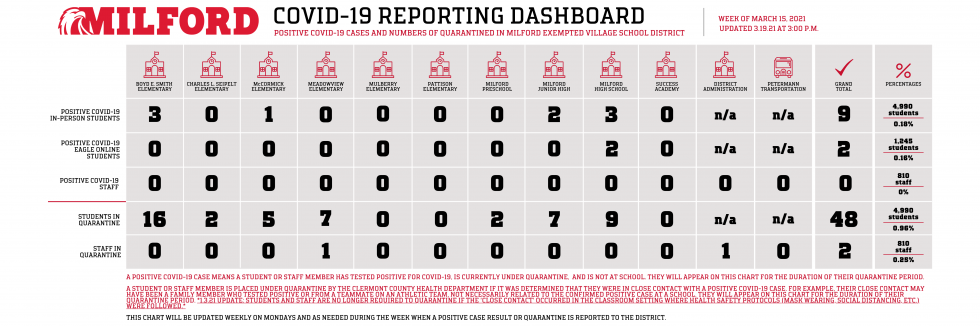
Milford and West Chester, Ohio – Two Ohio school districts with some of the highest cumulative case rates for COVID-19 say as they remained in-person, their safety protocols only got better.
Milford Exempted Village School District in Clermont County has remained in-person since the fall, and has had to close twice due to staff absences.
“We simply had too many staff out sick or quarantined and couldn’t find the subs,” Wendy Planicka, director of communications and public relations for the district, told the OCJ. “We have shut down grade levels at a few of our elementary buildings as well, but not an entire elementary building.”
The school district, like many in the state, provides weekly counts of COVID-19 cases on their website, along with cumulative district-wide data.
Since Aug. 1, the district has reported 649 total cases in their district of 6,235 students and 810 staff members.
Currently 4,990 students are enrolled in-person, with 1,245 students enrolled in the district’s virtual program, Eagle Online.
Planicka said community spread has been the “number one cause of our cases,” followed by spread through athletics or non-school sponsored activities such as family parties.
“There have been two or three cases where we believe spread happened in an athletic setting — for example when football was in season last fall, at one point almost the entire football team was quarantined due to possible spread,” Planicka said.
The school implemented protocols that require an investigation into every positive case, including contact tracing in partnership with Clermont County Public Health and a minimum 10-day quarantine period for students and staff who test positive.
In schools, a mask requirement is in place, and custodians are to disinfect desk areas every evening, along with using an electrostatic sprayer “at least every 30 days” according to Milford’s protocol list.
Milford’s reopening plan was developed to make the return to school as safe as possible, but not to return the school to exactly as it was, according to the plan itself.
“School will not look the same as it did prior to March 2020,” the plan stated. “These changes may be temporary or they may be permanent. Time will tell.”
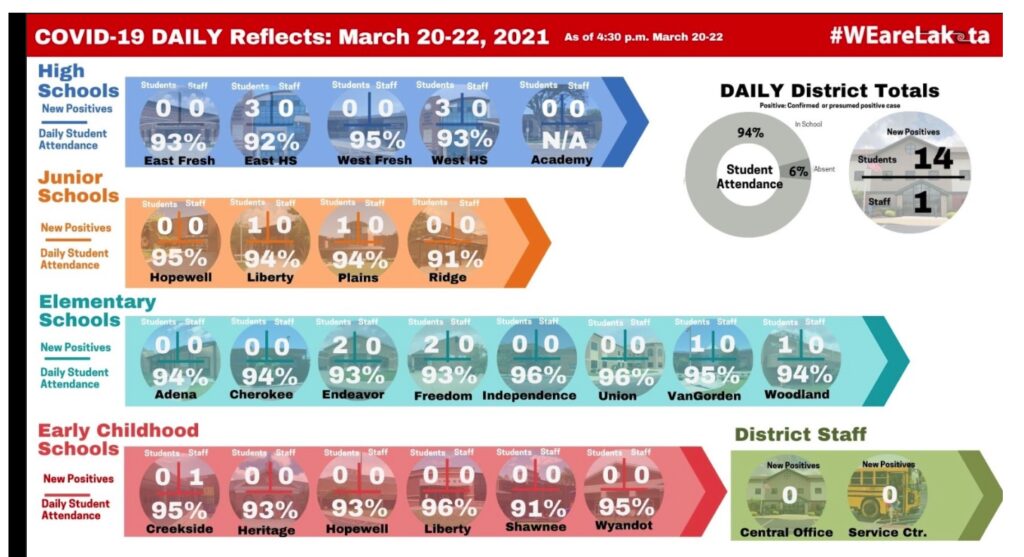
Butler County’s Lakota Local Schools had the highest number of cases since the pandemic counts began, with more than 700 total student cases, according to state data. The school is also home to 14,000 students, having reopened to in-person learning on August 17.
“Since then, our students have had the opportunity to attend school all day, every day,” said Betsy Fuller, community relations director for the district.
There is a virtual learning option at Lakota, being utilized by 3,000 students, according to Fuller.
In the five months that made up their first semester, the school reported 5,172 students in quarantine. The worst month for positive cases in students was December, with 221 of the 468 reported in that semester happening then.
“We traced many of the positive cases to holiday gatherings and celebrations happening outside of school between Halloween and Thanksgiving,” Fuller said. “It is also important to note that very few cases, if any, could actually be linked back to classroom spread.”
The district had guidelines in place as soon as it reopened, including requiring face coverings for all K-12 students, desk cleanings between classes, assigned seating at lunch, and block scheduling to avoid frequent class changes.
In the three months of the second semester so far, the district has reported 345 positive cases, but a 93% student attendance rate.
In February, the state implemented a vaccination program specifically for teachers and school personnel, making returning to school or already conducting in-person instruction a pre-requisite to districts receipt of vaccination doses.
The battle on abortion in Ohio will only be stopped by the U.S. Supreme Court or a change in the U.S. Constitution, according to reproductive law experts and those once again pushing for abortion bans.
Two state legislators have introduced a bill making abortion procedures a felony, which marks the second time in as many years that a bill was introduced hoping for the overturning of Roe v. Wade, the national Supreme Court decision that said abortion was legal nationwide.
A physician accused of “causing or inducing an abortion” would face an official charge of “criminal abortion,” which would be a fourth-degree felony under the new Senate Bill, introduced recently in the Ohio Senate.
If signed into law, the bill would not take into effect until either the U.S. Supreme Court overturns the 1973 decision in Roe. V. Wade, which legalized abortion nationwide, or an amendment to the U.S. Constitution “upholds Ohio’s authority under the federal system to prohibit abortion,” according to a statement from bill cosponsor state Sen. Kristina Roegner’s office.
“I believe that when the U.S. Supreme Court considers a challenge to Roe, they will realize that the original decision from 1973 was seriously flawed, and return the authority regarding abortion to the states,” Roegner said in the statement.
Nearly a year ago to the day, former state Rep. John Becker introduced similar legislation, which would have barred state funds from being disbursed for abortion-related services and created a first-degree felony charge of “abortion manslaughter.”
Becker’s bill never received a hearing, and therefore never moved in the 133rdGeneral Assembly. Currently, abortions are legal in Ohio up to 22 weeks gestation.
Both bills have an exception in the event that “the abortion was necessary to prevent the death of the pregnant woman,” according to language in the current bill.
Ohio is one of a few states trying to pass anti-abortion laws and create a review of Roe v. Wade.
The abortion fight in the state has been going on since Roe v. Wade was decided, but a law professor who also works on abortion challenges says the last few years have been more active than most.
“I think there’s almost nothing that’s beyond the pale right now,” said Professor Jessie Hill of Case Western Reserve University.
Hill is also cooperating attorney for the ACLU, which has five lawsuits against state abortion measures going on simultaneously, including one filed this weekchallenging a law on burial and cremation after surgical abortions. Since Hill returned to Ohio in 2001, she’s only seen efforts to regulate abortion ramp up year after year.
“All of a sudden these bills started passing, and in the last few years they’ve been more and more extreme,” Hill said, adding that gerrymandering creating a Republican-leaning legislature contributed to the increase in anti-abortion legislation.
Anti-abortion groups are lining up to support the bill, with lobby group Ohio Right to Life calling the legislation “powerful and life-affirming.”
“For the first time since abortion was legalized, we have a pro-life majority on the (U.S.) Supreme Court,” said Mike Gonidakis, president of Ohio Right to Life. “Roe v. Wade hangs by a thread. Ohio must be prepared for what comes next.”
Planned Parenthood’s Ohio chapter said the newest bill restricts access to care rather than making lives better.
“S.B. 123 is the latest egregious attack on abortion access from leaders in the Ohio General Assembly who are only focused on eliminating legal access to abortion, to the neglect of everything else – including the pandemic.”
Hill sees a constitutional amendment as a long shot, with a requirement of support from 75% of states in order to make that happen.
Targeting a U.S. Supreme Court decision is a bigger possibility, and even if the high court decides not to overturn the decision as a whole, Hill says cutting back the protections included in Roe v. Wade is something not often considered as the debate continues.
“I think it’s an under-appreciated possibility that the court is not really interested in overturning Roe v. Wade, but that they would reduce it to almost nothing,” Hill said.
The new Ohio bill will now be assigned to a House committee for hearings and consideration.
President Joe Biden is directing states to make all adults eligible for the COVID-19 vaccine by May 1, and Ohio Gov. Mike DeWine said over the weekend the state is on track to do thator better.
Biden’s COVID-19 advisers are projecting that enough Americans in priority groups will be able to access the vaccine by the end of April to allow for the lifting of restrictions on who can access the vaccine.
Alaska on Tuesday became the first state to open eligibility to anyone age 16 or older.
The announcement came Thursday on the one-year anniversary of the World Health Organization declaring the COVID-19 outbreak to be a pandemic.
Earlier on Thursday, Biden signed into law a massive pandemic stimulus bill that includes $20 billion to boost vaccination efforts across the country.
He also announced Wednesday that his administration secured another 100 million of the one-dose Johnson & Johnson vaccine, after helping to broker a deal in which Johnson & Johnson will team up with drugmaker Merck to produce doses faster.
More than 81 million vaccines have been administered since Biden took office in January. But state officials seeking to get those shots into arms have been hamstrung by too few doses, antiquated technology for coordinating appointments, and the challenge of securing enough manpower and other resources to meet the demand for vaccinations.
The administration has launched federally run vaccination sites across the country, and will more than double the number of federal mass vaccination centers. More than 4,000 active duty troops will deploy to support those vaccination efforts.
The Biden administration also will expand who is qualified to administer shots, adding dentists, advanced and intermediate emergency medical technicians, midwives, optometrists, paramedics, physician assistants, podiatrists, respiratory therapists, and veterinarians.
The Department of Health and Human Services will launch a new website for individuals to check if they are eligible to volunteer to administer shots.
Biden also will seek to make it easier for Americans to find a vaccination appointment, announcing plans to launch a federal website by May 1 that will show nearby locations that have vaccines, as well as a 1-800 number for those who lack internet access.
The administration also says it will deploy technology teams to states that need assistance in improving the websites they’re using to schedule vaccinations.