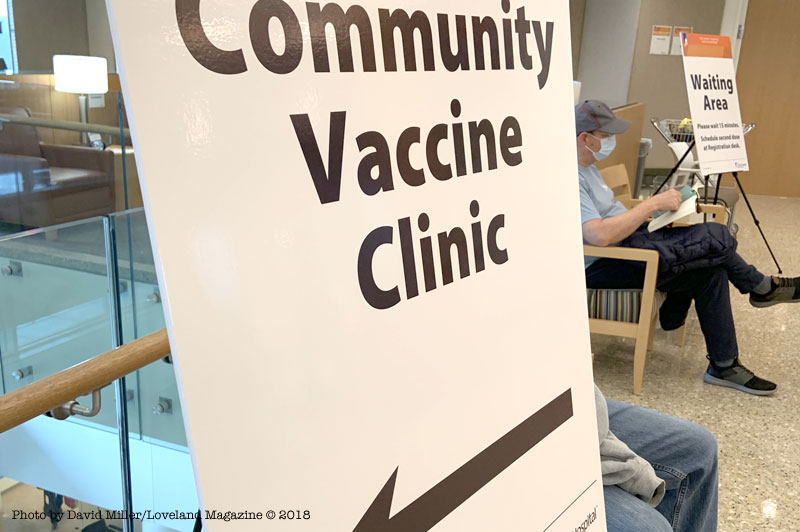
The Ohio Department of Health recontoured its COVID-19 vaccine lottery program, requiring inoculated Ohioans to register for entry in the $1 million sweepstakes instead of being automatically entered by virtue of voter registration and vaccination.
The change is likely to whittle down the number of entrants, thus increasing the odds of winning one of five drawings starting the week of May 24. Health officials said Monday they made the changes to enable a vaccination verification system.
ODH Director Stephanie McCloud, speaking to reporters, declined to quantify exactly how much she hopes or expects the lottery will drive up demand for vaccinations.
“It is not a numeric goal,” she said. “As I mentioned earlier, we are already seeing the success of this program. It is to create awareness, to make sure that those individuals who may not fully understand may now have an interest in asking the questions they may have put off asking about the vaccine.”
Ohioans’ demand for vaccination has unmistakably plummeted. On March 31, more than 107,000 Ohioans received a vaccine dose against COVID-19. On April 30, fewer than 24,000 did, according to an analysis of state health department data.
All told, fewer than 43% of Ohioans have started the vaccination process, compared to the national rate of 47%.
On Monday, he noted a modest increase in vaccine uptake May 14 as 25,000 Ohioans got their first shots, compared to about 13,000 per day on average over the preceding week. He cited this as early evidence of success of the lottery in incentivizing vaccination.
A health department spokeswoman declined a request for vaccine data among children aged 12-15.
As further evidence, DeWine said uptake among adults aged 30-74 increased slightly last week after two weeks of decline in the cohort.
Lottery details
At the briefing Monday, officials with the state lottery and state health department provided further details about the lotteries.
Alongside the $1 million drawings, vaccinated Ohioans aged 12-17 can enter to win one of five full-ride scholarships (including room, board, tuition and books) to any Ohio state college or university.
Ohioans can enter the lottery pool by visiting www.ohiovaxamillion.com or by calling 1-833-427-5634. Entrances will be carried over through all five drawings. State officials say they will remove all duplicate entries and verify vaccination records for all winners.
To be eligible, a winner must be a U.S. citizen and Ohio resident; not be incarcerated for a felony conviction; not be an employee of ODH, the governor, or the state lottery; not be both a blood relative or spouse and a household member of an employee of ODH, the governor or the lottery; and must have received at least the first dose of a Pfizer-BioNTech, Moderna or Johnson & Johnson COVID-19 vaccine.
ODH is using federal stimulus funds to pay out on winnings. The first winners will be announced at 7:29 p.m. May 26. Subsequent announcements are set to occur each of the next four Wednesdays.
The former Clermont County prosecutor is asking for a refund after a former state legislator asked him to investigate the Ohio governor for terrorism.
Ohio Attorney General Dave Yost told the 12th District Court of Appeals that he, too, thinks former state Rep. John Becker should pay “reasonable attorney fees” after filing an affidavit asking for seven felonies and three misdemeanors to be leveled against Gov. Mike DeWine.
Yost wrote in a brief to the court that an alternative to the approximately $4,000 reimbursement from Becker could be to “order Becker to spend a day observing criminal trials in open court, so that he can better understand the gravity of the matters for which prosecutorial and judicial resources must be preserved.”
Court documents say Becker, who left the legislature due to term limits, filed a “private citizen affidavit” last September, accusing DeWine of engaging in a pattern of corrupt activity, terrorism, inducing panic, making a terroristic threat, complicity and conspiracy. He also alleged that DeWine had committed bribery, coercion, interference with civil rights and “patient abuse or neglect.”
All of these charges were leveled against the governor “for his handling of the ongoing COVID-19 pandemic throughout the state of Ohio, but more specifically, within Clermont County,” according to court documents.
The case was referred to then-county prosecutor D. Vincent Faris because of the felony charges. After reviewing the affidavit that same day, Faris told the county clerk “I…do not find a basis for the filing of a complaint pursuant to this private citizen’s affidavit.”
Two days later, Becker’s attorney asked to see the records related to the investigation Faris had done, and after receiving all the documents the prosecutor’s office said they had, asked the court to compel Faris to “act in accordance with his clear legal duty.”
The “extremely short time frame” of Faris’ investigation and lack of investigatory records, Becker said, proved the prosecutor “did not conduct an ‘actual,’ ‘meaningful’ and ‘legitimate’ investigation into his allegations” against the governor.
Faris argued to the court that several of Becker’s allegations were “so vague” that they made further investigation “futile.”
The appeals court found that Faris had conducted an investigation, and that the time of an investigation isn’t set in Ohio Revised Code, adding that the time involved depends on the type of allegations made.
“(Ohio Revised Code) requires the prosecutor to conduct an ‘investigation,’ not an ‘investigation that takes longer than five hours and results in the production of voluminous investigatory records’ as Becker suggests,” the court wrote in their decision.
The court ruled that Faris is allowed to hold a hearing to impose “sanctions” on Becker, saying Becker’s conduct in the case “goes beyond a mere disagreement with the arguments presented by an opposing party.”
“Considering the record in this case, it is clear that the only ‘investigation’ that would satisfy Becker is one that would result in Prosecutor Faris issuing a warrant for Governor DeWine’s arrest and subsequent prosecution,” the court wrote. “But Prosecutor Faris is not required to bend the law in order to satisfy one man’s efforts to grandstand and garner media attention for himself to score political points with his (now former) constituents.”
A date for the hearing on sanctions against Becker was not specified in the court’s decisions.
Citing fears that a $300-a-week federal unemployment supplement was keeping Ohioans from returning to the workforce, Gov. Mike DeWine on Thursday announced that he would end it.
However, the governor was unable to cite any data showing that businesses’ trouble finding workers was due to the supplement and not other dislocations caused by the coronavirus pandemic.
Ohio will join 13 other Republican-led states in cutting off the payments to hundreds of thousands of Americans even though the benefit is shouldered entirely by the federal government. DeWine said he will wait until June 26 to terminate the supplement so those who haven’t already been vaccinated can do so before re-entering the workforce.
The governor said he was undertaking the move because Ohio unemployment is near pre-pandemic levels and employers around the state are complaining that they can’t find needed workers. He said that problem is made worse because the extra $300 a week made some Ohioans calculate that it’s a better deal to just stay home.
“The federal assistance is in some cases certainly discouraging people from going back,” DeWine said.
That theme has been echoed by other Republican governors as they justify ending the benefit. DeWine’s move also was applauded by the National Federation of Independent Business, which has received hefty funding from the billionaire Koch family and in the past has fought laws requiring paid sick leave.
“Ohio’s economy is growing and growing faster than our neighboring states. We need a robust workforce to maintain our positive trajectory,” Roger Geiger, NFIB’s Ohio executive director, said in a statement. “The time for additional unemployment payments is over. We appreciate Ohio Gov. Mike DeWine for recognizing that now is the time to strongly encourage everyone to get back to work.”
But some independent experts have said the issue is more complex. They believe problems with child and adult care, ongoing disruptions in certain industries and other dislocations caused by the pandemic are keeping many on unemployment.
Republican governors are “misguided in their thinking about why people aren’t returning to work,” Rebecca Dixon, executive director of the National Employment Law Project, told the Washington Post last week. “There are all of these ways our care infrastructure is not back up.”
The argument that increased benefits are keeping people out of the workforce also doesn’t seem to be supported by the most recent employment numbers, Paul Krugman, a Nobel Prize-winning economist and self-described liberal, wrote Monday in the New York Times.
One would expect a $300-a-week supplement to most impact the behavior of low-wage workers. But Krugman pointed out that the April jobs report shows low-wage jobs like leisure and hospitality growing robustly while better-paid work in professional and business services actually fell.
Asked whether he had data showing that federal supplements are keeping large numbers of Ohioans on the unemployment rolls, DeWine said, “If you look at why jobs are not being filled, I’m sure it’s multiple reasons. But whenever you go in and the market is distorted in that sense, you have certain consequences when you do that and should do that when you have a crisis.
“And we’re coming out of the crisis economically… This couldn’t go on forever. The federal government was going to end this — unless they change their mind — they were going to end this in September. We’re moving it up a little bit. We think that’s the appropriate thing.”
Dayton Mayor Nan Whaley, who is seeking the Democratic nomination for governor, released a statement saying she emphatically does not believe that ending the federal benefit early is the appropriate thing.
“As we come out of this crisis, the problem facing Ohioans is the same one we had before coronavirus: wages are too low,” she said. “One good job should be enough, and for too many of our friends and neighbors, it isn’t. Mike DeWine is turning down money that could help Ohioans because he’s worried about politics. When I’m governor, I’ll be worried about paychecks.”
In 1991, Sheridan High School freshman Nathan DeRolph thought Ohio’s education funding formula would change before he entered college.
He and his parents had filed a lawsuit against the state that would eventually make it to the Ohio Supreme Court, fighting against the overreliance on property taxes built into public school funding.
“I kind of naively, I think, thought by the time I’m a senior in high school, this will all be wrapped up and hopefully there will be a new funding plan in place, and generations after me won’t have to deal with the same challenges,” DeRolph said.
Three decades later, he just watched his daughter graduate from high school, under the same funding system his family fought against, through multiple supreme court decisions.
The Ohio legislature still has not overhauled the system, as ordered by the state’s high court decisions.
“Over 30 years, that’s 3 million kids that have been through a broken system, and we can’t afford to have another 30 years of the same broken system,” DeRolph said.
He and his father, Dale, told a virtual forum hosted by the League of Women Voter’s and the Children’s Defense Fund Ohio that they see hope in the new push to include a funding formula overhaul in the latest biennial budget.
The overhaul being considered for the new budget was already set up after years of work by now-Speaker Bob Cupp and former state Rep. John Patterson.
The overhaul, which started this year as a separate piece of legislation carried over from the last General Assembly, would lessen the weight of property taxes on the funding formula, basing 40% of the formula’s funding on the income levels of the district.
In the previous budget, the present school formula only took on a small part of district funding, as 82% of Ohio’s districts weren’t a part of the formula found to be unconstitutional.
“What that means is districts were either not getting enough money that the formula says they should have gotten, or they’re getting more money than the formula says they should receive,” said Tom Hosler, superintendent of Perrysburg Schools, and a member of a workgroup that has spent years searching for a solution to the education system.
Hosler said the $6,020 per student that is the current base cost — the most basic amount it takes to educate a child — is a result of “patchworking” and “fixing things on the fly” rather than a comprehensive dissection of Ohio districts.
“Why $6,020? We don’t know,” Hosler said. “We don’t know how it got there and we…have no idea how those dollars are to be spent or allocated, or how they came to us. It’s just the number.”
The need for a new funding model also comes from continually increasing education costs, and the inability for the current education model in the state to keep up, according to Steve Dyer, director of government relations for the Ohio Education Association.
That includes the ratio of local to state share of education within the funding model.
“2020 was the highest local share of education costs we’ve had since 1985,” Dyer said during the forum.
Comparing the amount of non-human services budget being allocated for primary and secondary education, data cited by Dyer showed the state is committing 6% less than was distributed in 1975.
When it comes to privatization of education, or the inclusion of private schools and charter schools in the public school funding via the EdChoice voucher program, Dyer said districts get about $1.6 billion less than they did before the voucher programs were paid for through district budgets.
That $1.6 billion matches up with the increase in property taxes the state has seen since 2003, when the Ohio Supreme Court issued its final ruling on the DeRolph.
“It’s not rocket science,” Dyer said. “If the state isn’t picking it up, local taxpayers are, or our kids are suffering with fewer resources or fewer opportunities.”
The state budget is currently being considered by the Ohio Senate, and a final version is due by July.
Ohio’s redistricting process is in a state of turmoil, with a delay in Census data leading the state to worry about there not being enough time to adequately draw new legislative maps.
Republicans and Democrats have both presented plans for how Ohio can deal with these delays. In essence, legislative leaders from both parties want to push back the deadline for completing the new maps that will be in place starting in the 2022 elections.
But the sides propose two very different ways to achieve that goal.
The next few days will be critical as Ohio lawmakers determine the preferred way of moving forward. The results from this week could have lasting implications for Ohio’s legislative government over the coming decade.
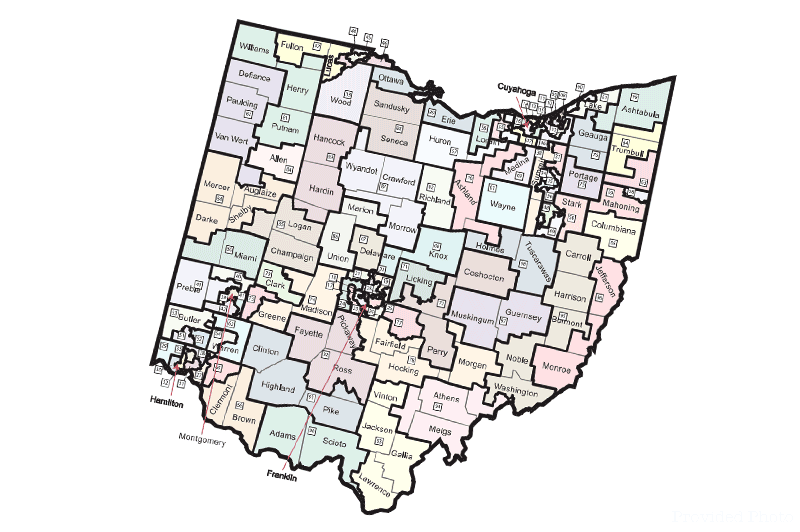
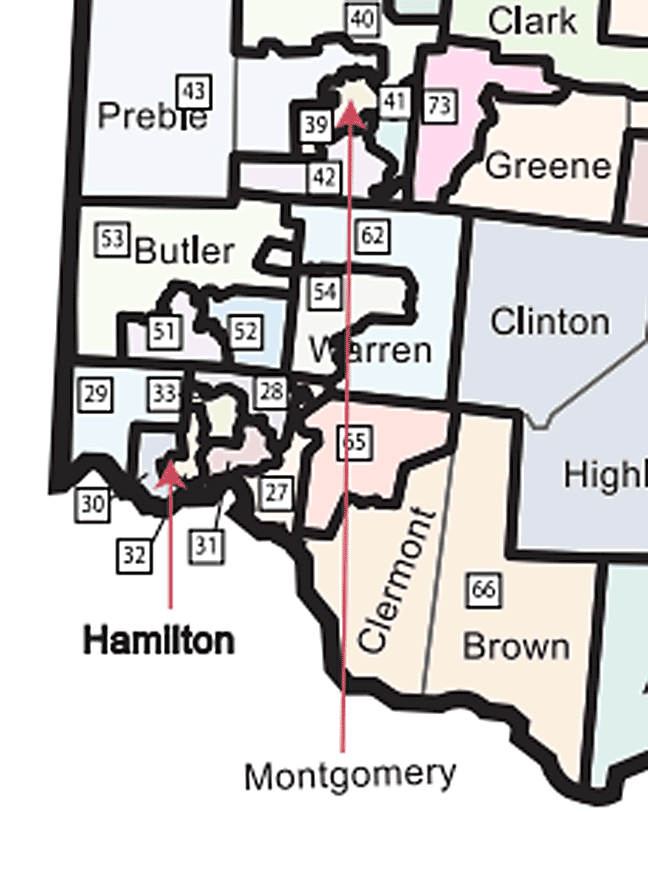
The current district map for the Ohio House of Representatives.
Not how Ohio voters drew it up
Each decade, Ohio redraws its federal legislative seats in the U.S. House of Representatives and state legislative seats in both the Ohio Senate and Ohio House of Representatives.
This is done to reflect changes in population and coincides with the U.S. Census, which is also conducted every 10 years.
After the last redistricting effort a decade ago, Ohio voters chose to reform the process for this year and the decades to follow. In short, voters approved a new system which puts a greater emphasis on transparency and bipartisanship.
These new plans — for federal and state maps — were approved via constitutional amendments on the 2018 and 2015 ballots, respectively.
These plans set specific deadlines to meet during the redistricting process.
Ohio voters could not have anticipated a global pandemic would occur at the same time the U.S. Census Bureau conducted its decennial count of American residents. The pandemic not only made the count more difficult, but has led to delays in processing and distributing census data used by officials to draw new legislative districts.
The Census Bureau announced this redistricting data will be provided to states by Sept. 30.
That’s a major problem — Ohio would therefore miss its redistricting deadlines:
This flow chart shows the new process for redrawing Statehouse districts. Circled is the deadline in question due to the delay in U.S. Census data.
This flow chart shows the new process for redrawing congressional districts in Ohio. Circled is the deadline in question due to the U.S. Census data delay.
Plan A involved a federal lawsuit from Attorney General Dave Yost seeking to get the redistricting data released earlier. The case was quickly dismissed. Now the two parties are offering some ideas for Plan B.
Back to the drawing board
If the government won’t release data early enough to match Ohio’s deadlines, officials here propose shifting the deadlines back to account for the late data.
This is not an easy fix. The 2021 deadlines were approved by voters and are thus embedded in the Ohio Constitution.
Senate President Matt Huffman, R-Lima, suggests the state get approval from voters to move back the deadlines as part of a one-time fix for this unique circumstance.
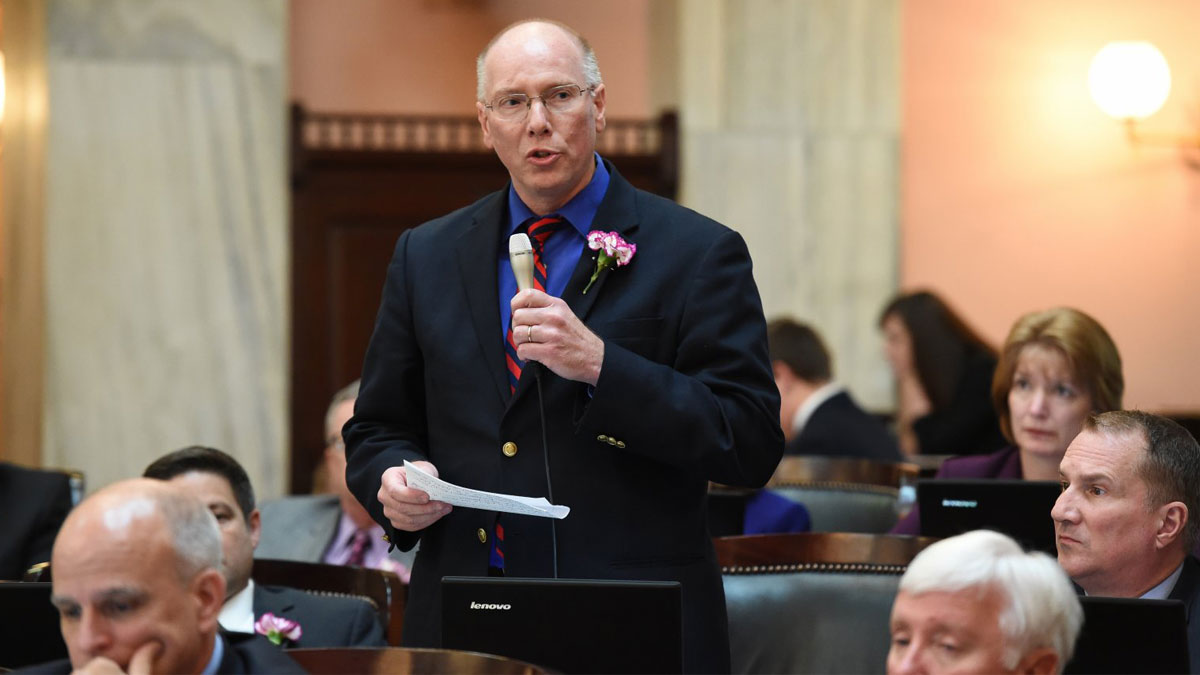
State Sen. Matt Huffman, R-Lima. Screenshot courtesy the Ohio Channel.
The next opportunity to get a constitutional amendment before Ohio voters would be the Aug. 3 special election.
Both chambers of the Ohio General Assembly (House and Senate) would have to pass a joint resolution to place the constitutional amendment on the August ballot. A three-fifths majority is required in each chamber for passage.
The deadline for filing this joint resolution with the Ohio Secretary of State’s Office is 90 days before the August election — that’s this Wednesday, May 5.
It’s possible, but the Republican leadership would need to work quickly. As of Monday morning a joint resolution has not yet been formally introduced.
An amendment requires a majority statewide vote to pass.
House Democratic Minority Leader Emilia Strong Sykes. Source: Ohio General Assembly.
Democratic leaders in the General Assembly say there are better options for handling the census delays than a hurried constitutional amendment attempt.
House Minority Leader Emilia Strong Sykes, D-Akron, and Senate Minority Leader Kenny Yuko, D-Richmond Heights, outlined their party’s own take on Friday for how to move forward.
“Constitutional amendments should be our final options,” Sykes argued, “not our first.”
The Democrats believe the best option is to ask the Ohio Supreme Court for an extension of the deadlines as other states, including Michigan, have done.
Senate Minority Leader Kenny Yuko is pictured at the Ohio Statehouse in 2018. Source: The Ohio General Assembly.
“I think (the Supreme Court) could understand that the people have spoken loud and clear, twice already, asking us to put an end to gerrymandering,” Yuko said. “What we’re proposing will do just that.”
While both plans call for extending the redistricting deadlines, neither party is suggesting to push back the 2022 primary election day to keep the full timeline intact.
All On The Line Ohio, a left-leaning organization which advocates for a fair mapmaking process, is calling for the primary election to get pushed back by a few weeks.
Sykes and Yuko said the Democrats would be introducing a plan to ensure the public has an adequate chance to provide input during what could be a truncated redistricting timeline.
DISTRICT MAPS
Every 10 years, following the decennial census, Ohio General Assembly and Congressional districts are redrawn to reflect changes in the state’s population in two parallel, but separate processes. The goal of each is to preserve the important one person-one vote principle – that all citizens are equally represented at the Statehouse and in the United States Capitol.
These maps were drawn based on data from the 2010 U.S. Census and are in effect from 2012-2022.
The Secretary of State’s office provides, for reference purposes, historical district maps dating back to 1972. Click here to request a ZIP file of these maps(opens in a new window). The file will be e-mailed to you. For up-to-date county district information, contact your county Board of Elections.
Organizers announced plans to delay a rally planned for last Saturday to give a special honor to a police officer who recently shot and killed a Black 16-year-old girl.
Chris Dorr, executive director of Ohio Gun Owners, obtained a permit for a “Back the Blue Rally” at the state Capitol on Saturday, claiming 400 people would attend.
According to Dorr, speaking in a Facebook video, Ohio Gun Owners requested barrier fencing near High Street to stave off “antifa, disruptors, [and] agents provocateur.”
He alleged that the Capitol Square Review and Advisory Board, which issues permits for political rallies at the Statehouse, refused to allow the fencing. In an interview, he said he canceled the event because the lack of fencing posed a threat to the safety of demonstrators.
Ohio law allows the open carry of firearms. Through the pandemic, political rallies have been rife with heavily armed cohorts. In January, one rally at the Ohio statehouse devolved into fistfights between Black Lives Matter activists and the Proud Boys, an extreme right-wing political group with a history of fistfights with liberal activists and the subject of a federal prosecution for their members’ prominent roles in the Jan. 6 insurrection in Washington D.C.
“We’re showing up to back the brothers in blue, our law enforcement, people like [Columbus Police officer] Nicholas Reardon who did what they did,” Dorr said.
“We have to allow antifa and Black Lives Matter and some of these violent protesters into our event? And they have equal right to stand there and say what they want to and antagonize our members and our supporters and all the people there to back the blue?”
Reardon, a white officer, arrived in a Columbus driveway April 20 after dispatchers received a call about someone being physically threatened, according to the Associated Press. Reardon approached a scene involving Ma’Khia Bryant, a Black teenager, swinging a knife at another girl or woman who fell backward. She then lunged at another woman when Reardon fired four shots, killing the teenager. A state investigation is ongoing.
Most Ohio’s colleges and universities say they will not require students to receive the COVID-19 vaccine to return to campus next fall.
All the largest institutions in the state — Ohio State University, the University of Cincinnati, Ohio University and others — said via spokespeople they have no plans to require students and employees to take the vaccine.
Just two Ohio universities to date have announced plans to require the vaccine to some extent: Cleveland State University and Kenyon College, a small liberal arts school in Knox County.
Six institutions — Case Western Reserve University, Denison University, University of Dayton, Xavier University, Bowling Green State University and Wright State University — indicated they’re still weighing it over.
Colleges already require students to show proof of a host of vaccines. For instance, OSU requires students take the Hepatitis B, Polio, Varicella and three other immunizations before enrolling.
The Food and Drug Administration granted an emergency use authorization for the three available COVID-19 vaccines as opposed to full approval, given the dire nature of the pandemic.
While the COVID-19 vaccines underwent clinical trials with tens of thousands of participants and are under ongoing federal scrutiny, the emergency-use status muddles calculations on requirements. Similarly, vaccine requirements and proof of vaccination has fallen into a polarized political morass that universities may seek to avoid.
The Association of Independent Colleges and Universities of Ohio, which represents dozens of smaller colleges, declined an interview request.
Here’s how schools responded when asked what their plans are.
Yes
CSU cited the increasing availability of vaccines in its decision. It will require vaccinations for all students living on campus.
“We will be doing our best to ensure that every member of our university community is vaccinated,” said university president Harlan Sands. “Now that the vaccine is available to everyone over the age of 16 in Ohio, we’re encouraging our students, faculty and staff to take advantage of the fantastic mass vaccination center at our Wolstein arena or another site that’s convenient.”
In a letter to students, Kenyon College President Sean Decatur said vaccines protect individuals from serious infection and possibly asymptomatic infection and transmission.
“Requests for reasonable accommodations for sincerely held religious beliefs and medical exceptions will be considered on an individual basis, but it is our expectation that an overwhelming majority of students will be vaccinated,” he said.
No
OSU, by far the state’s largest university, said it will not require the vaccine but is encouraging students to take it. UC, Kent State University and Oberlin College made similar statements.
Some schools said they have no plans to require the vaccine “at this time,” possibly leaving the door open in the coming months. These include the University of Toledo and Miami University, in Oxford.
OU spokeswoman Carly Leatherwood says there are no plans for a mandate in Athens.
“With the vaccine being under an Emergency Use Authorization (EUA), most universities and workplaces are not requiring vaccine,” she said. “We are working hard to encourage everyone – students, faculty, and staff to get vaccine as soon as possible.”
Maybe
Some schools are still hashing out a plan.
“We have not as yet set our expectations about vaccinations for students and employees for next year, but continue to strongly encourage students, faculty and staff to be vaccinated,” said Cilla Shindell, a spokeswoman for the University of Dayton.
Xavier hasn’t yet made its decision, said spokesman Doug Ruschman. However, he said the college estimates about 50% of students have already received the vaccine.
BGSU hasn’t yet made its decision, according to chief university health officer Ben Batey.
“As we look toward the future, BGSU continually strives to be as flexible as possible during the pandemic,” he said in a statement. “The university understands that every one of our community members has a different viewpoint on these topics, and BGSU continually strives to be as flexible as possible regarding the pandemic. The university understands that every one of our community members has a different viewpoint on these topics, and BGSU has worked to be supportive of each individual. If BGSU would decide to mandate the vaccine because of high case numbers and recommendations from state public health officials to do so, the university would also have an exemption process for students.”
Wright State, Denison, and Case Western Reserve also said in statements they’re still figuring out their policy.
Communications staff for the University of Akron did not respond to inquiries.
Some county health departments in Ohio are again telling state officials this week not to send them any more coronavirus vaccines. That’s because they haven’t been able to use up the supplies they already have.
It might be part of a national phenomenon. The news organization Axios reported this week on a paper by the Kaiser Family Foundation saying that based on its polling, just over 60% of Americans say they’ll get a vaccine.
“We estimate that across the U.S. as a whole we will likely reach a tipping point on vaccine enthusiasm in the next two to four weeks,” the paper said. “Once this happens, efforts to encourage vaccination will become much harder, presenting a challenge to reaching the levels of herd immunity that are expected to be needed.”
The paper conceded that the percentage of people willing to get a shot has crept up over time, so “61% may be a floor, not a ceiling.”
Even so, it portends a struggle to get to the 70% threshold that epidemiologists say is necessary to achieve “herd immunity,” the point at which the virus starts to find it difficult to find new hosts so it can keep spreading and evolving.
That’s an issue in Ohio.
Everyone 16 and older has been eligible to get a shot since the beginning of the month. But as of Wednesday just 38% of the state’s population had received a first dose of the vaccine and just 28% had completed it.
Further complicating the problem is that a fast-spreading variant that has ravaged Michigan has been spreading into Ohio, affecting the state’s northern counties first.
The presence of that variant and other factors have put the unvaccinated in more peril now than at any other time in the pandemic, Robert M. Wachter, chairman of the department of medicine at the University of California at San Francisco, wrote Monday in a column in the Washington Post.
Because more people — especially the elderly — have been vaccinated, case numbers, hospitalizations and deaths are far down from their winter peaks. But the numbers that health officials are counting now are affecting a smaller slice of the population: those who haven’t been vaccinated, and particularly those who haven’t survived an infection, Wachter wrote.
“The problem is that the aggregate numbers — even if they show down-trending test positivity rates, hospitalizations and deaths — may be masking an important duality,” Wachter wrote. “The situation may be getting enormously better in the growing vaccinated population, while at the same time growing somewhat worse in the unvaccinated group.”
Bruce Vanderhoff, medical director for the Ohio Department of Health, was asked Wednesday about younger Ohioans who might not think they’re particularly at risk if they don’t get vaccinated.
Bruce Vanderhoff, medical director for the Ohio Department of Health
Doctors around the country report more covid hospitalizations and complicationsamong young people, partly as a result of the increasing dominance of the B.1.1.7 variant. Yet just 27% of Ohioans 20 to 29 have received at least a first dose of the vaccine.
Vanderhoff said the risk extends beyond the individual.
“People who don’t get the vaccine are not only putting themselves at risk, they’re putting others at risk as well,” he said. “We’re doing a disservice to the people we care about.”
Gov. Mike DeWine said health officials are doing everything they can think of to make it easier to get a shot, including expanding walk-up vaccination centers, taking shots into neighborhoods and workplaces and offering vaccines to family physicians.
He’s also trying to convince people that they have a responsibility to family and community.
“You can’t be sure everybody you come in contact with has been vaccinated,” DeWine said. “We’re not in this separately. This is not a decision that people make and only they live with the consequences.”
Loveland, Ohio – Ohio took a step closer toward a constitutional school funding model with the passage Wednesday of a two-year operating budget in the Ohio House of Representatives, a sweeping bill that also proposes an across-the-board income tax cut, a broadband internet expansion plan and more spending to aid businesses struggling from the pandemic.
The House passed a two-year, $74.4 billion budget for Fiscal Years 2022 and 2023 by a vote of 70 to 27.
Democrats took issue with certain portions of the budget, but its education funding reforms helped lead a dozen of them to ultimately join the Republican majority in approving the bill.
The budget now heads to the Ohio Senate, which will negotiate its own version over the coming months. Members of both legislative chambers will eventually hash out disagreements before a final version is sent to Gov. Mike DeWine for approval this summer.
“We are investing in Ohio’s priorities and Ohio’s future,” said Rep. Scott Oeslager, R-North Canton, who serves as the House budget chairman as he has for several previous budget cycles.
Oeslager said the ongoing pandemic has presented a wide array of challenges for Ohio, and the ongoing needs associated with the crisis are evident. He complimented House members for crafting a “balanced, responsible and truly meaningful” budget.
This budget does not include any federal spending from the American Rescue Plan. Speaker Bob Cupp, R-Lima, said Ohio has not yet received this relief funding and a forthcoming committee would determine how best to spend it.
Here are budget highlights as approved by the Ohio House of Representatives.
Education funding model overhaul
Amesville Elementary in the Federal Hocking School District. Photo from district website. Lawmakers approved a new education funding model in the House budget passed on Wednesday.
It has been more than 24 years since the DeRolph v. State decision was handed down by the Ohio Supreme Court, which ruled Ohio’s state funding model does not provide an equal opportunity for all students to learn and is therefore unconstitutional.
Lawmakers were tasked with determining a more equitable, constitutional funding model — something they have failed to accomplish in the decades since.
Cupp has led a renewed push to reform the funding system in recent years and said after Wednesday’s vote he was glad this budget achieves that goal.
The House-approved budget includes a nearly $2 billion increase in school funding, with most districts expected to receive more funding over the next six years. (A spreadsheet showing the funding estimates for each individual district in Ohio was published by The Columbus Dispatch.)
The Loveland City School District may receive $941,996 additional State tax dollars according to the Columbus Dispatch.
Cupp said he did not want to speculate on potential disagreements the Senate may have with this funding plan, but hoped there would be more productive conversations between members of the two chambers on this subject.
“We think they will agree that it is a very good plan going forward,” he said.
Detailed Ohio Capital Journal reporting on the education reforms included in this budget is forthcoming.
More spending for COVID-19 relief, and vacating penalties for public health violations
The budget includes relief spending to benefit a variety of Ohio businesses.
Millions of dollars would go toward helping entertainment venues, bars, restaurants and hotels. Additionally, there is a “New Business Relief Grant” program to specifically help those businesses that opened after Jan. 1, 2020.
Republicans also inserted a budget provision that would vacate all public health violations incurred by Ohio businesses since March 2020.
A number of Ohio bars, including several on the island village of Put-In-Bay, were cited in 2020 for violating COVID-19 health orders. The House budget would expunge these violations and repay any fines levied against businesses. Photo from the Ohio Investigative Unit.
Businesses that have faced penalties for violating public health orders, such as not enforcing mask and distancing mandates, would have their violation records expunged. Any disciplinary actions currently in progress would be halted.
The state would be forced to repay any fines levied and reinstate licenses revoked. The Legislative Service Commission (LSC) estimates this would amount to $100,000 in fines repaid to health order offenders.
Cupp defended this provision by saying Ohio businesses failed to abide by public health orders because the virus was an “unknown” phenomenon in 2020.
“The restrictions were new, they were different, and a lot of businesses sort of got caught up in this administrative web. As we work our way out of the pandemic, we think it’s important to take another look at (the violations) and to give them some sort of the benefit of the doubt…,” Cupp said.
Tax cuts
Another main portion of the bill involves income tax cuts and deductions.
There is a 2% personal income tax cut for all earners, which LSC estimates would save taxpayers around $380 million in the coming two years.
“Once more, the wealthy and big businesses will fare far better than working families under this budget,” said Rep. Michael Skindell, D-Lakewood, who unsuccessfully proposed taking out the tax cut and diverting it to other priorities.
Those earning under $40,000 per year would receive virtually no benefit from this tax cut, the study found. Ohioans earning between $40,000-61,000 per year would see their taxes cut by an average of $7 over the course of an entire year.
The top 1% of Ohio earners, those making more than $490,000 per year, would comparatively see their taxes cut by an average of $612 each year.
Skindell said the tax cut shows a “huge disparity and continues the tax shift in this state.”
Separately, the House budget institutes an income tax deduction on capital gains earnings for Ohio-based “venture capital operating companies.” Such investors could deduct all of their earnings from investments in Ohio businesses and 50% of earnings from investments in businesses elsewhere.
LSC estimated this provision may cost the state tens of millions of dollars per year in income tax revenue lost.
Broadband internet expansion
The House budget includes $190 million in funding toward new broadband internet expansion projects. (Photo by Leonardo Fernandez Viloria/Getty Images).
Ohio lawmakers have worked toward a bipartisan effort this year of expanding broadband internet access in the state.
The budget allocates $190 million over the next two years toward grants to pay for new broadband expansion infrastructure projects.
Other pieces of the budget
Here are some other noteworthy provisions from the budget bill:
The governor had proposed changing antiquated language in Ohio law to clearly state all couples can adopt children (LGBTQ couples are legally allowed to in Ohio). The governor suggested changing the phrase “husband and wife” to read “legally married couple,” but Republican lawmakers took out this change to leave the original language in place.
The budget allocates millions of dollars for firefighting equipment and training, along with millions more for a law enforcement training program.
The budget provides $25,000 to Ohio domestic violence groups to give clients travel vouchers, gas cards and ridesharing credits.
Millions of dollars will go toward the Foundation for Appalachian Ohio, as well as money for workforce development around the state and in Appalachian communities.
The budget includes greater investments for maternal/infant health programs.
The budget does not include several major proposals from the governor, including gun safety reforms and a $50 million public relations campaign for Ohio.
They do not possess the power to do this under the U.S. Constitution, the Ohio Constitution, or precedent set by the U.S. Supreme Court, the highest court in the land that some Ohio Republicans seemingly believe they have the power to flout. Again, they do not.
As they’ve spent much of the COVID-19 pandemic wailing ignorantly in misunderstanding about the separation of powers in the Constitution and the checks and balances among government branches, they’ve turned most recently to proposing and passing laws defying these elemental aspects of American civics.
You see, the Ohio Constitution requires the General Assembly to actually pass law to exercise the power of law, not resolution. Laws must be signed by a governor, or a governor’s veto overridden by the legislature, in order to be enacted. This is an intentionally cumbersome process. A resolution requires neither. So simply ignoring the Ohio Constitution relieves them of this constitutional burden. The non-partisan Legislative Services Commission warned Republicans of the unconstitutionality of their proposal, and they ignored the LSC too.
This middle finger in the face of the Ohio Constitution was even shepherded through the Ohio House by current speaker and former Ohio Supreme Court Justice Bob Cupp, who should definitely know better.
Why did they do this? They do have the authority to rewrite law if they so wish. They could rewrite Ohio Revised Code and override the governor’s veto in doing so just as well. But apparently ignoring constitutionality was easier. This middle finger in the face of the Ohio Constitution was even shepherded through the Ohio House by current speaker and former Ohio Supreme Court Justice Bob Cupp, who should definitely know better.
Now comes House Bill 62 that seeks to declare any federal law, executive order, administrative action, or court ruling to be “null, void, and of no effect in this state” if it infringes upon the Second Amendment. This attempt by a state legislature to overrule federal law and courts is called nullification, and as a concept, it has never once been upheld in federal court in American history. Its most ignominious test came when the state of South Carolina attempted to nullify federal tariff law in 1832-33, led by slaver and slavery advocate John C. Calhoun.
Courts at the state and federal level, including the U.S. Supreme Court, repeatedly have declared that under the Supremacy Clause of the U.S. Constitution, federal law is superior to state law, and that under Article III of the U.S. Constitution, the federal judiciary has the final power to interpret the Constitution. Ohio even lost its own fight over nullification in a battle against the Bank of the United States in 1824.
But Ohio Statehouse Republicans’ self-contradictory views of home rule and local control appear to be based exclusively on their own political whims and no discernable standards or principles for the exercise of self-government.
Power for me and not for thee appears to be Statehouse Republicans’ only real governmental operating ethos.
Power for me and not for thee appears to be Statehouse Republicans’ only real governmental operating ethos.
While the self-contradictions on the roles of levels of government show a political agenda with no consistent civic principles behind it, the real failure here is to take any sort of thoughtful long-view. I can only imagine their caterwauling if Statehouse Republicans were the victims of this kind of power grab instead of the perpetrators. I don’t even have to imagine it. Former Ohio Gov. John Kasich ate Statehouse Republicans’ lunch by using executive power to expand Medicaid in Ohio under the Affordable Care Act against their wishes.
But let’s say Ohio Republicans don’t manage a permanent supermajority in the Statehouse, and that some day, perhaps decades from now, a Democratic General Assembly declares itself above the authority of the courts to decide issues of religious freedom, or abortion rights, or LGBTQ rights, or gun rights. Do you think Ohio Republicans would humbly accept the consequences of the path they’ve endorsed and chosen, or do you think they’d play the shameless hypocrite and contradict themselves entirely? I know my bet.
It’s hard to take people seriously who do not take themselves nor the basics of American civics seriously.
Due to extreme gerrymandering and the extremist and corrupt politics it breeds, however, Ohioans will be forced to continue to endure for some time longer a General Assembly that sees a radical faction of one political party and high-dollar donor special interests as their only true constituencies.
The rest of us and our pesky constitutions, judicial precedents, rule of law, checks and balances, and separation of powers be damned.