Tag: COVID-19

  • FDA Authorizes Additional Vaccine Dose for Certain Immunocompromised Individuals

    FDA Authorizes Additional Vaccine Dose for Certain Immunocompromised Individuals

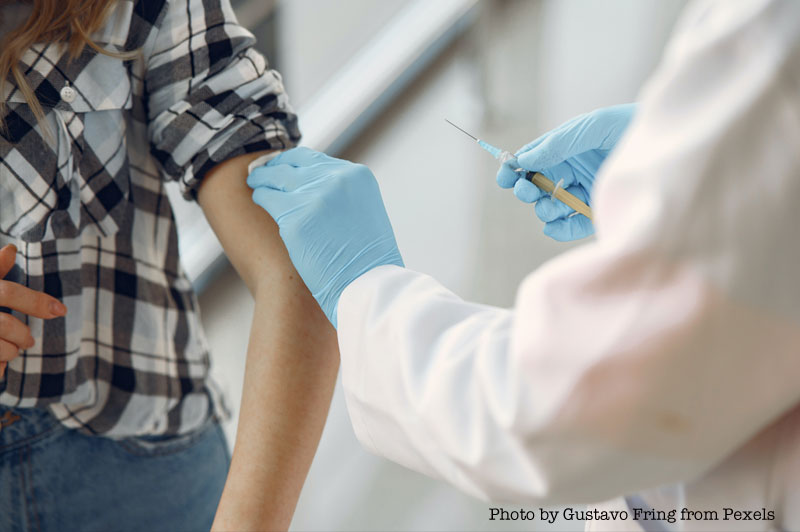
    Yesterday, the U.S. Food and Drug Administration amended the emergency use authorizations (EUAs) for both the Pfizer-BioNTech COVID-19 Vaccine and the Moderna COVID-19 Vaccine to allow for the use of an additional dose in certain immunocompromised individuals, specifically, solid organ transplant recipients or those who are diagnosed with conditions that are considered to have an equivalent level of immunocompromise. The Centers for Disease Control and Prevention’s Advisory Committee on Immunization Practices is scheduled to meet Friday to discuss further clinical recommendations regarding immunocompromised individuals. Today’s action does not apply to people who are not immunocompromised.

    Read more from the announcement…

    “The country has entered yet another wave of the COVID-19 pandemic, and the FDA is especially cognizant that immunocompromised people are particularly at risk for severe disease. After a thorough review of the available data, the FDA determined that this small, vulnerable group may benefit from a third dose of the Pfizer-BioNTech or Moderna Vaccines,” said Acting FDA Commissioner Janet Woodcock, M.D. “Today’s action allows doctors to boost immunity in certain immunocompromised individuals who need extra protection from COVID-19. As we’ve previously stated, other individuals who are fully vaccinated are adequately protected and do not need an additional dose of COVID-19 vaccine at this time. The FDA is actively engaged in a science-based, rigorous process with our federal partners to consider whether an additional dose may be needed in the future.”

    People who are immunocompromised in a manner similar to those who have undergone solid organ transplantation have a reduced ability to fight infections and other diseases, and they are especially vulnerable to infections, including COVID-19. The FDA evaluated information on the use of a third dose of the Pfizer-BioNTech or Moderna Vaccines in these individuals and determined that the administration of third vaccine doses may increase protection in this population. These patients should be counseled to maintain physical precautions to help prevent COVID-19. In addition, close contacts of immunocompromised persons should get vaccinated, as appropriate for their health status, to provide increased protection to their loved ones.

    It is recommended that immunocompromised individuals discuss monoclonal antibody treatment options with their health care provider should they contract or be exposed to COVID-19. The FDA has authorized monoclonal antibody treatments for emergency use during this public health emergency for adults and pediatric patients (ages 12 and older weighing at least 40 kilograms or about 88 pounds) with positive results of direct SARS-CoV-2 viral testing, and who are at high risk for progressing to severe COVID-19 and/or hospitalization. One authorized product includes use for preventative (prophylaxis) treatment after being exposed to SARS-CoV-2; however, this product is not a substitute for vaccination. 

    The Pfizer-BioNTech COVID-19 Vaccine is currently authorized for emergency use in individuals ages 12 and older, and the Moderna COVID-19 Vaccine is authorized for emergency use in individuals ages 18 and older. Both vaccines are administered as a series of two shots: the Pfizer-BioNTech COVID-19 Vaccine is administered three weeks apart, and the Moderna COVID-19 Vaccine is administered one month apart. The authorizations for these vaccines have been amended to allow for an additional, or third, dose to be administered at least 28 days following the two-dose regimen of the same vaccine to individuals 18 years of age or older (ages 12 or older for Pfizer-BioNTech) who have undergone solid organ transplantation, or who are diagnosed with conditions that are considered to have an equivalent level of immunocompromise.

    The EUA amendments for the Pfizer-BioNTech COVID-19 Vaccine and the Moderna COVID-19 Vaccine were issued to Pfizer Inc. and ModernaTX Inc., respectively.

    Related Information

  • Level of Community Transmission in Clermont and Warren County moves to “High”

    Level of Community Transmission in Clermont and Warren County moves to “High”

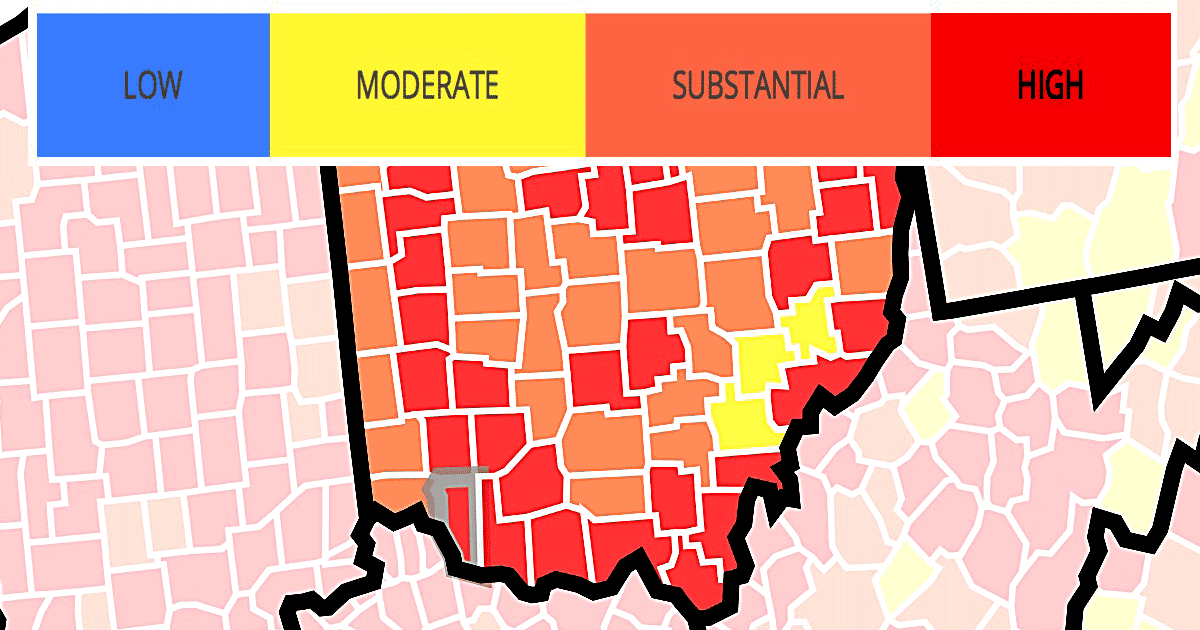
    Loveland, Ohio – The tracking system of the Centers for Disease Control and Prevention (CDC) has now moved Clermont and Warren Counties to the highest level of warning for the transmission of COVID 19.

    Hamilton and Butler Counties remain in the “Substantial” range.

    “The Delta variant has altered the game plan for COVID-19,” Hamilton County Health Commissioner Greg Kesterman told Loveland Magazine last week. “We know masking works and is yet another layer, in addition to vaccination, to protect all of us from another surge of the virus.”

    Vaccination remains the best way to avoid COVID-19 infection.“The vaccines are safe, effective and readily available,” according to Kesterman.  “This is now a pandemic of the unvaccinated. If you have questions or concerns about the vaccine, please talk to a trusted health professional for the best information.”

    https://lovelandmagazine.com/its-vaccination-info-wednesday/
  • Hamilton County Public Health responds to request for back to school info

    Hamilton County Public Health responds to request for back to school info

    “It is strongly recommended that schools implement masking.”

    Loveland, Ohio – When asked, this morning to provide Loveland Magazine with the current Board of Health guidance for covid 19 protocol for K-12 schools “Mike Samet, the Public Information Officer for Hamilton County Public Health responded, “We are following the Ohio Dept. of Health guidelines (attached) until we develop our own, if necessary.”

    The current Loveland school protocol reads in part, “…the Board will follow any mandates set forth by the Ohio Governor, Ohio State Health Department, Hamilton County Health Department, and Ohio Department of Education, (“Directing Entities”) as it relates to protecting the health of students, staff and visitors.”

    There will be no remote learning opportunities (Remote Academy) for Loveland teachers or students as all school buildings will return to full capacity in-person classes in August.

    Samet referred Loveland Magazine to the Ohio Dept. of Health (ODH) guidelines which are currently Hamilton County Health Department’s as well.

    The ODH guidelines begin with this opening introduction:

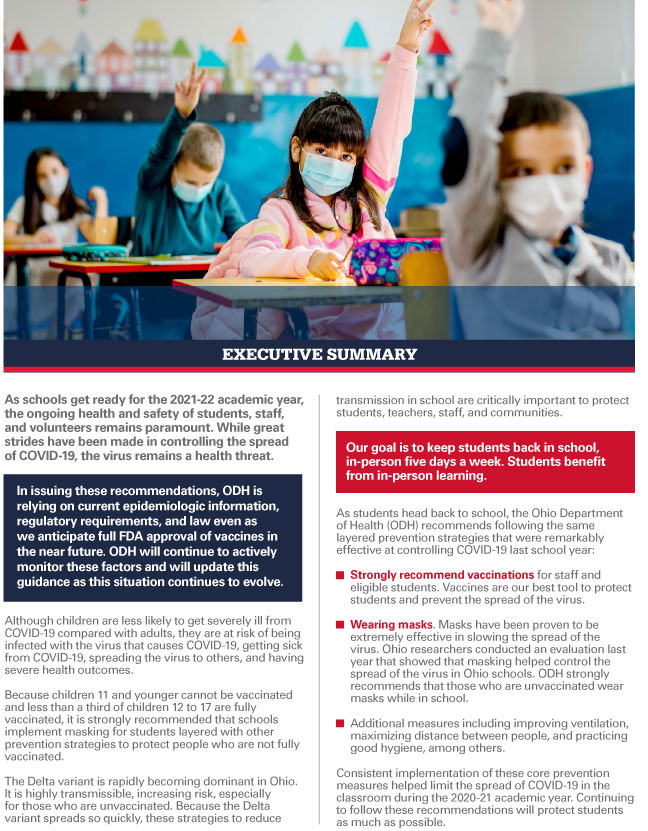
    As schools get ready for the 2021-22 academic year, the ongoing health and safety of students, staff, and volunteers remains paramount. While great strides have been made in controlling the spread of COVID-19, the virus remains a health threat. 

    Although children are less likely to get severely ill from COVID-19 compared with adults, they are at risk of being infected with the virus that causes COVID-19, getting sick from COVID-19, spreading the virus to others, and having severe health outcomes. 

    Because children 11 and younger cannot be vaccinated and less than a third of children 12 to 17 are fully vaccinated, it is strongly recommended that schools implement masking for students layered with other prevention strategies to protect people who are not fully vaccinated. 

    The Delta variant is rapidly becoming dominant in Ohio. It is highly transmissible, increasing risk, especially for those who are unvaccinated. Because the Delta variant spreads so quickly, these strategies to reduce transmission in school are critically important to protect students, teachers, staff, and communities.

    As students head back to school, the Ohio Department of Health (ODH) recommends following the same layered prevention strategies that were remarkably effective at controlling COVID-19 last school year: 

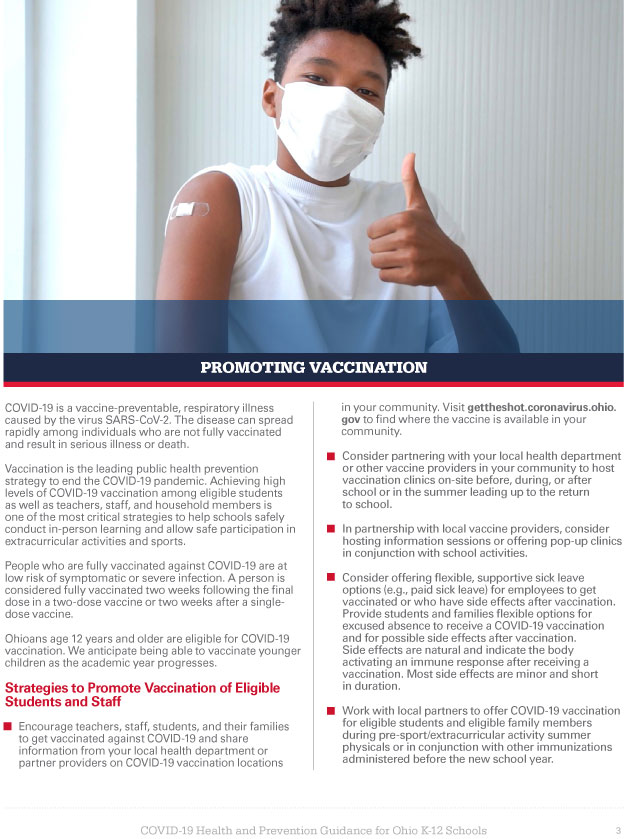
    Strongly recommend vaccinations for staff and eligible students. Vaccines are our best tool to protect students and prevent the spread of the virus. 

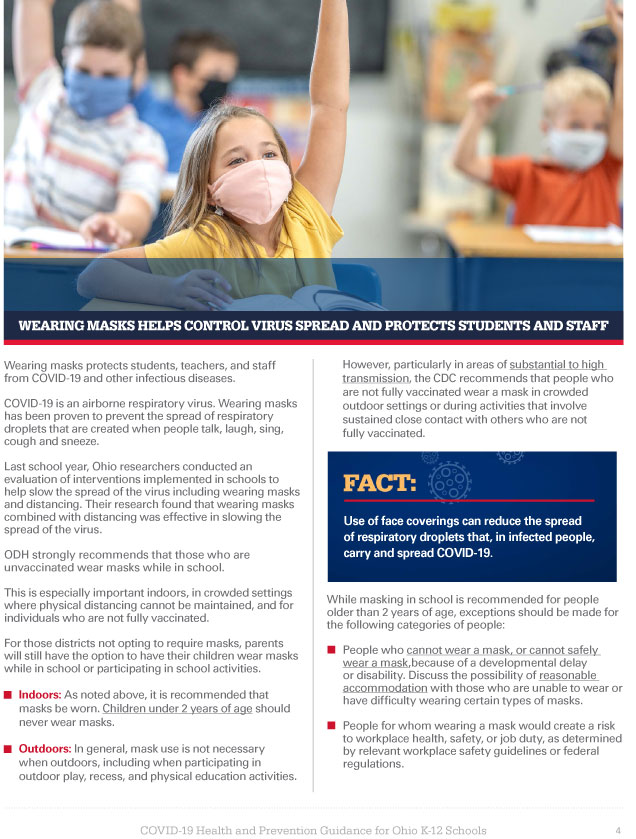
    Wearing masks. Masks have been proven to be extremely effective in slowing the spread of the virus. Ohio researchers conducted an evaluation last year that showed that masking helped control the spread of the virus in Ohio schools. ODH strongly recommends that those who are unvaccinated wear masks while in school. 

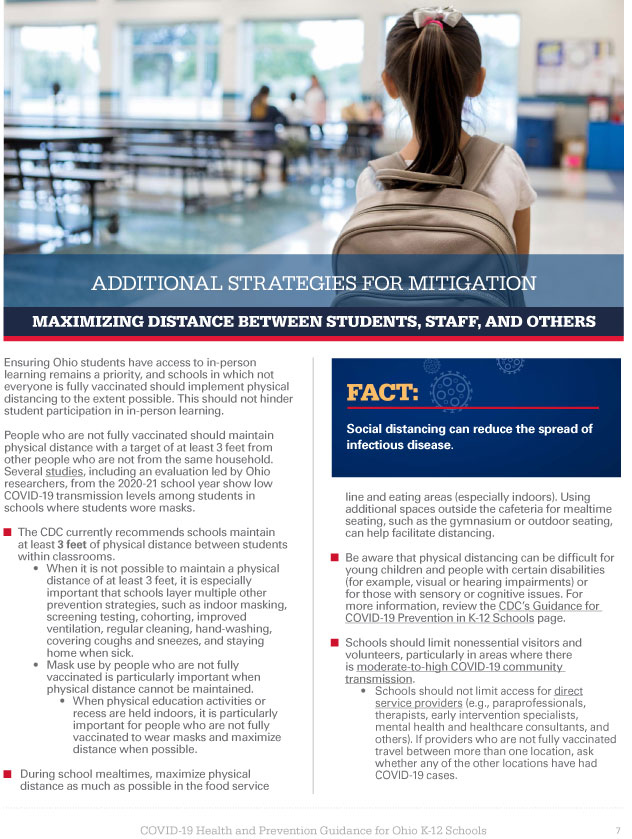
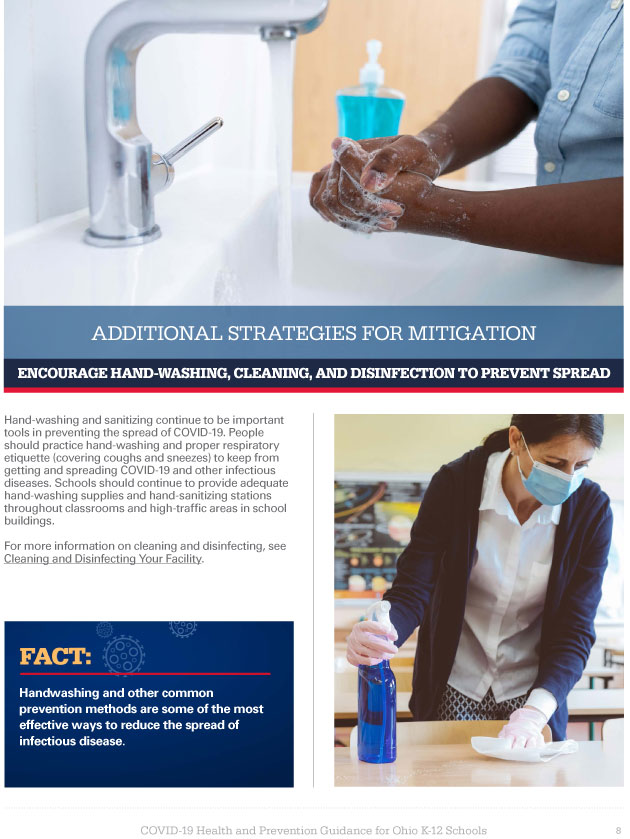
    Additional measures including improving ventilation, maximizing distance between people, and practicing good hygiene, among others. 

    Consistent implementation of these core prevention measures helped limit the spread of COVID-19 in the classroom during the 2020-21 academic year. Continuing to follow these recommendations will protect students as much as possible. 

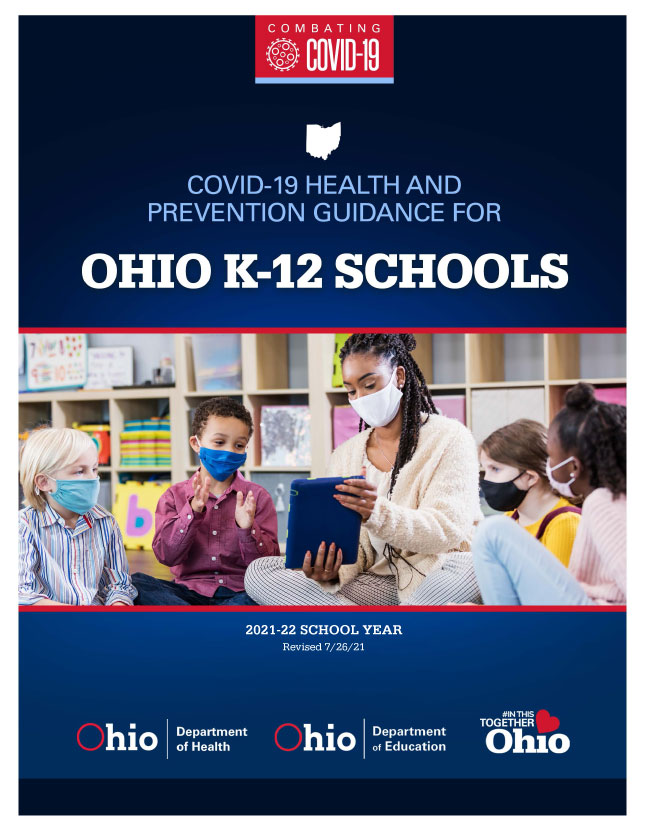
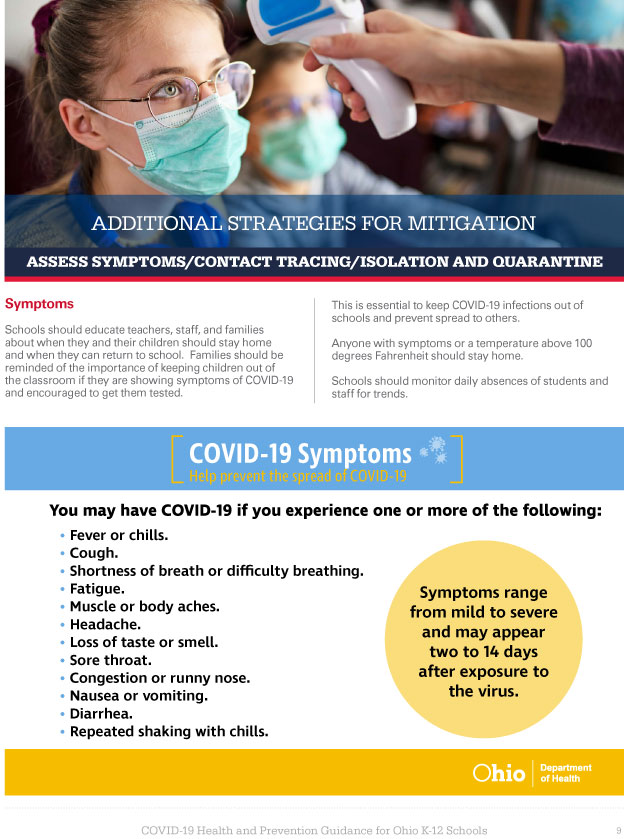
    Below is the full ODH document:

  • Cincinnati Children’s recommends all children wear masks at school

    Cincinnati Children’s recommends all children wear masks at school

    Statement from CINCINNATI CHILDREN’S HOSPITAL MEDICAL CENTER:

    Guidance Also Applies to Teachers and Staff

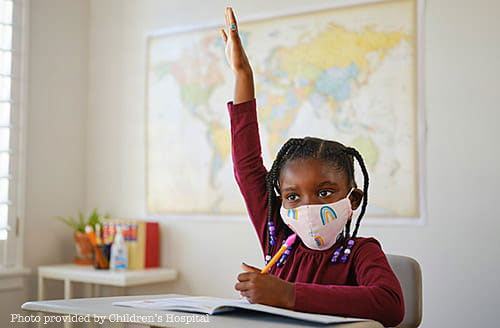
    Cincinnati Children’s recommends that all children returning to in-person school wear masks, regardless of vaccination status. Many children are not yet eligible to be vaccinated against COVID-19, and others should mask because no vaccine is 100% effective at preventing infection.

    In addition, teachers and staff should continue to wear masks, regardless of vaccination status.

    While each school district must decide the best way to safeguard students, it’s important to note that masks are about 85% effective in preventing the spread of the virus that causes COVID-19.

    Vaccines can provide even greater protection, but the federal government’s ongoing review of data from clinical trials may mean that children 11 and younger won’t be eligible for vaccination until late this year or early next year.

    Cincinnati Children’s agrees with recent guidance from the American Academy of Pediatrics that masks and vaccinations remain the most effective protection against severe illness, hospitalization, and risk of death from COVID-19. Hand washing and social distancing also can reduce the risk of transmitting COVID-19, influenza, and other respiratory viruses.

    Cincinnati Children’s also agrees with the AAP on the importance of in-person learning for all children. Beyond academic instruction, the school environment plays a fundamental role in the healthy development of children – including social interaction, nutrition, mental health, social services and extracurricular activities.

    Note that the impact of COVID-19 is evolving rapidly. This guidance reflects the current environment and will be updated as needed.

    For more information about all kinds of vaccines, visit our Vaccine Resources section.


    Reviewed July 27, 2021, by Joshua Schaffzin, MD, PhD, and Patricia Manning-Courtney, MD


    Current Loveland schools mask requirement

    Loveland Magazine –  Jul 28, 2021

    Centers for Disease Control issues new guidance for return to school

    Loveland Magazine –  Jul 28, 2021

    The Centers for Disease Control issued new guidance Tuesday for back to school protocol. Rochelle P. Walensky, MD, MPH,… 

    Ohio Department of Health Releases Updated K-12 School Guidance

    Loveland Magazine –  Jul 28, 2021

    The Ohio Department of Health released updated recommendations for K-12 schools yesterday. The guidance strongly recommends COVID-19 vaccinations for staff and eligible students; consistent…

    COVID-19 Guidance for Safe Schools from American Academy of Pediatrics

    Loveland Magazine –  Jul 21, 2021

    As the next school year begins, there needs to be a continued focus on keeping students safe, since not all students will…

  • Living with COVID-19 among us

    Living with COVID-19 among us

    Warren County Health District (WCHD) is administering free vaccines Monday through Friday from 8 AM until 3:30 PM at 416 S. East Street Lebanon OH 45036 Walk-in basis or you can call 513-695-SHOT for an appointment.

    Release from the Warren County Health District

    COVID-19 Variants, including the Delta Variant first seen in India, may play a part in our daily lives going forward. There have been cases of COVID-19 Delta variant in Warren County, in Ohio and now 50% of samples tested for variants in the US are Delta. We must learn to live with COVID in our communities. Please see the following list of things to do to protect yourself, your family, and your friends.

    Stay home if you are sick

    • Stay home except to get medical care
    • Take care of yourself. Get rest and stay hydrated. Take over-the-counter medicines, such as acetaminophen, to help you feel better.
    • Stay in touch with your doctor. Call before you get medical care. Be sure to get care if you have trouble breathing, or have any other emergency warning signs, or if you think it is an emergency.
    • Separate yourself from other people
    • Monitor your symptoms
    • Get Tested
    • If you are sick, wear a mask over your nose and mouth
    • Cover your coughs and sneezes
    • Clean your hands often
    • Avoid sharing personal household items
    • Clean all “high-touch” surfaces everyday
    Stay home if you might have been exposed to COVID-19 if you have NOT been vaccinated
    • Stay home for 14 days after your last contact with a person who has COVID-19.
    • Watch for fever (100.4◦F), cough, shortness of breath, or other symptoms of COVID-19
    • Stay away from others, especially people who are at higher risk for getting very sick from COVID-19

    Options to reduce quarantine

    – After day 10 without testing
    – After day 7 after receiving a negative test result (test must occur on day 5 or later)

    Stand back from others when out and about

    • When you are at the grocery, at an event, or somewhere with others, stand back a bit. Stand back a few feet when in line at the grocery. Take a different aisle at a store if the aisle is crowded. When meeting someone on the street, stand back a few feet while having a conversation. You can still interact with people, just be aware of spacing and hand washing. 
    • Consider wearing a mask when you cannot avoid being within 6 feet of others, especially in crowded indoor spaces (vaccinated or not vaccinated).


    If you are not vaccinated, consider wearing a mask

    We are all sick of the masks, but if you have not been vaccinated, you can be at high risk of getting COVID from a variant that is in the community. Protect yourself. The masks do not “filter” every virus, but we have seen over the last year that the masks DO stop droplets from entering your nose or mouth. The virus rides in on these droplets. Just like children on Chemotherapy wear masks when their immune system is down, we can protect ourselves the same way.

    Warren County Health District (WCHD) is administering free vaccines Monday through Friday from 8 AM until 3:30 PM at 416 S. East Street Lebanon OH 45036 Walk-in basis or you can call 513-695-SHOT for an appointment.

  • DeWine signs bill to temporarily ban school COVID-19 vaccine mandates

    DeWine signs bill to temporarily ban school COVID-19 vaccine mandates

    By Jake Zuckerman and Ohio Capital Journal

    His signature on the bill seems to violate his pledge to veto any legislation that would “discourage vaccination.”

    Columbus, Ohio – Ohio Gov. Mike DeWine signed legislation Wednesday that could block schools from mandating vaccination against COVID-19 for the fall.

    In the dying moments of the final legislative session before a summer recess, lawmakers tacked the vaccine provision as an amendment onto an unrelated bill regarding educational opportunities for military children. The amendment:

    • Forbids public K-12 schools and colleges from requiring any vaccine that has not yet received “full approval” from the U.S. Food and Drug Administration.
    • Forbids the schools from “discriminating” against anyone who has not been vaccinated, which includes infection control provisions like masks and social distancing.
    • Does not apply to hospitals or health care facilities operated by or affiliated with universities.

    It passed on party lines in both chambers, with Republicans in support and Democrats in opposition.

    All three vaccines available for use against COVID-19 are approved under an “emergency use authorization.” The FDA uses this streamlined regulatory process for drugs and vaccines that can be used against an ongoing emergency such as the pandemic, which has killed more than 608,000 Americans to date. The regulators issued the temporary authorization after reviewing clinical trial data on tens of thousands of recipients. The FDA, along with the Centers for Disease Control and Prevention (CDC), continues to monitor safety and efficacy profiles of all three vaccines.

    DeWine announced his approval of the bill without any public comment or fanfare. His signature on the bill seems to violate his pledge to veto any legislation that would “discourage vaccination.”

    Dan Tierney, a spokesman for the governor, played up the bill’s original aims in an email and said DeWine expects looming regulatory approval to nix the issue.

    “The primary purpose of the bill was to enhance educational opportunities for children in military families — a worthy goal,” he said. “The provision you are referring to is limited to vaccines that do not have full FDA approval. We are confident that these vaccines, proven repeatedly to be very safe and very effective, will be approved by the FDA, thus rendering this issue moot.”

    Passage comes amid an ongoing clash between DeWine and fellow Republicans in the legislature regarding public health policy. Earlier this year, lawmakers overrode DeWine’s veto on a broad weakening of state public health laws.

    Meanwhile, Republicans in the House Health Committee are considering legislation that would weaken state vaccination laws and prevent employers, nursing homes, hospitals, colleges and more from requiring vaccination of students and employees. DeWine has said he would veto the bill if it made it to his desk.

    During a hearing on that bill, lawmakers — many of whom have announced their refusal to seek vaccination against COVID-19 and aligned themselves with anti-vaccination activists — invited testimony from a discredited doctor who has claimed vaccines are a “depopulation” and “mass destruction” tool.

    DeWine’s signature furthers an emerging anti-vaccination push from Republican-controlled state legislatures. For instance, the Tennessee Department of Health halted all adolescent vaccine outreach and forced out its top vaccine official this monthunder pressure from Republican lawmakers, according to recent reporting from The Tennessean. Florida Gov. Ron DeSantis recently signed legislation to ban “vaccine passports,”which do not exist in most areas of the country but would theoretically be used by institutions to validate people’s vaccination status.

    Under the new Ohio law signed by DeWine on Wednesday, schools can still technically require immunization against COVID-19 once the federal regulators issue a full-blown authorization. However, Ohio is one of about a dozen states that allows exemptions to school immunization requirements for “reasons of conscience” — something of a catchall term.

    The new law’s sponsors, state Reps. Andrea White, R-Kettering, and Brian Lampton, R-Beavercreek, issued a lengthy statement regarding the help the bill will deliver for military children. They briefly addressed the vaccination issue.

    “By prohibiting our educational institutions from requiring vaccines that are not fully approved by the FDA, we are ensuring that safety is at the forefront of our priorities,” they said.

    The sponsors did not answer whether this means they consider the vaccines to be unsafe.

    Two Democrats on the House Health Committee issued a statement Wednesday evening criticizing the new law, saying it puts “political self-interests” ahead of good health policy.

    “With the arrival of the delta variant, this country is still in the midst of a dangerous pandemic and unvaccinated individuals are at highest risk,” said Rep. Allison Russo, D-Columbus.

    “Public schools and universities deserve to have the flexibility to either require COVID-19 vaccines or establish mitigation procedures they deem appropriate for the circumstances in their communities. Instead, this bill further undermines trust in science and a vaccine that has saved the lives of thousands of Ohioans.”

    This article was updated to reflect the legislation only applies to public schools and universities.

  • Ohio judge adds COVID-19 vaccination as terms of probation

    Ohio judge adds COVID-19 vaccination as terms of probation

    By Jake Zuckerman and Ohio Capital Journal

    A Franklin County judge recently began including vaccination against COVID-19 as a condition of defendants’ terms of probation.

    Common Pleas Judge Richard Frye said Thursday he added the vaccine as a condition on three cases this week of the roughly 20 sentences he imposed.

    He said he discussed the matter in open court with the defendants, and they attributed their unvaccinated status to procrastination. None raised any philosophical, medical or religious objection.

    Judge Richard Frye

    “It occurred to me that at least some of these folks need to be encouraged not to procrastinate,” Frye said in an interview. “I think it’s a reasonable condition when we’re telling people to get employed and be out in the community.”

    He declined to “speculate” what would happen if a defendant raised a medical, religious or philosophical exemption to vaccination, but said this is a different situation entirely than people who have simply put the matter off.

    An example: a man named Cameron Stringer entered a guilty plea for one charge of improperly handling firearms in a motor vehicle, for which he was sentenced to two years of probation (“community control,” as it’s known in Ohio).

    Stringer must submit to random drug screening; avoid further legal trouble; return a firearm in question to its rightful owner; and obtain a COVID-19 vaccine within 30 days and provide proof to the Probation Department, court documents show.

    It’s unclear how widespread this judicial practice is. Frye said he didn’t know if any other judges were doing anything similar. A spokesman for the Supreme Court, which oversees lower courts, said he didn’t know of any judges doing anything similar. However, he sent a link to a media report about a judge offering to shorten probation stretches for those who obtain a vaccine. 

    Gary Daniels, a lobbyist with the ACLU, expressed concern about the practice Thursday, comparing it to Ohio judges who have ordered defendants convicted of crimes not to procreate

    “It doesn’t have any real relationship to community control,” Daniels said of Frye’s practice, in a brief interview. 

    “At a minimum, it appears to be problematic.”

    Frye’s practice comes in a period of stagnation in a vaccination campaign against a disease that has killed more than 600,000 Americans. Despite a skyscraping death and morbidity toll; five $1 million lottery drawings for people who get vaccinated; and more than 6 months of availability, fewer than 48% of Ohioanshave started the vaccination process against COVID-19.

    “I just wanted them to be safe in the community,” Frye said.

  • Bands and Brews Brings the City of Loveland Together to Celebrate Summer!

    Bands and Brews Brings the City of Loveland Together to Celebrate Summer!

    by Cassie Mattia

    Loveland, Ohio – It was a beautiful Summer night at the first installment of Bands and Brews in the heart of Downtown Historic Loveland last Saturday!

    Families and friends grabbed their lawn chairs, blankets, and their favorite beverage and gathered around the Fountain Greene as they enjoyed live entertainment by the Counting Skeletons and Everything’s Jake.

    The fun-filled night kicked off at 6 PM with the Counting Skeletons performing their personal “Dance-able Rock” favorites. As Bone Head, Bon “E” Phish, Phred “Big Bones” McAllister, Skeleton Keys, Jon Bone-m, and Dead Ear got the crowd rocking and rolling kids from the surrounding families joined the Skeletons on stage showing off with their best dance moves!

    Check out the video below that I took of the Counting Skeletons rocking out with the community’s kids!

    After the Counting Skeletons finished their set, the crowd intermingled with one another as many members of the community had not seen each other since the COVID-19 pandemic began.

    Next on the entertainment line-up was Everything’s Jake featuring the trio of Ben Duke, Joe Cremeans, and Marianne Puntenney. The community of music lovers grabbed their beverages from the President of the Little Miami Chamber of Alliance, Cee Cee Collins, and intern, Amanda Fox, and once again gathered around for one heck of a show!

    Everything’s Jake ended the night with a bang playing everything from R&B to Blues to Pop. As everyone swayed and grooved to the sweet harmonies of Everything’s Jake it was clear that the first rendition of Bands and Brews was a Summer success!

    Check out the video below captured by Loveland Magazine Publisher David Miller of Everything’s Jake!

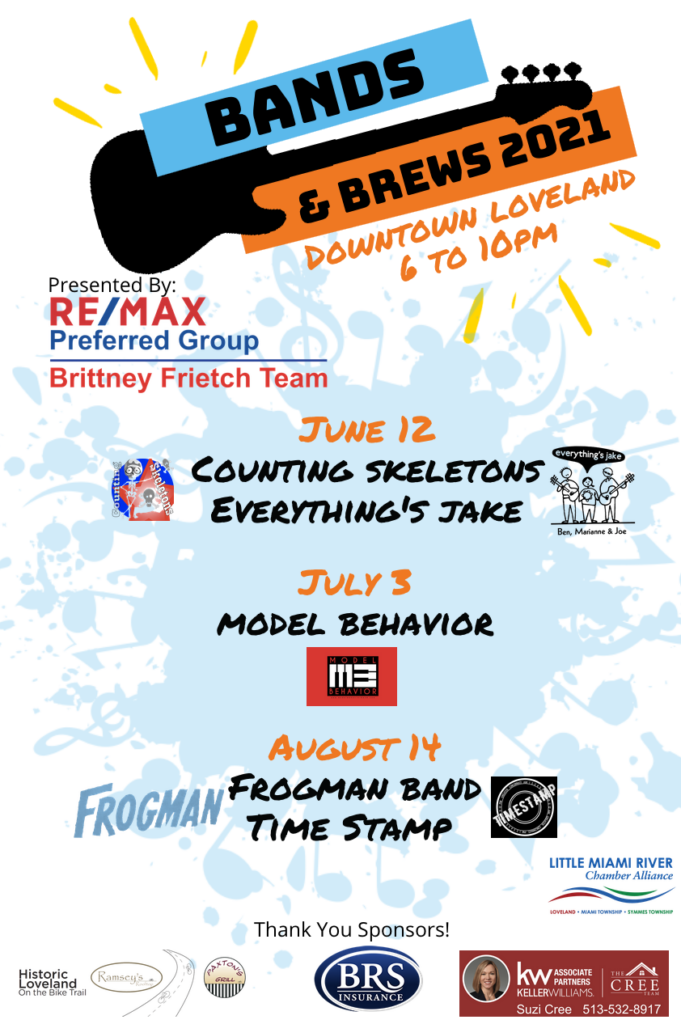
    Bands and Brews 2021 will be going on every month throughout the Summer from 6 PM-10 PM on the Fountain Greene in Downtown Historic Loveland. The next installment will be on July 3rd and will feature Model Behavior.

    Loveland Magazine wants to take the opportunity to say thank you to presenting Bands and Brews sponsors ReMax Preferred Group, and The Brittney Frietch Team, as well as LMRCA, BRS InsurancePaxton’s GrillRamsey’s TrailsideSuzi  Cree from Keller Williams, and Historic Loveland on the Bike Trail for making the event such as success!

    Missed out on Bands and Brews last Saturday? We have got you covered! Check out the photos taken by Loveland Magazine photographer Alex Eicher!

    Photos by Alex Eicher

    Photos by Alex Eicher


    Loveland Magazine photographer Alex Eicher

    (Click on any photo below to view larger)

    Stay tuned to the Loveland Salad With Me, Cassie Mattia for more on what’s going on this Summer in Downtown Loveland!

  • Bands and Brews Coming to Downtown Loveland This Saturday!

    Bands and Brews Coming to Downtown Loveland This Saturday!

    by Cassie Mattia

    Loveland, Ohio – The warm weather is finally here and Downtown Loveland is more than ready to bring the community back together once again to celebrate Summer 2021!

    The Little Miami River Chamber of Alliance (LMRCA) has been working harder than ever planning events as Ohio slowly but surely returns back to normal after all the COVID-19 chaos canceling the majority of events last Summer.

    Kicking off this Saturday, June 12th in the heart of Downtown Historic Loveland is the Summer Concert Series, “Band & Brews,” brought to you by presenting sponsors ReMax Preferred Group, and The Brittney Frietch Team. Other sponsors include LMRCA, BRS Insurance, Paxton’s Grill, Ramsey’s Trailside, Suzi  Cree from Keller Williams, and Historic Loveland on the Bike Trail. The fun-filled event will be held on the Fountain Greene from 6 PM-10 PM and will feature local bands Counting Skeletons and Everything’s Jake.

    Counting Skeletons is composed of a group of veteran musicians that are based out of both Cincinnati and Dayton. This local band is all about getting their audience up and dancing as they focus primarily on the ’70s, ’80s, and today’s “Dance-able Rock” hits! Bone Head, Bon “E” Phish, Phred “Big Bones” McAllister, Skeleton Keys, Jon Bone-m, and Dead Ear are all a part of Counting Skeletons.

    Click below to listen to Counting Skeleton’s “Super Moon!”

    Everything’s Jake, featuring trio Ben Duke, Joe Cremeans, and Marianne Puntenney, will also be headlining the first round of Bands and Brews on June 12th. This local band plays a little something for everyone, from R&B to Blues to Pop and Rock, Everything’s Jake is bound to get you singing along!

    The LMRCA encourages those who are attending to bring lawn chairs and blankets so that they can comfortably watch the live entertainment. Drinks will be sold at the event!

    Bands and Brews will take place each month throughout the Summer in Downtown Loveland from 6 PM to 10 PM and will feature only the best local bands! On July 3rd Model Behavior will take the stage and on August 14th both the Frogman Band and Time Stamp will be performing.

    As more details come in about Band and Brews The Summer Concert Series, Loveland Magazine will be here to deliver to you our loyal readers the latest news!

    We hope to see everyone celebrating Summer together at the first installment of Bands and Brews this Saturday at Fountain Greene in Downtown Loveland beginning at 6 PM! Let’s kick-off together a beautiful Summer 2021!

    For more updates on Loveland events and entertainment stay tuned to the Loveland Salad With Me, Cassie Mattia!

  • This rural county in Ohio has a COVID-19 case rate of zero

    This rural county in Ohio has a COVID-19 case rate of zero

    By Tyler Buchanan and Ohio Capital Journal

    Vinton County in rural Southeast Ohio was the last county in the state to record a positive case of COVID-19.

    It also appears to be the first without any cases remaining — at least for the time being.

    The sparsely-populated Vinton County has not been as hard hit by the pandemic as in other places of Ohio, and the recent data is the most optimistic yet.

    Over the past few weeks, not a single resident in Vinton County has tested positive for COVID-19. There has likewise not been a hospitalization since May 20.

    As of last Thursday, the county did not have any known active cases of coronavirus among its estimated 13,100 residents, according to the Vinton County Health Department.

    Vinton County’s location in rural Southeast Ohio.

    When the state health department published its most recent chart of county-by-county case rates, the one named for former Congressman Samuel Finley Vinton ranked the lowest. During the two-week period of May 19 through June 2, Vinton County didn’t recorded any new cases of the virus.

    Thus, the case rate was an even zero — the first county to achieve that since the early days of the pandemic.

    The next challenge? Boosting the county’s vaccination rate

    Vinton County has a history of figuring out creative solutions to problems. When the county suffered as a food desert, local officials secured grant funding to allow fresh produce to be sold at gas stations and at a drive-thru convenience store.

    Decades ago, the construction of a man-made lake threatened the survival of a historic covered bridge. The local agricultural society decided to save it, so a group of laborers spent two days moving the 25-ton bridge across the county. It now rests on the Vinton County Fairgrounds, where guests travel through it each July to reach the front entrance.

    Health officials are continuing to work toward getting residents vaccinated.

    The case rate may be promising, but the vaccination rate is hardly so. Only 30% of Vinton County residents have received at least one shot of the COVID-19 vaccine.

    The county lags behind the state percentages in every single age category, most alarmingly with the older demographic.

    Across the whole state, 77% of Ohioans aged 60 or older had received at least one shot as of June 4. In Vinton County, the number was just 59%.

    Part of the problem is geographic access. Vinton County has no hospital and only a few other medical care facilities. The health department is offering walk-in appointments at its location in the county seat of McArthur; there have also been shots offered at a local pharmacy and at a primary care clinic within the small village.

    Outside of McArthur, though, options have been limited. Vinton County is one of the least densely-populated counties in Ohio, and it is also among the most forested. Many residents live in very rural areas, traveling significant distances outside of the county for medical services and other errands in places like Chillicothe and Athens.

    The trip to and from the Vinton County Health Department, which now offers walk-in vaccine appointments, can require a round trip of more than an hour. That’s if fortunate enough to have transportation in the first place. There is little in the way of public transit in rural Ohio; those without vehicles or are too old to drive rely on transportation services provided by private companies as well as the senior citizens center in McArthur. Volunteers for the latter spend their free time driving elderly passengers to various appointments, grocery stores and 

    If it’s difficult for some residents to get to McArthur, health officials therefore strive to meet people where they are.

    Cassie Carver, a public health nurse for the Vinton County Health Department, said the department has been active in promoting the vaccine in the community. Officials have traveled to schools, churches and workplaces like area sawmills to educate on the importance of getting vaccinated.

    The health department recently hosted a mobile vaccination clinic at a farmers market in the smaller village of Hamden. Carver said the department plans to conduct more outreach during the upcoming summer months.