It seems like it should be common sense: When you provide a benefit only up to a certain, hard income level, it creates a cliff that gives a strong disincentive for a person to try to earn more.
The Ohio Department of Job and Family Services recently took steps away from that approach and a panel of economists strongly agreed with the move.
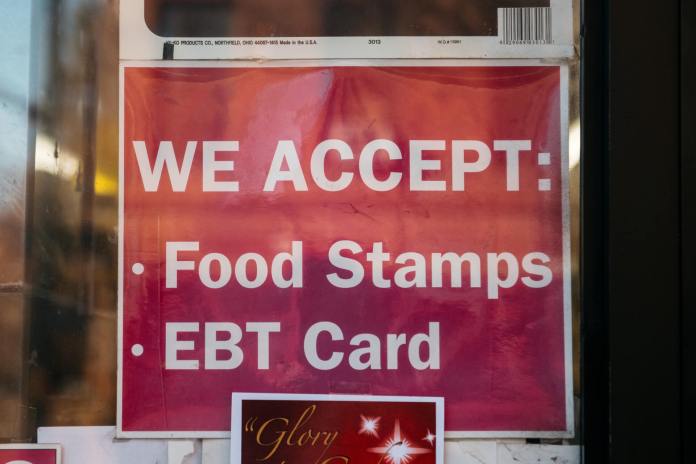
Previously, Ohioans were eligible for the state’s Supplemental Nutrition Assistance program, or SNAP, only if they earned 130% or less of federal poverty guidelines. For a family of four, that’s $40,560.
Earlier this month, the Department of Job and Family Services adjusted that, stepping down food stamp benefits along a sliding scale until a family is making 200% of federal poverty guidelines, or $62,400 for a family of four.
“Fear of losing food benefits can be a deterrent to taking a new job, working more hours, or even accepting a promotion,” ODJFS Director Matt Damschroder said in a statement announcing the change. “Instead of an all-or-nothing approach, we are creating a sliding scale that encourages people to earn more by slowly reducing their benefits as their income grows. This provides an incentive to accept promotions and pay raises knowing they won’t immediately lose benefits.”
A panel of Ohio economists appear to heartily agree, according to a survey that was released on Oct. 28. They were asked about “benefits cliffs,” or providing them at a certain level then abruptly cutting them off once an income threshold is reached.
GET THE MORNING HEADLINES.
Asked if benefit cliffs “caused by strict income requirements for public benefits create significant barriers to career advancement for low-income workers,” all 19 economists agreed, according to the survey conducted by Scioto Analysis.
“People make an economically rational decision, at least in the short run, to turn down raises or promotions that result in loss of a much more significant public benefit,” Bill Lafayette of Regionomics said in the comments section of the survey.
The economists were somewhat more mixed when asked if the changes enacted by ODJFs would “lower barriers to work for low-income people.”
Thirteen agreed, while six were uncertain or had no opinion.
“Eliminating the ‘benefits cliff’ is an efficient policy that reduces disincentives to work,” wrote Kevin Egan of the University of Toledo. “Moreover, it is a fair policy change to gradually reduce SNAP benefits so no households find themselves in such an unfair position.”
But Kay Strong, an independent economist, said barriers to work extend well beyond facing benefits cliffs.
“Barriers to work for low-income workers don’t occur solely on the supply side of the market,” she said. “Employers create barriers through their choice of workers, scheduling of workers, and willingness to assist employees over and around occasional personal obstacles that hinder workers.”
YOU MAKE OUR WORK POSSIBLE.
____________
Marty Schladen
Marty Schladen has been a reporter for decades, working in Indiana, Texas and other places before returning to his native Ohio to work at The Columbus Dispatch in 2017. He’s won state and national journalism awards for investigations into utility regulation, public corruption, the environment, prescription drug spending and other matters.
Ohio Capital Journal is part of States Newsroom, the nation’s largest state-focused nonprofit news organization.
An Ohio child advocacy group is making a push for paid family leave, one of many that have been made over the years as child care costs continue to rise.
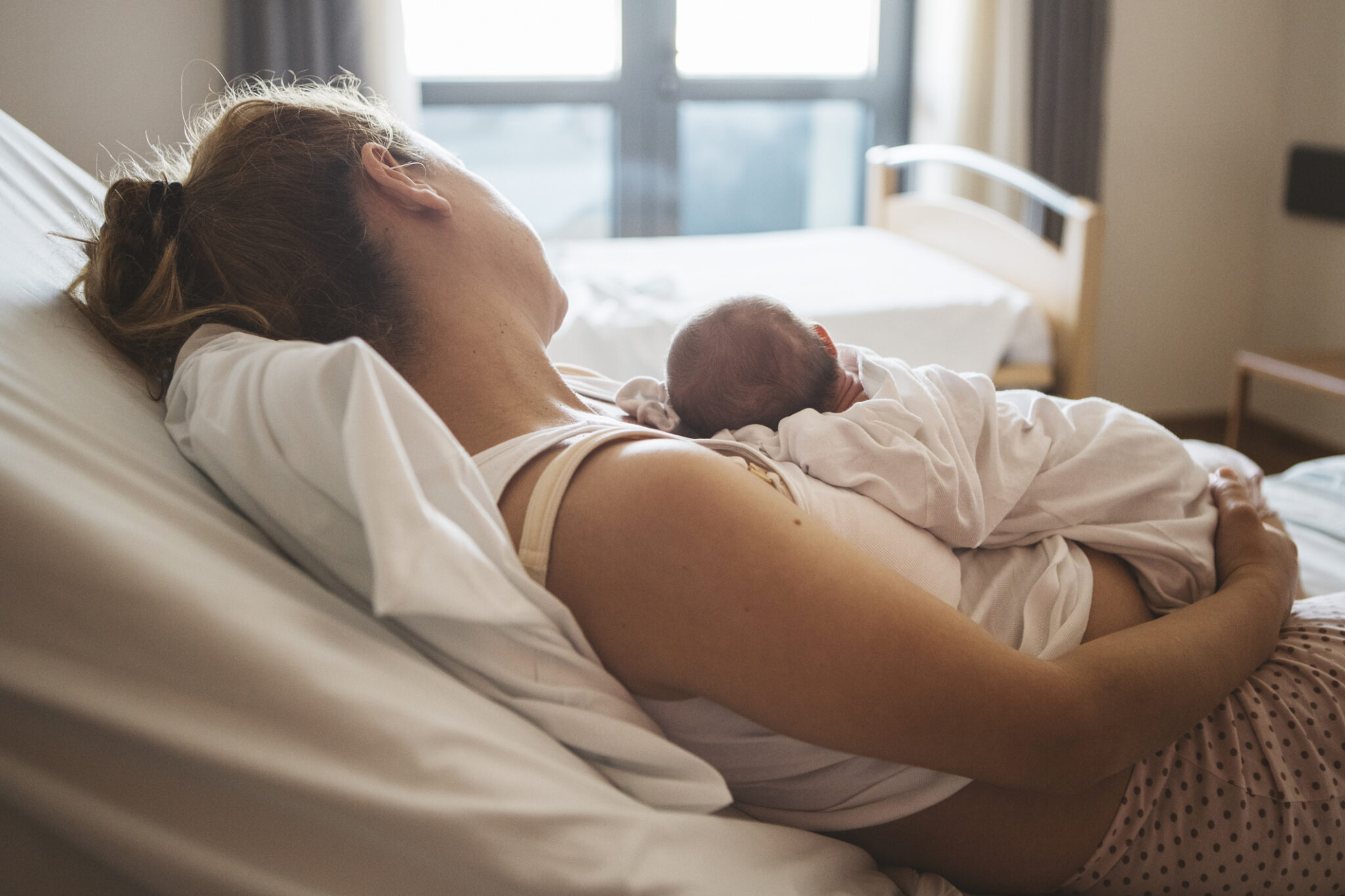
Groundwork Ohio used its newest report to encourage implementation of paid leave policies in a state where the vast majority of residents have jobs that don’t offer paid family leave.
“The benefits are vast, including improved health outcomes for mothers and babies, reduced infant mortality rates and diminished emotional and financial stress,” according to Lynne Gutierrez, president and CEO of Groundwork Ohio.
One of the other types of leave that exists in the U.S. is the federal Family and Medical Leave Act (FMLA), which provides leave that keeps individuals from losing their jobs for specific family and medical reasons, but that leave is unpaid. Groundwork Ohio’s analysis estimated 8.4 million people, about 5.3% of eligible workers – those in companies with 50 employees or more who have worked for at least a year –use FMLA annually, but also found that FMLA “has significant limitations forcing over 40% of the total U.S. workforce to the fringes of a benefit made accessible due to legal technicalities.”
Under FMLA, “family” is categorized as spouses, children and parents, but excludes “modern families and LGBTQ+ populations,” the study stated.
To fill the gaps in FMLA coverage, the report argued support for paid family leave should be taken up by state legislatures to not only support families in better ways, but also to bring the U.S. up to par with other countries. Currently, the U.S. is one of only six countries globally without national paid maternity leave, according to Groundwork, an “abysmally far cry from the average 29 weeks of paid maternity leave sanctified in most other countries.”
GET THE MORNING HEADLINES.
“In the absence of a functioning paid leave insurance system, U.S. workers are likely to repurpose earned vacation or sick time for family and health care reasons, leading to increased burnout, turnover and poorer mental health outcomes,” the study stated.
The paid family leave gaps come amid a child care landscape that is also considered inaccessible and unaffordable to many in Ohio and across the country.
Some state legislatures have already taken steps to fill the paid leave gap, with 21 states and D.C. enacting paid leave laws in 2023.
A study of state-level programs conducted by the National Partnership for Women & Families in 2023 found improved labor force participation, less need for the Supplemental Nutrition Assistance Program (SNAP) or other public assistance programs, and improvements in health outcomes for children and parents.
“People’s access to paid leave should not depend on where they live or work or what kind of job they hold,” the NPWF stated. “The success of paid family and medical leave programs at the state level demonstrates that there is an effective, affordable and proven model that works for families, businesses and the economy.”
Ohio’s economy could see boosts with the implementation of paid leave policies, according to Groundwork’s analysis. A full-time employee in Ohio gives up about $3,100 in income if they take one month of unpaid leave.
“If women in Ohio could participate in the labor force at the same rate as women in countries with paid leave policies, the state would see approximately $3.9 billion more in wages statewide, simultaneously boosting the state economy and helping to stabilize families,” the study stated.
Citing Federal Reserve estimates, the research stated Ohio’s overall GDP would have been $67 billion higher between 2005 and 2019 “if gender and racial wealth gaps were closed.”
YOU MAKE OUR WORK POSSIBLE.
_______________
Susan Tebben
Susan Tebben is an award-winning journalist with a decade of experience covering Ohio news, including courts and crime, Appalachian social issues, government, education, diversity and culture. She has worked for The Newark Advocate, The Glasgow (KY) Daily Times, The Athens Messenger, and WOUB Public Media. She has also had work featured on National Public Radio.
Ohio Capital Journal is part of States Newsroom, the nation’s largest state-focused nonprofit news organization.
As part of a group “working to restore faith in public elections,” two former Ohio elected officials are urging Ohioans to trust the process, and accept the results.
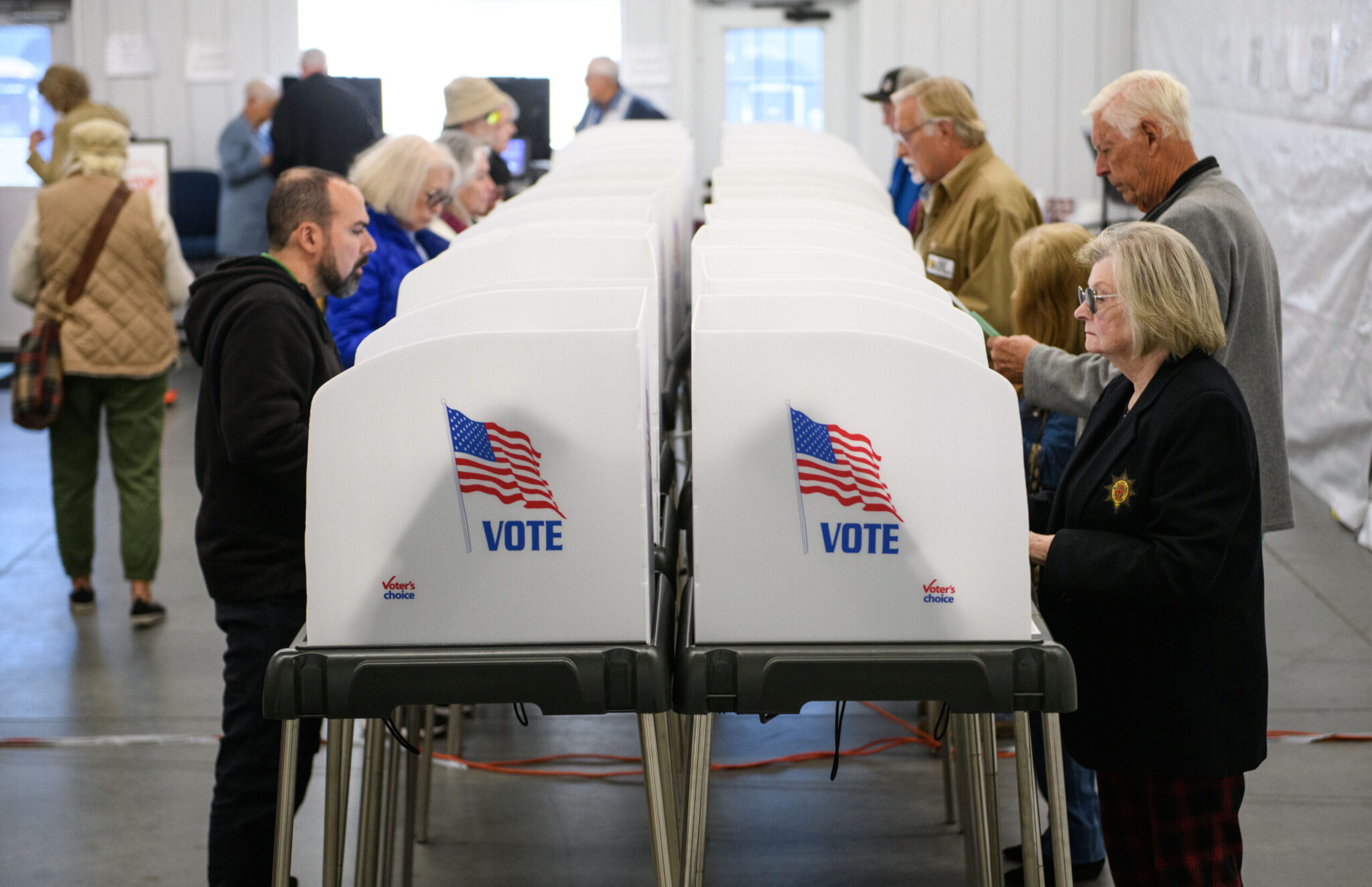
Former U.S. Representative Zack Space and former Ohio Secretary of State Ken Blackwell participated in a Wednesday panel discussion at the University of Cincinnati on election integrity and trust in the electoral process. The discussion was part of UC’s “Digital Futures Flashpoint” series.
Space, a Democrat, said he and the Republican Blackwell don’t agree on their choice of presidential candidate in the November election, or their choice in Ohio’s U.S. Senate race, or even on certain policies.
“But we agree on this: if you cast your vote … you can rest assured that it will be counted,” Space said.
Blackwell – who served in the George H.W. Bush administration, was an honorary co-chair of the George W. Bush campaign in 2004 and was a part of former President Donald Trump’s transition team in 2016 – said the strength of the elections system in Ohio should be believed.
“We need to turn up the volume to help people believe their vote does matter,” Blackwell said. “We can detect flaws in the system and fix flaws in the system. That’s something we do well in Ohio.”
In Blackwell’s tenure as Ohio’s secretary of state from 1999 to 2007, he dealt with his own share of election controversies and questions. With regard to an investigation into “irregularities reported in the Ohio presidential election” in 2004, U.S. House Rep. John Conyers, Jr., the ranking Democrat on the House Judiciary Committee, said “there were massive and unprecedented voter irregularities and anomalies in Ohio.”
Several counties were hampered by broken voting machines, not enough voting machines, and a directive by Blackwell on provisional ballots.
“In many cases these irregularities were caused by intentional misconduct and illegal behavior, much of it involving Secretary of State J. Kenneth Blackwell, the co-chair of the Bush/Cheney campaign in Ohio,” Conyers wrote.
GET THE MORNING HEADLINES.
State Democrats sued about a directive issued by Blackwell for that election that kept ballot boards from giving ballots to voters who were in the wrong precinct. A U.S. District judge blocked the directive, but an appellate court ruled in favor of Blackwell, throwing out certain provisional ballots.
Blackwell addressed the criticism over the long lines on Wednesday, saying the problem, particularly in Montgomery County, was a campaign that had engaged university students to vote, to the point where polling places were not prepared with enough machines, and long lines ensued.
Though he faced much criticism at the time, on Wednesday, he changed the narrative.
“The reality was it was a very positive sign,” Blackwell said, saying the increased voter turnout and the success of the student engagement was a good thing.
For this election year, Blackwell and Space are putting their heads together as part of the Democracy Defense Project, a bipartisan coalition of former elected officials from Arizona, Georgia, Michigan, Nevada, New Hampshire, Pennsylvania, Wisconsin and Ohio.
“An erosion of faith in our democracy and the proliferation of politicians undermining election integrity to bolster their own campaign, reputation or party’s influence have caused false narratives about ‘stolen elections’ to take root,” according to the project’s website. “The mistrust that many voters have for our electoral system puts our democracy at grave risk.”
The targets of the group include boosting confidence in election results and improving voter participation, according to the DDP website.
While the Ohio members of DDP agree that it is unlikely America will know the results of the presidential election next Tuesday night, with close calls and litigation anticipated, they urged the public to have faith in the election through the work that local boards of elections do and the protections in place for votes.
“There is a point by which the challenges are resolved and if it doesn’t go your way, you have to accept it,” Blackwell said.
YOU MAKE OUR WORK POSSIBLE.
_______________
Susan Tebben
Susan Tebben is an award-winning journalist with a decade of experience covering Ohio news, including courts and crime, Appalachian social issues, government, education, diversity and culture. She has worked for The Newark Advocate, The Glasgow (KY) Daily Times, The Athens Messenger, and WOUB Public Media. She has also had work featured on National Public Radio.
Ohio Capital Journal is part of States Newsroom, the nation’s largest state-focused nonprofit news organization.
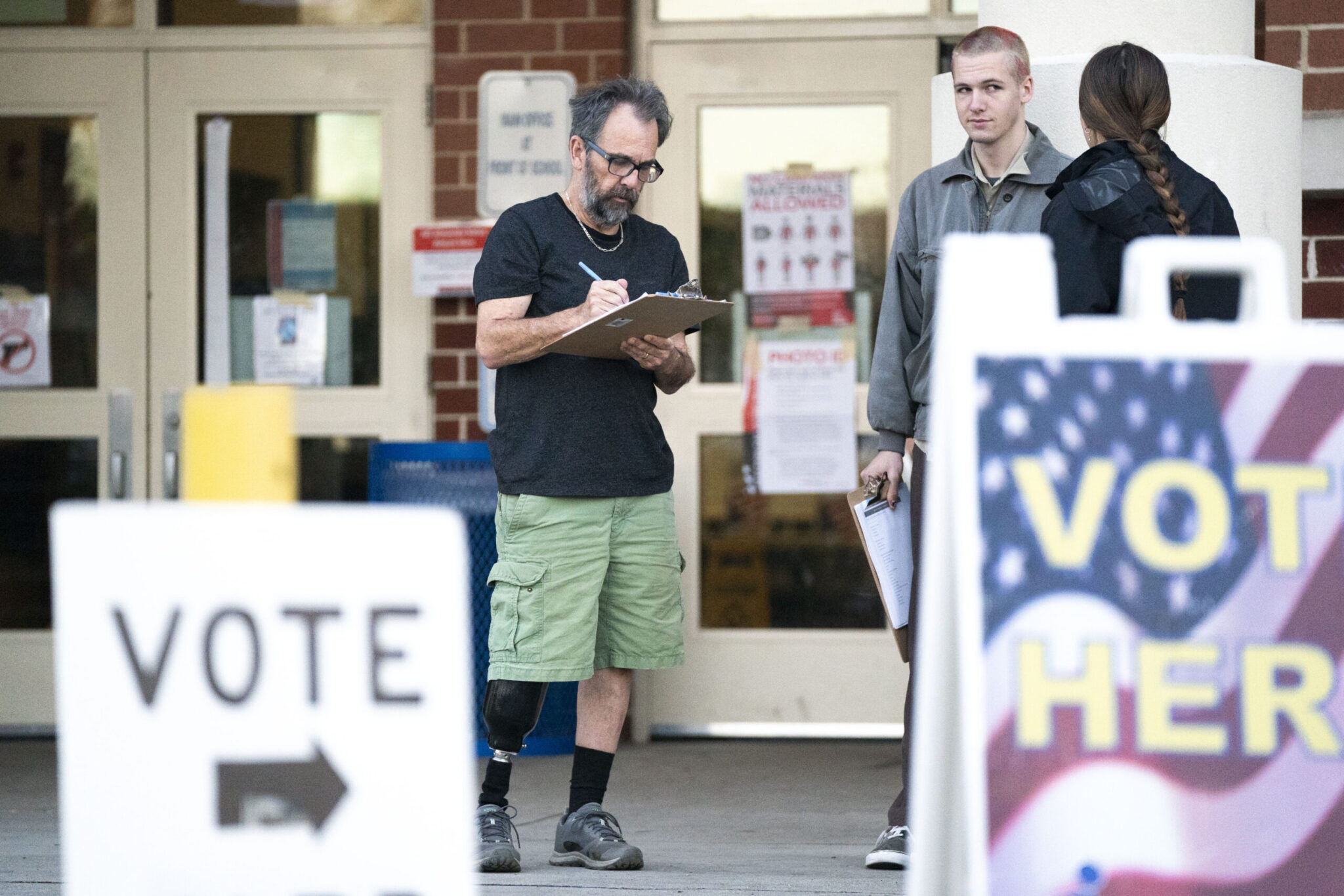
A man participates in exit polling after voting in the South Carolina Republican presidential primary at Dreher High School on Feb. 24, 2024 in Columbia, South Carolina. (Photo by Sean Rayford/Getty Images)
WASHINGTON — A pro-democracy organization warned Monday that disinformation and violent rhetoric could make the weeks that follow Election Day especially fraught, pushing the country past the upheaval that arose four years ago during the last presidential transition.
The comments from three members of the Defend Democracy Project came just days before voting ends on Nov. 5, though with several races extremely close, the country may not know for days who won the presidential contest as well as control of Congress.
That could leave considerable space for speculation as state election workers count mail-in ballots and potentially undertake full recounts, similar to four years ago.
“I think the biggest vulnerability will continue to be the mis- and disinformation that will happen in the aftermath of the election,” said Olivia Troye, who previously worked for Vice President Mike Pence as a special adviser on homeland security and counterterrorism.
Troye raised concerns that Republican presidential nominee Donald Trump may make false claims about election fraud and encourage violence similar to what took place on Jan. 6, 2021, should he lose the Electoral College again.
Troye referenced an election bulletin from the Federal Bureau of Investigation and the Department of Homeland Security she said cautioned that “candidates, elected officials, election workers, members of the media, judges involved in these cases” could all become targets of post-election violence.
“And they’re also concerned about the visible attacks and violence on polling places or ballot drop boxes,” Troye said, referencing the burning of ballots inside drop boxes in Oregon and Washington states early Monday morning.
Michael Podhorzer, chair of the Defend Democracy Project, said during the virtual briefing for reporters that one of the reasons many state officials didn’t go along with requests to “find votes” for Trump in the days following the 2020 election was because President Joe Biden had “two states to spare.”
“And that created a prisoner’s dilemma for every Republican election official who might have done the wrong thing,” Podhorzer said. “So if you take the call to (Georgia Secretary of State) Brad Raffensperger, he understood that even if he could find those votes that Trump wanted, unless two Democratic secretaries of state overturned their results, Donald Trump was not going back to the White House.
“And what that meant was that there wasn’t any single actor, in the way there was in 2000 in Florida, who could actually change the results of the election.”
That could be different this time, should Democratic presidential nominee Kamala Harris win by a small margin, potentially just one state’s Electoral College votes, he said.
Accepting the results
The Associated Press-NORC Center for Public Affairs Research released a survey Monday showing 86% of registered voters believe whoever loses the presidential election should accept the results, though just 33% expect Trump will concede if he fails to secure the votes needed to win the Electoral College.
About 77% of those surveyed expected Harris to accept the results should she lose the presidential race.
Anxiety about post-election violence was rather high among the registered voters surveyed, with 76% saying they are extremely or somewhat concerned about violent attempts to overturn the election results.
Eighty-two percent said they were at least somewhat concerned about “increased political violence directed at political figures or election officials.”
Voters are also worried about foreign interference in the elections, with 78% of the registered voters surveyed saying they are extremely or somewhat concerned about it “influencing what Americans think about political candidates.”
The co-chairs of Issue One’s National Council on Election Integrity — former U.S. Reps. Barbara Comstock, R-Va., Donna Edwards, D-Md., Tim Roemer, D-Ind., and Zach Wamp, R-Tenn. — released a written statement Monday addressing a fake video produced by Russian actors about ballots in Pennsylvania. The statement also criticized a Maryland Republican congressman who said North Carolina should just give its Electoral College votes to Trump.
“Foreign adversaries are seeking to influence U.S. elections by sowing division and spreading false information to undermine confidence in our system of self-government,” the co-chairs wrote. “In addition, people who want to win at all costs continue to spread false claims about election integrity and may create chaos, delay results, and challenge the outcome of our fair electoral process.”
The four wrote the suggestions from Maryland Rep. Andy Harris, chairman of the far-right U.S. House Freedom Caucus, that North Carolina simply grant its 15 Electoral College votes to Trump “before votes are counted are dangerous and against the rule of law.”
“By rejecting the so-called independent state legislature theory in Moore v. Harper, the Supreme Court affirmed that state legislatures do not have the power to replace the popular will with a slate of electors,” they wrote.
Issue One describes itself as a “crosspartisan” organization that works to “unite Republicans, Democrats, and independents in the movement to fix our broken political system and build an inclusive democracy that works for everyone.”
GOP blowback on Puerto Rico insults at Trump rally
GET THE MORNING HEADLINES.
Democrats and Republicans united somewhat Monday to express anger about comments a comedian made about Puerto Rico during a Trump rally on Sunday at Madison Square Garden.
Tony Hinchcliffe, who spoke in the hours leading up to Trump’s comments, called Puerto Rico a “floating island of garbage in the middle of the ocean right now.”
Hinchcliffe later said Latinos “love making babies” and made additional lewd comments.
Congressional Hispanic Caucus Chair Nanette Diaz Barragán, D-Calif., released a statement Monday calling the comments shameful and dangerous.
“This type of language emboldens prejudice, encourages violence, and undermines the values of unity and respect that our country is built on,” Barragán wrote. “It’s deeply troubling to see Republican leaders celebrate this rhetoric instead of promoting unity and truth.”
Vice President Harris told reporters traveling with her that the comedian’s comments were part of the reason voters are “exhausted” and “ready to turn the page” on Trump.
“It is absolutely something that is intended to, and is fanning the fuel of trying to divide our country,” Harris said.
Florida Republican Sen. Rick Scott posted on social media that the comedian’s comments about Puerto Rico were “not funny and it’s not true.”
“Puerto Ricans are amazing people and amazing Americans! I’ve been to the island many times. It’s a beautiful place. Everyone should visit!” Scott wrote. “I will always do whatever I can to help any Puerto Rican in Florida or on the island.”
Florida Republican Rep. Carlos A. Giménez posted on social media that the comedian’s comments were “completely classless & in poor taste.”
“Puerto Rico is the crown jewel of the Caribbean & home to many of the most patriotic Americans I know,” Giménez wrote. “@TonyHinchcliffe clearly isn’t funny & definitely doesn’t reflect my values or those of the Republican Party.”
Puerto Rico’s delegate to the U.S. House, Jenniffer González-Colón, a Republican, called the comedian’s remarks “despicable, misguided, and revolting.”
“What he said is not funny; just as his comments were rejected by the audience, they should be rejected by all!” González-Colón wrote. “There can be no room for such vile and racist expressions. They do not represent the values of the GOP.”
Ariana Figueroa contributed to this report.
Jennifer Shutt
Jennifer covers the nation’s capital as a senior reporter for States Newsroom. Her coverage areas include congressional policy, politics and legal challenges with a focus on health care, unemployment, housing and aid to families.
Ohio Capital Journal is part of States Newsroom, the nation’s largest state-focused nonprofit news organization.
Ohio spent nearly a billion dollars on private school scholarship programs for the 2024 fiscal year, the first full year with near-universal school vouchers.
The total scholarship amount for Ohio’s five private school scholarship programs was $970.7 million, according to final data from the Ohio Department of Education and Workforce. Well more than a third that money ($406.7 million) was from Education Choice Expansion scholarships.
“I think this does have potentially a negative impact on students, on public schools around the margins, as you see those enrollment trends, but then in the big picture, when you have close to a billion dollars in public money that’s going to private schools, that means a billion dollars in state money that’s not available to meet the needs of the nearly 90% of kids that attend our public schools,” said Ohio Education Association President Scott DiMauro.
The five private school scholarship programs are the Autism Scholarship Program, the Jon Peterson Special Needs Scholarship Program, the Cleveland Scholarship, the Education Choice Scholarship and the Educational Choice Expansion Scholarship Program.
Students on the autism spectrum are eligible to receive vouchers up to $32,455 for the Autism Scholarship Program. Students who have an Individualized Education Program (IEP) from their district are eligible for the Jon Peterson Special Needs Scholarship. The Cleveland Scholarship is for all students living in the boundaries of Cleveland Metropolitan School District. Students living in the boundaries of a low-performing school district are eligible for Education Choice scholarships.
Lawmakers expanded the Education Choice-Expansion eligibility to 450% of the poverty line last year through the state budget — creating near-universal school vouchers. This means a family of four above the $135,000 income threshold can still be eligible for at least 10% of the maximum scholarship.
K-8 students can receive a $6,165 scholarship and high schoolers can receive a $8,407 scholarship in state funding under the expansion.
There were 93,159 applicants for the EdChoice Expansion scholarships and 89,794 were awarded scholarships, according to ODEW data. The amount of EdChoice-Expansion scholarship payments more than tripled from fiscal year 2023 to fiscal year 2024.
For the traditional EdChoice scholarships, there were 44,020 applicants and 42,779 were awarded scholarships — totaling $273.1 million, according to ODEW data.
During this time, nonpublic school enrollment increased about 2%, going from 169,807 in fiscal year 2023 to 173,156 in fiscal year 2024, according to ODEW data.
Public school enrollment declined slightly — dropping about 6,000 students from the 2022-23 school year to the 2023-24 school year.
Most of these new EdChoice Expansion scholarships are students who were already attending private schools, DiMauro said. Ohio’s voucher program started with the Cleveland Scholarships back in 1996.
“This was intended to help students who didn’t have the resources to have options outside of public schools,” DiMauro said. “(The EdChoice Expansion) is clearly intended to benefit people that had long ago made the decision to send their kids to private schools.”
In some cases, the universal vouchers have allowed private schools to increase tuition, he said.
GET THE MORNING HEADLINES.
“The increased revenue comes at the expense of the state,” DiMauro said. “It’s the private schools themselves that are directly being subsidized through this program, even more than families are.”
If private schools are going to accept vouchers, DiMauro wishes there was more transparency when it comes to private school tuition.
The OLSC predicts the five scholarship programs’ payment total will exceed a billion dollars next year.
Aaron Churchill, Ohio’s research director for the Thomas B. Fordham Institute, thinks these scholarship payment figures are sustainable year-to-year.
“I do think we can walk and chew gum at the same time,” he said. “We can support great public schools. We can provide the resources for them. … We can also empower families with greater choice. And I think that’s the direction that Ohio is moving.”
Total payments for the five scholarship programs for the past five fiscal years, according to ODEW data:
$610.2 million in fiscal year 2023
$554.5 million in fiscal year 2022
$444.5 million in fiscal year 2021
$394.2 million in fiscal year 2020
$346.6 million In fiscal year 2019
Remaining scholarships
For the Cleveland Scholarship this fiscal year, there were 8,626 applicants and 8,361 scholarships were given — totaling $53.6 million, according to ODEW data.
There were 5,610 applicants for the Autism Scholarship and 5,385 were awarded for $141.7 million, according to ODEW data.
For the Jon Peterson Scholarship, there were 9,439 applicants and 9,082 scholarships were awarded, totaling $95.6 million, according to ODEW data.
Megan Henry is a reporter for the Ohio Capital Journal and has spent the past five years reporting in Ohio on various topics including education, healthcare, business and crime. She previously worked at The Columbus Dispatch, part of the USA Today Network.
Ohio Capital Journal is part of States Newsroom, the nation’s largest state-focused nonprofit news organization.
The U.S. Supreme Court ruling in Dobbs v. Jackson Women’s Health Organization in June 2022 ended federal abortion rights. (Photo by Sofia Resnick/States Newsroom.)
The Ohio Attorney General’s Office says state has 30 days to “determine next steps.” The law will remain struck down unless Attorney General Dave Yost appeals the decision
A Hamilton County judge has permanently overturned Ohio’s six-week abortion ban that had been tied up in court since its inception in 2019, but was put into effect for several months after Roe. v. Wade was overturned.
Hamilton County Judge Christian A. Jenkins had already temporarily stopped enforcement of the law when the case entered his courtroom in the fall of 2022 several months after the Dobbs decision overturning national abortion rights established in Roe.
Thursday’s decision means the law is struck down unless the Ohio Attorney General decides to appeal the decision.
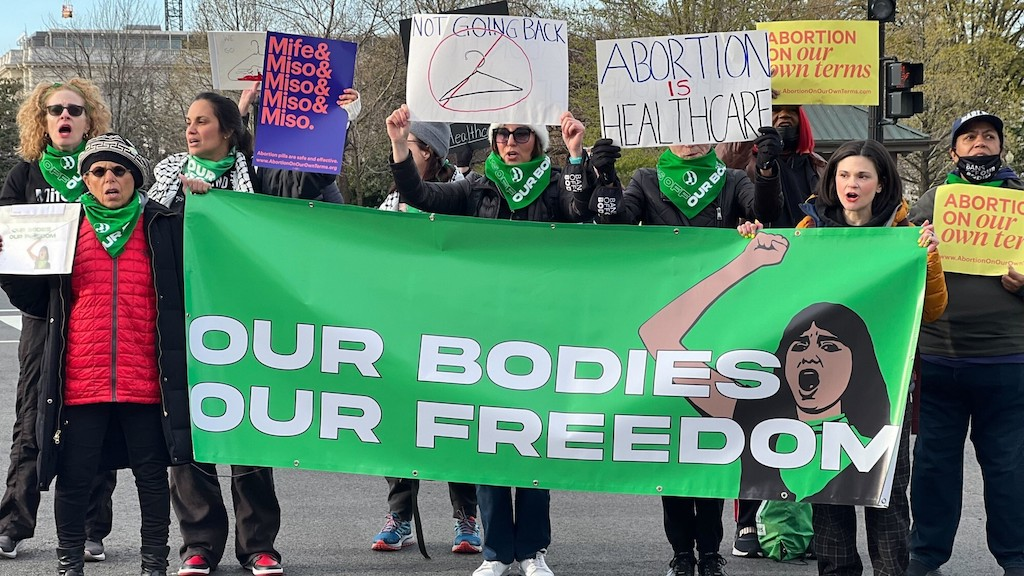
In November 2023, Ohio voters passed a reproductive rights amendment with 57% support.
“Ohio’s Attorney General evidently didn’t get the memo,” Jenkins wrote. “For even after a large majority of Ohio’s voters … presumably both women and men — approved an amendment to the Ohio Constitution protecting the right to pre-viability abortion on November 8, 2023, the Attorney General urges this court to leave ‘untouched’ all but one provision of the so-called ‘Heartbeat Act’ clearly rejected by Ohio voters.”
Hours after the Dobbs decision came down in June 2022, Ohio Attorney General Dave Yost asked a federal court reinstate the six-week abortion ban law, which was approved by the court quickly after the request was made. The ban included no exceptions for rape or incest.
GET THE OHIO CAPITAL JOURNAL MORNING HEADLINES.
Just as quickly, though, the law was then shoved back into court by abortion rights advocates. At first, advocates asked the Ohio Supreme Court to rule on the case, but after a period of inaction by the state’s high court, they chose to challenge the law locally, specifically in Hamilton County.
With the approval of the reproductive rights amendment in Ohio, attorneys had a new avenue to challenge the six-week ban. They used the language — which allowed abortion to the point of fetal viability, a determination to be made by the pregnant person’s physician, rather than at a point determined by state law — as a tipping point for arguments that the six-week ban was now unconstitutional. Fetal viability typically comes in a range between 24 to 26 weeks.
Yost pushed back, saying the reproductive rights amendment could not be used to negate any law or provision that was remotely related to abortion rights.
However, he also acknowledged it would be quite a battle to argue that the six-week ban did not violate the new constitutional amendment.
In a legal analysis on the reproductive rights amendment before the vote, that has often been used against him in the year since, Yost said the amendment “will make it harder for Ohio to maintain the kinds of law already upheld as valid prior to last year’s decision in Dobbs.”
“In other words, the Amendment would give greater protection to abortion to be free from regulation than at any time in Ohio’s history,” Yost wrote.
He went on to say that “many Ohio laws would probably be invalidated,” and that “others might be at risk to varying degrees.”
That included the so-called Heartbeat Act, according to him.
“Ohio would no longer have the ability to limit abortions at any time before a fetus is viable,” he wrote. “Passage of Issue 1 would invalidate the Heartbeat Act, which restricts abortions (with health and other exceptions) after a fetal heartbeat is detected, which is usually at about six weeks.”
Even so, Yost attempted to argue in the case that certain provisions included in the law should be allowed to stand.
Jenkins disagreed, saying the state constitution “now unequivocally protects the right to abortion” and that “to give meaning to the voice of Ohio’s voters, the Amendment must be given full effect, and laws such as those enacted by (Senate Bill) 23 must be permanently enjoined.”
He said that if Ohio courts adopted the state’s arguments, Ohio doctors who provide abortion care would continue to be at risk of felony criminal charges, $20,000 fines, medical license suspensions and renovations, and civil claims for wrongful death.
“Patients seeking abortion-care would still be required to make two in-person visits to their provider, wait twenty-four hours to receive abortion care, receive state-mandated information designed to discourage abortion and have the reason for their abortion recorded and reprinted,” Jenkins wrote. “Unlike the Ohio Attorney General, this Court will uphold the Ohio Constitution’s protection of abortion rights. The will of the people of Ohio will be given effect.”
ACLU of Ohio cooperating attorney Jessie Hill, who led the legal challenge in the case, called the ruling “momentous” and a show of “the power of Ohio’s new Reproductive Freedom Amendment in practice.”
Dr. Sharon Liner, medical director for Planned Parenthood Southwest Ohio Region and one of the parties in the case, said the ruling was “an important step in the right direction for access.”
“The permanent blocking of the six-week ban brings us one step closer to getting our patients the access they deserve,” Liner wrote in a statement.
A spokesperson for Yost’s office said in a Friday morning statement that the state has up to 30 days to “determine next steps.”
“This is a very long, complicated decision covering many issues, many of which are issues of first impression,” spokesperson Hannah Hundley told the Capital Journal.
Ohio Right to Life and the Center for Christian Virtue were contacted and have not yet provided a response.
Asked if Gov. Mike DeWine had any comment on the ruling, a spokesperson stated, “No.”
Susan Tebben
Susan Tebben is an award-winning journalist with a decade of experience covering Ohio news, including courts and crime, Appalachian social issues, government, education, diversity and culture. She has worked for The Newark Advocate, The Glasgow (KY) Daily Times, The Athens Messenger, and WOUB Public Media. She has also had work featured on National Public Radio.
Ohio Capital Journal is part of States Newsroom, the nation’s largest state-focused nonprofit news organization.
Ohioans for a Healthy Economy Action Fund recently started running an attack ad against the three Democratic candidates running for Ohio Supreme Court.
A conservative group heavily funded by Republican megadonor Richard Uihlein — who has supported candidates who falsely denied the results of the 2020 election — donated half a million dollars to a PAC with ties to the Ohio Chamber of Commerce over the summer, according to recently published Federal Election Commission data.
The Fair Courts America PAC gave $500,000 to Ohioans for a Healthy Economy Action Fund back in August, the Super PAC affiliated with Ohioans for a Healthy Economy, Inc which recently started running an attack ad against the three Democratic candidates running for Ohio Supreme Court.
“Criminals let loose. Destroying lives. Even our children aren’t safe because Melody Stewart, Michael Donnelly and Lisa Forbes put their agenda above our safety,” the voice over says in the ad.
Incumbent Democratic Justice Donnelly is being challenged by Republican Hamilton County Court of Common Pleas Judge Megan Shanahan.
Incumbent Democratic Justice Stewart is being challenged by incumbent Republican Justice Joseph Deters, who decided not to run for his current seat and instead chose to go up against Stewart for a full six-year term.
Democratic Judge Forbes, of the Eighth District Court of Appeals, and Republican candidate Dan Hawkins, of the Franklin County Court of Common Pleas, are competing for Deters’ open seat, a term that expires on Dec. 31, 2026.
“Fair Courts America is basically just moving its money to this group in Ohio, which is then spending on the ads,” said Evan Vorpahl, a senior researcher at True North Research.
Republicans currently have a 4-3 majority on the Ohio Supreme Court. Depending on the outcome of the election, the Democrats could flip the court or the Republicans could strengthen their hold on the court.
Fair Courts America and Richard Uihlein
Fair Courts America formed in February 2022 and has spent millions of dollars on various state Supreme Court races — including Alabama, Wisconsin, Pennsylvania, Kentucky and Illinois.
Fair Courts America is affiliated with Richard Uihlein’s Restoration of America. Uihlein also donated $333,000 to Fair Courts America on two occasions recently — Aug. 28 and Sept. 19.
Fair Courts America and Restoration of America did not respond to questions sent by the Capital Journal.
Last year, he donated more than a million dollars to the failed campaign that was trying to make it harder to amend the state’s constitution. He helped finance the majority of the group “Protect Our Constitution” during last year’s August Special Election. 57% of Ohioans voted against the measure that would have raised the threshold to amend the state’s constitution to 60%.
Uihlein is a big funder of Club for Growth Action, which has run millions in ads backing Bernie Moreno for Senate and helped fund a Super PAC that supported Ohio Secretary of State Frank LaRose’s failed Senate primary campaign earlier this year.
Uihlein is opposed to abortion and has invested in many anti-abortion causes, Vorpahl said.
GET THE OHIO CAPITAL JOURNAL MORNING HEADLINES.
“For someone like Uihlein, Ohio and the Ohio Supreme Court seem right for the picking,” said Jessica Dickinson, the Ohio Fair Courts Alliance’s Outreach and Elections Manager. “I think especially since we’ve had partisan labels to the ballot … even though the abortion amendment passed, they’ve really been making those inroads into Ohio.”
“Powerful people have always tried rigging the rules in their favor, and they are targeting state and federal courts,” Vorpahl said. “They’re trying to take America backwards and control who we can be, who we can love, how we can care for our bodies, our families and the world. And they’re ultimately just trying to put their thumbs on the scales of justice with their fortunes.”
Uihlein has contributed to some extreme causes in recent years. The Chicago Tribune reported he was a big contributor to the “March to Save America” rally that took place before the deadly attack on the U.S. Capitol on Jan. 6, 2021.
A Daily Beast report published in November 2022 said Uihlein and his wife Elizabeth have donated almost $2 million to Republicans since the Jan. 6 insurrection and more than 80% of those candidates denied or questioned the 2020 election results.
Richard and Elizabeth started Uline — a shipping, packaging and industrial supplies company that started in their basement in 1980. Richard is the CEO and their company has more than 9,000 employees.
Ohioans for a Healthy Economy
COLUMBUS, Ohio — APRIL 20: The Ohio Chamber of Commerce in Columbus, Ohio. (Photo by Graham Stokes for Ohio Capital Journal)
Ohioans for a Healthy Economy Action Fund seems to be a shell group for the Ohio Chamber of Commerce, Dickinson and Vorpahl said.
The address listed for Ohioans for a Healthy Economy Action Fund is the same as the address for the Ohio Chamber of Commerce, according to a Federal Election Commission form.
The Ohio Chamber of Commerce and Ohioans for a Healthy Economy Action Fund also did not respond to questions sent by the Capital Journal.
Ohioans for a Healthy Economy Action Fund also ran ads during the 2018, 2020 and 2022 Ohio Supreme Court races, Dickinson and Vorpahl said.
The Ohio Chamber of Commerce endorsed Deters, Shanahan and Hawkins for Ohio Supreme Court.
“It’s about keeping their preferred judges on the bench,” Dickinson said. “Business entities and billionaires in these corporations want to keep the court’s current majority because it’s good for business.”
Megan Henry is a reporter for the Ohio Capital Journal and has spent the past five years reporting in Ohio on various topics including education, healthcare, business and crime. She previously worked at The Columbus Dispatch, part of the USA Today Network.
Ohio Capital Journal is part of States Newsroom, the nation’s largest state-focused nonprofit news organization.
Opponents of Ohio’s Issue 1 redistricting reform claim it would be bad for communities of color. Supporters of the proposal to replace politicians with a citizens commission point to the ways the current maps crack and pack Black voters.
The Issue 1 proposal would replace the current Ohio Redistricting Commission made up of seven elected officials with a 15-member commission made up of citizens.
The current commission includes the Ohio governor, auditor, and secretary of state, along with four lawmakers — one from each party in each chamber of the legislature. The 15-member citizens commission being proposed would be made up of five Republicans, five Democrats, and five independents, selected by a bipartisan panel of former judges.
Voting yes on Issue 1 would create the 15-member Ohio Citizens Redistricting Commission. Voting no on Issue 1 would keep the current Ohio Redistricting Commission.
Arguments for and against the ballot initiative have been targeted at communities of color, with both sides saying minority representation will be affected by the results of Issue 1.
In a press conference at the Ohio Statehouse, state Sen. Michele Reynolds, R-Canal Winchester, brought former legislator John Barnes and two other Ohioans to urge voters to reject the ballot measure, claiming the changes “could fragment cohesive minority voting blocks, diluting our political influence.”
“I am deeply concerned about the disastrous effects that Issue 1 will have on the Black state legislative and congressional districts in Ohio,” said Reynolds, who is one of five Black members of the 33-member Ohio Senate, and the only Republican.
One of the Democratic members, state Sen. Catherine D. Ingram, who is also vice president of the Ohio Legislative Black Caucus, responded to Reynold’s press conference by saying Issue 1 “would ensure fair maps are drawn and expand opportunities for greater representation across our state, beyond the areas that have historically confined us.”
“For generations, Black Americans have faced disenfranchisement, and gerrymandering adds an additional barrier to our adequate representation,” Ingram said in a statement.
Issue 1 would create a 15-person citizens redistricting commission to replace the current commission. After a vetting process by a bipartisan panel of judges, the selected citizen commissioners would be required to hold public hearings and conduct the drawing of Statehouse and congressional maps in a transparent process, and create maps that receive a majority vote of the commission.
Drawing the maps would require adherence to federal laws like the Voting Rights Act and the statewide partisan preferences of the voters of Ohio.
The current process
In 2021 and 2022, Republican partisans on the commission produced five Ohio Statehouse maps and two U.S. Congressional district maps that were struck down as unconstitutionally gerrymandered by a bipartisan majority on the Ohio Supreme Court.
Despite the fact that the congressional map was never revised to correct the errors found by the state’s highest court, it is the map being used for the 2024 election.
A recent League of Women Voters of Ohio analysis of the current congressional map found that in Massillon, what’s considered a “large politically cohesive African American population” was split between the 6th and 13th Congressional districts.
“Rather than keeping this clear community of interest united in one congressional district, mapmakers sliced Massillon into two pieces, specifically cutting off areas with large concentrations of minority voters from each other,” according to research analysis done by University of Cincinnati professor David Niven.
Niven called the one-third of Stark County voters put in the 6th district “castaway voters,” citing research that said being a “castaway” voter “inhibits political information flows, mobilization and ultimately, representation.”
“The political consequences of landing on the other side of those lines are powerful,” Niven wrote.
The boundary-drawing of certain current congressional districts are “inexplicable” and “drawn in service of confusion not representation,” according to Niven’s research.
The 1st district, for example, borders the 8th district in a “textbook gerrymandering maneuver — dividing a neighborhood and town and causing confusion on who lives in which district, serving no legitimate purpose,” Niven wrote.
“Here’s a congressional district where people on the southern end of the district live in the shadow of Ohio’s third largest city with all its urban needs and opportunities, and people on the northern end have a local government that advertises when someone loses their mittens in the park,” Niven stated.
Cracking and packing
Voting rights advocates tend to agree with this assessment, saying the splitting of communities means less visibility, and less visibility means a lack of attention from people who purport to represent them.
“What we’ve seen with supermajorities is communities are left out of conversations,” said Deidra Reese, director of voter engagement for the Ohio Organizing Collaborative and supporter of Issue 1. “Those issues that are coming from communities that have a smaller presence in those bodies just don’t get to have those issues elevated.”
Important issues in communities of color, like in other communities, can include things like health care, economic issues, gun law reform and hunger. Without competitive districts that create the need for representatives and senators to engage with constituents of all kinds, Reese said legislation won’t match what is needed.
“When you shut the door on people when you pass policies … it’s a disservice and what happens is African Americans just don’t get representation,” Reese said.
Infant and maternal mortality rates were noted as a big concern for Black communities, which see disproportionate rates compared to their white counterparts.
The LWV analysis showed some congressional districts combine those two vastly different mortality rates, like the 9th, 12th and 2nd districts. The 9th district holds Lucas County, with one of the highest rates of infant mortality and Wood County, one of the lowest. The 12th district includes the high rates in Holmes County, and the low rates in Guernsey County. Ohio’s 2nd district has Lawrence County’s high infant mortality rates and Scioto County’s low rates.
“Again, this data begs an essential question,” the LWV study ponders, “How could any elected leader craft policy solutions for their constituencies, when the needs within their sprawling, contorted districts are so far apart?”
Kayla Griffin, president of the Cleveland branch of the NAACP, said the fact that the district maps are still unfair despite previous legislative redistricting reforms in 2015 and 2018 leaves questions about how closely the process was even followed by the elected officials on the Ohio Redistricting Commission.
“I think that becomes a serious problem that erodes the trust and the democracy that we have,” Griffin said.
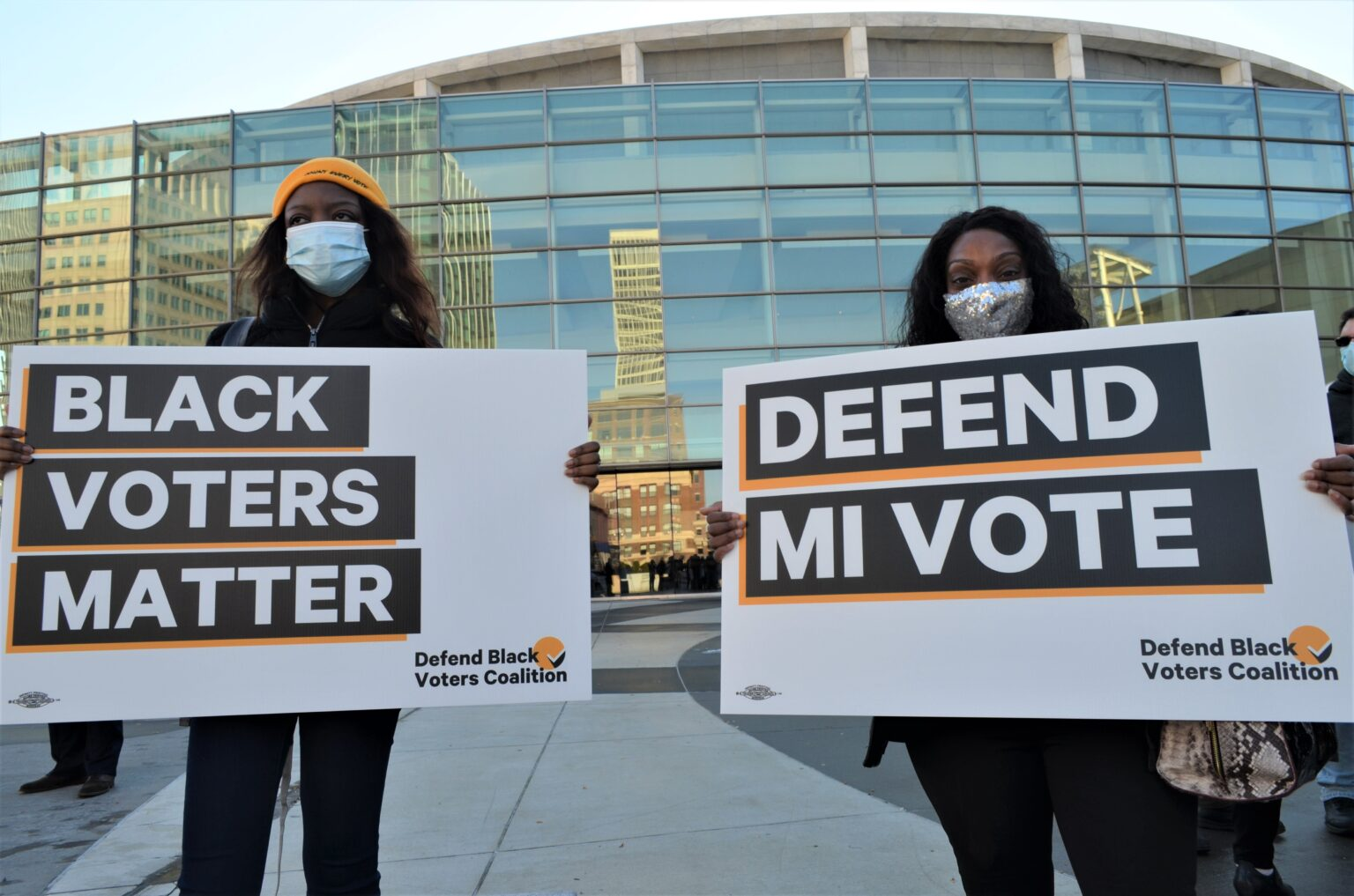
An even bigger problem that Griffin and other advocates are dealing with is the concern from many Black voters that their vote doesn’t hold weight under the current maps, and therefore won’t make much different in the November general election.
Those talking to voters are trying to focus on the wins, most notably the rejection of a constitutional amendment to make it harder to amend the state’s founding document, and the approval of a ballot initiative that enshrined reproductive rights into that same constitution.
“That is how our vote counts, that is how our voices are heard.” Griffin said. “I’m letting folks know that we can do this again.”
YOU MAKE OUR WORK POSSIBLE.
__________________
Susan Tebben
Susan Tebben is an award-winning journalist with a decade of experience covering Ohio news, including courts and crime, Appalachian social issues, government, education, diversity and culture. She has worked for The Newark Advocate, The Glasgow (KY) Daily Times, The Athens Messenger, and WOUB Public Media. She has also had work featured on National Public Radio.
Ohio Capital Journal is part of States Newsroom, the nation’s largest state-focused nonprofit news organization.
More than half a million Ohioans have cast their ballot in the election so far, as of Friday morning.
Combining absentee and early voting, more than 660,000 Ohioans have voted as of Friday morning, according to the Ohio Secretary Of State.
A majority have been through early voting, which takes place at your local county Board of Elections. Early voting began on Oct. 8 and 433,413 Ohioans have voted early.
More than 34,000 people have voted early so far in Franklin County, the state’s most populous county. In Hamilton County, 25,506 people have voted early so far. Nearly 16,000 people have voted early in Cuyahoga County.
There were 1.1 million absentee ballots requested by mail and 234,786 ballots have been returned. Those who requested an absentee ballot tend to skew older, with about a million of those requests coming from Ohioans 55 and older.
More than 800,000 of those who requested an absentee ballot are Independents. Nearly 400,00 Republicans and nearly 300,000 Democrats requested an absentee ballot.
Absentee ballot applications are due to your local board of elections Oct. 29 by 8:30 p.m. and mailed absentee ballots must be postmarked by Nov. 4.
Election Day is Tuesday Nov. 5 and polls are open from 6:30 a.m. to 7:30 p.m. You can find your local polling location here.
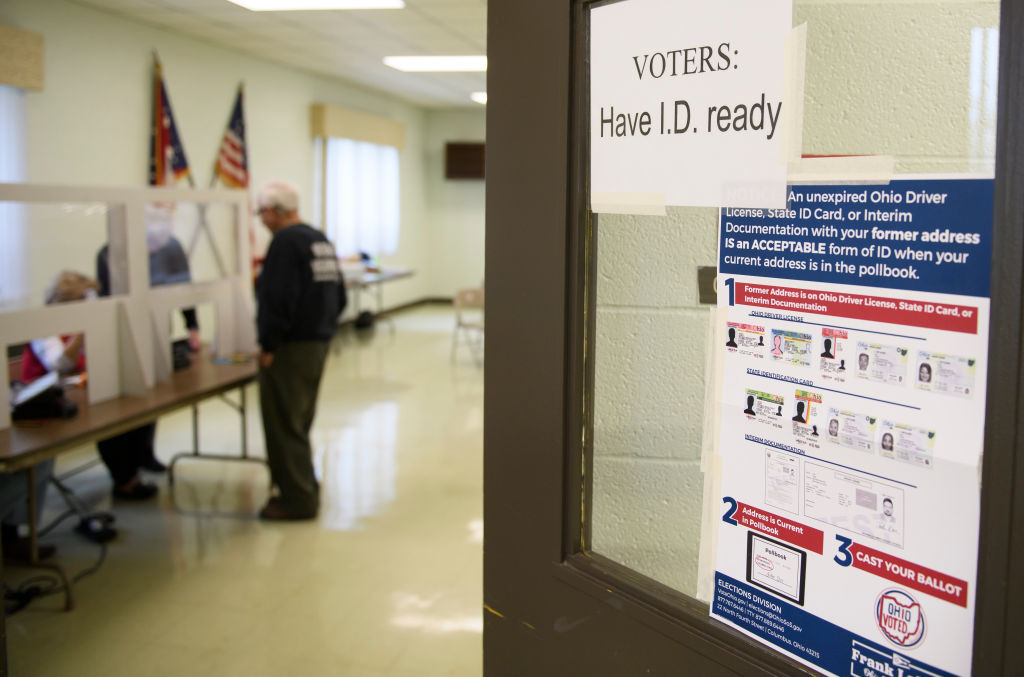
Voters must have a photo ID to vote in person. This could be a valid Ohio driver’s license, a U.S. passport, a military ID, an Ohio ID card, an interim ID form issued by the Ohio BMV, an Ohio National Guard ID card or a U.S. Department of Veterans Affairs ID card.
There are more than 8 million registered voters in Ohio, according to the Ohio Secretary Of State.
Megan Henry is a reporter for the Ohio Capital Journal and has spent the past five years reporting in Ohio on various topics including education, healthcare, business and crime. She previously worked at The Columbus Dispatch, part of the USA Today Network.
Ohio Capital Journal is part of States Newsroom, the nation’s largest state-focused nonprofit news organization.
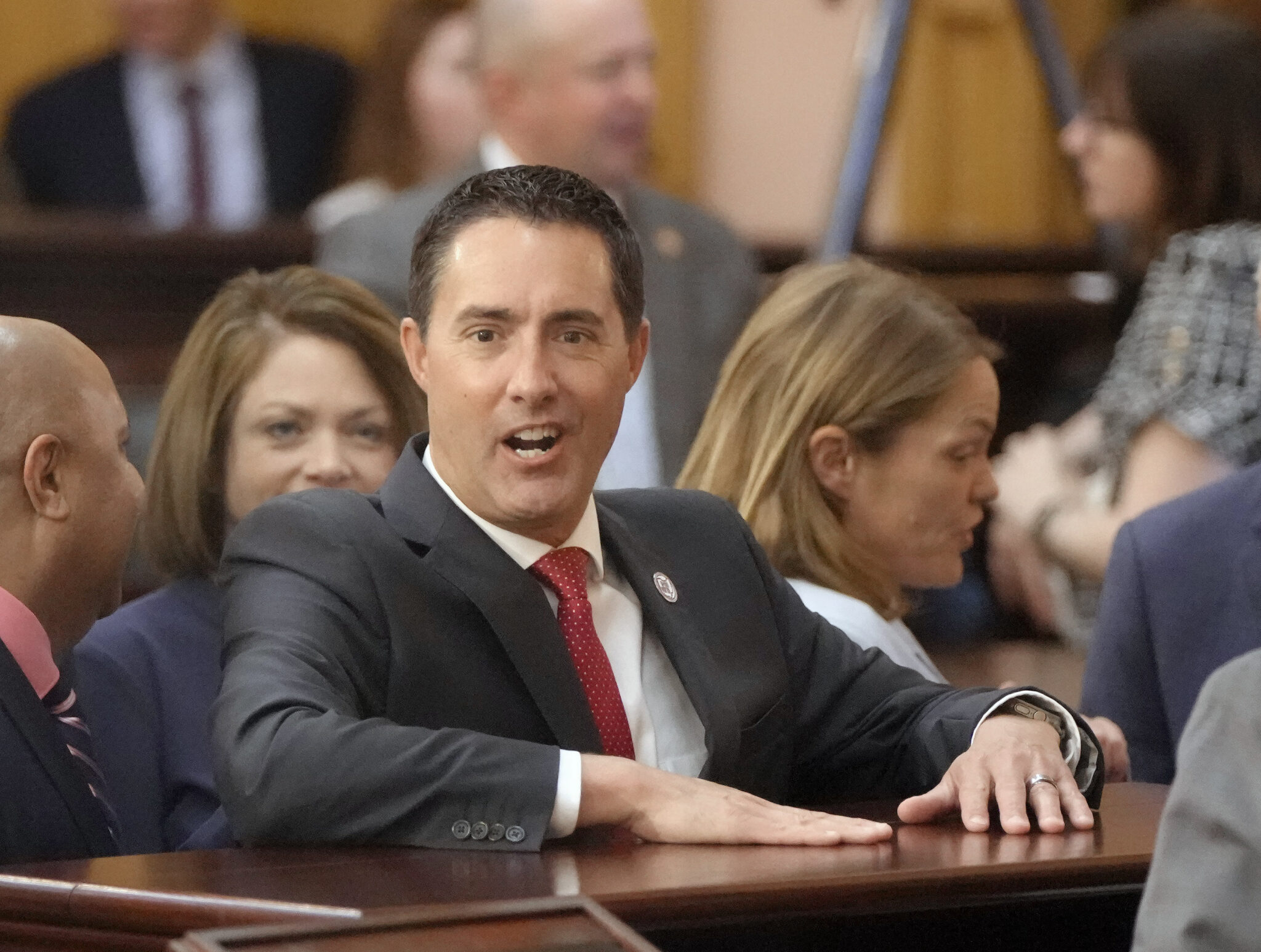
Ohio Secretary of State Frank Larose mingles before the 2024 State of the State address in the Ohio House chambers at the Ohio Statehouse. (Pool photo by Barbara J. Perenic, Columbus Dispatch.)
Ohio elections chief last year allowed the group to manipulate ballot language
Ohio Secretary of State Frank LaRose has provided an announcement on election integrity “exclusively” to anti-abortion Ohio Right to Life, the group said in a Monday press release. It contains a link to a YouTube video in which LaRose talks about how Ohio elections are safe because the nuts and bolts of the process are overseen at the local level by officials from both parties.
LaRose’s office didn’t respond to questions for this story.
In the video, the secretary of state repeated his saying that in Ohio, “it’s easy to vote and hard to cheat.” And he lays out several reasons why it’s hard at least for voters themselves to cheat.
LaRose explains that county boards of election are each run by two Republicans and two Democrats and that voting machines are “airlocked,” meaning they’re never connected to the internet and thus not vulnerable to hacking. LaRose added that even access to the machines has to be on a bipartisan basis.
“The voting machines are under bipartisan surveillance and they’re kept in a storage system with dual locks and keys that require a Republican key to open the door and a Democratic key to make sure that both parties are present,” he said.
LaRos later added, “We take election integrity seriously here in Ohio.”
As of last year, LaRose had forwarded 521 cases of possible noncitizen voting for prosecution over five years. That resulted in just one prosecution for voter fraud.
In addition, in the video he recorded for Right to Life, LaRose said that audits comparing electronic vote results to paper backups have been correct more than 99.9% of the time since he took office at the beginning of 2019.
Despite the lack of a statistical case that there’s a problem, LaRose has taken aggressive steps that he says will protect election integrity.
For example, he’s purged hundreds of thousands of Ohioans from the registration rolls. Many were eligible voters who were purged for not voting in recent cycles even though critics point out that there’s no constitutional basis to argue that just because a citizen hasn’t voted in some past elections he or she is ineligible.
A progressive watchdog group, Dēmos, found that LaRose’s office has some of the worst practices for ensuring that eligible voters aren’t improperly purged from the Ohio rolls. And civil rights advocates say Ohio’s purges disproportionately target voters of color, who tend not to vote for the GOP, LaRose’s party.
On the issue of citizen-proposed constitutional amendments, as chair of the Ohio Ballot Board, LaRose has significant control over the description of an amendment that appears on the ballot — in other words, what voters read when they enter the voting booth.
He’s under intense fire this year for the language he used to describe the Issue 1 amendment aimed at removing elected officials from the process of drawing maps of Ohio’s legislative and congressional districts in favor of a citizens commission.
In 2021 and 2022, LaRose and the other Republicans on the Ohio Redistricting Commission ignored seven bipartisan rulings by the Ohio Supreme Court that said the maps they drew violated earlier anti-gerrymandering amendments that were passed by huge majorities of Ohioans.
The proposed amendment that will appear on the November 2024 ballot is meant to be more water-tight than the earlier ones by removing politicians from the process, replacing them with citizens, and retaining a ban on partisan gerrymandering. But LaRose wrote ballot language that opponents say is intended to sway voters against the amendment, which LaRose publicly opposes.
Marty Schladen has been a reporter for decades, working in Indiana, Texas and other places before returning to his native Ohio to work at The Columbus Dispatch in 2017. He’s won state and national journalism awards for investigations into utility regulation, public corruption, the environment, prescription drug spending and other matters.
Ohio Capital Journal is part of States Newsroom, the nation’s largest state-focused nonprofit news organization.