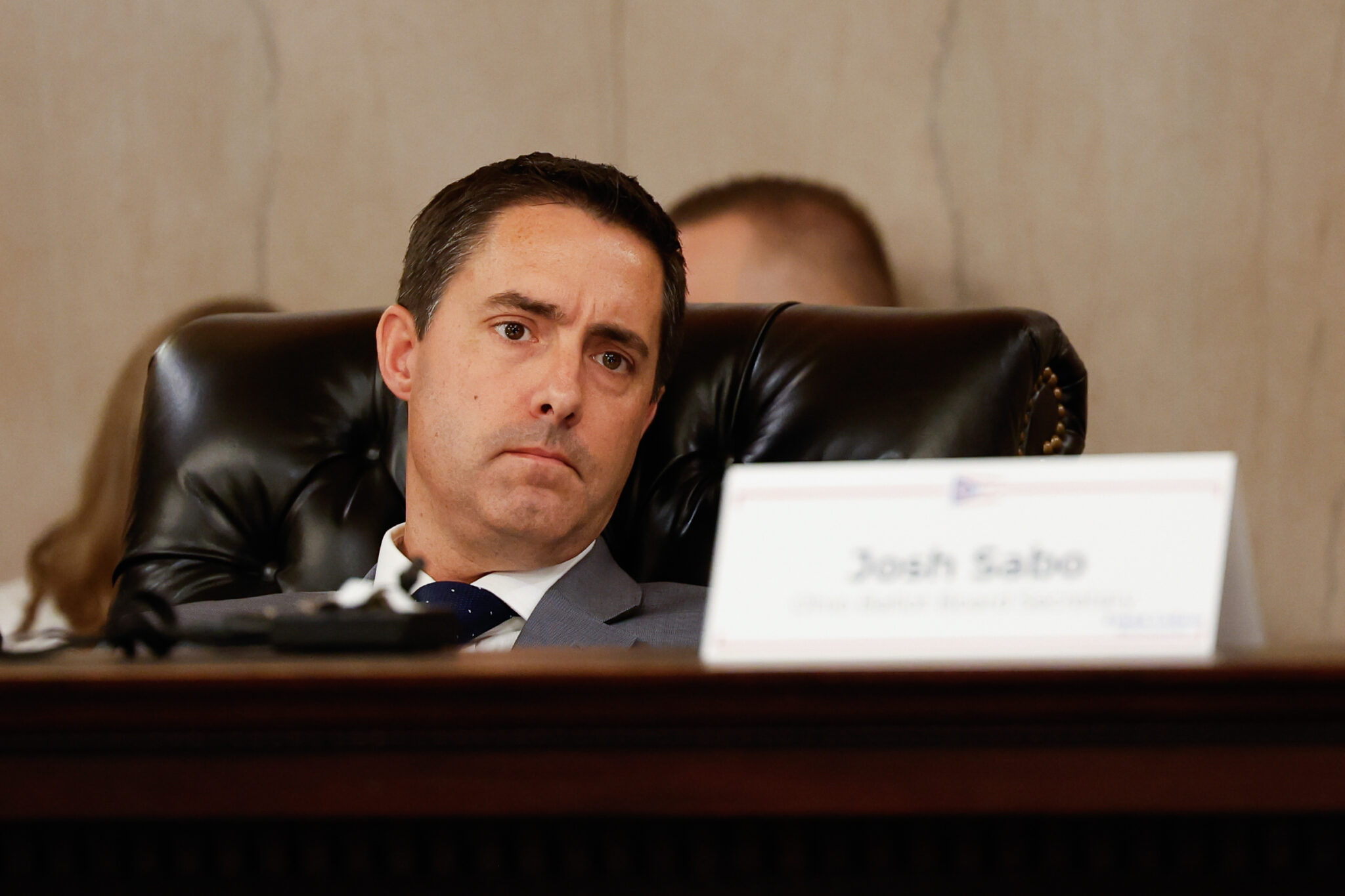
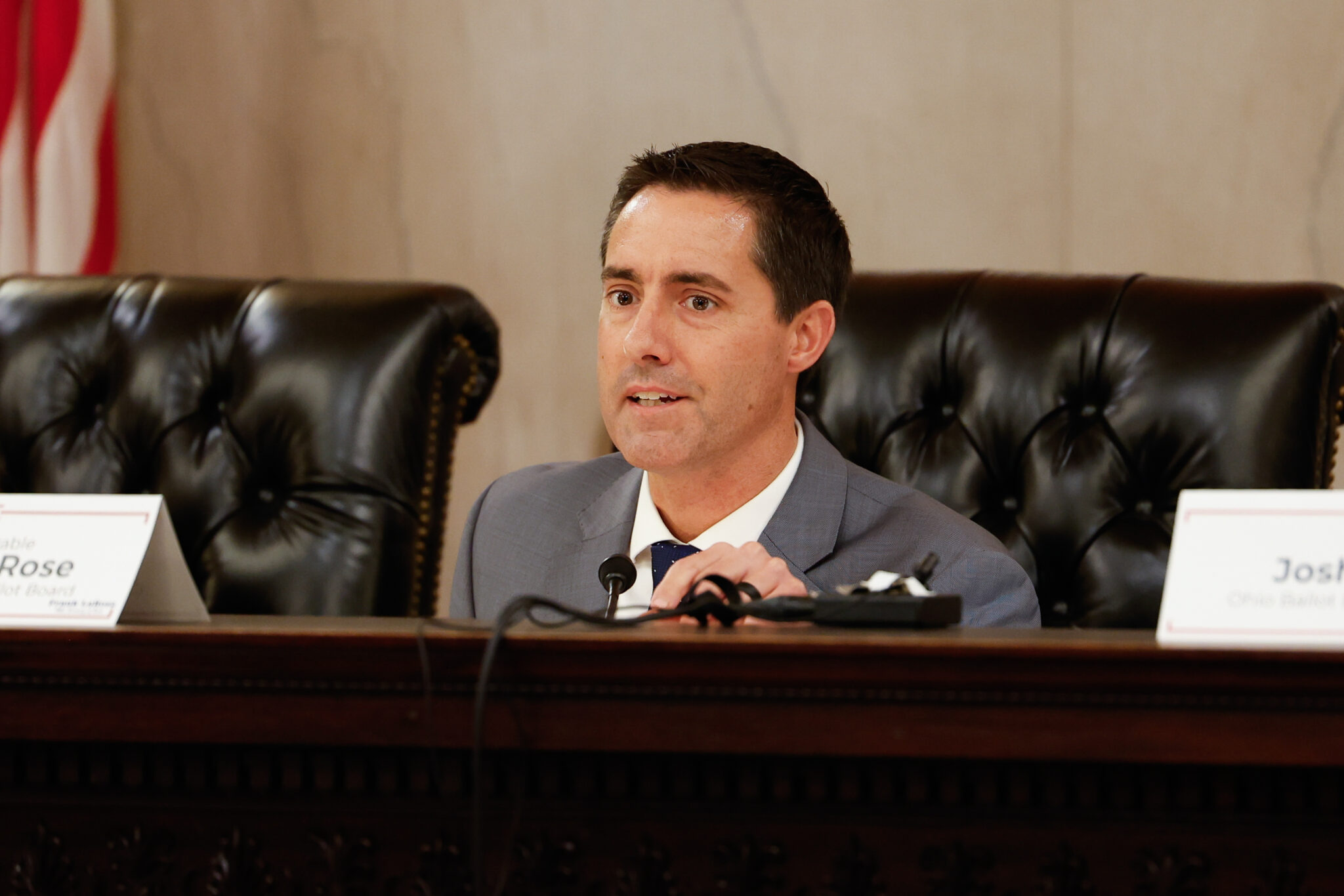
A bill that would raise Ohio’s minimum wage was rolled out for the first time to the Senate Workforce and Higher Education Committee Wednesday afternoon during sponsor testimony.
Ohio Sens. Kent Smith, D-Euclid, and Hearcel Craig, D-Columbus, introduced Senate Bill 146, which would gradually increase the state’s minimum wage $1 each year until it was up to $15. Under the bill, minimum wage would increase to $12 an hour starting in 2024; $13 starting in 2025; $14 starting 2026; and $15 in 2027.
“From that point forward, the minimum wage would annually adjust based upon the inflation rate,” Smith said in his testimony.
With only Democratic co-sponsors in the Republican supermajority chamber and Statehouse, prospects for the bill are slim. Ohio’s current minimum wage is $10.10 per hour for non-tipped workers and tipped employees earn half the state’s minimum wage, plus tips. This bill would eliminate the tipped worker distinction, automatically increasing their pay to minimum wage.
Eight states have nixed the tipped minimum wage, Smith said.
“Ending the tipped working penalty and creating an economy where workers do not have to work 76 hours a week to cover basic expenses is good for Ohio families,” he said in his testimony.
An Ohioan without children must earn $15.33 an hour to have a living wage in Ohio, according to the MIT Living Wage Calculator.
For housing, full-time workers need to make at least $19.09 an hour to afford a 2-bedroom apartment in Ohio — a $2.04 increase from last year, according to a joint report from the Coalition on Homelessness and Housing in Ohio (COHHIO) and the National Low Income Housing Coalition (NLIHC).
“An artificially low minimum wage has kept too many Ohioans trapped in a cycle of poverty: taking on another minimum wage job, unable to move up, while losing buying power,” Craig said in his testimony. “Raising the minimum wage to $15 by 2027 would give over a million Ohioans a raise that is long overdue while allowing people to lift themselves out of poverty.”
Tipped workers
Committee Chair Sen. Jerry Cirino, R-Kirtland, questioned the need to get rid of the tipped worker distinction.
“We all know that the reason we have that difference is because they are getting tips, presumably if their service is good and people are feeling generous,” he said.
He explained how his grandchildren who work in restaurants while going to college earn good tips.
“It has to do with service levels and performance,” Cirino said. “If you are a good wait server, you are going to get good tips.”
Smith responded by saying that while tipped workers are disproportionately young, one in four are over the age of 40.
“Tipped workers are nearly twice as likely to live in poverty as non-tipped workers,” he said.
Benefits cliff
Cirino and Sen. Michael Rulli, R-Salem, questioned if raising the minimum wage would cause a benefits cliff, meaning a decrease in public benefits that can happen with a small increase in earnings.
Rulli told a brief story about how he had used to have an assistant deli manager who was a single mom with three kids at home who was a hard worker, so he rewarded her with raises. Eventually, she resigned.
“She started making so much money with me that the state took all her benefits away and she was behind the eight ball,” he said.
Megan Henry is a reporter for the Ohio Capital Journal and has spent the past five years reporting in Ohio on various topics including education, healthcare, business and crime. She previously worked at The Columbus Dispatch, part of the USA Today Network.
One might think that a movement associated with a former state Supreme Court chief justice could draft a petition summary that passes legal muster. But twice already, Ohio Attorney General Dave Yost has rejected summaries of a petition to put an anti-gerrymandering amendment on Ohio’s November 2024 ballot.
So far, nobody’s explicitly accusing Yost of deliberately slow-walking approval of the anti-gerrymandering amendment, but frustration is growing — and one advocate of redistricting reform pointed out that further delays can become critical quickly.
“The slower this goes, there are increasingly serious consequences,” said Catherine Turcer, executive director of Common Cause Ohio, which supports the amendment.
Ohio’s legislative and congressional districts are highly gerrymandered. While Donald Trump carried the state by less than eight percentage points in 2020, Republicans control 68% of seats in the state House, 78% in the state Senate and 66% of the state’s seats in the U.S. House of Representatives.
Ohio voters apparently didn’t want things to be this way. In 2015 and 2018, redistricting amendments to curb extreme partisan gerrymandering in the legislature and Congress both passed with more than 70% of the vote.
But since the 2020 Census, seven sets of maps passed by the Republican-dominated Redistricting Commission have been rejected by the Ohio Supreme Court. By effectively running out the clock, the districts rejected by the court are still in effect.
Former Chief Justice of the Supreme Court of Ohio Maureen O’Connor. (Photo by Graham Stokes for Ohio Capital Journal. Republish photo only with original story.)
Former Chief Justice Maureen O’Connor, a Republican, voted with the court’s three Democrats to reject the GOP-drawn maps, until she was forced to retire because of her age in 2022. Now she’s working with the group Citizens Not Politicians to put another constitutional amendment on the ballot.
She says this one will close loopholes by creating a truly independent redistricting commission made of up of citizens that won’t place a partisan thumb on the scales.
It would ban partisan gerrymanders and create a 15-member commission of Republicans, Democrats and independents to draw the lines. Current and former officeholders, lobbyists and large donors would be banned from sitting on it.
Despite the claims made by GOP leaders during their August attempt to restrict citizen access to the process, voter-initiated amendments to the Ohio Constitution are anything but easy.
First activists have to draft a proposed amendment and a summary of it, gather 1,000 signatures from registered voters and submit them to the attorney general. If the Ohio Attorney General approves the petition summary as accurate, then they have to gather more than 400,000 signatures from registered voters — with a percentage coming from each of 44 of the state’s 88 counties.
And, because many signatures are typically disqualified, proponents try to gather hundreds of thousands more than the minimum. It’s an intensive, costly, time-sensitive process.
Two petition summary rejections and a third submission in waiting
So far, Citizens Not Politicians has twice had its petition summaries rejected.
On Aug. 23, Attorney General Yost rejected the first summary, citing nine instances of “omissions and misstatements.”
For example, the summary said that a bipartisan panel appointing commissioners would hire a professional search firm to “assist” it. But the proposed amendment says that the consulting firm would “solicit applications for commissioner, screen and provide information about applicants, check references, and otherwise facilitate the application review and applicant interview process.”
The summary was, well, too summary, Yost ruled.
“The summary thus diminishes the actual role of the search firm in the application process, by merely stating the search firm would ‘assist’ the panel,” the ruling said.
Then after listing specific shortcomings the attorney general found in the first summary, the letter made a statement that made it seem all but certain that a second attempt would fail as well.
“The above instances are just a few examples of the summary’s omissions and misstatements,” it said.
A spokeswoman for Yost didn’t respond when asked why the attorney general didn’t specify the other problems he found with the petition summary. She also didn’t respond to a question asking whether Yost, who is eyeing a run for governor, believes extreme partisan gerrymandering is a problem in the United States.
Citizens Not Politicians quickly gathered another 1,000 signatures and submitted a new summary. On Sept. 14, Yost rejected that as well, but this time he cited only one deficiency.
The summary didn’t explain that the proposed amendment lays out a specific method of determining the party affiliation of redistricting commission members, while the amendment would leave it to the GOP-controlled Ohio Ballot Board to determine the affiliations of members of the panel that would select those commissioners, Yost wrote.
“To be clear, a fair and truthful summary should articulate this distinction so that a signer can understand the Amendment’s true meaning and effect,” Yost’s letter said. “Otherwise, the summary misleads a signer into misbelieving that party affiliation is judged consistently and with the same objective criteria when it is not.”
Citizens Not Politicians submitted a third version of the summary language last Friday and Yost has until Oct. 2 to accept or reject it. The group was less than pleased with the latest ruling.
“We are disappointed and frustrated that the Attorney General has chosen to reject our petition summary for a second time,” its spokesman, Chris Davey, said in a statement. “We adjusted our summary language as the Attorney General requested on the first submission, and we know our summary language was accurate.”
The impacts of delays
Advocates of the gerrymandering amendment might seem like they have a long time to get their ducks in a row, but time can grow short quickly and delays can be disastrous for them.
It’s not perfectly analogous, but Yost played a role in another delay — one that helped kill an attempt to repeal the corruptly passed House Bill 6. That’s the bribery scheme in which Akron-based FirstEnergy paid more than $60 million and got a $1.3 billion ratepayer bailout in return. Former Ohio House Speaker Larry Householder, R-Glenford, is now serving a 20-year prison term for his role in the scandal, but somehow, HB 6 remains on the books.
The law was so objectionable that as soon as it passed in 2019, a strong effort at a voter-initiated repeal was announced.
Leaders of the attempted repeal had 90 days after the law’s enrollment to gather at least as many valid signatures as 6% of the number who voted in the most recent gubernatorial election — about 265,000 in 2019. But first, they had to submit a summary of the ballot language along with 1,000 valid signatures for review by the attorney general and the Ballot Board.
Yost rejected the first summary that was submitted and by the time a second was approved — along with another batch of 1,000 signatures — the repeal team had only 54 days left of the original 90 to submit more than a quarter-million valid signatures.
With 40% of the clock expired — and with FirstEnergy spending more than $30 million on a brutal, dishonest campaign to thwart the repeal — time ran out before circulators could gather enough signatures to get it on the ballot.
Anti-gerrymandering protest. (Photo by Olivier Douliery, Getty Images.)The timetable for the anti-gerrymandering isn’t nearly that compressed, but each passing week is crucial, Turcer, of Common Cause Ohio, said.
“It could be that this is standard operating procedure,” she said of the two rejections so far. “But it could slow things down so much that they can’t collect signatures during early voting and Election Day.”
She was referring to Nov. 7, when a closely watched abortion rights amendment is expected to draw many Ohioians to the polls. In-person early voting starts Oct. 11 — just 22 days away.
Turcer explained that early voting and Election Day are important for petition circulators because that’s when registered voters — the group eligible to sign petitions — are gathered at county boards of election during early voting and at polling places on Election Day.
Assuming Yost approves the summary language on Oct. 2, it still has to be approved by the Ballot Board and petition forms need to be printed.
“Citizen initiatives are incredibly challenging,” Turcer said. “But they’re much harder if you have a compressed time period.”
MARTY SCHLADEN
Marty Schladen has been a reporter for decades, working in Indiana, Texas and other places before returning to his native Ohio to work at The Columbus Dispatch in 2017. He’s won state and national journalism awards for investigations into utility regulation, public corruption, the environment, prescription drug spending and other matters.
A Franklin County judge has issued a temporary restraining order to block lawmakers’ attempts to overhaul Ohio’s K-12 education system.
Seven members of the Ohio State Board of Education filed a lawsuit against Ohio Gov. Mike DeWine Tuesday in the Franklin County Court of Common Pleas to stop the transfer of power from the Board to the governor’s office.
Christina Collins, Teresa Fedor, Kathleen Hofmann, Tom Jackson, Meryl Johnson, Antoinette Miranda, and Michelle Newman filed the lawsuit. They are being represented by Democracy Forward and Ulmer & Berne LLP.
Franklin County Judge Karen Held Phipps issued the temporary restraining order Thursday and will now go to a preliminary injunction hearing on Oct. 2, a day before the changes are scheduled to take effect.
“Creating a new cabinet-level agency is not a silver bullet and does not magically solve problems,” House Minority Leader Allison Russo, D-Upper Arlington, said in a statement. “Board members are elected on a non-partisan basis and because of that, expertise and experience in education is a big factor of who gets elected. With a governor appointee, there’s little doubt we’ll see an increase in partisan decision-making.”
What’s in the lawsuit?
The state’s operating budget, signed into law by DeWine, would rename the Ohio Department of Education to the Ohio Department of Education and Workforce. It would create a cabinet-level director position, put the department under the governor’s office and limit the State Board of Education’s power to teacher disciplinary and licensure cases and territory disputes.
“If unchecked by this Court, the system Ohio’s citizens mandated for governing education in Ohio will be rendered virtually powerless,” the lawsuit reads. “The bill strips the Board’s democratically elected members of their core and constitutionally intended duties and responsibilities for the oversight and governance of Ohio’s public education system.”
The plaintiffs are asking the court to grant a temporary, preliminary and permanent relief to stop the changes from going into effect, remove this piece of legislation from the state budget and strike it void.
The Ohio State Board of Education is currently made up of 19 members — 11 elected and eight appointed by Gov. DeWine.
Under the changes, the plaintiffs fear parents and students won’t be able to voice “their support for or opposition to developments in education policy.”
Democratic Senators Nickie J. Antonio, Catherine Ingram, Vernon Sykes, and Paula Hicks-Hudson all support the lawsuit.
“This lawsuit is an opportunity to restore the voice of all Ohioans through protecting the duties and powers of their state board of education members,” Antonio said in a statement.
Senate Bill 1
These changes to the Ohio Department of Education and State Board of Education started out as Senate Bill 1, which Sen. Bill Reineke, R-Tiffin, introduced in January.
“In fear that the Senate Bill 1 power grab would not pass on its own merits, the Majority chose to circumvent the process by including it in the biannual budget, violating the single subject rule,” Hicks-Hudson said in a statement. “In doing so, they also chose to disenfranchise duly elected representatives to the Board of Education.”
These seven board members previously wrote a letter to DeWine the day he received the budget and asked him to veto the “power grab” of changing the the state board’s roles.
Constitutional violations
The plaintiffs in the lawsuit argue these changes to the State Board of Education and ODE violate the state constitution.
“When SB 1 could not pass as standalone legislation, the Education Takeover Rider was attached to HB 33 at the eleventh hour to ensure that the rider became law nonetheless,” the lawsuit reads. “This practice — known as logrolling — is prohibited by … the Ohio Constitution.”
Phipps said “the Court finds it necessary to address only” the logrolling argument, according to court documents.
Ohio voters passed a constitutional amendment in 1953 that created a State Board of Education with the power to appoint a Superintendent of Public Instruction.
The Ohio Constitution also has the three-reading rule, which means a bill should be considered by each house on three different days.
“The Education Takeover Rider was not considered by each house of Ohio’s General Assembly on three different days,” the lawsuit says.
Megan Henry is a reporter for the Ohio Capital Journal and has spent the past five years reporting in Ohio on various topics including education, healthcare, business and crime. She previously worked at The Columbus Dispatch, part of the USA Today Network.
The Ohio Supreme Court has ordered one tweak to summary language approved by Republicans on the Ohio Ballot Board for voters to see in November on a proposed reproductive rights amendment. The split state supreme court rejected using the full text of the proposed amendment and declared that that summary language that voters will see on their ballots is not misleading.
That summary language was written by the office of Ohio Secretary of State Frank LaRose, a Republican ballot board member who has spoken out against November’s Issue 1 reproductive rights amendment proposal, and campaigned vigorously for August’s Issue 1 proposal to make amendments harder to pass, saying that the Aug. 8 effort was “100% about keeping a radical pro-abortion amendment out of our constitution.” Issue 1 in August was rejected by voters 57% to 43%.
The coalition proposing November’s reproductive rights amendment sued to the Ohio Supreme Court claiming that the summary language is deceptive and asking the full amendment text be used instead.
They argued that the summary makes changes advocates say alter the language in a biased way, such as using “unborn child” rather than the medically accurate term “fetus,” and changing “pregnant patient” to “pregnant woman.” The summary also only lists 1 of 5 protected rights included in the amendment, focusing on abortion and failing to mention contraception, miscarriage care, fertility treatment, and continuing one’s pregnancy.
Moreover, the abortion rights groups and individuals said the summary actually “inverts” protections that would be given in the amendment by saying the amendment would “always allow an unborn child to be aborted” if a physician determines it necessary. Amendment supporters say the actual language of the amendment “would prohibit such an abortion if the patient objects to it.”
Finally, the complaint took issue with the summary language saying “citizens of the state of Ohio” would be prohibited from enacting laws regulating abortion in certain ways instead of “the state of Ohio” would be so prohibited.
The Ohio Supreme Court ruled Tuesday that this last part is the only tweak the Ballot Board must make — they can not use “the citizens of the state of Ohio” instead of “the state of Ohio.”
______________
Proposed amendment: “B. The State shall not, directly or indirectly, burden, penalize, prohibit, interfere with, or discriminate against either: 1. An individual’s voluntary exercise of this right or 2. A person or entity that assists an individual exercising this right, unless the State demonstrates that it is using the least restrictive means to advance the pregnant individual’s health in accordance with widely accepted and evidence-based standards of care. C. As used in this Section: … 2. “State” includes any governmental entity and any political subdivision.”
The Ohio Ballot Board’s language that needs changed to remove “citizens”: “The proposed amendment would: • Prohibit the citizens of the State of Ohio from directly or indirectly burdening, penalizing, or prohibiting abortion before an unborn child is determined to be viable, unless the State demonstrates that it is using the least restrictive means. • Only allow the citizens of the State of Ohio to prohibit an abortion after an unborn child is determined by a pregnant woman’s treating physician to be viable and only if the physician does not consider the abortion necessary to protect the pregnant woman’s life or health.”
______________
The Ohio Supreme Court wrote they were tasked with determining whether the GOP summary language is “impermissibly argumentative, either in favor of or against the issue.”
Regarding the Ballot Board summary’s failure to mention 4 of 5 categories included in the reproductive rights amendment proposal, the Republican court majority cited the amendment’s own emphasis on abortion care and said “the omission is not material when considering the amendment as a whole.”
Regarding the Ohio Ballot Board changing “fetus” to “unborn child” in the summary for voters, the majority said this is not improper persuasion. They did not elucidate an argument but instead quoted precedent from a 2021 court decision: “[I]f ballot language is factually accurate and addresses a subject that is in the proposed amendment itself, it should not be deemed argumentative.”
The court majority referenced this again later in rejecting that other portions of the summary language are weighted against the proposal.
______________
Proposed Amendment: “A. Every individual has a right to make and carry out one’s own reproductive decisions, including but not limited to decisions on: … 3. continuing one’s own pregnancy; B. The State shall not, directly or indirectly, burden, penalize, prohibit, interfere with, or discriminate against either: 1. An individual’s voluntary exercise of this right, However, abortion may be prohibited after fetal viability. But in no case may such an abortion be prohibited if in the professional judgment of the pregnant patient’s treating physician it is necessary to protect the pregnant patient’s life or health.”
Ballot Language: “The proposed amendment would: • Prohibit the citizens of the State of Ohio from directly or indirectly burdening, penalizing, or prohibiting abortion before an unborn child is determined to be viable, unless the State demonstrates that it is using the least restrictive means. • Only allow the citizens of the State of Ohio to prohibit an abortion after an unborn child is determined by a pregnant woman’s treating physician to be viable and only if the physician does not consider the abortion necessary to protect the pregnant woman’s life or health; and • Always allow an unborn child to be aborted at any stage of the pregnancy, regardless of viability if, in the treating physician’s determination, the abortion is necessary to protect the pregnant woman’s life or health.”
______________
The court majority wrote, “While (litigants) do not like the way in which the language is phrased, the structure of statements is not improperly argumentative. As stated above, this court will not deem language to be argumentative when it is accurate and addresses a subject in the proposed amendment.”
Ohio Supreme Court Democrats agreed with ordering the change from “citizens of the state” to “the state,” but panned the approval of the rest of the ballot board’s language.
Justice Jennifer Brunner, a Democrat, said the Ohio Ballot Board “obfuscated the actual language” of the proposed amendment by “substituting their own language and creating out of whole cloth a veil of deceit and bias in their desire to impose their views on Ohio voters…”
Democratic Justice Melody Stewart said that the Ohio Ballot Board failed its duty and instead it “crafted partisan ballot language designed to do any number of things, but not simply designed to do its job—that is, inform voters of the substance of the proposed amendment.”
Democratic Justice Michael Donnelly said of the Ohio Ballot Board that “it’s unfortunate that advocacy seems to have infiltrated a process that is meant to be objective and neutral,” but that he’s confident that voters will be informed about the issue in November.
Ohio Secretary of State Frank LaRose has struck a deal to share voter data with three other Republican-led states. The agreement comes roughly six months after LaRose chose to exit a much larger, bipartisan interstate compact known as ERIC.
Ohio’s new agreements give the state access to interstate voter information on its own terms. When LaRose announced Ohio was backing out of the compact, he praised that “a al carte” model.
But even with three new partner states, Ohio will get a lot less of that information than it got from ERIC.
LaRose’s new deal
Under the agreements, Ohio will share voter data with elections officials in Florida, Virginia and West Virginia. Those states in turn will give Ohio access to their voter rolls. However, LaRose’s announcement offers scant details about scope and terms of the agreements.
In a press release, LaRose touted “state-specific data sharing and security protocols.”
“Ohio took the lead on this election integrity project,” LaRose said, “and it’s only one aspect of the work we’re doing to keep our elections honest as we prepare for the next presidential election year.”
Unlike the previous the data sharing system, LaRose inked three separate agreements with each individual state. The secretary said the data will allow both states to identify cross state voter fraud and duplicate registrations. Ohio Capital Journal has requested those agreements, but they were not immediately made available.
Amanda Grandjean, a deputy assistant and senior advisor in LaRose’s office, said they anticipate additional agreements with other states.
“These new agreements came from a 27-state working group that formed earlier this year in hopes of finding a more durable and accountable solution to cross-state data sharing that fit each state’s individual needs,” Grandjean said.
Grandjean led negotiations on the three existing deals. She expressed confidence more will follow as states address “legal and cybersecurity protocols.”
The deal they left behind
Previously, Ohio was part of ERIC, the Electronic Registration Information Center. State elections officials lead the organization, and it pools voter data from member states. Using that combined database and information from federal sources, ERIC helped members maintain accurate voter rolls.
It also enabled them to identify voters illegally casting ballots in different states for the same election. Last October, for instance, LaRose touted finding 75 incidents of alleged multi-state voter fraud.
As part of ERIC’s efforts, though, member states had to encourage eligible but unregistered voters to register. In his letter to ERIC announcing Ohio’s decision to pull out, LaRose alluded to those requirements.
Conservative media seized on those demands, describing them as “a left-wing voter registration drive.” ERIC member states fall all along the spectrum of conservative to liberal. Two of the most left-leaning states in the country, California and New York, have never joined.
Since 2022, eight states, all of them Republican-led, have left ERIC. Texas’ resignation from the organization will take effect in October. After that, the organization will include 24 states and the District of Columbia.
At a panel on election policy last month hosted by the National Conference of State Legislatures, even one of the conservative leaning panelists criticized the exodus. Matt Germer from the R Street Institute argued conservative states should reform ERIC rather than leave.
“Instead, what we’ve seen are a number of states throwing the baby out with the bathwater.”
But in LaRose’s announcement of his office’s new agreements, he took a parting shot at the organization.
“This is a major new development,” LaRose insisted, “as states look to move beyond the old model of sharing voter data through an unaccountable third-party vendor.”
Nick Evans has spent the past seven years reporting for NPR member stations in Florida and Ohio. He got his start in Tallahassee, covering issues like redistricting, same sex marriage and medical marijuana. Since arriving in Columbus in 2018, he has covered everything from city council to football. His work on Ohio politics and local policing have been featured numerous times on NPR.
A proposed constitutional amendment in 2015 would have granted “exclusive rights” for commercial marijuana growth, cultivation and extraction to 10 predetermined parcels of land. It was defeated 64% to 36%.
Ohio voters will once again have the chance to legalize marijuana on Nov. 7 — eight years after Ohioans overwhelmingly rejected a proposed constitutional amendment that would have made cannabis legal.
But there are some key differences between the two.
“Because of that, it does allow the legislature significantly more leeway to be able to change the details of the law with further legislation,” said Morgan Fox, political director for National Organization for the Reform of Marijuana Laws.
Another major difference between the two is the oligopoly — essentially a marijuana monopoly — that the defeated Issue 3 would have created. It would have granted “exclusive rights” for commercial marijuana growth, cultivation and extraction to ten predetermined parcels of land.
BUCKEYE LAKE, Ohio — AUGUST 17: Roger Davis of Grove City works to remove fan leaves from around the flowers before the marijuana plants are dried, August 17, 2023, at PharmaCann, Inc.’s cultivation and processing facility in Buckeye Lake, Ohio. (Photo by Graham Stokes for Ohio Capital Journal. Republish photo only with original story.)
“That absolutely rubbed people the wrong way, even supporters of legalization,” Fox said.
Don Wirtshafter, an Athens attorney who curates the Cannabis Museum in Ohio and supports marijuana legalization, calls himself one of the most vocal opponents of the failed Issue 3.
“2015 was a power play by basically one group of financiers who created 10 number corporations and the initiative would have given those anonymous corporations being powered by anonymous money the monopoly on growing and selling cannabis in Ohio,” he said.
Wirtshafter plans on voting yes on this year’s effort to legalize marijuana, going “from being a vocal naysayer to an enthusiastic yes voter.”
While marijuana legalization failed in 2015, Ohioans passed a constitutional amendment during the same election that prohibits the establishment of a “monopoly, oligopoly or cartel” in the state’s constitution.
“We couldn’t be more different than the 2015 constitutional amendment,” said Tom Haren, a spokesperson for the Coalition to Regulate Marijuana like Alcohol. “We are not a monopoly-type framework. We are building off an existing medical marijuana infrastructure that already has hundreds of licenses.”
2015’s effort to legalize marijuana included Buddie the mascot, who looked like a superhero and had a marijuana bud for a head.
Buddie was supposed to drum up support from college students, but instead drew criticism from child advocates who worried the marketing was targeting kids.
“We’re not going to have any mascots,” Haren said.
What’s changed since 2015?
A lot has happened in the marijuana landscape since 2015.
BUCKEYE LAKE, Ohio — AUGUST 17: Marijuana plants in a flowering room where the artificial sunlight is adjusted to stimulate growth of the flowers, August 17, 2023, at PharmaCann, Inc.’s cultivation and processing facility in Buckeye Lake, Ohio. (Photo by Graham Stokes for Ohio Capital Journal. Republish photo only with original story.)
Only four states had legalized recreational marijuana at the time — Alaska, Colorado, Oregon, and Washington. Today, 23 states and Washington D.C. have legalized the recreational use and sale of cannabis.
Ohio legalized medical marijuana in 2016 and the first dispensary opened in 2019. 101 dispensaries have received certificates of operation and 34 have active provisional dispensary licenses as of Aug. 24, according to the Ohio Medical Marijuana Control Program.
“2015 was a lifetime ago in cannabis policy and since then we have seen states do it successfully, some better than others, but we’ve seen that our medical marijuana program has been successful,” Haren said.
Twenty-three cultivators in Ohio have received Level I provisional licenses and 21 have received certificates of operation. Fourteen have received Level II provisional licenses and 13 have received certificates of operation.
There have been 800,682 medical marijuana patient recommendations (a patient can have more than one recommendation), 384,705 patients have registered and 178,709 patients have both an active registration and an active recommendation, as of July 31.
Marijuana polling
A July Suffolk University/USA Today poll shows 59% of Ohio voters support Ohioans 21 and older buying and possessing marijuana. It showed 77% of Democrats, 63% of independents and 40% of Republicans support the issue.
The Suffolk University/USA Today poll surveyed 500 registered Ohio voters over the phone. Their margin of error is +/- 4.4 percentage points.
“The biggest contrast is that we are going to pass on the ballot in November,” Haren said.
Megan Henry is a reporter for the Ohio Capital Journal and has spent the past five years reporting in Ohio on various topics including education, healthcare, business and crime. She previously worked at The Columbus Dispatch, part of the USA Today Network.
The Ohio Redistricting Commission will meet on Wednesday for the first time since May 2022 to discuss Ohio Statehouse voting districts.
After well over a year of inaction, and five different Ohio Supreme Court rejections, the commission comes back to work with heavy criticism of previous maps, and a mixed amount of optimism among anti-gerrymandering advocates that things will change.
“Even though activists from across the state wrote letters, attended, called (senators and representatives) … we know that those calls to do something different largely fell on deaf ears,” said Petee Talley, head of the Ohio Coalition on Black Civic Participation, of previous efforts to comment on district maps.
Court cases out of states like Alabama and Florida showed courts on all levels, including the U.S. Supreme Court, did not agree that racial demographics should be shoved to the side when debating voting districts.
Groups like Talley’s OCBCP, the NAACP of Ohio and the Ohio Organizing Collaborative said in a recent press call they were happy to see the rulings after Ohio mapmakers admitted they were instructed by legislative leaders not to include demographic data in Statehouse maps.
“We are hopeful that we have a vote in the next drawing in what these districts look like so that we can get the representation that we need,” Talley said on the call.
But in expressing doubts about the process considering the elected officials on the redistricting commission, Tom Roberts, a former state senator and the current president of the NAACP’s Ohio chapter, cited Secretary of State Frank LaRose’s recent letter expressing the need for maps to be passed by the end of September in order to be used in the November 2024 general election.
“This just tells me that they have no interest in drawing fair maps, they have no interest in doing the right thing,” Roberts said.
The former elected official said he’s “not optimistic” that the ORC will do “any more than they did the last time.”
The only way to get to fair maps, Roberts said, is to remove elected leaders from the commission and make it a citizen-run body. That concept has been brought up in the form of a proposed constitutional amendment for the ballot in 2024 attempting to revise the redistricting process yet again by replacing the politicians on the Ohio Resdistricting Commission with an Ohio Citizens Redistricting Commission.
The amendment had a set back as language for the proposal was rejected by the Ohio Attorney General’s office, but amendment advocates have since resubmitted language for reconsideration.
The idea of changing the way legislative and congressional maps are drawn was put to legislators in a recent Gongwer-Werth poll, where 100% of Democratic legislators polled said changes should be made, and 71% of Republican participants disagreed. Only 18% of the GOP legislators surveyed said there should be changes, with 12% undecided.
Of 51 legislators polled, 61% said lawmakers should continue to serve on the redistricting body. The partisan split was significant, however, with 88% of Democrats in the survey saying no lawmakers should acts as map adopters as 12% undecided, and 91% of Republicans landing on the side of lawmaker-led redistricting, with 6% against it and 3% undecided.
Unanimously, Democratic participants said the governor should not be a member of the commission, but 76% of GOP survey-takers saying the leader of the executive branch should be a part of the map drawing process.
Republicans were split when asked if a more competitive district map could be drawn in Ohio, with 45% of those participating saying there could be a more competitive map, and 42% of the GOP members surveyed saying it couldn’t be done.
Unsurprisingly, all Democratic participants said more competitive districts were possible.
Ohio’s U.S. Congressional district map won’t see a change until after the 2024 election, as court cases challenging the map declared unconstitutional by a bipartisan majority on the previous Ohio Supreme Court were dismissed by the current Ohio Supreme Court at the request of map challengers.
With a map draw set to happen after 2024 either way, challengers said they decided that continuing the case would only add confusion and another state of “limbo” for voters as a general election with hot-button issues approaches.
SUSAN TEBBEN
Susan Tebben is an award-winning journalist with a decade of experience covering Ohio news, including courts and crime, Appalachian social issues, government, education, diversity and culture. She has worked for The Newark Advocate, The Glasgow (KY) Daily Times, The Athens Messenger, and WOUB Public Media. She has also had work featured on National Public Radio.
In the fight against Ohio Ballot Board language that reproductive rights groups say is deceptive, an attorney has asked the Ohio Supreme Court to order the full text of the proposed amendment to be used on November ballots.
The Ohio Ballot Board approved language last month for voters to see on their ballots that took out specific details of the amendment, such as protections for miscarriage care and contraception.
The language was ostensibly meant to summarize Issue 1, a proposed amendment that would add abortion and reproductive rights into the state constitution, but those who created the proposed amendment say the summary approved by the ballot board in a 3-2 vote misleads voters and adds biased terms like “unborn child” instead of the medically accurate term “fetus.”
In a filing this week, attorney Don McTigue asked the Ohio Supreme Court to send the Ohio Ballot Board back to the drawing board, specifically to “prescribe that the amendment’s full text be used as the ballot language.”
“The Ballot Board’s prescribed language misleads the voters about ‘what they are being asked to vote on’ and engages in improper ‘persuasive argument … against’ the Amendment,” McTigue wrote, citing previous Ohio Supreme Court languages.
The summary language has various defects, according to the abortion rights groups, including misleading voters about “what right the amendment would create,” what restrictions the amendment would create, “whether and to what degree” the proposal would continue a pregnancy, a physician’s discretion regarding fetal viability, and “how the amendment would limit state regulation.”
“Each of these defects violates the constitution and laws of the state of Ohio, and cannot survive under this court’s precedents,” McTigue wrote.
Along with the alleged defects, the brief says the ballot board’s summary changes language enough to alter the meaning of the amendment and give false information to voters.
The summary language states that the amendment would “always allow an unborn child to be aborted at any stage of pregnancy, regardless of viability if, in the treating physician’s determination, the abortion is necessary to protect the pregnant woman’s life or health.”
“To the contrary, if the amendment were adopted, such an abortion would not be allowed insofar as the pregnant patient objected to it,” McTigue wrote. “In that case, the pregnant person would have an individual right to decide to continue [their] own pregnancy.”
He also argued that the majority that voted for the summary language included two people who have been working against the measure. One of which, state Sen. Theresa Gavarone, took time during the board meeting in which the summary language was considered, to call the amendment “dangerous” and commit to campaigning against the measure.
“Gavarone attacked the substance of the amendment itself as ‘an abomination,’ and asserted that the amendment entailed an ‘assault on parental rights,” the court filing noted.
Ohio Secretary of State Frank LaRose, who leads the ballot board, has also been a vocal opponent of the proposed amendment, posting on social media with anti-abortion groups, and working on a failed constitutional amendment to raise the threshold to approve amendments specifically to block the abortion rights measure.
“This context, together with the ballot language’s length and many defects, makes clear that the board majority’s personal opposition to the amendment infected the ballot board’s exercise of authority,” McTigue told the court.
The Ohio Attorney General’s Office, who represents the ballot board in legal proceedings, denied wrongdoing by the board in response to the lawsuit.
SUSAN TEBBEN
Susan Tebben is an award-winning journalist with a decade of experience covering Ohio news, including courts and crime, Appalachian social issues, government, education, diversity and culture. She has worked for The Newark Advocate, The Glasgow (KY) Daily Times, The Athens Messenger, and WOUB Public Media. She has also had work featured on National Public Radio.
House Bill 6 wasn’t only a bad law because it involved $61 million in bribes in exchange for a $1.3 billion utility bailout.
Most of the bailout payments have been repealed, but somehow the law — the product of perhaps the biggest corruption scandal in Ohio history — remains on the books. And after it eliminated most efficiency programs, Ohio utilities have gone from above average to among the worst in the country, according to an analysis that was released last week.
One of them, Columbus-based AEP, acknowledged that in the absence of the efficiency programs, acknowledged that the elimination of the programs has limited what it can offer customers to save electricity.
The American Council for an Energy Efficient Economy, a Washington, D.C.-based non-profit, publishes an efficiency scorecard of the nation’s 53 largest electric utilities once every three years.
It found that in 2018 — a year before the corrupt bailout was passed — Duke Ohio had the 18th-best score for efficiency programs. AEP Ohio had the 21st-best programs, according to the scorecard. Edison Ohio came in at 34th.
But the scorecard published last week looked at data related to efficiency programs in 2021 — a year after HB 6 took effect. It found that AEP and Duke tied for 49th out of 53.
In an email, AEP spokesman Scott Blake said “House Bill 6 ended energy efficiency requirements, which hampers our ability to offer programs to customers. AEP Ohio had implemented many successful energy efficiency programs prior to this change in state law. Our customers have expressed interest in energy efficiency, and we have proposed to offer a new menu of voluntary programs in our Electric Security Plan currently under consideration by the Public Utilities Commission of Ohio. They would need to approve those programs in order for us to offer them to customers.”
Edison Ohio is a subsidiary of Akron-based FirstEnergy, which paid more than $60 million to finance the corrupt bailout law that gutted efficiency standards. It finished dead last in the most recent efficiency score.
The 2019 law was ramrodded by former House Speaker Larry Householder, R-Glenford. The vast majority of the money it required from ratepayers went to prop up two failing nuclear plants in Northern Ohio. FirstEnergy wanted to prop them up so it could sell them and avoid liability for cleaning up the sites when they’re shut down.
It forces Ohio ratepayers to spend hundreds of millions propping up two aging coal plants — including one that isn’t even in Ohio. And it gutted energy-efficiency and renewable standards that utilities formerly had to adhere to.
The efficiency standards were built into consumers’ bills to incentivize the use of technologies that save electricity and thus obviate the need for more carbon-spewing generation. For example, they enabled Ohio utilities to offer discounts on fluorescent light bulbs when they were relatively expensive, but much longer-lasting and efficient than incandescent bulbs.
The idea was that with greater demand, manufacturers would scale up production and make them more cheaply. That approach helped to allow the federal government to completely phase out the sale of incandescent bulbs this year.
The way efficiency standards worked, regulators set goals and offered “shared savings” to utilities and consumers once those goals were met. Rob Kelter, a senior attorney with the Environmental Law and Policy Center, conceded in an interview last month that the efficiency incentives weren’t perfect.
“I think there were some legitimate concerns that legislators raised about the value of efficiency and whether the programs were well-run,” he said. “But the programs were always pretty good and they delivered good value to customers.Were we too generous with the incentives for utilities? Yeah. A little bit.”
For example, Kelter said, when they were collecting money from incentives for fluorescent bulbs, utilities were slow to move to the next technology, LED bulbs, because they had a sure thing in fluorescents.
Regardless of the programs’ merits, some Ohio officials have long opposed efficiency standards.
Sam Randazzo — whom Gov. Mike DeWine in 2019 nominated to chair the Public Utilities Commission — had previously worked as a utility lobbyist to repeal efficiency and renewable standards.
In a deferred prosecution agreement with the federal government, FirstEnergy said it bribed Randazzo $4.3 million to do its bidding as he was poised to become the state’s top regulator. The FBI searched his Columbus condominium a few months after the July 2020 arrests of Householder and four others in the HB 6 conspiracy, but Randazzo hasn’t been charged.
During Householder’s federal court trial earlier this year, witnesses testified that even though he was supposed to be regulating utilities, Randazzo helped draft HB 6, the corrupt bailout legislation. Perhaps predictably, it eliminated efficiency and renewable standards and prompted the news organization Vox to call it “the worst energy bill of the 21st century.”
One reason Randazzo and the HB 6 conspirators might have been so eager to eliminate the efficiency and renewable programs was to use the resulting savings as what government insiders call a “pay for.” The bailout that was going to FirstEnergy — and to a much lesser extent AEP and other utilities — was going to show up on ratepayers’ bills. So those pushing the legislation looked for other things to cut to pay for the new charges.
On the witness stand, Householder, who was later sentenced to 20 years in prison, said he “wanted to do away with costly mandates.” He and other HB 6 supporters claimed that eliminating efficiency and renewable standards would save consumers more than $1 billion.
But federal prosecutors smashed those claims, showing that the supporters’ math didn’t take the full cost of HB 6 into account. Householder and the others also failed to mention that through efficiency programs, ratepayers stood to save by using less electricity.
The efficiency scorecard that found such precipitous drops among Ohio utilities in the wake of HB 6 scores them according to numerous metrics. But more than half of the available points are from three straightforward ones: net annual and lifetime electricity savings, and peak demand reduction.
The latter measure is important because when electricity demand reaches a peak, system operators often have to fire up gas-powered generation facilities to meet it. By contrast, when customers use electricity during off-peak times, they’re pulling power that’s already on the grid.
Mike Specian, lead author of the efficiency scorecard, praised the three big Ohio utilities for some of their offerings — including discounts to customers who use power at off-peak times.
However, Specian said in an email, “the cancelation of utilities’ efficiency programs (in HB 6) had an adverse impact on nearly every other aspect of utility performance that we evaluated, including for low-income customers.”
Duke didn’t respond to questions for this story.
Lauren Siburkis, a FirstEnergy spokeswoman, said in an email that she isn’t “able to comment on the (efficiency) report itself.” But she said her company has numerous efficiency programs that it voluntarily offers customers.
They include $100 rebates for energy-efficient appliances such as refrigerators, freezers and clothes dryers. The company also incentivizes efficiency among commercial and industrial customers through its commercial lighting program, Siburkis said.
Blake, of AEP, said a bill is moving through the legislature that would allow ratepayers to voluntarily participate in efficiency programs.
“The legislature is considering House Bill 79, a bipartisan effort sponsored by Bill Seitz and Bride Rose Sweeney, that would allow AEP Ohio and other utilities to offer energy efficiency programs while giving customers the option to participate,” Blake said.
MARTY SCHLADEN
Marty Schladen has been a reporter for decades, working in Indiana, Texas and other places before returning to his native Ohio to work at The Columbus Dispatch in 2017. He’s won state and national journalism awards for investigations into utility regulation, public corruption, the environment, prescription drug spending and other matters.
Almost two months after workplace accommodations for pregnant workers became law, the rules surrounding what employers can and cannot do have yet to be finalized — but that doesn’t mean the protections are not in place.
The Equal Employment Opportunity Commission’s proposed regulations are expected to offer more clarity once finalized, but workers can still access their rights under the new Pregnant Workers Fairness Act and employers are still required to understand the law and follow it.
Here’s what you need to know about why workers say the law was needed, what workers’ rights are under the law and employers’ obligations to employees.
Why the law was needed
Other federal laws cover the rights of pregnant workers but advocates have long argued that many of them are too narrow to address the situations pregnant workers face when they seek accommodations. The Americans with Disabilities Act, for instance, does not consider pregnancy to be a disability but pregnancy-related complications, such as preeclampsia, do qualify. Under the ADA, a pregnant worker can’t seek out an accommodation in the hope of preventing dangerous pregnancy-related complications.
The Pregnancy Discrimination Act, passed in 1978, prohibits discrimination against pregnant employees but it’s difficult in practice for workers to receive accommodations under the law, because it requires finding another worker who received accommodations like the ones they’re seeking. This can be a challenging and time-consuming process because workers may not be aware of what kinds of accommodations their coworkers are seeking or may not have access to this information in the way their employer does.
Despite those laws, 23% of mothers said in a survey last year that they had weighed whether or not to leave their job because their workplace lacked reasonable accommodations or they were worried about pregnancy discrimination.
The Pregnant Workers Fairness Act, which passed in December, has been in the works for a decade. In the intervening years, states began taking their own action. As of April, 30 states — including Alaska, Colorado, Minnesota, and Tennessee — as well as the District of Columbia, and four localities, had similar laws to the Pregnant Workers Fairness Act, some of which may offer stronger protections in certain situations than the PWFA, according to A Better Balance, a worker advocacy nonprofit. Twenty states did not have state protections like these at the time of its state analysis, including Alabama, Missouri, Pennsylvania, Wisconsin, and Michigan. The nonprofit has a comprehensive list of state policies on pregnant workers’ rights.
What are your employee rights
Congress and federal agencies, employment agencies, labor organizations, private employers with 15 or more workers, and state and local governments with 15 or more workers are subject to the law, according to the EEOC.
While the rules haven’t been finalized, if you think your rights have been violated, you can already take action. On June 27, the EEOC began allowing workers to file charges under the law for violations that occurred on that day or later. Workers need to take this step before they can file a lawsuit against their employer. The law protects employees and job applicants who need accommodations because of pregnancy, childbirth, or conditions related to pregnancy and childbirth. Under the PWFA, pregnant workers should be able to make requests for reasonable accommodations, such as closer parking, uniforms in their size, and additional rest time.
The PWFA is similar in many ways to the Americans with Disabilities Act. It does not require an employer to provide an accommodation if doing so would bring it “undue hardship,” or in other words, it would come at great difficulty or expense to the employer.
But the law is also a bit different than the ADA. Unlike the ADA, where the employee has to be able to do the essential functions of their job or they no longer qualify for accommodations, the PWFA says that workers do not always have to be able to perform an essential function temporarily because of their pregnancy. It is expected that they will be able to resume those duties in the near future.
The EEOC’a proposed rules define the “near future,” or when workers will be able to perform essential functions of their job after being temporarily unable to do so, as generally going up to 40 weeks. This does not mean workers will always have 40 weeks but that needing 40 weeks doesn’t disqualify an employee for the accommodations. The regulations also say that if there are multiple options for effective accommodations, the employer should favor the worker’s preferred accommodation.
Liz Morris, deputy director for the Center for WorkLife Law, said applicants and new employees who want to work remotely because of their pregnancy will also be covered in the PWFA. Applicants can request accommodations during the hiring process itself, such as making modifications to a physical test. If a pregnant applicant anticipates that they will need adjustments from an employer because of their pregnancy, the applicant can agree to a general policy without accommodations and then request them once they are employed.
The EEOC regulations also get into detail about pregnancy-related medical conditions that apply to workers under the PWFA, A Better Balance Vice President Elizabeth Gedmark said.
“…The proposed rule discusses pregnancy-related issues ranging from preterm labor to anxiety and depression while also making clear that limitations can also be ‘modest, minor, and/or episodic,’” she told States Newsroom over email.
Lactation, potential pregnancy, miscarriage, infertility and fertility treatments, and having an abortion are also listed in the regulation. An employee who needs to take leave because of a limitation due to a condition related to pregnancy and childbirth should qualify for that leave under the PWFA, according to the proposed rules. The EEOC gives miscarriage and childbirth as examples of reasons for workers to take different forms of leave. The same definition of “near future” also applies. I
A Better Balance provides sample letters for employees to use when requesting work accommodations related to pregnancy.
What employers need to know
The rules are going through a public comment period through Oct. 10, and Victor Chen, director of communications at the EEOC, told States Newsroom that employers are not required to follow the proposed rules just yet. But he added that the PWFA itself provides direction for employers. He suggested employers read the EEOC’s list of commonly asked questions and listen to its webinar. He said the EEOC “will move as quickly as possible to finalize the regulation” after the comment period closes.
Morris said that although the regulations aren’t set in stone, “If I were an employer, I would certainly follow them for now, as they are an excellent indication of how the law will ultimately be interpreted.”
The rules specify that employers can’t deny work to an applicant or employee because of their need for an accommodation, make a decision for a pregnant worker without any discussion on which accommodation they will receive or force them to go on leave if there is an accommodation they could take to continue working. They also can’t retaliate against workers for advocating for themselves under the law and reporting discrimination nor can they try to stop workers from enjoying their legal protections.
Michael Fallings, the managing partner of Tully Rinckey PLLC’s Austin office, who specializes in federal employment law, said he thinks it will be useful for employers to have more information on how to fairly treat pregnant workers seeking reasonable accommodations.
“I think it could be helpful for employers because I think some employers are in fear of litigation at times and now that you have a law in place that says what you can or cannot do, it provides some basis for the employers,” he said.
Morris said that employers should keep in mind that they need to swiftly provide accommodations and if they can’t, they should think about interim accommodations. The proposed EEOC regulations explain that an “unnecessary delay” could result in a violation of the law.
The future of the law and its regulations
The law’s regulations may be tweaked during the rulemaking process and could be eventually challenged in the courts. The Alliance Defending Freedom, which has been involved in numerous lawsuits challenging abortion rights, called the proposed regulations “federal overreach.” The ADF, a legal advocacy group, has argued that the administration doesn’t have the legal authority to include abortion in its implementation. Morris said that accommodations related to abortion are reasonable to include because the EEOC has always defined pregnancy, childbirth and related medical conditions in the courts as including abortion.
Organizations that supported or opposed the law will also have the opportunity to suggest changes to the regulations. The U.S. Chamber of Commerce advocated for the passage of the law and will provide a public comment on parts of the rule that could be changed, the group told States Newsroom, but declined to elaborate on what should be revised.
Morris said her organization also plans to submit a public comment on the proposed EEOC regulations. She wants to see some revisions on the issue of medical certification to make it even easier for employees to receive accommodations.
“A shocking number of people don’t receive prenatal care because they don’t have access to it either because of financial barriers or because they live in a remote area where it’s difficult to travel to, to receive prenatal care,” she said.
CASEY QUINLAN
Casey Quinlan is an economy reporter for States Newsroom, based in Washington, D.C. For the past decade, Quinlan has reported on national politics and state politics, LGBTQ rights, abortion access, labor issues, education, Supreme Court news and more for publications including The American Independent, ThinkProgress, New Republic, Rewire News, SCOTUSblog, In These Times and Vox.