Tag: Ohio Capital Journal

  • ‘Trust issues’ prompt nursing home workers to decline COVID-19 vaccine, union says

    ‘Trust issues’ prompt nursing home workers to decline COVID-19 vaccine, union says

    By Jake Zuckerman and Ohio Capital Journal

    Nursing home workers are passing on their chance at early access to the COVID-19 vaccine, officials say, blowing a crosswind against a scarce supply of doses and a pandemic in a tailspin.

    Gov. Mike DeWine first drew attention to the issue Wednesday, claiming during a televised press briefing that roughly 60% of staffers who were offered the vaccine declined it.

    “I think in this case, [DeWine] is on target,” said Pete Van Runkle, executive director of an industry association representing Ohio’s long term care facilities.

    “I talk to a lot of members on a regular basis. They are reporting a pretty low uptake among staff.”

    Patrick Schwartz

    Patrick Schwartz, a spokesman for Leading Age Ohio, an elder advocacy group, said he’s hearing mixed reports of some providers finding that 90% of staff chose to take the vaccine while others are “well below 50%.”

    He attributed the shortfalls to misinformation and fear surrounding the potential for an adverse reaction to the vaccine.

    “Many staff are simply ‘not yet ready,’ which will hopefully change as they see more and more colleagues vaccinated without side effects and confidence continues to build,” he said.

    “By contrast, an overwhelming majority of residents seem willing to accept the vaccine, with many coming from the generation that saw polio and other deadly diseases wiped out by life-saving vaccines.”

    The local Service Employees International Union surveyed its members on the issue, it said in a statement Monday.

    The responses, according to SEIU 1199 President Becky Williams, indicate a trust problem between an exhausted, underpaid, underappreciated, and in many cases already-infected staff and health authorities.

    She said this is a “substantial issue” that’s bigger than just the union and requires outreach and education from the state.

    “Workers commented that the vaccine appeared rushed and unproven without enough data to show that it would be effective,” she said.

    “Some workers are also concerned that the vaccine could cause fertility issues among women who may want to have a child. There are trust issues among frontline health care workers — some of which preceded the pandemic. These trust issues continue after so many nursing home workers have been on the frontlines of the pandemic without hazard pay and support such as needed personal protective equipment.”

    Several news outlets have debunked this notion of ‘fertility issues’ related to the vaccine. A quick scroll through the right Facebook group can deluge visitors with this and similar pieces of misinformation relating to the vaccine.

    The Ohio Capital Journal called 13 state long-term care facilities Monday, who have each reported at least 100 COVID-19 cases among their residents, to discuss vaccination among their staffs. No administrators agreed to an interview.

    Two vaccines (one from Moderna and one jointly from Pfizer and BioNTech) are currently approved for emergency use against COVID-19. They are both two-dose vaccines, taken several weeks apart.

    Company data reviewed by the Food and Drug Administration shows both vaccines are about 95% effective preventing symptoms of COVID-19. While side effects (sometimes more intense than a standard flu vaccine) have been reported with both products, none of the vaccine trials have reported any serious safety concerns, according to information from Johns Hopkins University.

    Before coming to market, both vaccines underwent large scale clinical trials over the course of months. They are now under review via continuous monitoring for problems and side effects from the FDA and the CDC.

    The vaccine hesitancy comes as COVID-19 has infected 727,000 Ohioans, put about 39,000 in the hospital, and killed at least 9,143 since March.

    At least 4,856 of those deaths occurred among residents of Ohio’s long-term care facilities.

    Nationally, more than 353,000 Americans have died of COVID-19 and nearly 21 million have been infected.

    Tory Harper Hogan, PhD

    There are several theories as to why nursing home workers would rebuff a vaccine dose, according to Tory Hogan, an Ohio State University professor who researches nursing homes and infection control.

    She said some probably just don’t trust health authority; some have “been in the trenches” of the pandemic for a year now, prompting them to shrug off the unknown risk of vaccine for the better-known risk of infection; some probably just don’t want to be the guinea pigs.

    “There has been so much misinformation about everything in this process,” she said.

    Wood County Health Commissioner Ben Robison said he’s detected some vaccine hesitancy and refusal across all industries. However, some who deny at first are likely to come around.

    “Anecdotally, we’ve heard among some of the populations we’re reaching with our vaccine, some have initially said no and then later said yes,” he said.

    Some employers, especially in the health care industry, mandate the flu vaccine and other immunization. However, Van Runkle said the industry is already dealing with a widespread staffing shortage, only worsened by the pandemic.

    He said most of Ohio’s nursing homes do not even mandate the flu vaccine. Mandating a COVID-19 vaccine would worsen staffing problems.

    “We don’t need another reason for people not to work in our facilities,” he said.

    A vaccine mandate would backfire

    Hogan agreed that a vaccine mandate would backfire, and Williams, from SEIU, said education and outreach should drive universal vaccination.

    The Ohio Department of Health has shipped 341,100 Moderna first-doses, as well as 9,750 Pfizer first-doses plus another 9,750 Pfizer second-doses, according to ODH spokeswoman Melanie Amato. Only about 162,942 Ohioans have started the vaccination process, which is prioritizing health care workers, first responders and nursing home staff and residents.

    ODH said it is not actively tracking vaccine declination rates. CVS Health, a company administering the doses in state long term care facilities, isn’t either.

    “We do not have visibility to how many staff members at a facility decline to be vaccinated,” said CVS Health Spokesman Charlie Rice-Minoso.

    “While we aren’t provided with full staff rosters, based on feedback from our teams in the field we’re seeing more vaccine hesitancy among staff when compared with residents.”

    Walgreens, another company administering the vaccines, did not respond to inquiries.

    Looking at the bigger picture, Hogan said governments from the federal to local level need to do a better job understanding why some are declining vaccination. Similarly, she said they need to emphasize, as they did during the polio years, that vaccination is the patriotic thing for Americans to do.

    “It takes consistently pushing the right message, the correct and accurate information,” she said. “That takes money, a federal response, all levels. We’re struggling with that a lot.”

  • Indigent burial program may see more action amid opioid epidemic, COVID-19 pandemic

    Indigent burial program may see more action amid opioid epidemic, COVID-19 pandemic

    By Susan Tebben and Ohio Capital Journal

    A state program to help those who can’t afford to bury their loved ones might see more action than usual, and cause the need for re-education for townships that have to pay for these burials.

    The Indigent Burial and Cremation program works with townships and municipalities to reimburse some of the costs of funeral disposition. When a resident is found to fall below the federal poverty line, Ohio law requires that a local government pay for the burial or cremation.

    But local government officials have said the program wasn’t used often in its last version, nearly two decades ago.

    More recently, however, several townships have called the state’s Board of Embalmers and Funeral Directors to get information about the program, and there are currently 450 applications being processed, according to Cheryl Grossman, the board’s executive director.

    “We look for that number to grow dramatically,” Grossman said.

    While a death certificate isn’t required with the application for funding reimbursement, Grossman and others have said the ongoing opioid epidemic and the COVID-19 pandemic could cause the program to have increased use.

    “The opioid crisis is not going away and in some places it’s only being exacerbated by the COVID-19 crisis,” said Heidi Fought, executive director of the Ohio Township Association.

    The program was a part of the budget more than a decade ago, but budget cuts led to the elimination of it until the last budget bill, passed in July of 2019.

    The new budget line item moved the program from the state Department of Job and Family Services to the Board of Embalmers and Funeral Directors and allowed the reimbursement of a total of $2 million.

    Under the new version of the program, a township can get reimbursed for up to $1,000 in burial or cremation expenses for an adult, and up to $750 for a child. Those numbers are a slight increase from the previous program, where reimbursements were set at $750 for an adult and $500 for a child.

    The Board of Embalmers and Funeral Directors seems to be the only state agency with information on the program. Representatives from the Ohio Department of Job and Family Services, the Department of Health, the Office of Budget and Management and the Auditor of State all referred questions about the use and payment of the program to the board.

    “While the local governments in the Southeast Region receive some funding, it is usually sporadic and nominal,” said Denise A. Blair, assistant chief auditor in the Southeast Region for the Auditor of State. “It would not rise to the level of materiality that would be included in our scope.”

    The OTA specifically lobbied to bring back the funding for the indigent burial program in the last budget, despite the rarity of a cut program returning to the state budget.

    “The fact that it did come back does show that the need is there,” Fought said.

    The need to re-educate townships on the existence of the program and how to be reimbursed for it is also there, because of the turnover over of local officials in the period between the program’s existence, according to Fought.

    Only local government representatives can apply for the reimbursement, so individuals have to go through those government officials to get help with their funeral disposition.

    The Ohio Township Association says the push to increase the program’s funding will continue, especially considering local governments are required to pay for indigent burials whether or not there is money in the program’s coffers to reimburse them.

    “A local government entity must carry out this duty even if funds are no longer available through the program,” according to the embalming and funeral directors board page on the program.

    The program is needed as a state program because poverty does not focus on one particular county, nor does the need for burials or cremations.

    “Indigency knows no boundaries,” said Fought. “They’re in central Ohio or Cleveland or Cincinnati, they’re everywhere.”

  • DeWine: 60% of Ohio nursing home workers are refusing vaccine

    DeWine: 60% of Ohio nursing home workers are refusing vaccine

    By Marty Schladen and Ohio Capital Journal

    As the coronavirus vaccine dribbles out far more slowly than promised, many of the people who can get it are refusing to do so.

    Gov. Mike DeWine on Wednesday said that a whopping 60% of nursing home workers who have been offered the vaccine have refused it. 

    The news comes amid disappointing vaccination numbers across Ohio, which was told by the Trump administration that it would receive more than 530,000 doses of the vaccines by the end of December. Just 94,000 so far have been administered.

    “I am not satisfied with where we are in Ohio,” DeWine said during a coronavirus press conference. “We’re not moving fast enough, but we’re going to get there.”

    He said he had a Wednesday morning conference call with CEOs of Ohio hospital systems and set a goal of getting the covid vaccine into people’s arms within 24 hours of when hospitals receive it. DeWine said the job of distributing the vaccine is more complex than many appreciate, but it’s vital to do it quickly.

    “There’s a moral imperative to get this out just as quickly as we can,” he said.

    But the numbers emerging from nursing homes might portend something just as bad.

    “Our bigger concern is the amount of staff who are not taking it,” DeWine said. “I don’t have data in front of me, but anecdotally, it looks like somewhere around 40% of staff at nursing homes are taking the vaccines and 60% are not taking it.”

    Those figures are disturbing not only because of what they might say about attitudes toward the vaccines among the larger population. They also mean that most staffers will be unprotected as they move between the outside world and nursing homes filled with vulnerable people — some of whom will not be able to take the vaccine for medical reasons.

    Even so, DeWine said he isn’t going to make anybody take it.

    “I’m not going to compel anybody to do it, but I’m urging people to take that vaccine,” he said. “It’s very important,” 

    It’s not clear why the governor isn’t imposing such a requirement. 

    All 50 states have laws requiring — with exemptions — that children be vaccinated before going to school. Also, many healthcare facilities require employees to be vaccinated.

    A DeWine spokesman didn’t immediately respond when asked why DeWine wouldn’t order Ohio nursing homes to follow suit.

    Ohio’s problems distributing the coronavirus vaccine come amid national problems producing and distributing the two vaccines that so far have received approval. With hospital beds filling, the country is falling far short of the Trump administration’s promises.

    The administration said that 20 million Americans would be vaccinated by the end of December, but so far, only 11.4 million doses have been sent to states and just 2.1 million people have received a first dose, the Washington Post reported Tuesday.

    At the current pace, it will take 10 years to vaccinate enough Americans to achieve herd immunity, NBC reported.

    Among those promising 20 million vaccinated Americans by the end of 2020 was U.S. Surgeon General Jerome Adams. He made the statement just 11 days ago in a press conference with DeWine.

    Adams dismissed reports that vaccine doses were coming to states at substantially lower levels than promised as blips that are to be expected in such a complex project. He also scoffed at the need to invoke the Defense Production Act to scale up production of approved vaccines, saying the manufacturers were operating at full capacity.

    Three days later, the New York Times reported that Pfizer, manufacturer of one of the vaccines, was close to a deal with the administration to use the Defense Production Act to obtain more of the materials to make it. Pfizer had been asking for such help since September, the story said.

  • Ohio teachers demand change as wages lag

    Ohio teachers demand change as wages lag

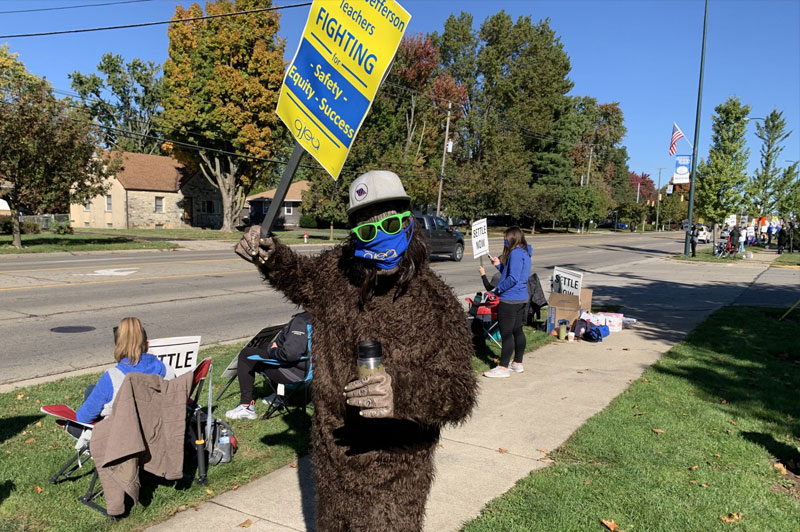
    A Gahanna-Jefferson Education Association teacher opted to arrive in costume for the first day of a strike outside Gahanna Lincoln High School. By Jake Zuckerman.

    By Susan Tebben and Ohio Capital Journal

    Ohio teachers are adapting to COVID-19 learning, while also fighting for wages and benefits that are lower than professionals with similar education and experience.

    Teachers from across the state shared their experiences in an event hosted by the progressive think-tank Policy Matters Ohio.

    Tati Weaks, of the Greenfield Exempted Schools, which serves portions of Fayette, Highland and Ross counties, said investment in the community is an important part of being a teacher. But in an area that lost thousands of jobs when DHL pulled out of the Wilmington Air Park more than a decade ago, and saw the wealth in the area change to poverty as factories went elsewhere, she said keeping teachers engaged in the area isn’t easy.

    Despite the fact that Wilmington Air Park has had investment since DHL left, the roller coaster of success and loss creates stress with a state public school funding system based on property wealth.

    “We want to attract good teachers, we want to keep good teachers,” Weaks said. “But our base salary is already so much lower due to school funding.”

    “Wage Penalty”

    Experts call the lower wage that teachers receive compared to other professionals with similar education and experience a “wage penalty.”

    In a 2020 study by the Economicy Policy Institute, the teacher wage penalty was shown to have grown from 6% in 1996 to 19.2% in 2019. The year before, the penalty had been even worse, at 22%.

    “This is something where there’s been an attack on teachers,” said one author of the study, EPI fellow Lawrence Mishel, during the Policy Matters discussion. “We have not been putting in the resources, and this is something we really need to do to guarantee children have the professionals that they need.”

    That lowering came from “widespread strikes and other actions by teachers in 2018 and 2019,” the study stated.

    In Ohio, the wage penalty stands at 15.2%, according to the Economic Policy Institute.

    Teachers actually received a wage higher than those of similar experience — called a wage premium — back in the 1960s and 1970s, when women teachers received pay that was 14.7% more than comparable female professionals., according to the EPI study.

    “In 2019, women teachers were earning 13.2% less in weekly wages than their nonteaching counterparts were — a 27.9% percentage-point swing over the last six decades,” the study concluded.

    The wage penalty for men was found to be larger than women, and getting worse, according to the policy institute.

    In 1979, the teacher wage penalty for men was 16.6%, and in 2019, men received 30.2% less as teachers than men did in other professions.

    Teachers sacrifice

    With less funding from their school districts, teachers are still sacrificing their lesser pay for supplies for their classrooms and students.

    Mandy Wagner had to get a second job for her first 10 years of teaching just to pay rent and make student loan payments. She also wanted to pursue her Master’s degree in English literature so she could teach higher level classes to her students, but that meant spending more money.

    “More education means more debt, so trying to benefit the kids, I’m putting myself in more debt,” Wagner said.

    Those sacrifices are being asked of them in collective bargaining negotiations as well, as Tamar Gray, of the Cleveland Heights-University Heights School District, saw first-hand. The teachers and the district just finished contract negotiations in which the district entertained the idea of raising health care costs 250%, with only a total of 8% in raises over the last ten years.

    The district and the teachers were able to come to an agreement, but Gray came out with a bad taste in her mouth, especially after teachers were called “heroes” at the beginning of the pandemic.

    “The fact that teachers are being asked to settle, to make less, to fix budget problems on one of the most important things that can happen in the state…there’s something wrong with that,” Gray said.

    Two education bills were in the General Assembly, and after years of work, House Bill 305 made it through the House. But the end of the lame duck session has run out the clock on the legislation, and the bill floundered in a Senate committee.

    The capital budget passed last week included only a small part of the school funding overhaul. Legislators have said they want to make education a priority, but need to see more studies on the cost of the funding formula before they sign on.

    House Bill 305’s funding framework would have taken some of the pressure off of property taxes as the main informer of funding levels for local school districts, and put more of the onus on direct state funding.

    Many teachers and school district officials spoke in support of the bill, seeing it as a sign of hope for teachers and struggling school districts.

    “We’re running education on a budget,” Wagner said. “And what are we doing having budget teachers and budget education? This is something that we should absolutely be investing in and prioritizing.”

    The teachers present during the Policy Matters event say the fate of education affects the poor, affects people of color, and affects the disenfranchised. Therefore, it shouldn’t be hard for their representatives in the Statehouse to do something.

    “We’re supposed to have people that want to do well by the public, so to sit up here and say we can’t find the solution…it’s inexcusable,” Gray said.

  • Unfinished business: 5 legislative priorities in Ohio pushed to 2021

    Unfinished business: 5 legislative priorities in Ohio pushed to 2021

    By Tyler Buchanan and Ohio Capital Journal

    Columbus, Ohio – The 133rd Ohio General Assembly wrapped up its term with a flurry of lame-duck activity last week, closing out a challenging year of legislating amid a global pandemic. 

    Lawmakers hurried to get priority bills passed and sent to Gov. Mike DeWine’s desk for a signature before the two-year term ended. There were, however, a number of major legislative projects that did not get passed.

    Here are some of the priorities falling to the 134th General Assembly, which starts in January:

    What to do with House Bill 6?

    After months of deliberation about House Bill 6, lawmakers have decided to punt any repeal or replacement effort to 2021.

    HB 6 is the $1.3 billion nuclear bailout bill at the center of what has been called the largest corruption scheme in state history. 

    In the days after Speaker Larry Householder and four other political operatives were arrested in July, one thing was clear: Ohio lawmakers needed to do something about the tainted bill. 

    DeWine, who signed the bill into law in 2019, called for its repeal. Householder was removed as House Speaker. His replacement, Rep. Robert Cupp, R-Lima, said one of the first priorities of his speakership would be addressing HB 6. 

    Davis Bees Nuclear Power Station with electricity pylons, Ohio. Getty images.

    Cupp did create a new “House Select Committee on Energy Policy and Oversight,” which met nine times between September and December to hear testimony on various attempts to repeal HB 6.

    Members could not come to an agreement on how to best approach HB 6; some wanted a full repeal, others wanted only certain portions replaced and a few defended the whole bill as being good public policy, even if it did come about through sordid means. 

    Two of those involved have already pleaded guilty in federal court; the cases against Householder and two others are ongoing.

    Householder was reelected to another term and it remains to be seen if the chamber will take a vote in 2021 to expel him. When Cupp was elected as speaker in July, he indicated such a vote would wait until after the new term starts.

    School spending reform will take more time

    The Ohio Supreme Court ruled the state’s school funding model was unconstitutional back in 1997. Decades later, lawmakers are still working to figure out a constitutional and equitable substitute.

    A bipartisan funding overhaul passed the House in early December, but did not make it through the Senate. 

    Sen. Matt Dolan, R-Chagrin Falls, who chairs the Senate Finance Committee, wrote in a December letter “there is not enough time in the legislative session for the Senate to have the in-depth hearings this bill deserves.” Dolan suggested the new formula could be passed as a piece of the next state budget, which will be decided in the first half of 2021.

    Republicans still concerned about pandemic authority

    For all the condemnation leveled against Ohio’s pandemic response by Republican lawmakers in 2020, the legislature achieved little this year in the way of curbing the government’s executive powers.

    Between May and December, Republicans introduced numerous bills targeting the pandemic authority of the governor and the Ohio Department of Health (ODH). Only a few of them passed, and DeWine followed through on a pledge to veto any bill restricting ODH’s ability to issue health orders meant to stem the spread of COVID-19.

    DeWine vetoed a bill over the summer which would have reduced the penalties for violating a public health order. Lawmakers did not seek a veto override. 

    Gov. Mike DeWine is pictured during his statewide address on Wednesday, Nov. 11. Photo courtesy Ohio Channel.

    More recently, DeWine vetoed a bill to prevent ODH from issuing widespread quarantine orders (it also would’ve given lawmakers authority to vote down any public health orders). Despite protests and pressure from conservative lawmakers to override the veto, such a vote was not taken during the lame-duck session.

    Late in the term, lawmakers debated efforts to make future health orders more fair to business owners, should they be necessary. At other points this year, legislators said they wanted to address the state’s pandemic authority for future crises beyond the coronavirus. Those efforts may come up again in 2021.

    Campaign finance and election reform

    These were two hotly-debated topics this year in large part because of the presidential election cycle and the House Bill 6 scandal.

    As the Ohio Capital Journal has reported, lawmakers proposed a wide array of improvements to the state’s election system over the past term — from automated voter registration to online absentee ballot requests. Some legislators expressed worry about approving reforms during an election year, which may provide an opportunity for reforms to be heard during an “off year” like 2021. 

    The HB6 scandal involved allegations of bribery money being funneled through “dark money” groups in order to influence Ohio elections and public policy. These groups are registered nonprofits which are not required to disclose who funds them. 

    Ohio Secretary of State Frank LaRose, whose office oversees campaign finance in the state, came out in favor of improved transparency when it comes to “dark money groups.” He supported legislative efforts which followed Householder’s arrests to require such groups to publicly disclose their financial activity. 

    Secretary of State Frank LaRose is flanked by state Reps. Gayle Manning and Jessica Miranda during a press conference in support of HB 737.

    A bipartisan bill proposing reforms to the state’s campaign finance system did not receive a hearing in 2020, but these efforts may carry over to the new term.

    Split opinions on criminal justice reform

    There was much attention paid to the legislature’s work to reform the Ohio criminal justice system, with plenty of disagreements leading to mixed results.

    Lawmakers passed Senate Bill 1, which expands access to drug treatment programs in lieu of convictions and broadens the description for criminal records that may be sealed. 

    A separate bill to reclassify low-level drug offenses from felonies to misdemeanors passed the Senate last June, but was not taken up for a vote during the House’s lame-duck session. The bill sought to divert drug offenders into treatment rather than criminal punishment.

    Despite bipartisan support in the Statehouse and among civil rights groups, the bill remained controversial among law enforcement groups and prosecutors. The Ohio State Bar Association came out against the bill, arguing in testimony that some drug offenders “must have serious consequences hanging over their heads like the threat of a felony and prison time” in order to commit to a treatment program. 

    Rep. Bill Seitz, R-Green Twp., a supporter of the bill who will serve as Majority Floor Leader next term, told The Cincinnati Enquirer that work will continue in 2021 on criminal justice reform.

  • Ohio’s minimum wage to rise by 10 cents per hour in 2021

    Ohio’s minimum wage to rise by 10 cents per hour in 2021

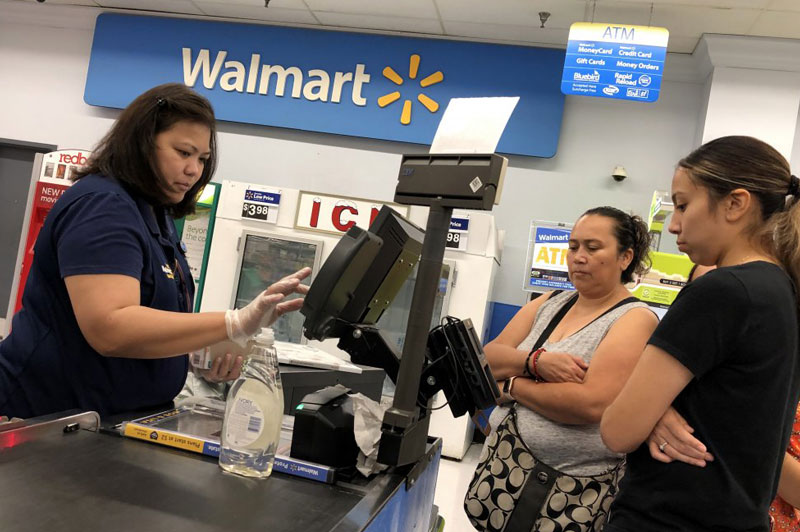
    Customers look on as a Walmart cashier rings up their purchases at a Walmart store. Photo by Justin Sullivan/Getty Images.

    By Tyler Buchanan and Ohio Capital Journal

    The Ohio minimum wage will rise by 10 cents to $8.80 per hour in 2021.

    That will be the wage for non-tipped employees. Tipped workers will earn $4.35 per hour plus tips in 2021.

    Ohio workers under the age of 16 will make the federal minimum wage, which is $7.25 per hour.

    Ohio’s minimum wage rises gradually each year to match the rate of inflation, per a state constitutional amendment implemented in 2007. The minimum wage that year was $6.85; it has gone up nearly $2 in the 14 years since.

    Michael Shields, a researcher with the left-leaning think tank Policy Matters Ohio, said this increase is not enough to help low-income Ohioans still suffering from the pandemic.

    There were several unsuccessful attempts this legislative term (which ends next week) to increase the Ohio minimum wage. 

    A 2019 bill from state Rep. Brigid Kelly, D-Cincinnati, called for increasing the wage to $12 per hour and then going up by $1 per year until it reached $15 per hour. Tipped workers would have risen to $6 per hour, going up by 50 cents per year until it reached $7.50 per hour. From there, wages would have risen gradually as is presently done.

    State Sens. Cecil Thomas, D-Cincinnati, and Hearcel Craig, D-Columbus, offered a similar bill in the Ohio Senate. These two bills would have allowed local governments to set even higher minimum wages. 

    Later in 2019, Democratic state Reps. Lisa Sobecki of Toledo and Kent Smith of Euclid introduced a bill to raise the minimum wage for all workers (regular, tipped and juvenile) to $10.55 per hour in 2021. The wages would’ve then risen gradually in years after that.

    None of the above bills made substantial legislative progress. 

    There was also an effort in early 2020 to place a referendum raising the minimum wage on the November ballot. Organizers suspended the campaign, saying coronavirus shutdowns made it difficult to secure the signatures necessary to place the referendum on the ballot.

  • Congress seals the deal on emergency relief after dispute over Fed lending settled

    Congress seals the deal on emergency relief after dispute over Fed lending settled

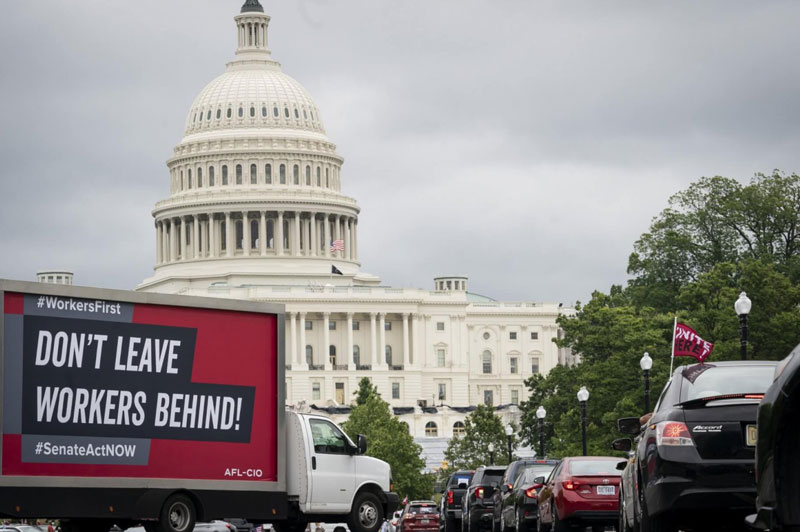
    Protesters take part in the AFL-CIO Workers First Caravan for Racial and Economic Justice near the U.S. Capitol on June 17, 2020 in Washington DC. The caravan circled the U.S. Capitol and national mall while honking their car horns to bring attention to their cause. | Drew Angerer/Getty Images.

    By Laura Olson and Ohio Capital Journal

    Washington D.C. — A deal on a coronavirus relief package finally emerged on Sunday night, after members of Congress resolved a days-long impasse over a provision sought by U.S. Sen. Pat Toomey of Pennsylvania to ensure that several temporary Federal Reserve lending programs will end this year.

    Working through that disagreement over the Fed was a key final piece to hammering out what’s expected to be a $900 billion aid bill, which would be the first major pandemic relief measure to reach the president’s desk since March.

    The Fed provision is just one piece of the massive bill that’s expected to include a $600 direct payment to Americans who received a check earlier this year; $300 a week in  emergency unemployment benefits; an extension of eviction protections; the suspension of student loan payments; additional loans for small businesses; and added funding for food assistance, child care support and coronavirus testing centers and vaccine distribution.

    The text of the bill was not yet available on Sunday night and a final vote is not expected until Monday at the earliest. According to Democratic leaders, it also will include an end to so-called surprise billing for emergency and scheduled health care; $25 billion in rental assistance for struggling families; an enhanced tax credit for low income housing; $82 billion for K-12 schools and higher education; an expansion of Pell Grants for low-income college students; and $7 billion to increase access to broadband.

    To give themselves more time to finish up the massive relief measure, which would be paired up with funding for the government for fiscal 2021, the House and Senate were set to vote late Sunday night on another stopgap spending bill that would prevent a government shutdown, this one running through Monday.

    “We have now reached agreement on a bill that will crush the virus and put money in the pockets of working families who are struggling,” House Speaker Nancy Pelosi (D-Calif.) and Senate Minority Leader Chuck Schumer (D-N.Y.) said in a statement Sunday night.

    Senate Majority Leader Mitch McConnell (R-Ky.) tweeted that an agreement was at hand.

    “As the American people continue battling the coronavirus this holiday season, they will not be on their own. Congress has just reached an agreement. We will pass another rescue package ASAP. More help is on the way,” tweeted McConnell.

    Negotiators in the Democratic-controlled House and Republican-controlled Senate had appeared close to a deal late last week. But those talks stretched on, with the disagreement over Toomey’s Federal Reserve provision cited as a final sticking point.

    Toomey, a Republican who was involved in crafting the CARES Act, said the legislation approved last spring allowed the Fed to create several temporary credit facilities because the financial markets were in danger of freezing up at the height of the economic crisis. Those programs were intended to be temporary and not a long-term expansion of the Fed’s authority, he added.

    But Democrats viewed the language he sought as too broad, and potentially too much of a restriction on the Fed’s power. That led to days of negotiations, and forced Congress to approve another short-term spending bill late Friday as lawmakers scrambled to save the aid package. That stopgap would expire at midnight Sunday.

    Toomey said Sunday morning that the final language was still being drafted, but was narrowed to clarify the programs that would end this year.

    “The Democrats made a fair point. That was too broad. And that might have captured facilities that we didn’t intend to capture,” Toomey told reporters. “So yes, it was narrowed down.”

    Negotiators were unable to resolve disagreements on two contentious provisions: additional aid to state and local governments, which was sought by Democrats, and a GOP-backed proposal to protect employers from COVID-19-related lawsuits by workers who get sick. Both were dropped.

    “We are disappointed that Republicans have refused to recognize the need to honor our heroic frontline workers by supporting robust funding for state and local governments.  State and local governments need much more funding to prevent senseless layoffs and critical service cuts.  The agreement does provide some new targeted funds for government functions that will help ease their budget burdens,” Pelosi sand Schumer said.

    President Donald Trump, who has largely been absent from the negotiations, tweeted late Saturday night, urging Congress to “GET IT DONE, and give (Americans) more money in direct payments.”

  • History Thursday: Ohio headlines from the last year Ohio State-Michigan didn’t play

    History Thursday: Ohio headlines from the last year Ohio State-Michigan didn’t play

    By Tyler Buchanan and Ohio Capital Journal

    A winter without an Ohio State-Michigan football game is, well, it’s like hot soup without a spoon. It’s like an Ohio highway without orange barrels. 

    “I know that life in Ohio is not complete without the glory of Ohio State football and other football,” President Trump told supporters in Circleville.

    The rivalry is older than the Circleville Pumpkin Show. The two teams first played in 1897 and competed in most years over the next decade or two, though they took several years off during World War I.

    Starting in 1918, though, the Buckeyes and Wolverines faced off in every season thereafter. Until this year. A yearly tradition that began the year of the Spanish flu pandemic ends the year of the COVID-19 pandemic. 

    The streak of playing 102 years in a row predates Kewpee burgers in Lima and Skyline chili in Cincinnati. It predates the construction of the Cedar Point causeway in Sandusky and the Terminal Tower in Cleveland.

    It even predates the founding of the NFL in Canton.

    Life was different in 1917, the last year the two teams didn’t play. Let’s look at a few news storylines from that year:

    Darke County newspaper: Ohio lawmakers are stupid

    The Greenville Journal in western Ohio offered a rather provocative headline on March 15, 1917: “General Assembly Noted As Peculiar.” The subheadline: “Legislature, Taken in the Aggregate, Is Below Average Ohio Body in Intellectual Force.”

    Newspapers weren’t nearly as polite back then.

    Dr. Clarence Maris, a Columbus physician and political writer, offered an explanation as to why the 1917-18 Ohio General Assembly was, in his view, lacking in intelligence. 

    “(M)any of the Democrats elected in normally Republican counties or senatorial districts were thought by the party managers to have no chance for election,” Maris wrote,” and men were put up to be sacrificed, but the (Woodrow) Wilson peace wave carried them into office.”

    Maris went on to list a number of legislative projects undertaken by the legislature to back up his claim. In defense of Ohio’s lawmakers from the 1910s, Maris made a lot of wild claims. A decade later, the New York Times quoted him as saying Ohio State University was rife with communism and that the “youth movement” at OSU was controlled by Moscow. 

    Ohio overhauls its statewide health authority

    The above Greenville Journal paper had another noteworthy article on March 15 in a separate column called “News Culled In The Capital.”

    The Ohio House of Representatives had just voted to abolish the state board of health. Instead, lawmakers wanted to have a singular state health commissioner run the show, which would be aided by an advisory council. Governor James Cox supported the move. 

    The reason for this change? The Marion Star reported the health board “has been in the limelight repeatedly during the last year because of internal dissensions.”

    The Lima Times-Democrat reported that “too much bickering” from the seven health board members made them the “subject of considerable criticism.” The newspaper continued: “The health commissioner, to be chosen by the council, with the governor’s approval, will be endowed with administrative and executive powers.”

    The new law specified the commissioner had to be a physician and be skilled in sanitary science. The term would be for five years. Dr. A. W. Freeman of Cincinnati was chosen in September 1917 to be the first state health commissioner.

    New Cleveland Indians pitcher paid a pretty penny

    Team owner Jim Dunn made a big bet in signing pitcher Joe Wood ahead of the 1917 season.

    This illustration of “Smoky” Joe Wood printed in a 1917 edition of the Sandusky Star-Journal.

    After all, Dunn paid $15,000 for his prized new hurler. 

    “Smoky” Joe Wood, formerly of the Boston Red Sox, didn’t pitch in 1916. But the Tribe hoped he would return to form in ‘17.

    “Tris Speaker, Wood’s former teammate and close friend, has said that he believes Joe is in as good of shape as he ever was,” the Sandusky Star-Journal reported. “But of course till Wood shows the goods on the diamond the deal is completely a gamble.”

    For reference, a century later, Cleveland Indians star Carlos Santana was paid $20,333,333 for the 2019 season. He came to bat 686 times that year, earning $29,640 per plate appearance.

    In essence, Santana earned “Smoky” Joe Wood’s 1917 salary twice over every time he stepped in to hit.

  • House passes abortion burial bill, now moves to governor for signature

    House passes abortion burial bill, now moves to governor for signature

    By Susan Tebben and the Ohio Capital Journal

    The House passed a bill on Thursday to require abortion providers to bury or cremate fetal remains, despite arguments from religious groups and health clinics in the state.

    State representatives passed the bill on a 60 to 35 vote along party lines.

    The bill passed out of the House Civil Justice Committee the same day where members of state right-to-life groups acknowledged existing law regarding disposal of fetal remains, but said Senate Bill 27 was needed to further specify the role of abortion providers.

    “Current Ohio law requires the humane disposition of fetal remains but it is vague and open to interpretation,” said Meg DeBlase, of Right to Life of Greater Cincinnati.

    Opponents to the bill noted that the bill requires the burial or cremation of fetal remains from surgical abortions, but leaves out those from medication abortions, stillborns, miscarriages, and embryos from fertility clinics.

    Several opponents to the bill held a press conference Thursday morning because they felt due to the pandemic it was unsafe to testify at the Ohio Statehouse. During the press conference, members of clinics who provide abortions and abortion access advocacy groups said the bill had little to do with the need for burial services, and more to do with closing abortion clinics by creating another cost for them.

    Chrisse France, of Pre-Term Cleveland, said the law “does not serve any public health interest,” and places the legislature as a faith advisor and doctor, rather than lawmaking body. According to Lauren Blauvelt-Copeland, of Planned Parenthood of Ohio, the laws already made in the state cover what Senate Bill 27 does.

    “There are already laws in place that require safe medical tissue disposal and Planned Parenthood and other providers follow them,” Blauvelt-Copeland said.

    On the House floor, state Rep. Erica Crawley, D-Columbus, called it “unacceptable” that the General Assembly has quickly taken up the measure while legislation regarding infant mortality and maternal mortality remain stalled in committees. Ohio stands as one of the top states in infant and maternal mortality rates.

    “That leaves me to believe that we are okay with women dying during childbirth or after, and babies dying within one year of their life,” Crawley said. “I do not hear the same passion for these women and infants who are dying.”

    State Rep. Candice Keller, R-Middletown, one of the authors of the the total ban on abortion in the state which is currently being fought in court, stood in support of the bill, saying the abortion “industry” should take up the cost of disposing of the fetal remains.

    She also accused a Democratic legislator, state Rep. and physician, Beth Liston, D-Dublin, of “age discrimination” for arguing that fetal remains at a certain point are about the size of a grain of rice, and therefore “untenable” to dispose of in a burial or cremation.

    “This industry can afford to bury these babies, and they deserve it, and their mothers deserve it,” Keller said.

    The bill now moves to the governor for a signature, and with a pattern of support for anti-abortion measures, Gov. Mike DeWine is expected to support the bill.

  • Lawmakers seek Ohio moratorium on evictions, foreclosures

    Lawmakers seek Ohio moratorium on evictions, foreclosures

    State Reps. David Leland, D-Columbus, and Jeffrey Crossman, D-Parma

    By Tyler Buchanan and the Ohio Capital Journal

    Ohioans struggling to pay their rents or mortgages may head into 2021 without the housing protections and public assistance that have carried them through much of the pandemic this year.

    A federal moratorium on evictions is about to expire. Two other relief programs helping unemployed Americans are set to run out. There are believed to be thousands of Ohioans who are in immediate risk of eviction due to unpaid rent, with many low-income earners still working reduced hours or remaining out of work entirely. 

    Back in March, two Democratic lawmakers proposed a statewide moratorium on eviction and foreclosure actions so long as Ohio stayed under a state of emergency amid the COVID-19 pandemic. The economy has rebounded somewhat from historic unemployment in the spring, but the virus outlook looks grim as the state heads into the cold winter months.

    State Reps. David Leland of Columbus and Jeffrey Crossman of Parma believe the moratorium is needed now more than ever. 

    “This is not just a humane thing to do,” Leland said in a committee hearing on the bill Thursday morning, “it’s not just asking you to embrace the holiday spirit. Instead, as we survey the landscape after these tumultuous nine months and ahead of next year’s budget negotiations, this is a way to save numerous low-income Ohioans’ from unimaginable hardship.”

    “The urgency of this legislation is really right now,” Leland continued.

    Under House Bill 562, landlords could still file eviction actions, but courts would be prevented from acting on them while the state of emergency is in place. Law enforcement officers could not carry out eviction orders either. Courts would not be able to conduct any business pertaining to foreclosures and must halt all pending foreclosure actions.

    This moratorium would apply to residential and commercial properties.

    Nearly two-dozen Democrats and one Republican have supported the bill as cosponsors.

    iStock / Getty Images Plus

    ‘Last remnants of the safety net’

    The large-scale CARES Act signed into law in March has provided trillions of dollars of relief, but many of its programs benefiting Ohio tenants have already run out or are about to. 

    This includes the Pandemic Emergency Unemployment Compensation and the Pandemic Unemployment Assistance programs, which have helped those who have lost work during the crisis. Both programs end the day after Christmas.

    In September, the Centers for Disease Control and Prevention (CDC) issued a nationwide moratorium on evictions for residential properties. It prohibits U.S. landlords and property owners from evicting a tenant for unpaid rent. 

    That moratorium is set to expire on New Year’s Eve.

    “Just as covid cases are exploding and our hospitals are filling, and just as the coldest parts of winter are setting in, hundreds of thousands of Ohioans are set to be stripped of the last remnants of the safety net Congress put in place back in March,” Leland said.

    Ohioans struggled to pay their housing costs even with that safety net in place. A survey from this past summer found more than a half-million residents could not pay rent in June 2020.

    Now these same residents potentially face 2021 without the CDC moratorium and without relief assistance — unless Congress acts again to pass a relief bill to close the gaps left by the still struggling economy.

    A total of $50 million from the CARES Act was allocated for emergency rental assistance in October. But advocates say more is needed.

    “Unless the Senate stops blocking any meaningful relief, we’re really worried about what’s going to happen in 2021,” said Marcus Roth, a spokesman for the Coalition on Housing and Homelessness in Ohio, last month.

    That’s also the hope of Gov. Mike DeWine, who again called on Congress to pass a relief bill during his COVID-19 press conference on Thursday. 

    DeWine was asked if he supported the CDC extending its eviction moratorium into 2021. 

    “I’d have to take a look at that. I don’t know,” DeWine answered. “But look, this is a problem. This is a problem and is something that we are in fact focused on.”

    Lt. Gov. Jon Husted argued that a moratorium alone does not address the costs faced by property owners and suggested such action should be paired with further government relief.

    “There’s still somebody that has a mortgage to pay on that facility, who has a default that could potentially happen with their lender, which creates a whole chain of events and series of events,” Husted said. “So there has to be a financial solution to go along with any moratorium so that we don’t create a chain reaction in the system that causes additional problems.”

    Unintended consequences to a moratorium?

    In committee, state Rep. D.J. Swearingen, R-Huron asked the HB 562 sponsors about the “unintended consequences” of continuing a moratorium in Ohio. Swearingen noted that property owners still have costs such as repairs and that smaller banks may not be able to carry so many unpaid loans.

    State Rep. D.J. Swearingen, R-Huron

    Crossman acknowledged those concerns but said the ramifications of doing nothing would have a greater impact on individuals.

    “I think we just have to ask ourselves, who’s in a better position to bear the burden here? The individual who is not making any income trying to keep their family fed and clothed and in a housing situation during the middle of a pandemic, particularly if they don’t have a job, or a lender who can maybe take a two- or three-month pause from getting their mortgage payments?”

    Crossman said the latter is in “a far better position financially” to handle the issue. 

    Lawmakers also heard testimony from Dan Acton, a lobbyist for the Ohio Real Estate Investors Association who spoke in opposition to passing an Ohio moratorium. He said his organization consists of a few thousand “smaller” real estate investors who typically own single-family housing units.

    He claimed these property investors operate on “razor-thin profit margins.” When tenants do not pay their rent bills, Acton said, this reduces the “profits for a property owner that could otherwise be used to reduce the overall debt on a property or make improvements.”

    “The pandemic and the resulting eviction moratoria and payment delays are leaving our members on the brink of failure,” Acton said, arguing it would be “dangerous” for the government to “interfere” with a private leasing contract. 

    Leland said a moratorium is not meant to be a “long term-solution,” but would allow Ohioans to stay in their home until winter passes, the economy rebounds and a vaccine is made available.

    Separately, Leland and fellow Democratic Rep. Juanita Brent of Cleveland also sponsored House Bill 744 that would allocate around $270 million from the state’s “rainy day fund” to pay for a new COVID-19 Emergency Rental Assistance Program. No action has been taken on this bill.