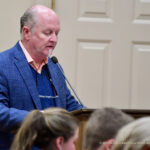
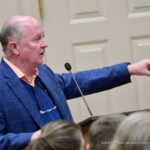
Loveland, Ohio – On February 4, the Loveland City Hall was filled with a crowd to witness and hopefully influence a vote for or against the building of an apartment complex at Loveland’s 102 Oak Street. As the meeting commenced, the public heard Rodney Sabo of Sabo Design Associates, describe the plans for the complex, budget, and method of parking and traffic.
The proposal the Planning and Zoning Commission was considering during the public hearing was to build four 16 unit apartment buildings on Oak Street in the Clermont County side of the City. “Oak Apartments” would have been four levels each with parking garages below each building. The proposal was for 106 total parking spaces with 1.6 parking spaces per unit. The lot is 1.033 acres.
Sabo Design submitted the application on behalf of their client, Hunt and Whitacre. To build the project the City would need to create a Special Planning District (SPD) which if approved would have erased the existing zoning restrictions and protections for the immediate neighborhood and create a separate zoning district with distinct restrictions, permissions, and guidelines.
The current zoning of the immediate neighborhood is Residential-Medium Density (R-MD). The existing R-MD zone does not permit high-density multiple-family uses.
Commission Chairman Al Kressler, Mark Redmond, Michael Kady, Brian O’Neill, and Tim Butler posed questions for the plan such as the possible rewards and pitfalls from the building of this complex before they each voted, “No”.
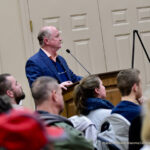
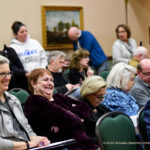
In opposition to the plan, the public bound together to declare and stand for the preservation of the land and current zoning, as each speaker presented individual points to support their cause. Many of the points included environmental damage, blockage of people’s home views, out-of-place aesthetics, lowering of the water pressure, and the promotion of in-and-out rental, not community bound estates.
The Commission heard both sides and decided with a 5-0 vote to not develop the land into an apartment complex.
The filled room disbanded in agreement around 9:10 PM.
Scroll down through this story to see a photo slideshow and watch post meeting interviews. You can watch the speeches during the open-forum, the proponent explaining the proposal, the staff report, and the questions P&Z had for the applicant.
Oak Street Apartments Interviews
Connie Crawford on Oak Street Apartment Proposal
Julie Fuson comments of Oak Street Apt. proposal
Neil Kluender wants his neighborhood protected
Becky Hasselbeck speaking about preventing more apartments
Steve DeFosset explains potential water supply problems if Apartments are built
Todd Osborne talks about proper use of SPD Zoning
Rocky Carpenter speaks up to preserve sanctity of his neighborhood
Mary Ann Bird discusses Oak Apartment proposal
Scott Lindgren talks about traffic conditions if Oak Street Apartments are built
Mark Krum talks about tearing down a home built in 1870s to built apartments
Cati O’Keefe lives immediately downhill from Oak Apartment and talked about how unstable the hillside is
Real Estate Agent Keli Williams’s take on Oak Apartment proposal
Tom Smith introduces staff report
Rodney Sabo with Sabo Design Associates explains his proposal for Oak Apartments
On December 15, 2016, a Loveland City Hall newsletter was sent to residents announcing, “Downtown Development on the Horizon.”
The announcement continued, “Thus in 2017, the plan is for the current City Hall to be demolished. The planned replacement (elevation renderings shown above) is a four story building.“
The story sounded a little fishy to Loveland Magazine as we keep a pretty close eye on City Hall and we had never heard of the proposal, let alone how it could be a done deal. Also to be sure we did not miss something we researched past meeting minutes and found no council vote… no discussion… nothing. Someone at City Hall had written a story that wasn’t true, yet that didn’t stop the Loveland Herald from running with the story. Why wouldn’t they, they would not know better as they had stopped attending Loveland Council meetings years ago. Never-the-less, the Herald was able to gather enough quotes to write about the imminent demolition of Loveland’s City Hall.
Loveland Magazine never reported the story because we knew it was not true.
The newsletter and the Herald story fit the textbook definition of “fake news”, except it wasn’t going to end up being “fake” if City Hall could get away with the backroom scheming it took to hatch the plan. Many residents had different ideas.
The other things residents became aware of was the sudden announcement to impose very high fees and severe restrictions for community groups holding public events. Many residents had different ideas.
Add to that, the announcement that Donna Bednar would not be re-appointed to the Loveland Beautification Committee, and the subsequent resignation of all but one member.
Add to all of this upheaval was when behind City Hall’s closed doors a decision was made to “Trademark” the name Christmas in Loveland and the surprise announcement that City Hall had usurped the event that belonged to the Little Miami River Chamber Alliance.
It’s where the hashtag, “#lovelandtransparency” comes from.
This is where the stories below start and will give readers a final chance to catch up on our City Hall reporting (including the successful re-call effort of the sitting mayor) before they go to vote next Tuesday. These are resident views, candidate views, and some of the legal challenges both residents and council members faced this past year.
These stories below appear in the order they were published – oldest to newest.
Halie Rebeccaschild is the Secretary of the Loveland Community Heartbeat PAC
First, In his argument that certain sitting City Council members are “anti-business,” Kulik stated, “Legally required public hearings were voted down by this Council to stop positive business growth.” It appears that Mr. Kulik has over simplified the matter, as Council has stopped a public hearing from proceeding only in one case this year, that of the city hall project. The city never moved to a public hearing because residents expressed outrage at multiple City Council meetings in May and June of this year over the planned demolition of Loveland City Hall. In fact, On May 9th, City Council deadlocked on the nature of public engagement. After Community Improvement Corporation (CIC) President Jay Stewart recommended involving residents and holding a work session with Ken Geis, Vice Mayor Angie Settell immediately motioned for a public hearing (1). Such a move would have then fulfilled the legal requirement for a single hearing prior to transferring the city hall property to the autonomous CIC, ensuring demolition of our city hall building in July, as planned.
Mayor Mark Fitzgerald, Vice Mayor Angie Settell, and Pam Gross voted no on these public engagement forums.
Residents had expressed great concern about the city hall project moving too quickly, which may be seen in both April and May City Council meeting minutes. Rob Weisgerber, Kathy Bailey, and Ted Phelps responded to residents by opposing the vote to immediately move to fulfill the single public hearing requirement. Then, Council Member Rob Weisgerber motioned for no less than three resident engagement sessions, which would have brought residents into the planning process on either a 2-story, 2.5 story, or 4-story building. Mayor Mark Fitzgerald, Vice Mayor Angie Settell, and Pam Gross voted no on these public engagement forums, while Council Members Rob Weisgerber, Kathy Bailey, and Ted Phelps voted yes. The deadlocked votes reflect a difference in how much emphasis was placed on resident engagement.
Not a single resident has come to address Council to demand that the city hall demolition move forward, so who does Mr. Kulik represent?
Mr. Kulik spoke of the public hearing requirement completely out of context of the planned demolition of City Hall, and in such a way that suggested a law was somehow broken in slowing down the city hall project for residents to give necessary sanction. Indeed, if the public hearing had occurred as pushed by Mark Fitzgerald, Angie Settell, and Pam Gross, the transfer of our city hall to the CIC would have been final. Once in possession of the CIC, residents would have had no further input. This process would have prevented residents from thoroughly engaging in the planning for our new, city hall building in Old Loveland. Instead of anti-business, as Mr. Kulik suggests, Rob Weisgerber, Ted Phelps, and Kathy Bailey’s vote for multiple hearings reflect their duty as public servants to residents of Loveland. Residents have been relieved that the planned demolition and any repurposing of city hall will wait until after elections when residents will have their say with their votes. Not a single resident has come to address Council to demand that the city hall demolition move forward, so who does Mr. Kulik represent?
Next, Mr. Ryan Kulik went on to claim that City Council acted wrongly by cancelling Mr. Stansel’s contract. Kulik said, “What is it Mr. Stansel did wrong? I can see where council should have had the discussion on his services, but we never had that discussion. Rob Stansel was hired by the City Manager, not council. Stop lying. This is what the city manager does. The council should have had a chance to vote on his contract when the spending limit was exceeded. We never had this discussion.”
Yet again, Mr. Kulik is mistaken.
Yet again, Mr. Kulik is mistaken. City Council did have a discussion about cancelling Rob Stansel’s contract just prior to their vote that terminated it on May 9th. Mr. Kulik asks, “What was illegal about the contract? Was it because the spending limit was exceeded? Okay, I understand that.” If Mr. Kulik understands that City Council voted after a discussion to cancel the contract because it violated the City Manager’s spending authority, then what’s his agenda? Why would he want Council to violate our city charter?
Then, Mr. Kulik goes on to say, “[Stansel] secured over $600,000 for, I believe, the Chestnut property.” Not exactly. The “letter of intent” brought by Mr. Stansel to the city died upon expiration on May 5th, 2017, four days prior to City Council voting to terminate Stansel’s contract on May 9th (2,3). Perhaps Mr. Kulik should speak with City Manager Dave Kennedy about why the offer wasn’t pursued. Because at this point, it appears that Mr. Kulik is speaking beyond his knowledge and expertise.
it appears that Mr. Kulik is speaking beyond his knowledge and expertise.
Last, Kulik goes on to say, “[Rob Stansel] was working on the Christman property that we’ve heard a lot about.” Yet, again, Mr. Kulik references a development project that brought Loveland residents out in droves against it. Residents from the Brandywine and Butterworth Glen neighborhoods overflowed Loveland City Hall at the public hearing on June 13th when City Council was expected to vote on an ordinance to transfer city land to the Community Improvement Corporation that would have then been sold to Drees Co. and ultimately culminated in a Drees Homes development of 10 acres nearby. Apparently, the residents of those neighborhoods believed the city years ago when it claimed to have bought the Christman property to be a park, and they weren’t too excited about the pending development deal. That’s why the city did not transfer the land to the Community Improvement Corporation, and the private deal between the developer and the commercial real estate firm dissolved.
Upon scrutiny, Ryan Kulik’s arguments fail due to his oversimplification and outright error. In any regard, I appreciate him bringing up three very important topics to Loveland residents, and hope everyone registers to vote by October 10th and comes out to vote this November 7th.
Halie Rebeccaschild is the Secretary of the Loveland Community Heartbeat PAC.
“We are the few willing to make a serious sacrifice to address corruption head on.”
– Halie Rebeccaschild
Loveland, Ohio– In the former Loveland mayor’s resignation speech at Tuesday’s council meeting, he made some blistering comments towards his political opponents. There was no open forum on the agenda for the meeting Mark Fitzgerald called to discuss his political future.
The Loveland Community Heartbeat Political Action Committee was particularly targeted in the speech so their spokesperson, Halie Rebeccaschild was asked if she would like to respond on the pages of Loveland Magazine.
You can view Fitzgeralds speech at the bottom of this page.
Halie Rebeccaschild
“Look Out for a Wolf in Sheep’s Clothing,” said Mark Fitzgerald. This statement from him came at the end of a long, accusatory speech at the end of his unfortunate political career here in Loveland, Ohio. Residents signed a petition for Mark Fitzgerald’s recall election twice this year, the last time driving by the hundreds to sign at a remote location; yet, Mark Fitzgerald still does not get the big picture. And on 8/14, residents were treated to his pathetic attempt to discredit those brave enough to dare question his history of fraud allegations. He belittles both us and our demands of honesty and integrity from him and our elected City Council. And he would have residents believe that holding our elected public servants to a high standard of accountability makes us, the informed and politically engaged residents, the problem. But let’s take a look at a couple of his points to see if they hold merit.
First, Mark Fitzgerald accused the Loveland recall committee of having a singular origin of a small group of people. False. Loveland Community Heartbeat was only one organization of two behind the recall. Neighbors for Loveland, also supported the recall campaign (https://www.facebook.com/groups/NeighborsforLoveland/), and together, with other unafilliated residents around the city, we comprised more than thirty resident circulators who span the political spectrum. More, the recall committee takes no singular position on “growth” other than fiscal conservation, and we do not yearn for nostalgia, unless dreaming of a time when politicians served the people who elected them. Instead, the recall committee focused on the unethical behavior of Mark Fitzgerald, and in doing so, we collected over eighteen hundred signatures on the final petition.
Second, In addition to misinforming residents about the members of the recall committee, in his lengthy diatribe, Mark Fitzgerald acted coy about any reasons for recall. Of the complaint stated on the recall petition, he mocked, “What does this mean?” Of course, the reasons for recall, were posted since April on the website, www.lovelandheartbeat.org/recall, with links to primary sources revealing the nature of the fraud allegations brought forth by two whistleblowers during his employment as city administrator in North College Hill, and more recently, the disastrous Ohio state audit of North College Hill during his tenure (http://lovelandheartbeat.org/train_wreck/). The fact that Mark Fitzgerald failed to inform residents about the two fraud allegations during his 2015 campaign for City Council is at the basis for recall. This singular lie-of-omission is enough; yet, Loveland residents may also point to abuse of power, exemplified in the following third point.
Third, Mark Fitzgerald accuses the resident-stakeholder organization driving the recall, Loveland Community Heartbeat, of having no platform. False. Loveland Community Heartbeat advocates for resident engagement. We have promoted a resident-led master plan (http://lovelandheartbeat.org/about/masterplan/) and have addressed City Council in the past year to promote the positive benefits of residents at the table to determine the future direction of our city. Yet, our addresses to City Council repeatedly fell on the deaf ears of Mark Fitzgerald, Angie Settell, Pam Gross, and Steve Zamagias. We can see this in action when looking to the votes around the 4-story city hall project. Although, Rob Weisgerber advocated for residents’ concerns by motioning for interactive conversations with residents prior to any public hearing, his motion was shot down by the majority four. As a public hearing was the final step needed by law before the project and land would be turned over to the Community Improvement Corporation where it would be out of residents’ hands, Weisgerber’s motion could have led to resident engagement around the city hall project. Instead, the majority blocked such engaged discussions and have gone silent ever since (https://youtu.be/Z8215klQaAg).
Mark Fitzgerald doesn’t want to talk about the 4-story city hall project, and he certainly doesn’t want you to know that the mayor he voted into office on 8/14, Angie Settell, defended a 4-story city hall building as “among the most original and creative business decisions the city has made” (Cincinnati Enquirer, 12/16, http://www.cincinnati.com/story/news/local/loveland/2016/12/20/loveland-get-new-city-hall/95706160/)
And if Rob Weisgerber, Ted Phelps, and Kathy Bailey hadn’t blocked the vote for the public hearing required by law before setting that project in motion, residents would today be looking at a demolished plot at 120 W. Loveland Avenue with two years of construction smack in the middle of Old Loveland. Did Mark Fitzgerald, Angie Settell, Pam Gross, and Steve Zamagias do their job as public servants to speak with residents across all neighborhoods before pushing to a final vote? It appears not, as the project was politically unpopular and failed miserably under resident scrutiny. Loveland Community Heartbeat was there to slow this project down until residents can be at the planning table.
Finally, Mark Fitzgerald threw around some interesting conspiracy theories to discredit our resident movement. He made veiled threats to reveal all the dirt on our identities, our past employment, our financial histories, you name it. Yet, nothing about the identities of Loveland Community Heartbeat stakeholders is private. By law, our contributions and identities are made available for anyone willing to take a drive to the Hamilton County Board of Elections, so why all the veiled threats? Does Mark Fitzgerald feel powerful by insinuating that residents who don’t appreciate his service are horrible people with histories and lives more scandalous than Mark Fitzgerald’s himself? The truth is, Loveland residents don’t care about the intricacies of stakeholders’ lives. Loveland residents just want an honest and ethical local government. Mark Fitzgerald just doesn’t get it.
But to momentarily entertain this unprofessional personal attack, I’ll say, Loveland Community Heartbeat comprises the voices of residents who are brave enough to take a stand against Mark Fitzgerald and this corrupt majority regime who claws with all their might to keep a stranglehold around our necks. And we are the few willing to make a serious sacrifice to address corruption head on, risking such personal attacks as seen here by Mark Fitzgerald. We are not a small group of residents, and we will grow even larger as we talk with our neighbors about the scandalous abuse of authority on display at the 8/14 Special City Council meeting. Residents should be outraged by Mark Fitzgerald’s political manipulation to place his chosen majority in power with a vote from him before he resigned from City Council. We would have residents ask, was that vote even legal?
This coordinated and pre-planned theatrical display by Mark Fitzgerald, Angie Settell, Pam Gross, and Steve Zamagias, (not unlike the staged majority walk out https://youtu.be/rZkh0LpYxt4) with their families present to witness, makes crystal clear their repeated and brazen violation of Sunshine Laws. Loveland just moved to settle a Sunshine Law suit; yet, it’s clear the majority City Council Members, including our new mayor, Angie Settell, care nothing about the law or the tax payer dollars spent to fight their corruptions of power.
Mark Fitzgerald, in his effort to cling to power, wants residents to look everywhere but at him to see the wolf in sheep’s clothing. He wants us to fight among ourselves and to blame each other for the problems that he repeatedly creates for Loveland. He wants to claim the high road, with a resignation letter that doesn’t recognize the legal outcome of our successful recall petition but claims he’s resigning out of respect for non-existent term limits. Loveland, we are much better without Mark Fitzgerald, and we can, and will, do much better than those who propped him up. We will continue our good work by voting out this majority power on November 7th, 2017.
RP Diamond is the exclusive retailer of LOVELAND HIGH SCHOOL SPIRIT WEAR Welcome to RP Diamond Printing & Embroidery located at 370 Loveland Madeira Road.
EDITOR’S NOTE: Please excuse the quality of our recent video work from the Loveland City Hall council chamber. After the City recently hired a Public Information Officer (PIO), LOVELAND MAGAZINE TV has been put into a small corral to one side of the room, and the podium was placed so that when the public rises to speak, they have their backs toward the audience and our camera. We have talked to the City Manager and the Clerk of Council about how this arrangement significantly degrades our video, “The old set-up allowed a video camera to swing back and forth between those at the podium and the council table. That arrangement had been used for decades.”
Our plea has fallen on deaf ears. The PIO, however, did respond saying, “Unfortunately, the arrangement of the media area will not be moved to accommodate better angles at this time.”
So, for the time being, LOVELAND MAGAZINE TV is forced to show butts instead of faces, except when Councilwoman Pam Gross uses the podium. (See this recent video)
[/quote_box_left]
Loveland, Ohio – Resident Elizabeth Blust spoke at the May 23 Council meeting. She said she only recently became more aware of City politics. The talked about her ethical concerns surrounding activities at City Hall and finished by saying she did not give Mayor Mark Fitzgerald permission to bulldoze the municipal building.
Loveland Sweets is a purveyor of hand-crafted chocolates, caramels, marshmallows, and ice creams. Our house-made candies are prepared in small batches.
Loveland, Ohio– Resident, Dick Dyson went to the Council meeting on May 23 and asked why Councilwoman Pam Gross was the City Council Representative for the Planning and Zoning Commission and was the Vice President of Community Improvement Corporation.
Loveland, Ohio – On Tuesday, May 23, Tom Morris went to the Loveland Council meeting and asked Council to slow down the demolition of City Hall. He told council members that he moved to Loveland because it was a small town that cared more about its history and its people than its desire for growth and revenue.
Morris said that Loveland Station was a blight and the project was handled terribly from selling the land to changing the laws to appease a single developer.
He also said that the community was now stuck with a cheap looking building and traffic problems.
Morris asks Council to slow the demolition of City Hall and have hearings on the project to see if the community actually wants the project to move forward. He said, “There is a suspicious lack of information about the project”
Morris said, “Instead of talking down to people, perhaps you should be explaining to us like the voting adults we are, why this is a project the City needs.”
Loveland, Ohio – Diane Powers and Steven Smith took to the open forum podium at the May 9th Council meeting and both played out how they would like council member to proceed with the possible tearing down of City Hall and replacing it with a four-story commercial building in Historic Downtown. The plan is for City Hall to occupy the second floor, with retail on the bottom and apartments on the top two floors.
This memorandum is the Community Improvement Corporation’s (CIC) update to City Council regarding their recommendations and options for build a new City Hall. This recommendation was presented to City Council at their meeting on May, 9. City Council was expected to vote on setting a date and time for public hearings on the recommendation, but could not reach consensus on how the meetings should be conducted, or how many meetings to have.
Loveland, Ohio– On May 9th Jay Stewart the President of the Community Improvement Corporation (CIC) presented the final recommendations to City Council with options on how to repurpose the City Building. Part of the recommendation was for Council to hold “public hearings” on the recommendations before proceeding with the project. Mayor Mark Fitzgerald asked for a motion to hold a hearing at the next meeting.
Both Weisgerber and Phelps wanted more than a “public hearing” style of opportunity for the public to weigh-in on the proposal. They want a more give and take opportunity for the public, where there would be dialogue, instead of monologue; a more informal format. Weisgerber said he wanted, “General sessions, informational sessions, or charrettes with the public to get input.”
Phelps said that this was the first-time the CIC has addressed City Council to discuss the repurposing of City Hall. He had the same questions as Weisgerber, and, “More.” He wanted to find out more about the process and how the CIC arrived at their recommendations, and why the three- story option was eliminated. Both Phelps and Weisgerber said that he would not be in favor of holding a public hearing at this point.
Fitzgerald thought Council should follow the recommendation of the CIC.
The motion by Vice-Mayor Angie Settell was voted down with a 3-3 tie vote. Fitzgerald, Settell, and Pam Gross voted, “Yes.” Ted Phelps, Rob Weisgerber, and Kathy Bailey voted, “No.” Stephen Zamagias was absent.
Weisgerber then moved to have no less than three open sessions with the public in Council Chambers, during after-work hours that all of Council can attend, to talk about design options and receive public input. The motion was seconded by. Bailey. The motion received loud applause from the audience.
Phelps said the meetings proposed by Weisgerber would allow, “Stakeholders, neighboring property owners, and downtown residents to weigh-in on the project.”
Fitzgerald then said he did not understand why Weisgerber did not want to begin with the formal type of public hearing at the next council meeting that was the recommendation of the CIC. He then abruptly shut off debate on the motion and called for a vote.
The motion also failed, with a 3-3 tie, reversing their votes on the earlier Settell motion.
During the open forum part of the meeting, Diane Powers asked Council to have three or four, “across the table discussions” to build trust and dialogue with the residents and stakeholders. She urged Council to “take some time off” before they position themselves, and take a vote.
Fitzgerald said he found it, odd that Powers would want to delay the recommendation of the CIC, because, “It would not preclude other meetings.”
Steven Smith also took a turn at the podium urging more community input on the project and explained in a detailed handout, how it could be accomplished.
These two LOVELAND MAGAZINE VIDEOs are of the Council votes.


![[Videos and Photos] Citizens successfully organize to preserve their neighborhood](https://lovelandmagazine.com/wp-content/uploads/2020/02/feature-julie-fuson-2.jpg)


































































![[VIDEO] Dick Dyson wants answers about Pam Gross sitting in too many seats](https://lovelandmagazine.com/wp-content/uploads/2017/06/maxresdefault-23-100x65.jpg)

![[VIDEO] Tom Morris says there is a suspicious lack of information about City Hall project”](https://lovelandmagazine.com/wp-content/uploads/2017/06/maxresdefault-22-100x65.jpg)